Brick and Mortar in Construction | Benefits and Types
Building blocks like stones, brick and mortar or concrete masonry units are bound together, a workable material that hardens over time.
Introduction – Brick and Mortar:
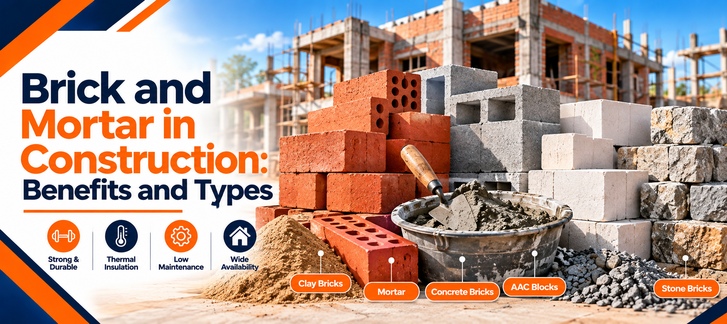
The phrase “brick and mortar” has strong roots in the construction sector and refers to conventional building techniques that use bricks and binding mortar to produce long-lasting structures. For architects, builders, and homeowners seeking longevity and aesthetic appeal, it is essential to comprehend the importance of brick and mortar building as well as its forms and advantages.
When cement mortar hardens and forms a solid aggregate structure, it becomes a weaker component than the building blocks. However, because mortar is easier and less expensive to repair than building blocks, it acts as a sacrificial element in the masonry. In order to create mortars, bricklayers usually use sand, water, and a binder. Although builders have widely used Portland cement as a binder since the early 20th century, certain specialized new buildings still use the antiquated binder lime, which produces lime mortar. Craftspeople often repair and repoint historic buildings and structures using lime, lime mortar, and gypsum in the form of plaster of Paris.
What is Brick and Mortar in Construction?
The process of methodically laying bricks and binding them with mortar—a concoction of cement, sand, and water—is known as brick and mortar construction in its most basic form. The foundation of residential, commercial, and infrastructure development worldwide, including in Pakistan, is this tried-and-true method.
Ancient Brick and Mortar:
Builders used Plaster of Paris, another name for gypsum mortar, to construct many old buildings. Because it is composed of gypsum, workers needed a lower fire temperature. Because it is easier to manufacture and sets up considerably faster than lime mortar, it may have been the standard mortar that builders used in the construction of ancient brick vaults and arches. In wet circumstances, gypsum mortar is less resilient than other mortars.
Researchers have found several forms of cement at Indus Valley civilisation sites on the Indian subcontinent, with gypsum showing up at places like the Mohenjo-daro city-settlement, which predates 2600 BC.
Ordinary Portland Cement Mortar:
Ordinary Portland cement mortar, sometimes referred to as OPC mortar or just cement mortar, combines water, fine aggregate, and powdered ordinary Portland cement. Joseph Aspdin created it in 1794, and he patented it on December 18, 1824, mostly as a consequence of his efforts to create more robust mortars. It gained popularity in the late nineteenth century and, by 1930, was a more common building material than lime mortar. Portland cement has the benefit of setting hard and fast, which speeds up building. Additionally, using Portland cement to create a structure requires less experienced people.
Types of construction using brick and mortar:
Using Bricks to Support Weight
With this approach, bricks directly support the structure’s weight. Builders frequently use this method in older and smaller residential structures.
Construction using Brick Veneer
In brick veneer construction, builders affix a single layer of bricks to a structural framework, often made of steel or wood. This method blends contemporary structural techniques with brick’s aesthetic advantages. It blends contemporary structural methods with brick’s aesthetic advantages.
Building Cavity Walls
This technique uses two walls—an outer and an inner—separated by a hollow. Both the builders improve moisture resistance and enhance thermal insulation.
Brick Construction with Reinforcement
Here, they increase the brickwork’s tensile strength by embedding steel reinforcing bars, which makes it appropriate for seismically active locations.
Building Using Mortarless Bricks
This technique, which has emerged as a sustainable choice, employs specially made bricks that interlock without the need for mortar, cutting down on building time and expenses.
Brick and mortar’s advantages in construction:
Longevity and Durability
Brick and mortar buildings are resilient to the elements, severe weather, and natural calamities. This construction technique is frequently responsible for the durability of historic structures that are more than a century old.
Warm Insulation
Because of their superior thermal mass, bricks help keep interior temperatures lower in the summer and retain heat in the winter. This attribute improves the energy efficiency of dwellings.
Resistance to Fire
Compared to other construction materials like wood, brick structures offer an extra degree of protection since they are more fire-resistant.
Minimal Upkeep
Brick and mortar structures require little upkeep after builders complete them. Their resistance to termites, rot, and ordinary wear guarantees long-term cost savings.
Visual Appeal
Bricks provide a traditional and timeless look. Brick exteriors provide unparalleled visual appeal for both contemporary urban structures and rustic country residences.
The significance of high-quality suppliers and materials:
To ensure the construction is strong and long-lasting, builders must use the proper brick and mortar mix. Customers may choose wisely for their brick and mortar needs with the support of digital platforms like Zarea, which provide competitive pricing, quality assurance, and access to recognised suppliers. The growth of eCommerce and physical stores created the idea of omnichannel retail. In general, it is a tactic that guarantees consumers, irrespective of the channel via which they engage with the business, receive a constant, flawless customer experience.
Final Thoughts:
The building industry still relies heavily on brick and mortar construction because it combines timeless beauty, safety, and longevity. Builders and homeowners may make wise judgements and guarantee that their constructions last for many generations by being aware of its kinds and advantages. Brick and mortar is still a dependable and developing option for contemporary building, even with advancements in material quality and construction methods.
Use brick and mortar brilliance to create smarter and stronger.