Essential Types of Bricks: How to Choose the Best one?
Uncover the vital types of bricks every builder should know. Compare materials, costs, and applications to effortlessly choose the perfect match for your budget.
Introduction:
Bricks are among the oldest and most dependable building materials in the world. Whether you talk about traditional homes and the boundary walls. Or even if you talk about commercial buildings, roads and architectural structures around us. Bricks have remained an important part of our construction for centuries.
But not every brick is the same.
Different manufacturing methods and raw materials have different appearances. Because different firing temperatures and quality levels produce different strengths of bricks. That's why every brick has a different application. Therefore choosing the right brick can influence the durability and safety of your project. It can also influence the appearance and overall cost of your construction project.
So what are the different types of brick? Which bricks are best for construction?
We guide you through the major types of bricks and their properties. We also describe the quality classifications and common applications of these bricks. While through this guide you can learn practical ways to identify good-quality brick.
What Are Bricks?
Bricks are rectangular construction units generally manufactured from materials such as clay, shale, sand-lime mixtures or other suitable mineral-based materials. Traditional clay bricks are formed into specific shapes. Before these bricks were dried and fired in a kiln to be ready.
The manufacturing process generally involves:
Raw material preparation → Mixing → Moulding → Drying → Firing → Cooling → Quality inspection
Clay bricks' burning process gives them much of their strength and durability.
Modern brick production uses automated machinery to achieve this result. Because this process has more consistent dimensions and controlled firing conditions.
Red bricks are popular because they can provide a useful combination of strength and durability. While they also provide fire resistance and thermal performance in some conditions. Moreover these bricks have a relatively simple installation as well.
Different Types of Bricks:
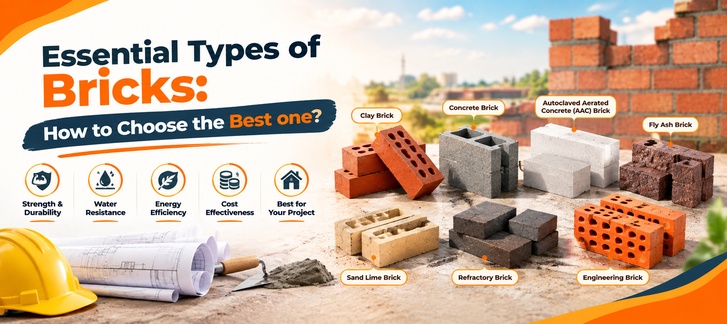
There are many ways to classify bricks. They can be categorized according to their material, manufacturing process, quality, shape and intended application.
Some of the most common types of brick are discussed below.
1) Burnt Clay Bricks
Burnt clay bricks are among the most traditional bricks. Because they are mostly used in construction.
Moulding clay produces these bricks when it were fired at high temperatures. While their properties depend heavily on clay quality and its manufacturing process.
They are commonly used for:
1) Walls
2) Foundations in suitable conditions
3) Partition walls
4) Residential construction
5) General masonry
The affordability of these bricks makes them popular in many regions. While their widespread availability also makes it famous.
2) Engineering Bricks
Engineering bricks are manufactured to provide high strength. Where its low water absorption ability also makes it special.
These special bricks particularly useful where structural performance is important. Where resistance to moisture is compulsory.
Typical applications include:
1) Foundations
2) Retaining walls
3) Drainage structures
4) Heavy-duty construction
5) Infrastructure projects
Their dense structure makes them more resistant to water penetration. Therefore they are made for harsher conditions compared to ordinary bricks.
3) Fly Ash Bricks
Fly-ash bricks are manufactured using fly ash and different other materials. This may include cement, sand and other suitable ingredients when required.
They are often produced with consistent dimensions and a relatively smooth surface.
Potential advantages include:
1) Uniform shape
2) Lower water absorption in suitable products
3) Reduced mortar requirements due to dimensional consistency
4) Use of an industrial by-product
They can be used in residential and commercial masonry depending on applicable construction standards.
4) Concrete Bricks
Concrete bricks are manufactured using cement and other aggregates. This includes water and other materials that make them a perfect choice.
These bricks can be produced in different sizes, shapes and finishes.
Concrete bricks are commonly used for:
1) Walls
2) Facades
3) Landscaping
4) Decorative construction
5) Boundary structures
Their appearance can also be modified through pigmentation and surface treatments as well.
5) Sand-Lime Bricks
Sand-lime bricks are also called calcium silicate bricks. They are primarily manufactured from sand and lime. They are formed under pressure and cured using controlled processes.
They can provide consistent dimensions and a relatively smooth appearance which makes them unique.
These bricks are used in masonry and architectural applications. Because these are places where uniformity and appearance are important.
6) Fire Bricks
Fire bricks are specially designed to withstand high temperatures like in Asian places.
They are manufactured using heat-resistant materials. Therefore they are commonly used in special environments. Because these are environments where ordinary bricks may deteriorate under extreme heat.
Typical applications include:
1) Furnaces
2) Kilns
3) Fireplaces
4) Boilers
5) Industrial heating equipment
Fire bricks should not be confused with ordinary construction bricks. Because their composition and performance requirements are different.
What Are the Types of Bricks Based on Quality?
Traditional burned clay bricks are often classified into some quality categories. While these categories are based on their manufacturing quality and the intended use of them.
1) First-Class Bricks
First-class bricks are generally well-shaped bricks. Because they are properly fired and relatively uniform in size before use.
They typically have:
1) Sharp edges
2) Consistent dimensions
3) A relatively uniform color
4) Good strength
5) Low water absorption compared with lower-quality bricks
They are suitable for high-quality masonry purposes. Because appearance and durability matter before it can be used.
2) Second-Class Bricks
Second-class bricks may have minor irregularities in shape and surface finish.
They can be suitable for construction where plastering or finishing will cover the brickwork, depending on structural and local building requirements.
3) Third-Class Bricks
Third-class bricks are generally under-burnt and have lower strength and durability.
They may be used for temporary or less demanding applications where these types of bricks are permitted. But they are generally unsuitable for critical structural work.
4) Over-Burnt Bricks
Over-burnt bricks are exposed to excessive heat during firing. They may become distorted, dark and irregular.
Although individual over-burnt bricks may not be suitable for normal masonry, crushed over-burnt brick material can sometimes be used as aggregate or in other applications.
Applications for Different Types of Bricks:
Different projects require different brick properties.
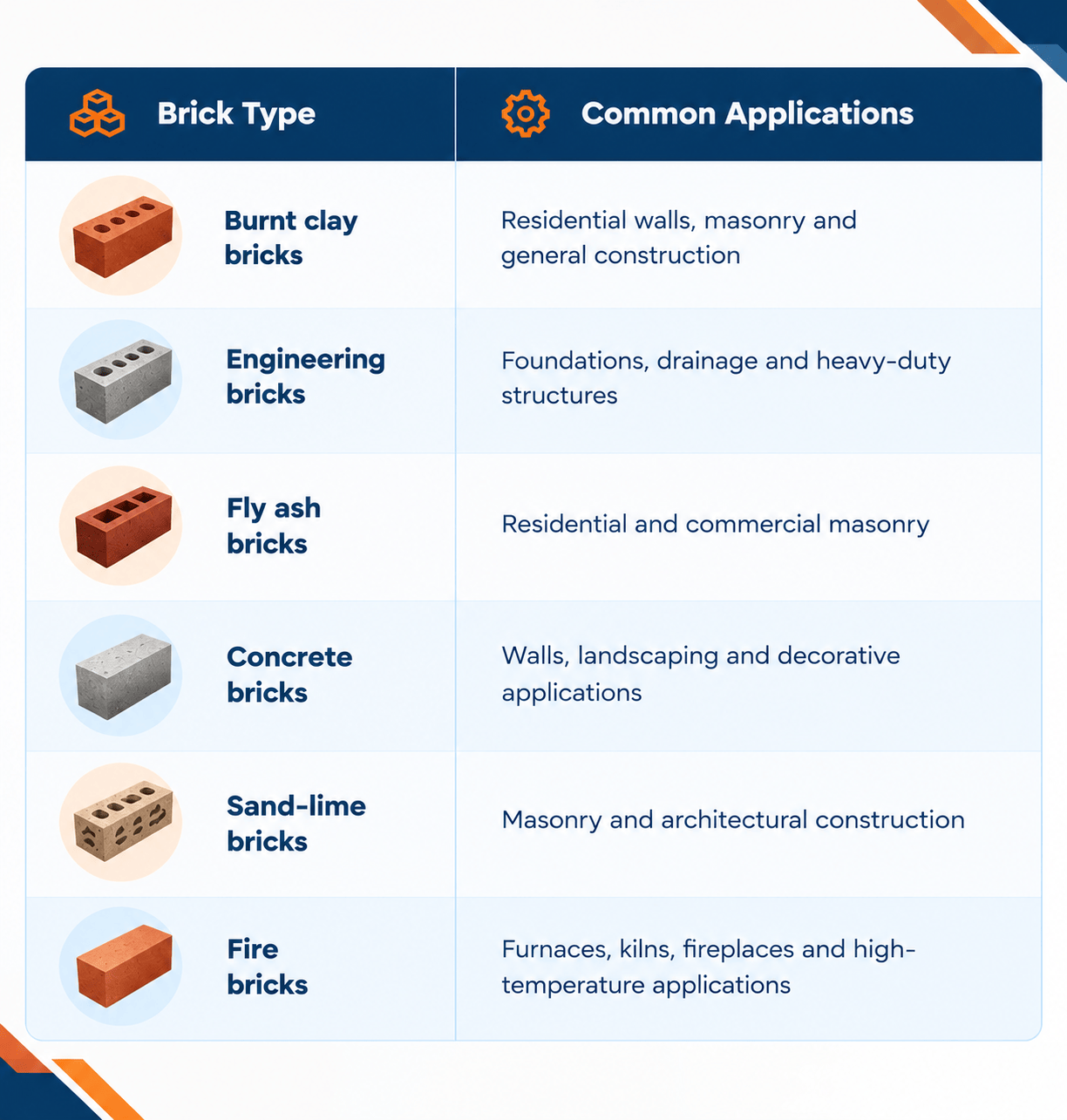
The "best" brick therefore depends on the project.
A brick that performs well inside a furnace is not necessarily the right choice for a residential exterior wall.
How to Identify Good-Quality Bricks?
Knowing how to identify good bricks can help buyers avoid inconsistent materials. In this way buyers can also avoid unsuitable materials for their project.
1) Check the Shape
Good-quality bricks should generally have a consistent shape. While also having reasonably sharp edges for better performance.
Large distortions can indicate poor manufacturing or firing.
2) Examine the Color
Well-fired clay bricks often have a relatively uniform color which makes them unique.
Significant variations can sometimes indicate inconsistent firing. Or it can also indicate the material composition that is used in these bricks.
However, its color should never be used as the only quality test.
3) Listen to the Sound
When two suitable bricks are gently struck together, it can puzzle you. Therefore a good-quality fired brick typically produces a clear ringing sound. This test can easily identify brick quality.
A dull sound may indicate cracks, poor firing or other defects.
4) Look for Cracks
Visible cracks can compromise brick performance.
Inspect bricks for cracks, excessive warping, holes or other obvious defects before purchasing large quantities.
5) Check Dimensions
Consistent dimensions make masonry easier to construct and can reduce variations in mortar joints.
For major projects, dimensions should be checked against the relevant construction standard or project specification.
6) Consider Water Absorption
Water absorption is an important property to check in bricks. Because excessive absorption can affect durability and masonry performance.
Brick testing should follow applicable building standards. Rather than relying only on visual inspection of the material.
What Are the Properties of Bricks?
The properties of bricks determine where and how they should be used.
1) Compressive Strength
Compressive strength indicates how much compressive load a brick can withstand.
Structural applications require bricks that meet the specified strength requirements.
2) Water Absorption
Water absorption indicates important things to you. Because you can easily identify. How much water a brick can absorb under standardized testing conditions?
Low absorption is generally desirable in some situations. Especially in situations where moisture resistance is important. Although the appropriate requirements heavily depend on the brick type and its application.
3) Durability
Highly durable bricks should withstand environmental exposure. It should also withstand normal service conditions without excessive deterioration.
4) Fire Resistance
Many masonry bricks provide very good resistance to fire conditions. Although the performance of these bricks depends on their different compositions. Yet wall construction and exposure conditions also matter for bricks.
5) Thermal Properties
Bricks can contribute to thermal mass as well. Because it helps buildings moderate their temperature changes. Their overall thermal performance depends on wall thickness and construction design. Where density and insulation also matter.
6) Hardness
A suitable brick should have sufficient hardness. For the resistance to abrasion for its intended application also matters under some conditions.
7) Dimensional Stability
Consistent dimensions are important for producing straight and uniform masonry structures. While controlling mortar joints also plays an important role in these kinds of dimensions.
How to Choose the Best Brick for Construction:
Choosing among the types of bricks used in construction should begin with the requirements of the project rather than price alone.
Consider these factors:
1. Application: Determine whether the brick is intended for structural walls, partitions, facades, foundations, landscaping or high-temperature environments.
2. Strength: Select a brick that meets the required compressive-strength specification.
3. Water Exposure: For damp environments, consider bricks with appropriate water absorption and durability characteristics.
4. Climate: Local weather conditions can influence brick selection.
5. Appearance: For exposed brickwork, color, texture, shape and dimensional consistency become particularly important.
6. Standards: Always check relevant national or project-specific standards and specifications.
7. Supplier Quality: Purchase from a reliable manufacturer or supplier capable of providing consistent-quality products.
Wrap Up:
The world of types of bricks is more diverse than it may initially appear. Burnt clay bricks remain widely used, while engineering bricks, fly ash bricks, concrete bricks, sand-lime bricks and fire bricks serve specialized purposes.
There is no single brick that is perfect for every construction project.
The right choice depends on strength, water absorption, durability, appearance, thermal requirements, environmental conditions and the intended application.
For homeowners, builders and contractors, understanding the different types of bricks makes it easier to compare materials and select products that meet project requirements.
Ultimately, good construction starts with good materials—and when it comes to masonry, choosing the right brick is one of the first building blocks of a durable structure.
FAQ's:
Which type of brick is best for construction?
There is no single best brick for every construction project. The right brick depends on the application, structural requirements, climate, exposure to moisture, required durability and applicable building standards. Engineering bricks may be suitable for demanding applications, while traditional clay bricks are widely used for general masonry.
How can you identify a good-quality brick?
A good-quality brick should generally have consistent dimensions, a suitable shape, reasonably sharp edges and no major cracks or excessive warping. For fired clay bricks, a relatively uniform color and a clear ringing sound when gently struck can also indicate good manufacturing quality. Formal testing should be used for critical construction projects.
What are the properties of good bricks?
Important brick properties include compressive strength, water absorption, durability, hardness, fire resistance, dimensional stability and thermal characteristics. The required level of each property depends on how and where the brick will be used.
Why is compressive strength important in bricks?
Compressive strength indicates how much compressive load a brick can withstand. It is particularly important when bricks are used in structural masonry or other applications where the material must support significant loads.
Why is water absorption important for bricks?
Water absorption measures how much water a brick can absorb under specified testing conditions. Excessive water absorption can affect durability and masonry performance, particularly in environments exposed to moisture.