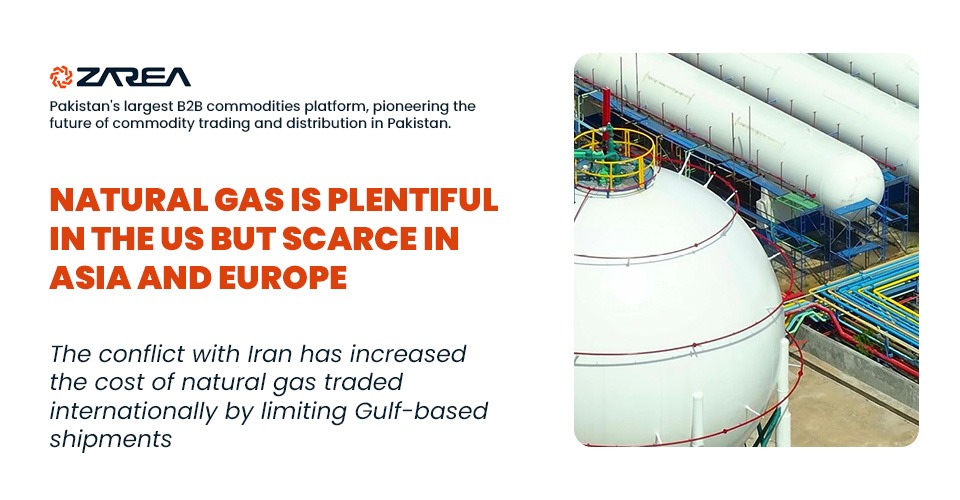
Natural Gas is Plentiful in the US but scarce in Asia and Europe
The conflict with Iran has increased the cost of natural gas traded internationally by limiting Gulf-based shipments. Some producers in West Texas have to pay to have gas removed because it is so plentiful.
Global LNG Crisis:
There is now a huge natural gas excess in the United States. In the meantime, acute shortages and skyrocketing costs are plaguing Europe and Asia. However, the current geopolitical strife in the Middle East is the main cause of this "bifurcation" of the market. Thus, the physical infrastructural barriers that keep US goods from getting to consumers across the world.
Due to the Gulf War's restrictions on exports, the price of natural gas sold internationally has increased. Gas is so plentiful in West Texas that some producers have to pay to have it removed. Twenty percent of the world's supply of LNG has been cut off due to the conflict and Iran's strikes on Gulf energy firms.
Current Market Disconnect:
1) Price Disparity: US Henry Hub futures have fallen to a 17-month low of about $2.52 per mmBtu as of May 2026.
2) Global Spikes: At $21 to $22 per mmBtu, prices have increased by 84% in Europe and 108% in Asia.
3) Negative Pricing: Because pipeline capacity is full in the US Permian Basin, gas is so abundant that producers sometimes pay purchasers to remove it.
Qatari LNG Facilities:
Iranian threats to fire on them have caused damage to Qatari LNG installations and prevented tankers from passing through the Strait of Hormuz canal at the Gulf's entrance.
The crisis has shown a significant divide in the world's gas market: the United States, the world's greatest producer, user, and exporter of gas, is still overflowing with fuel, with prices close to 17-month lows, while import-dependent nations in Europe and Asia are fighting over limited supplies.
However, because US pipelines are full and LNG export facilities are operating at full capacity, inexpensive US gas cannot reach foreign consumers, resulting in a division that is even more pronounced than in the oil markets. Gas futures at the US Henry Hub benchmark in Louisiana have fallen as much as 12% since the start of the conflict with Iran, reaching a 17-month low of USD 2.52 per million British thermal units (mmBtu).
Global costs have increased to between USD 21 and USD 22 per mmBtu, with increases of up to 84 percent in Europe and 108 percent in Asia. The worldwide benchmark for petroleum, Brent, is now trading at about $111 per barrel. Although both have increased by more than 50% due to the conflict, the US benchmark is currently at $104 a barrel.
Why Asia and Europe are Scrambling?
1) Supply Disruptions: About 20% of the world's supply of liquefied natural gas (LNG) has been cut off because to the recent dispute with Iran.
2) Infrastructure Damage: Tankers are unable to pass via the Strait of Hormuz due to damage to important LNG facilities in Qatar.
3) Import Dependency: Major economies in Europe and Asia, in contrast to the US, rely significantly on imports since they cannot generate enough gas domestically to supply demand.
PAYING TO TAKE GAS AWAY:
The United States has enough supply to fill the LNG export facilities that cool gas into liquid form as well as to fulfill domestic demand. No matter how much gas prices rise globally, the US will not be able to convert much more gas into LNG for export because those plants were already running close to full capacity prior to the conflict. Even lower than benchmark futures are US pricing in the Permian Basin, the main shale area.
This year, spot gas at the Waha Hub in West Texas has traded below zero nearly every day due to the full Permian gas pipelines, which means there isn't any extra capacity to move the fuel. In other words, as if it were a waste product, some manufacturers must pay others to remove it.
US Energy Department Statement:
According to a recent US Energy Department projection, US gas output, which is currently at a record 107.7 billion cubic feet per day (bcfd) in 2025, is predicted to continue increasing to feed new LNG export facilities and fulfill the growing need for power-hungry data centers. As oil producers raise their output, their wells gradually generate more gas than they did previously due to the depletion of oil reserves.
At best, more pipeline capacity won't be available for months. According to a research by Bank of America analysts, "meaningful transport relief doesn't show up until late this year or early 2027, when larger pipeline projects are anticipated to start." Certain regions of the nation are especially vulnerable to high foreign gas costs, such as New England, which lacks sufficient connections to the national gas pipeline infrastructure to satisfy heating demands and must import pricey LNG and burn oil to produce electricity during the winter.
Businesses with surplus LNG to sell have been best positioned to benefit, at least temporarily, from the worldwide price disruptions caused by the Iran war. Energy companies worldwide have bought additional cargoes from US LNG producers like Venture Global, the country's second-largest LNG business after Cheniere Energy, to replace gas deliveries that Qatar canceled.
According to Bob Yawger, director of energy futures at Mizuho, "Venture Global is (relatively) new to the LNG game and had spot cargoes available to put out to the highest bidder." "Now that QatarEnergy is no longer involved, everyone suddenly needs LNG."
Why the US Surplus Cannot Be Exported?
1) Export Capacity: Regardless of worldwide demand, the United States is unable to convert additional gas into liquid form for export since its LNG export facilities are currently working at maximum capacity.
2) Pipeline bottlenecks: Surplus gas is stuck in producing areas like West Texas because internal US pipelines are full.
3) Relief Timeline: Until late 2026 or early 2027, significant transportation relief from new pipeline projects and enlarged LNG terminals is anticipated.
The Capacity of US LNG:
Based on the facilities now under development, US LNG capacity will nearly double over the next five years, from around 18 bcfd in 2025 to about 35 bcfd in 2030. However, US gas producers that sell to LNG businesses have not done as well since they sell a large portion of their output at the domestic price, which has been hindered by poor spring demand and plenty of supplies in storage in addition to near-record production.
Some energy companies, including EQT, the second-largest US gas producer after Expand Energy, have even been forced to reduce output due to low US prices as they wait for demand and prices to increase later in the year. Following the company's earnings report this week, EQT CFO Jeremy Knop told investors, "Our strategic curtailments act as a form of storage, keeping gas in the ground (during) seasonally low periods of demand."
Final Thoughts:
The circumstances highlight a significant geographical gap in the world energy market. In the meantime, natural gas is almost "drowning" the United States. However, there is a serious energy shortage in the rest of the world.
In the short run, American consumers and industry gain a competitive edge due to some of the world's lowest energy costs. On the other hand, Europe and Asia's high energy prices are significantly impeding their industrial production and economic expansion.