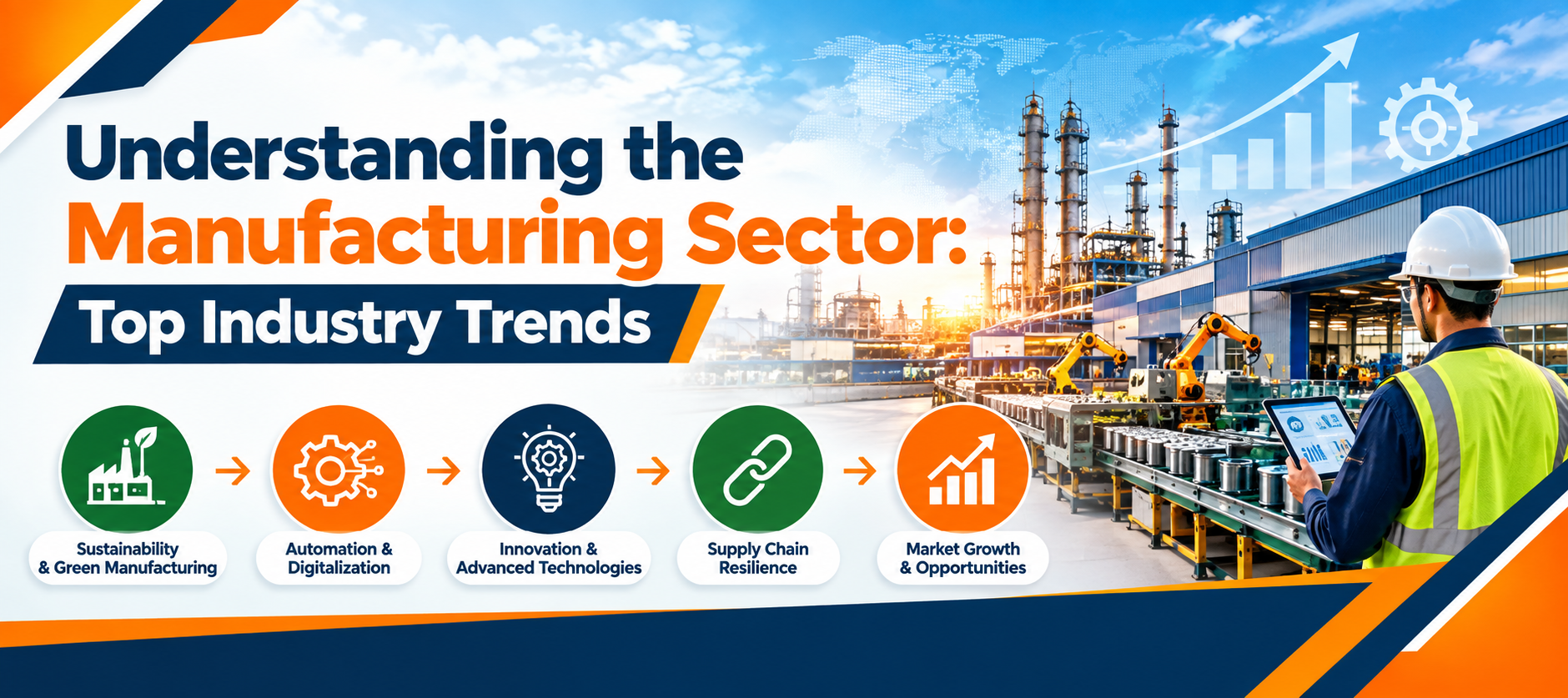
Understanding the Manufacturing Sector: Top Industry Trends
Discover how the manufacturing sector drives the global economy. Explore key categories, modern smart factory trends, and the future of industrial automation.
Introduction:
Manufacturing is quietly behind much of modern life. Whether you're talking about the smartphone in your hands or the car outside your home. Or you could talk about packaging around your food and even the machinery that you use to build cities. Every modern industry is a manufacturing one.
The manufacturing sector transforms raw materials and resources into finished or semi-finished products. Where its components connect agriculture, mining, energy and technology together. Same as logistics and retail connect manufacturing to the consumer. These all industries make manufacturing one of the most important parts of the global economy.
But things are not as simple as you think. Because manufacturing is always changing rapidly.
Digital supply chains and sustainable production are reshaping how factories operate. While automation, artificial intelligence and robotics are also reshaping the industry. Manufacturers face challenges ranging from rising costs and labor shortages at the same time. Where supply-chain disruptions and increasing environmental expectations also do the same thing.
So, what is the manufacturing industry? What are manufacturing major types? Where is manufacturing heading next?
Let's explore the structures and challenges that shape modern manufacturing. Also, discuss the emerging trends that define modern manufacturing.
What Is the Manufacturing Industry?
The manufacturing industry refers to the economic activities involved in converting raw materials. Or it converts components or parts into new products using machinery and labor. Where technology and industrial processes also play a part in it.
Manufacturing processes can range from relatively simple processes. This includes food processing and pharmaceutical production. Also include aerospace engineering and other highly sophisticated operations that involve in semiconductor fabrication as well.
A simplified manufacturing process looks like this:
Raw materials → Processing → Assembly → Quality control → Packaging → Distribution
For example, steel can be transformed into automotive components. On the other hand agricultural commodities can be processed into food products. Basic chemicals and their raw materials can become cleaning products or pharmaceutical ingredients. While the plastics and coatings industry also depends on these raw materials.
Therefore manufacturing creates value additions to our lives. Because they transform materials into products that businesses and consumers can use.
Why Is the Manufacturing Sector Important?
Manufacturing has a significant role in economic development because it creates products, employment, investment and demand for the supporting industries.
A manufacturing facility rarely operates in isolation.
It may depend on:
1) Raw-material suppliers
2) Energy providers
3) Equipment manufacturers
4) Logistics companies
5) Warehouses
6) Technology providers
7) Financial institutions
8) Distributors
9) Retailers
These industries interconnect around a structure that creates a broad industrial ecosystem.
Manufacturing can also stimulate innovation to the next level. Because companies continually seek out better ways to reduce production costs and develop new products. While the industry also seeks to improve the quality of their products.
In developing economies, industrial development can additionally support exports and the diversification of the economic base.
Types of Manufacturing Industries:
The phrase top manufacturing industries covers a remarkably broad range of sectors. Some of the major manufacturing industries include the following.
1) Food and Beverage Manufacturing
Food manufacturing converts agricultural products into processed packaged food.
Examples include flour milling and dairy processing products. Where beverages, edible oils, meat processing and packaged foods are also included in it.
2) Chemical Manufacturing
Chemical manufacturing produces materials that are used across the agriculture and construction fields. Thus textiles, pharmaceuticals, cleaning and countless other industries also rely on the chemical industry.
Basic chemicals such as acids and alkalis along with some other industrial gases. These materials can serve as raw materials for downstream manufacturing.
3) Automotive Manufacturing
The automotive industry involves itself in the production industry. While the assembly of vehicles and their components is also involved in this industry.
It has become an increasingly technologically-driven field in many aspects. So, particularly this field rises with the growth of electric vehicles and connected vehicle systems. This industry also uses advanced sensor systems for a better tomorrow.
4) Pharmaceutical Manufacturing
Pharmaceutical manufacturing involves the production of medicines and other related healthcare products.
This field requires highly controlled environments and rigorous quality standards to perform. While it also depends on specialized equipment as well.
5) Textile and Apparel Manufacturing
Textile manufacturing transforms fibers into yarn and fabric products.
It remains an important industry in many manufacturing economies. Because digital design and sustainability requirements have increasingly influenced this industry.
6) Electronics Manufacturing
Electronic manufacturing includes semiconductors and electronic components. This may also include computers, smartphones, or some appliances as well.
It is one of the most technologically-intensive manufacturing sectors. This is because it depends heavily on sophisticated global supply chains.
7) Steel and Metal Manufacturing
Metal industries transform ores or recycled materials into steel. While this industry also makes aluminum and other materials that are used in construction industry. While the transportation, machinery, and manufacturing industries also rely on the metal industry.
These industries are particularly important to us. Because metals form the physical foundations of many industrial products these days.
The Role of Technology in Manufacturing:
Technology is changing the manufacturing sector entirely from the factory floor to the boardroom.
Traditional factories rely heavily on manual processes. While these factories also have fixed production systems that rely on them. Therefore modern facilities can increasingly use connected machines and control their production. Same as sensors, robotics and software that monitors also connected with modern facilities.
Several technologies are particularly important in manufacturing field.
1) Artificial Intelligence
Artificial intelligence can analyze large amounts of production data. This technology also identifies patterns that may be difficult to detect manually.
Manufacturers can use AI for predictive maintenance and process optimization. Whereas some quality inspection processes and demand forecasting are also predictable through this technology.
2) Industrial Robotics
Robots can perform various repetitive, precise or hazardous tasks in difficult environments.
They are commonly used for assembling and other production activities. This may also include welding, packaging and material handling systems as well.
3) Internet of Things
Industrial IoT connects machines and systems to each other. So that manufacturers can collect real-time information about their production materials.
A connected factory can monitor equipment performance, temperature, energy consumption and production output.
4) Digital Twins
A digital twin is a digital representation of a physical product, machine or production process.
Manufacturers can use digital models to simulate changes and identify potential problems before implementing them in a physical environment.
5) Additive Manufacturing
3D printing allows manufacturers to create components layer by layer.
It can be particularly useful for prototyping, customized components and selected low-volume production applications.
What Is Smart Manufacturing?
Smart manufacturing refers to the integration of digital technologies, connected equipment, automation and data analytics into manufacturing processes.
Instead of machines simply performing instructions, smart manufacturing systems can continuously collect information about production conditions.
This creates a feedback loop:
Sense → Analyze → Decide → Act → Improve
For example, sensors may detect unusual vibration in a machine. Software can analyze the data and identify a potential equipment problem. Maintenance can then be scheduled before a major failure occurs.
This approach can reduce downtime and improve production efficiency.
Challenges Facing the Manufacturing Industry:
Despite technological progress, the manufacturing industry faces several significant challenges.
1) Rising Production Costs
Energy, raw materials, transportation and labor costs can significantly influence manufacturing profitability.
2) Supply-Chain Disruptions
Manufacturers increasingly recognize that relying heavily on a limited number of suppliers can create vulnerabilities.
A shortage of a single component can sometimes disrupt an entire production line.
3) Labor and Skills Shortages
Modern factories require workers who understand automation, data systems, robotics and advanced machinery.
Finding and developing these skills can be challenging.
4) Cybersecurity
As factories become increasingly connected, cybersecurity becomes more important.
A cyberattack can potentially disrupt production systems, compromise sensitive information or create operational risks.
5) Environmental Pressure
Manufacturers face increasing pressure to reduce emissions, waste, water consumption and energy use.
This is encouraging companies to explore cleaner technologies and more efficient production systems.
Economic Manufacturing and Its Wider Impact:
The concept of economic manufacturing can be understood through the relationship between industrial production and economic growth.
Manufacturing contributes to an economy by creating products and generating demand throughout interconnected supply chains.
When a factory expands, it may require more raw materials, transportation, maintenance, packaging and services.
This creates economic activity beyond the factory itself.
Manufacturing can also support exports when domestically produced goods are sold internationally.
However, manufacturing growth needs to be balanced with productivity, resource efficiency, environmental responsibility and workforce development.
Simply producing more does not automatically mean producing more efficiently.
Future Trends in Manufacturing:
The future of manufacturing will likely be defined by a combination of automation, intelligence, flexibility and sustainability.
1) Greater Use of AI
AI is expected to become increasingly integrated into production planning, quality control, maintenance and supply-chain forecasting.
2) More Autonomous Factories
Automation will continue to expand as manufacturers seek greater productivity and consistency.
This does not necessarily mean eliminating human workers. Instead, people are likely to move toward roles involving supervision, engineering, maintenance, analysis and decision-making.
3) Sustainable Manufacturing
Manufacturers are increasingly looking for ways to reduce energy consumption, material waste and emissions.
Renewable energy, recycling, efficient machinery and circular-economy models are likely to become increasingly important.
4) Resilient Supply Chains
Companies are reassessing supply chains to improve resilience.
This can include diversifying suppliers, increasing inventory for critical components, developing regional production capacity and improving real-time supply-chain visibility.
5) Mass Customization
Digital manufacturing technologies are making it easier to produce customized products without completely abandoning the efficiency of large-scale production.
The factory of the future may therefore be both high-volume and highly flexible.
What Will the Manufacturing Sector Look Like in the Future?
The factory of tomorrow may look very different from the factory of the past.
Instead of rows of machines operating independently, manufacturers are moving toward interconnected production environments where machines, software and people communicate continuously.
A future manufacturing facility could monitor production in real time, predict equipment failures, automatically adjust processes and use AI to identify quality problems.
But technology alone will not determine success.
Manufacturers will also need skilled workers, resilient supply chains, responsible resource management. Because the ability to adapt quickly to changing grains markets as well.
The winning formula will increasingly be:
Technology + People + Data + Efficiency + Sustainability
Wrap Up:
The manufacturing sector is far more than factories producing physical goods. It is a complex ecosystem connecting raw materials, technology, workers, suppliers, logistics providers and consumers.
From food and chemicals to automobiles, textiles, metals, pharmaceuticals and electronics, the top manufacturing industries support virtually every part of modern economic life.
Technology is now accelerating the transformation.
Artificial intelligence is improving decision-making. Robotics are automating repetitive operations. Industrial IoT is connecting machines. Digital twins are helping manufacturers simulate processes, while sustainable technologies are changing how factories use energy and resources.
At the same time, manufacturers must navigate rising costs, supply-chain uncertainty, cybersecurity risks and skills shortages.
The future of the manufacturing industry will therefore not simply be about building bigger factories.
It will be about building smarter, more flexible, resilient and sustainable manufacturing systems—systems capable of producing what the world needs while using resources more intelligently.
For businesses and economies alike, understanding these changes is essential because manufacturing remains one of the strongest links between innovation, production and economic growth.
FAQ's:
1) What are the top manufacturing industries?
Some of the world's major manufacturing industries include automotive, electronics, chemicals, pharmaceuticals, food and beverages, textiles, steel and metals, machinery and aerospace. Their importance varies by country, available resources, industrial infrastructure and market demand.
2) How does manufacturing contribute to economic growth?
Manufacturing can contribute to economic growth by creating jobs, generating investment, supporting exports and developing interconnected supplier networks. A manufacturing facility can create demand for raw materials, logistics, maintenance, packaging, technology and other services, extending its economic impact beyond the factory.
3) What is smart manufacturing?
Smart manufacturing is the use of connected technologies, automation, sensors, software and data analytics to improve manufacturing processes. Smart factories can collect real-time production data and use it to monitor equipment, improve quality, reduce downtime and optimize operations.
4) How is artificial intelligence changing manufacturing?
Artificial intelligence is changing manufacturing by helping businesses analyze production data, identify quality problems, forecast demand and predict equipment failures. AI can also support production planning, process optimization and automated visual inspection.
5) What is Industry 4.0 in manufacturing?
Industry 4.0 refers to the development of increasingly connected and intelligent manufacturing systems. It combines technologies such as industrial IoT, artificial intelligence, robotics, cloud computing, data analytics, automation and digital twins to create more connected production environments.