What Is Crude Oil? Formation, Refining & Uses
Crude oil explained in plain English, how it forms, how refining splits it into fuel and motor oil, and why prices move. Includes a fractions chart.
Quick Overview
Crude oil is a thick, dark, naturally occurring liquid made mostly of hydrocarbons. It forms over millions of years as heat and pressure transform buried marine organisms into oil trapped in porous rock.
On its own, it isn't usable; refineries heat it and split it, through a process called fractional distillation, into fuels like petrol, diesel and jet fuel, plus lubricants, asphalt and plastic feedstock.
I used to think of oil as just “the stuff that comes out of the ground and gets turned into fuel,” full stop, and didn't think much past that. Turns out there's a lot more to it.
That bottle of motor oil sitting in your garage started as rock buried a few kilometres down, rock that in some cases has been sitting there since before the dinosaurs.
Crude oil itself is nothing fancy to look at, just a thick, dark liquid, mostly hydrocarbons, which really just means old organic matter, dead plants and tiny sea creatures mostly, that got buried, squeezed, and cooked under pressure for millions of years until it became something we could dig up and use.
It doesn't come out of the well looking like anything useful, though. What you're picturing when you think of gasoline, diesel, or a bottle of engine oil is what's left after crude oil goes through a whole refining process, and that process is honestly the more interesting part of the story.
Key Takeaways
Crude oil is an unrefined, naturally occurring liquid made mostly of hydrocarbons, not a finished fuel on its own.
It forms from ancient marine organisms buried, heated, and compressed over tens of millions of years, which is why it's classed as nonrenewable.
Refineries separate crude oil into usable products through fractional distillation, based on each hydrocarbon's boiling point.
A single barrel yields everything from LPG and petrol to diesel, jet fuel, motor oil base stocks, and asphalt.
Crude oil is graded sweet/sour (sulphur content) and light/heavy (density), which determines how easily it refines and what it's worth.
Brent and WTI are the two global benchmark prices; most other crude trades at a premium or discount to one of them.
Where Does Crude Oil Come From?
Go back far enough, millions of years, and most of what's now crude oil started as something alive. Tiny organisms mostly, plankton and algae, the kind you'd need a microscope to see.
They died in huge numbers, sank, and settled on ancient seafloors. Sediment then kept piling on top, year after year, century after century, until the weight and heat down there transformed that dead organic material into hydrocarbons.
Give that process tens of millions of years, and you end up with crude oil trapped in porous rock underground, which is essentially what's still being pumped out today.
That's also why nobody talks seriously about crude oil being a short-term supply problem, but also why it gets called nonrenewable. It isn't a crop you replant next season.
Whatever's down there right now took an almost unthinkable stretch of time to form, and nothing we do speeds that up. What exists in the ground today is, for any practical purpose, all there is.
How Is Crude Oil Refined? (Fractional Distillation Explained)
Straight out of the ground, crude oil is thick, sticky, and not good for much on its own. Turning it into something useful means sending it through fractional distillation at a refinery. It sounds complicated, but the idea behind it is fairly simple once it's laid out.
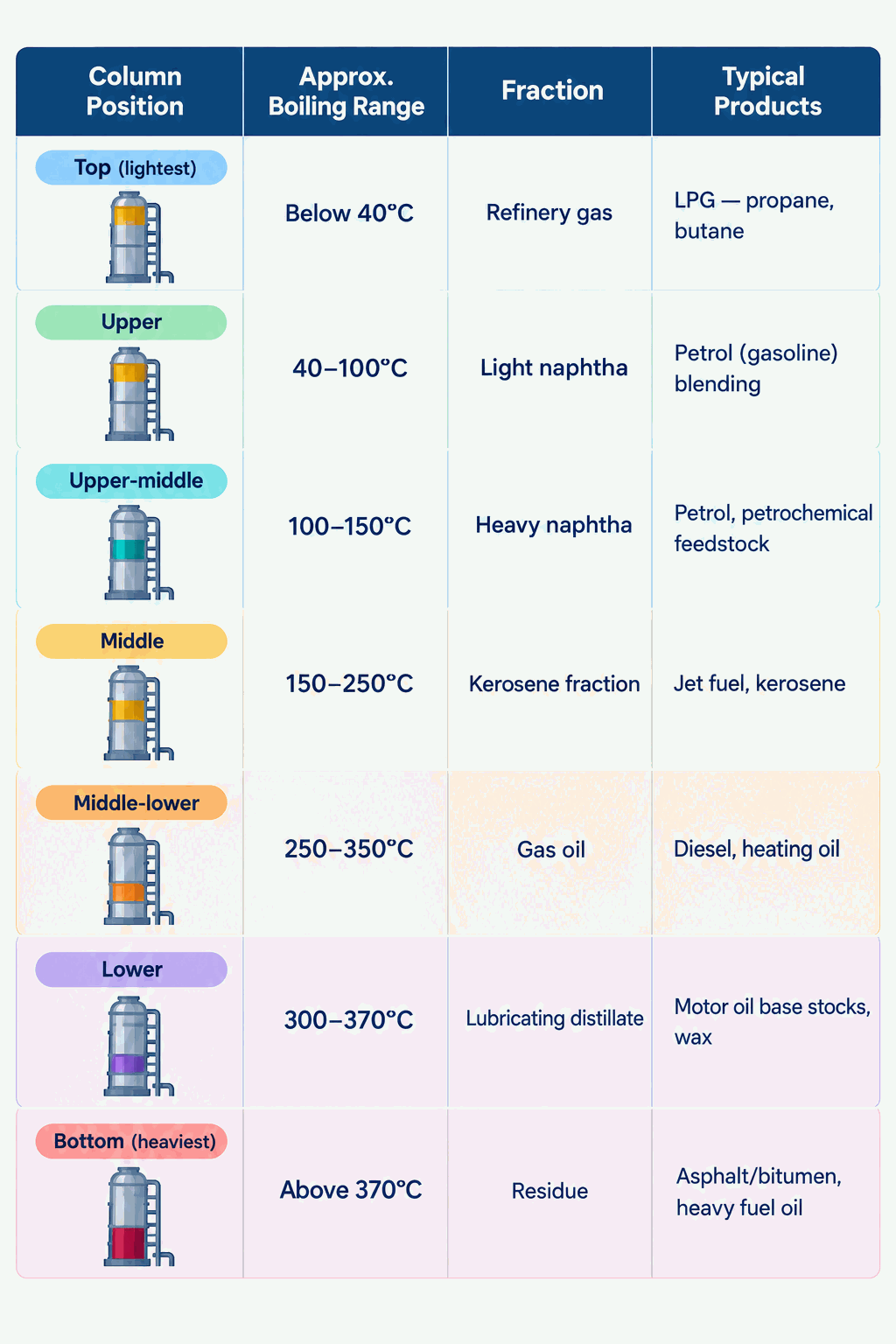
Crude oil is heated until it vaporises, then fed into a tall distillation column. As the vapour rises, it cools, and different hydrocarbons condense back into liquid at different heights depending on their boiling point.
The lightest, smallest molecules rise highest before condensing, things like propane and butane, the gases that become LPG. Further down you get petrol, then kerosene and jet fuel, then diesel.
Near the bottom, where it's still hot enough that only the heaviest molecules condense, you end up with lubricating oil base stocks, and at the very bottom, asphalt.
So in a very real sense, the LPG cylinder in someone's kitchen and the bottle of motor oil in their car's engine started life as the same crude oil, just pulled off the distillation tower at completely different points.
Crude Oil Fractions and Processing Stages
Here's roughly how a distillation column separates crude oil, from lightest to heaviest. Exact cut points vary by refinery and by the crude grade being processed, so treat the temperatures as typical ranges rather than fixed lines.
What Products Are Made From Crude Oil?
This is where it stops being an abstract chemistry lesson and starts being stuff people actually buy. Under Zarea's energy and petroleum category, most of what's listed is a downstream product of exactly this refining process, just further blended and formulated for a specific job.
Take LPG gas, for instance. That's about as close to raw refinery output as a consumer product gets, mostly propane and butane pulled off near the top of the distillation column, compressed into liquid form for storage and transport.
Motor oils are a different story. They start from the heavier base stocks that condense near the bottom of that same column, but nobody's selling raw base oil to a truck driver; it gets blended with additive packages designed for a specific job before it ever reaches a shelf.
Mobil Delvac MX 15W-40 and Mobil Delvac 1300 Super 15W-40 are both heavy-duty diesel engine oils built for trucks, buses, and industrial equipment running long hours under load, where the oil has to resist breaking down at high temperatures over extended drain intervals.
On the passenger vehicle side, Mobil Super 2000 X1 10W-40 and Mobil Special 10W-30 serve everyday petrol and diesel cars, while Mobil Special 20W-50 is a thicker grade suited to older engines or hotter climates where a heavier film helps protect worn components.
The lighter multi-grade oils, Shell/Mobil 5W-30, Shell/Mobil 0W-40, and Shell/Mobil 10W-30, are formulated to flow more easily at low temperatures on startup, which matters more for modern engines built to tighter tolerances.
And Mobil ATF 220 isn't engine oil at all; it's automatic transmission fluid, a specialised blend that has to handle heat transfer and precise friction properties inside a gearbox rather than lubricate pistons.
Every one of these starts as the same basic crude oil. What makes them different is where they got cut on the distillation tower and what got blended in afterward.
Sweet or Sour, Light or Heavy: How Is Crude Oil Graded?
Not all crude oil is equal, and buyers care about that a lot. Crude gets graded on two main scales. Sulphur content splits it into sweet (low sulphur) or sour (high sulphur), and sweet crude is generally easier and cheaper to refine into fuel since it needs less processing to strip out the sulphur.
Density is the other axis: light crude flows easily and yields more petrol and diesel per barrel, while heavy crude is thicker, harder to pump and refine, and tends to produce more of the heavier products like asphalt and fuel oil.
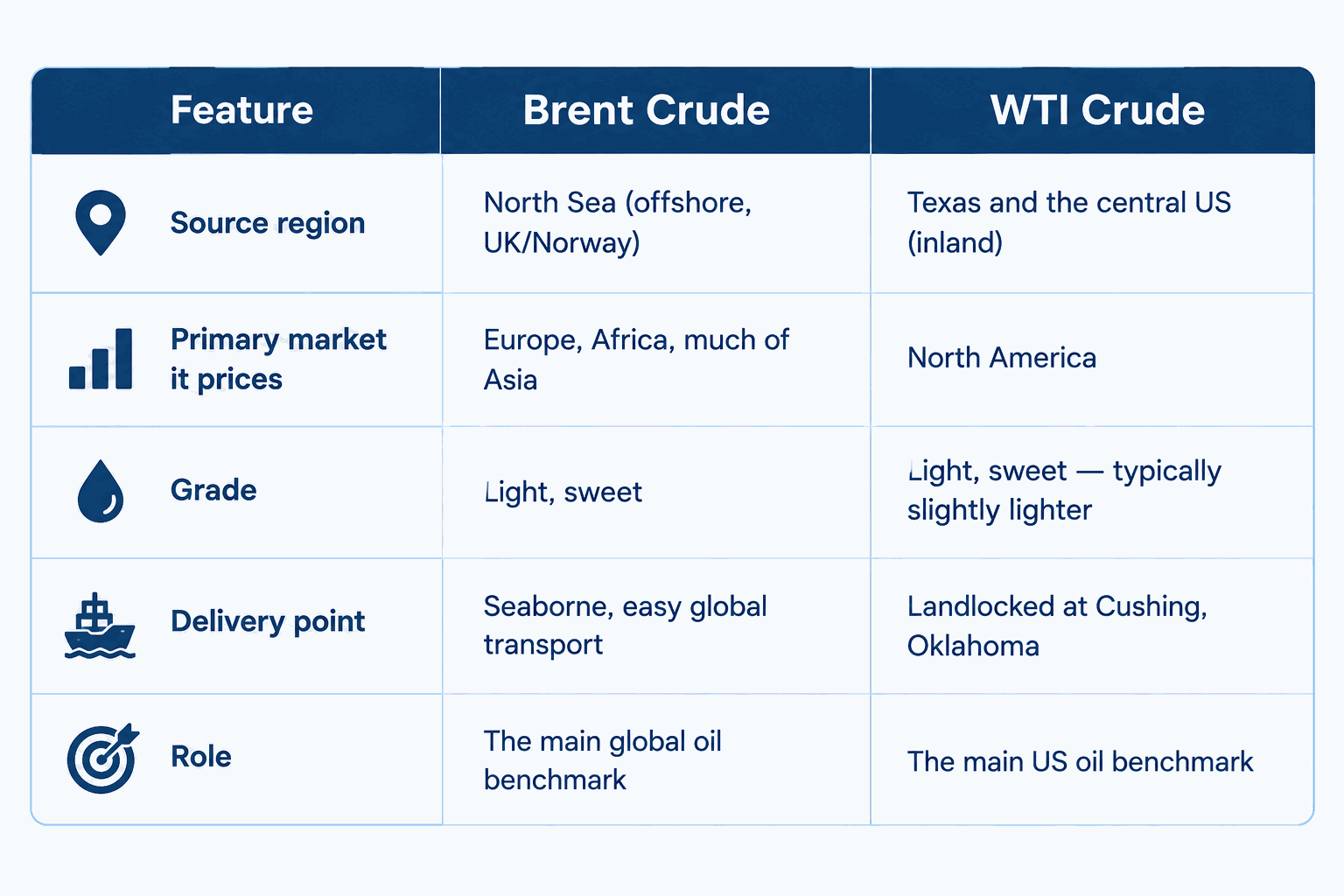
This is also where benchmark prices come in. Brent crude, sourced from the North Sea, and WTI (West Texas Intermediate) are the two most widely quoted reference prices globally, and most other crude oil around the world gets priced at a discount or premium relative to one of those two benchmarks depending on quality and how far it has to travel to market.
Brent Crude vs WTI: Quick Comparison
Why Do Crude Oil Prices Move the Way They Do?
Anyone who's glanced at the news knows crude oil prices today can look completely different from a month ago, sometimes even a week ago.
The Brent crude oil price in particular gets quoted constantly because it's the reference point for so much of the world's oil, from Europe through to Asia, so when it moves, it tends to drag a long chain of other prices along with it.
A lot of different things push that number around:
OPEC+ production decisions; cutting or raising output directly changes how much oil hits the market.
Wars and political instability near major producing regions, sometimes overnight.
Seasonal demand shifts, like a colder-than-usual Northern Hemisphere winter bumping up demand for heating oil.
Inventory levels and refining capacity, which shape how tight or loose supply looks in the short term.
None of this stays contained to crude either. When the Brent crude oil price climbs, it eventually shows up in what people pay at the pump, and further down the chain, in what a workshop pays for a drum of motor oil, since the raw material behind both is the same barrel.
Frequently Asked Questions
Is crude oil the same as petroleum?
Not exactly. Petroleum is the broader term covering crude oil and all the refined products that come from it — fuels, lubricants, plastics feedstock, and more. Crude oil specifically refers to the raw, unrefined liquid before it goes through any processing.
What's the difference between Brent and WTI crude oil?
They're the two major global price benchmarks. Brent comes from North Sea oil fields and tends to set the reference price for crude moving through Europe, Africa, and much of Asia. WTI is sourced from US wells, mainly Texas, and serves as the benchmark for North American crude. Both are light, sweet crude grades, which is part of why they're used as pricing references in the first place.
How is the price of crude oil determined?
It comes down to global supply and demand, adjusted by grade and location. OPEC+ production decisions, geopolitical events, inventory levels, and refining capacity all move the benchmark prices, and individual crude grades then trade at a premium or discount to Brent or WTI depending on quality and transport costs to reach a refinery.
What products are made from crude oil?
Fuels make up the largest share — petrol, diesel, jet fuel, and LPG among them — but refining also produces lubricating oils, asphalt, and the feedstocks used to manufacture plastics and synthetic fabrics. Which products a barrel of crude yields depends heavily on whether it's a light or heavy grade to begin with.
What is crude oil vs petrol?
Crude oil is the raw material pulled out of the ground — thick, dark, and not much use to anyone in that state. Petrol (gasoline in American English) is one specific product that comes out the other end once crude has been through a refinery. Petrol is made from crude oil; it isn't crude oil itself, just one of several dozen things a refinery can turn it into.
What made crude oil?
Tiny marine organisms, mostly. Plankton and algae died in huge numbers millions of years ago and settled on ancient seafloors, then got buried under layer after layer of sediment. Down there, heat and pressure slowly cooked that organic matter over an unbelievably long stretch of time until it turned into the hydrocarbons now pumped up as crude oil.
Why is petrol called crude oil?
Technically it isn't, though it's an easy mix-up since people use “oil” loosely to cover everything from the stuff in the ground to what's in their car's tank. Crude oil is the unrefined raw material; petrol is a finished, refined fuel separated out from crude at a refinery. Calling petrol “crude oil” is a bit like calling flour “wheat” — related, but not the same thing at that point.
Can a car run on crude oil?
Not really, no. Raw crude oil is too thick, too impure, and burns wrong for a modern engine — it would gum up the fuel system and damage the engine rather than power it. Cars need petrol or diesel specifically, fuels that have already been separated and refined out of crude to the right specification. There's no shortcut where you pour crude straight into a tank and drive off.
Wrap Up
Crude oil looks like one product from a distance, a barrel of dark liquid, but by the time it's actually useful, it's been split into dozens of different things, from the gas in someone's kitchen cylinder to the oil protecting a truck engine on a long haul.
Understanding that chain, from ancient seabed to distillation tower to a bottle on a shelf, makes it a lot easier to understand why fuel and lubricant prices move together the way they do, since they're all still tied back to the same barrel underneath it all.