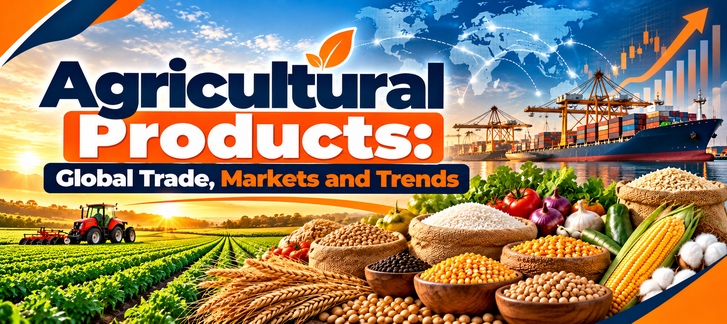
Agricultural Products: Global Trade, Markets and Trends
What drives the global trade of agricultural products? Discover the latest market trends, economic forecasts, and supply chain insights in our latest guide.
Introduction:
Food is a universal commodity. But behind every serving of meals that sits on your table there is a story. Because there is a massive and invisible global commerce network that helps to provide you with food. Whether you talk about the morning coffee which jumpstarts your day. Or maybe you talk about the cotton sheets that you used to sleep under. Therefore, agriculture is anchored completely to our daily lives.
But what are agricultural products, exactly? Why does their global movement matter so much to the everyday consumer, and how is the landscape changing as we march into the future?
Let’s dive into the fascinating world of global trade, market shifts, and the essential goods that power our planet.
What are Agricultural Products?
To put it simply, agricultural products are any raw materials or commodities derived from the cultivation of plants and the raising of animals to sustain and enhance human life. They are the bedrock of human civilization.
Historically, agriculture was a hyper-local survival mechanism. Because there is a sophisticated and multi-trillion-dollar global industry that exists today. When these goods are bought and sold in massive quantities for commercial manufacturing purposes. Or they are retailed for distribution purposes. It doesn't matter now. Because they are traded as wholesale agricultural products globally. So these wholesale markets ensure that a grocery store in a bustling metropolis stays stocked with fresh produce. While a textile factory that is thousands of miles away receives a steady stream of raw wool or flax.
Types of Agricultural Products:
The sheer variety of food items originating from a farm can be overwhelming. But before you can understand the global market for these products. You must understand economists who generally classify these goods. Because these goods are classified into four core categories:
1) Food Products: This is the most vital category for agricultural goods. Because they encompass everything that humans eat. This includes grains, fruits, vegetables, meat, dairy, and other edible oils etc.
2) Fuels: Renewable energy has turned farms into power-producing energy sources. Because biofuels, bioethanol from corn or sugarcane are included in this category. Where the biodiesel variety made from soybeans is also shifting how we view energy security.
3) Raw Materials: These are non-food commodities that are specially used in the manufacturing industry. So if you think of rubber for tires or lumber for construction. Or if you think about hides for leather goods everything is included in this category.
4) Fibres: The common example of this good is the clothing industry. Because clothing across the world require a massive agricultural output. But before they are spun into textiles. Thus, cotton, hemp, silk, and wool are all cultivated and harvested first.
Key Examples of Agricultural Products Around the World:
Different regions are excelled at producing specific commodities because of their climate. Or because of their soil geography and technological infrastructure. So these factors affect these goods' production globally. Therefore the global trade map is a beautifully complex web of interdependence.
1) Grains and Cereals (The Staples)
Rice, wheat, corn, and barley are the foundations of a global food supply. Therefore the USA, China, and Brazil dominate global corn production. While Canada and the European Union are major premium wheat exporters. Because of their vast plains that produce wheat of a huge variety.
2) High-Value Cash Crops
Coffee, cocoa, and tea are also counted as heavily traded global commodities. Because millions of people around the globe rely on Brazil for coffee beans. While West Africa (specifically Côte d'Ivoire and Ghana) supplies the majority of the world's wholesale cocoa. Additionally it's satisfying the global demand for chocolate as well.
3) Livestock and Poultry
Meat and dairy represent a massive agricultural trade sector. Whereas Australia and New Zealand are world leaders in dairy and beef exports. While South America has rapidly expanded a market for its poultry and other meat market footprint.
4) Oilseeds
Soybeans and palm oil are critical for both human consumption and industrial use. That's why Indonesia and Malaysia supply the bulk of the world's palm oil. While the Americas drive the global soybean trade to the next level.
Importance of Agricultural Products:
When food appears seamlessly on supermarket shelves. Then it is easy to take agriculture for granted. However, the stability of these products dictates global peace and economic health. While human survival also depends on the stability of these products.
1) Economic Engine: Agriculture is often the primary driver of GDP and the largest source of employment for developing nations. Because millions of livelihoods depend on the harvest of these products.
2) Food Security: The same as consistent access to affordable food prevents famine and social unrest. Because global trade routes ensure that countries with scarce arable land can still feed their citizens at any cost.
3) Industrial Backbone: Whether you can talk about pharmaceuticals utilizing plant extracts. Or you can talk about fashion houses that source organic cotton for you. So there are countless secondary industries that exist in many fields. So these industries would collapse without steady agricultural inputs.
Future of Agricultural Products: Emerging Trends:
The agricultural sector is currently undergoing its most significant transformation. Because this transformation has been going on since the Industrial Revolution. While amidst climate pressures and technological breakthroughs always drive it. Therefore the future of farming looks vastly different compared to what it did a generation ago.
1) Smart Farming and AgTech
Artificial intelligence (AI) and precision agriculture's rise have allowed farmers to monitor their crop health. While drone mapping helps farmers in the millimeter accuracy of their farms. Water and fertilizer use can optimize crop production. The same as AgTech maximizes crop yield. While minimizing environmental strain as well.
2) Sustainability and Regenerative Agriculture
Consumers always demand for transparency. Therefore market trends show an unprecedented surge in organic products. Where they also show sustainably source wholesale agricultural products in many chains. That's why regenerative farming practices focus on restoring soil health. Rather than depleting it roughly. Or transition it from a niche trend into mainstream corporate supply chains.
3) Climate Adaptation
Shifting weather patterns are forcing scientists to develop climate-resilient crop varieties. The same as unpredictable droughts cause the Drought-tolerant maize production. While flood-resistant rice is becoming vital assets in safeguarding the future food supply chain.
Final Thoughts:
From a simple seed planted in fertile soil to a complex shipment of wholesale agricultural products crossing the ocean, agriculture remains the ultimate heartbeat of our global economy. Understanding what are agricultural products is more than an academic exercise—it is an insight into how our world feeds, clothes, and powers itself. As technology marries tradition, the markets and trade routes of tomorrow will continue to evolve, proving that the ancient art of farming remains our most futuristic endeavor.