Asaan Karobar: Finance, Card, Eligibility & How to Apply
Explore Asaan Karobar 2026, including Finance and Card eligibility, loan limits, application steps, fees, and how to check your application status.

A business loan can look attractive on paper, especially when the advertised interest rate is zero. But before applying for Asaan Karobar, it helps to know which facility you're looking at.
Punjab introduced the programme in January 2025 with two options: a business credit card with a published limit of up to Rs 1 million, and a separate Finance scheme for larger loans.
The Bank of Punjab is the lender. During the early-November 2026 review, the card portal was reported to have stopped new registrations, while the Finance portal still showed an application option. That position needs checking again before you apply.
The details that matter are often buried beneath the headline: who can apply, what documents the bank wants, when repayments begin, and which fees still apply.
This guide puts those questions in one place, along with the steps for checking an application. Where the published terms are unclear or dated, we'll say so rather than guess.
Quick Answers
1) What it is: a Punjab government scheme where the government pays the markup, so eligible borrowers pay 0% interest to the Bank of Punjab.
2) Two products: the Asaan Karobar Card (up to Rs 1 million, 3 years) and Asaan Karobar Finance (Rs 1 million to Rs 30 million, up to 5 years).
3) Status now: the card portal says registration is stopped. Finance was still accepting applications, according to checks in September and October 2026.
4) Official portals: akc.punjab.gov.pk for the card and akf.punjab.gov.pk for Finance. Helpline: 1786.
5) Catch: 0% interest is not zero cost. The card carries a Rs 25,000 plus FED fee, and you repay every rupee you use.
What is the Asaan Karobar Scheme?
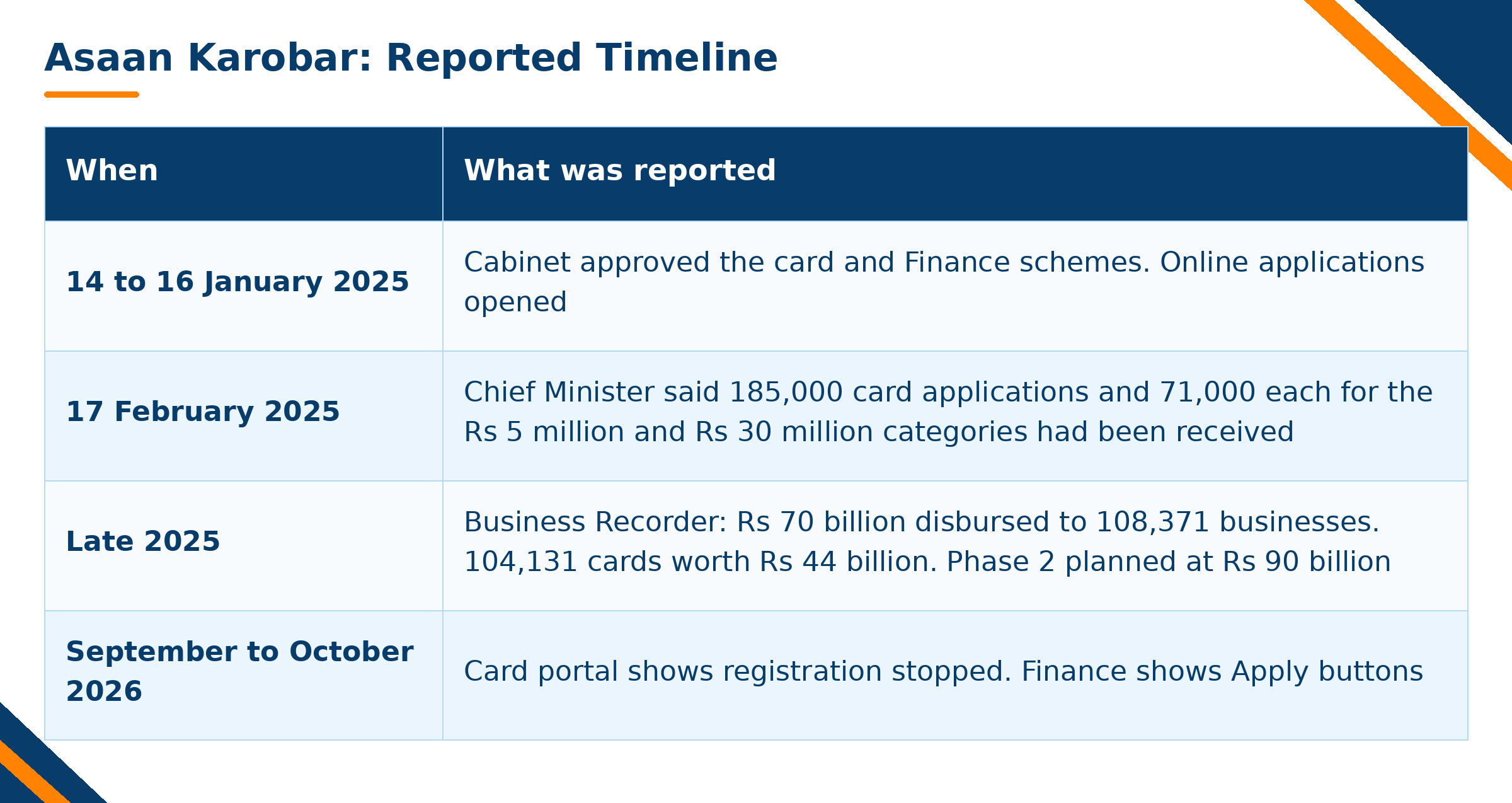
Asaan Karobar covers two Punjab government business-financing schemes, not one loan with two names. The provincial cabinet approved the programmes on 14 January 2025.
The Punjab Small Industries Corporation (PSIC) oversees the initiative, the Punjab Information Technology Board (PITB) operates the card portal, and the Bank of Punjab handles lending and repayments.
Knowing which organisation does what can save time when you need an answer about an application.
The government covers the bank's markup, so the schemes are described as interest-free for eligible borrowers. Demand was strong from the beginning.
At a February 2025 distribution event, the chief minister reported 185,000 card applications and 71,000 applications in each of the Rs 5 million and Rs 30 million finance categories.
Business Recorder later reported that by late 2025, the scheme disbursed Rs 70 billion to 108,371 businesses, including 104,131 cards worth Rs 44 billion.
Those are historical figures, not an indication that applications are open today.
You may also see the name written as 'Asan Karobar' or described online as the Maryam Nawaz business loan scheme.
The important geographical point is that the programme is intended for qualifying people and businesses in Punjab, rather than applicants across Pakistan.
Asaan Karobar Finance: Loan Tiers and Eligibility
Finance is the option to look at when a business needs more than short-term stock purchases.
The published uses include starting or expanding operations, buying equipment, and meeting working-capital needs.
There are separate loan tiers, and reports mention an additional exporter category.
The table gives the amounts described in the source material; treat it as a starting point, not a replacement for the bank's current offer.
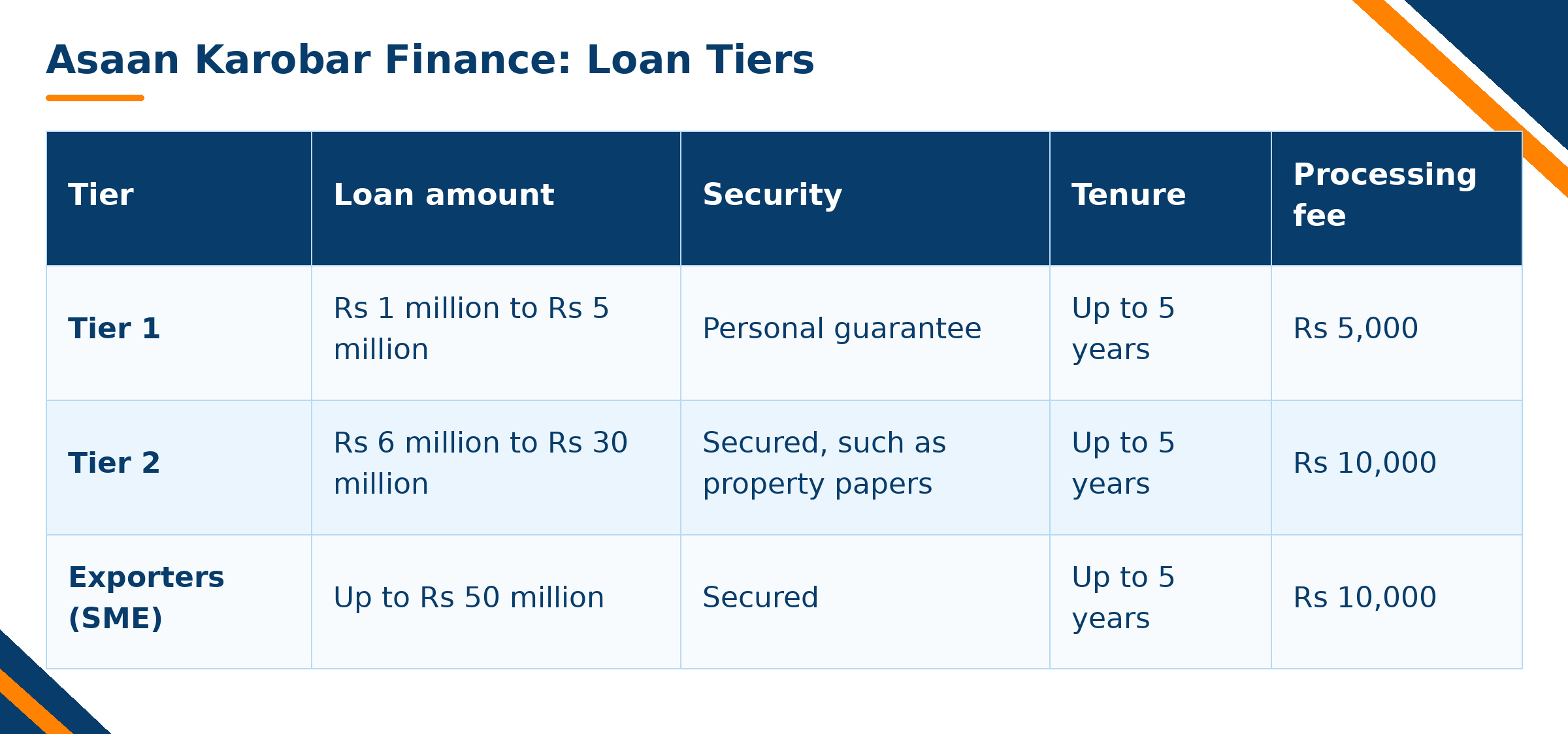
Source note: These tier figures were taken from secondary summaries of the programme. Reports disagree on whether Tier 2 starts at Rs 5 million or Rs 6 million; the exporter ceiling also requires direct confirmation.
Do not rely on this table for a financing decision without checking the official Finance portal.
Before spending time on an application, check the eligibility basics. Published guidance points to an age range of 25 to 55, residence and business operations in Punjab, active FBR filer status with an NTN, a satisfactory credit record, and two references who are not blood relatives.
Your own contribution and any security depend on the category. Some summaries also mention a 3% annual handling charge for existing businesses, but do not explain its calculation clearly enough to budget for it without asking the bank.
Asaan Karobar Card: Credit Limit, Fees and Repayment
The Asaan Karobar Card is meant for approved business spending; it isn't a grant, and it isn't a card for unrestricted personal purchases.
The published arrangement allows a revolving credit period before the outstanding amount moves into scheduled repayments.
Check the current card terms for withdrawal restrictions, the grace period and payment dates.
Those details determine how useful the facility will actually be for a shop or small business.
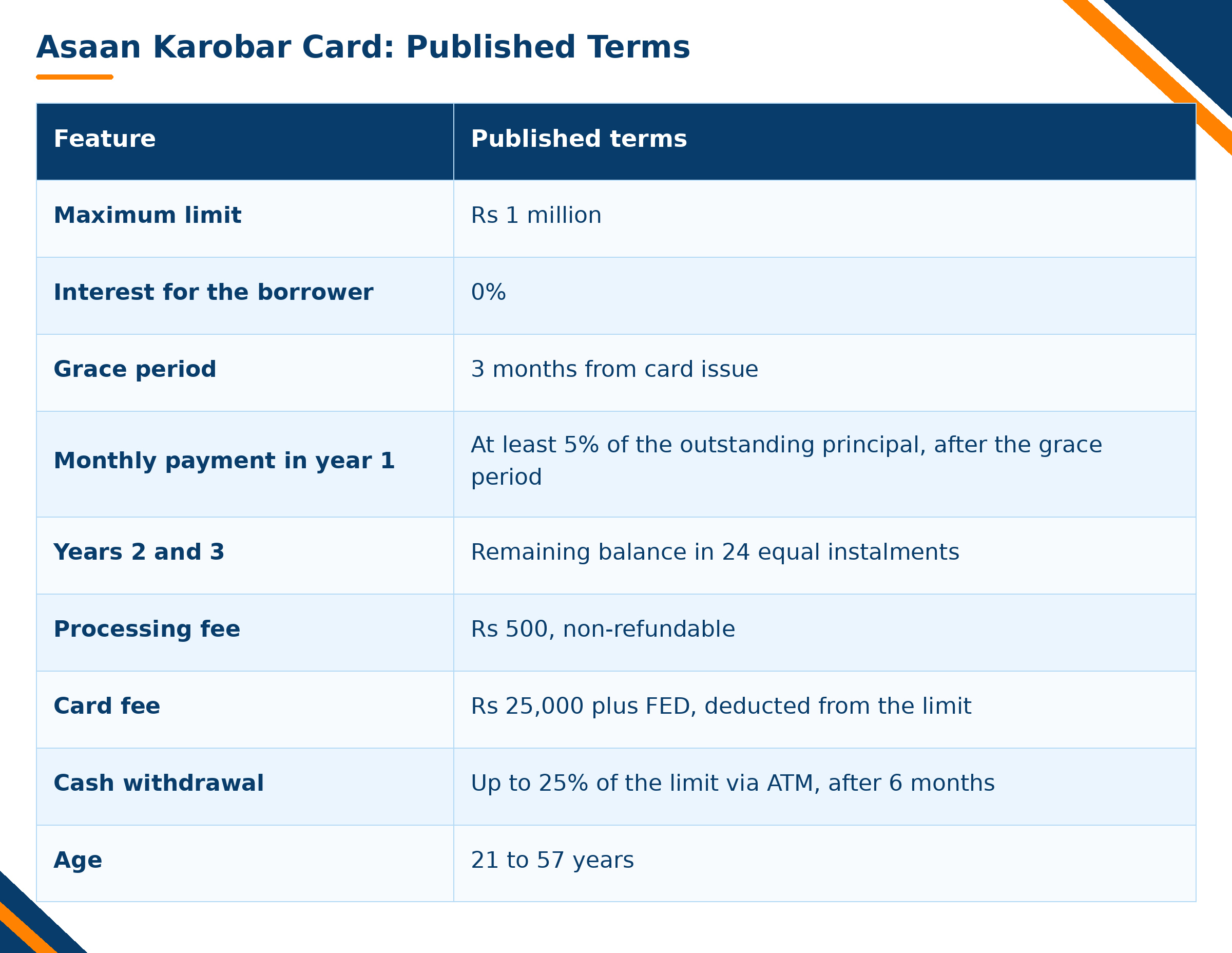
Source note: Card limits, fees, and repayment terms in this table come from a September 2026 independent summary, not a fresh confirmation from the official portal. Verify the fee deductions, withdrawal facility, and payment schedule before publishing or applying.
There are obligations after approval, too. The published card conditions require tax registration with the Punjab Revenue Authority or FBR within six months, followed by business verification.
A card may be blocked if the required registration or positive verification is missing. Keep track of statements and payment deadlines rather than assuming the interest-free label means payments can wait.
Asaan Karobar Card vs Finance: Which Fits Your Business?
Think about what the money will do in the business. Replacing stock every few weeks is a different need from paying for a machine that may take years to recover its cost.
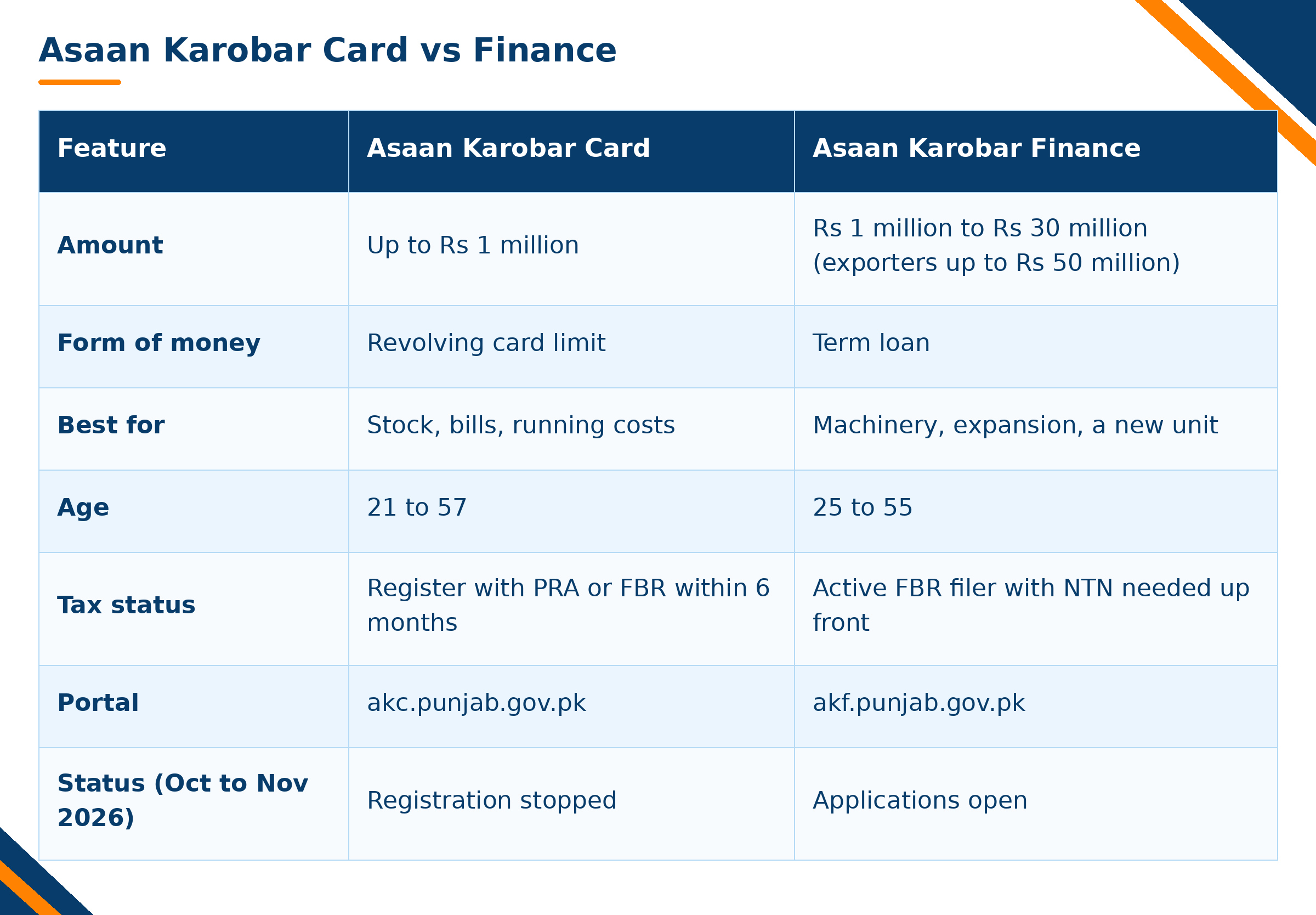
For a shopkeeper, access to a revolving limit could help with repeat stock purchases. A manufacturer planning a new production line may be better suited to a term loan.
Neither is automatically better. And if card applications are closed, Finance is not simply the same product under a different name: the eligibility, paperwork, and security requirements can be tougher.
How to Apply for Asaan Karobar Finance or Card
First, check whether the relevant portal is actually accepting applications.
The November 2026 review found reports of stopped card registration and a visible Finance application option, but application windows can change.
Open the official site yourself or call 1786 before preparing paperwork or paying a fee. An old social-media post is not reliable evidence that a new round has begun.
1) Check the portal first. Open akf.punjab.gov.pk (or akc.punjab.gov.pk for the card) and confirm the Apply button is live. Call 1786 if you’re unsure.
2) Register with your CNIC and a mobile number registered in your own name.
3) Choose your tier and purpose, and enter your business details and the amount you need.
4) Upload documents. Typical requests are your CNIC, photo, proof of business and address, tax registration, and two references who are not blood relatives.
5) Pay the processing fee only through the PSID the portal gives you. Rs 500 for the card, Rs 5,000 for Tier 1, and Rs 10,000 for Tier 2.
6) Wait for checks. The Bank of Punjab reviews your credit history, feasibility, and security, and a business verification visit follows.
7) Sign digitally and collect the loan or card once approved, then use it only for the stated business purpose.
One small mismatch can hold up an application. Check that your CNIC, mobile registration, business details, and tax records agree with what you've entered.
Save the application reference and payment receipt somewhere you can find them later. The bank still decides whether the application meets its requirements.
Asaan Karobar Card Status Check: Step-by-Step
If you applied for the card earlier, sign in at akc.punjab.gov.pk with the credentials used for your application.
Your dashboard should show the current stage and whether anything is still required from you.
Finance applicants use akf.punjab.gov.pk. An SMS may be helpful, but confirm important updates through the official portal or helpline.
Don't worry if the wording isn't immediately clear. An application may be saved but unfinished, waiting for payment, under verification, approved, or rejected.
If you cannot access the dashboard or don't understand the message, call 1786 and have your application reference ready.
No legitimate status check requires you to share an OTP, PIN, or password with a third party.
Asaan Karobar Loan Repayment: What 0% Interest Really Costs
Zero markup doesn't mean there are no costs. Processing fees, card charges, and any applicable handling fees can change what a loan costs your business.
The examples below show the effect of repayment timing; they are illustrations, not instalments quoted by the bank.
Card example: Suppose the full Rs 1,000,000 is outstanding, and you pay 5% of the remaining principal in each of nine months.
On that simplified assumption, around Rs 630,249 remains. Split evenly over the next 24 months, that is about Rs 26,260 a month.
Actual card repayments may differ because of spending dates, fees, and the bank's schedule. Don't treat this calculation as your statement amount.
Finance example: Repaying Rs 5 million in equal principal instalments over 60 months works out to about Rs 83,333 a month before charges.
If six months pass before principal repayment begins and the amount is instead spread over 54 months, it rises to about Rs 92,593.
A 3% charge on the full Rs 5 million would be Rs 150,000 in a year, but the lender must confirm whether that is how any handling fee is assessed.
The real question is whether you can make the payment when sales are slow. Look at rent, wages, supplier bills, and the time it takes customers to pay you.
If the numbers only work in your busiest month, the loan amount may be too high.
Asaan Karobar Updates: What Has Changed Since Launch?
The scheme has reached businesses in several phases, but past disbursement figures say nothing about whether a new applicant can register today.
Check any announcement against the relevant official portal before making plans around it.
Using Business Financing Wisely: Inventory and Purchasing Decisions
Once funding is approved, decide what it should purchase before placing an order.
A small retailer might compare bulk wheat and Daal Chana against expected weekly sales, storage space, and cash available for repayments.
Buying a larger quantity only makes sense when the savings exceed carrying costs, and the stock will sell in time.
A business upgrading a shop or warehouse should separate essential repairs from optional improvements.
For example, compare the specifications and delivered cost of Chenab Sand before committing to building work.
For a solar installation, a Growatt 6KW on-grid inverter is one possible equipment reference, but its suitability depends on the project design and approved financing purpose.
For repeat purchasing, compare suppliers using the same unit, grade, delivery point, and payment terms.
Zarea’s commodity price can provide a reference point for selected materials, but published prices are not a substitute for a current supplier quotation.
Where relevant businesses can compare product categories:
1) Food retailers and grain traders can explore the grains and pulses marketplace for available commodity options. Check the product listing for actual quantity and delivery terms.
2) Construction suppliers can compare materials in the building and finishing categories rather than assuming every supplier quotes the same grade.
3) Solar contractors can review the solar when comparing panels, inverters, and associated equipment.
4) Businesses processing agricultural residues may explore the agricultural biomass to understand relevant materials before investing in processing equipment.
5) A mill or processing business has another question to answer before borrowing: what exactly will the equipment produce, and who will buy it? Put the machinery list, running costs and expected orders on paper first. Also check whether the planned purchase qualifies under the scheme; not every supplier payment necessarily will.
When comparing inventory quotes, work out the cost of stock you can actually sell. Include transport, storage, wastage and how long customers take to pay.
A lower price per bag or unit doesn't help much if the delivery is late or the quality creates returns.
Suppliers should keep invoices, delivery notes and payment records in order.
Apart from making everyday bookkeeping easier, these records help explain where working capital went and which customers still owe money.
A simple test is to write down expected cash coming in and going out for the next three months. Include a quiet month, not just your best sales forecast.
Then add the proposed loan payment. If making it would require another loan, revisit the purchase or the amount you plan to borrow.
Asaan Karobar Application Mistakes and Scams to Avoid
1) Trusting a “new round” post. If the official portal doesn’t show it, it isn’t open.
2) Paying an agent. Nobody can get you selected or raise your limit. The only official charges are the fees paid through the PSID on the portal.
3) Sharing an OTP, PIN, or password. Signing codes are for you alone.
4) Using a SIM in someone else’s name, which the portals reject.
5) Skipping tax registration. It can get a card blocked or stop a Finance application.
6) Mixing personal and business spending, which breaks the terms.
Use only akc.punjab.gov.pk and akf.punjab.gov.pk, and call 1786 if anything looks wrong.
FAQs
What are the Eligibility Criteria for the Asaan Karobar Card?
Published criteria include being 21–57 years old, residing in and operating a business in Punjab, holding a valid CNIC and a mobile number in your name, and meeting the bank’s credit checks. Verify the latest criteria before applying.
How to Check Asaan Karobar Card Status?
Sign in at akc.punjab.gov.pk and open your application dashboard. If the result is unclear, call the official helpline at 1786 with your application details.
How to Check Balance in Asaan Karobar Card?
Use the Bank of Punjab’s official card or account service, if enabled for your card, or contact the bank through the number on the card to ask about the available credit limit and outstanding balance. Do not share your PIN or OTP.
Wrap-up
Asaan Karobar may be useful, but the right choice depends on the business and its cash flow.
Check whether applications are open, read the charges in full, and work out the repayments before committing.
A facility that looks affordable at the application stage can feel very different once the monthly bills arrive.
This guide is for general information, not individual financial advice. Scheme phases and bank terms can change.
Confirm current eligibility, fees, and availability with the official Punjab portals and the lender.