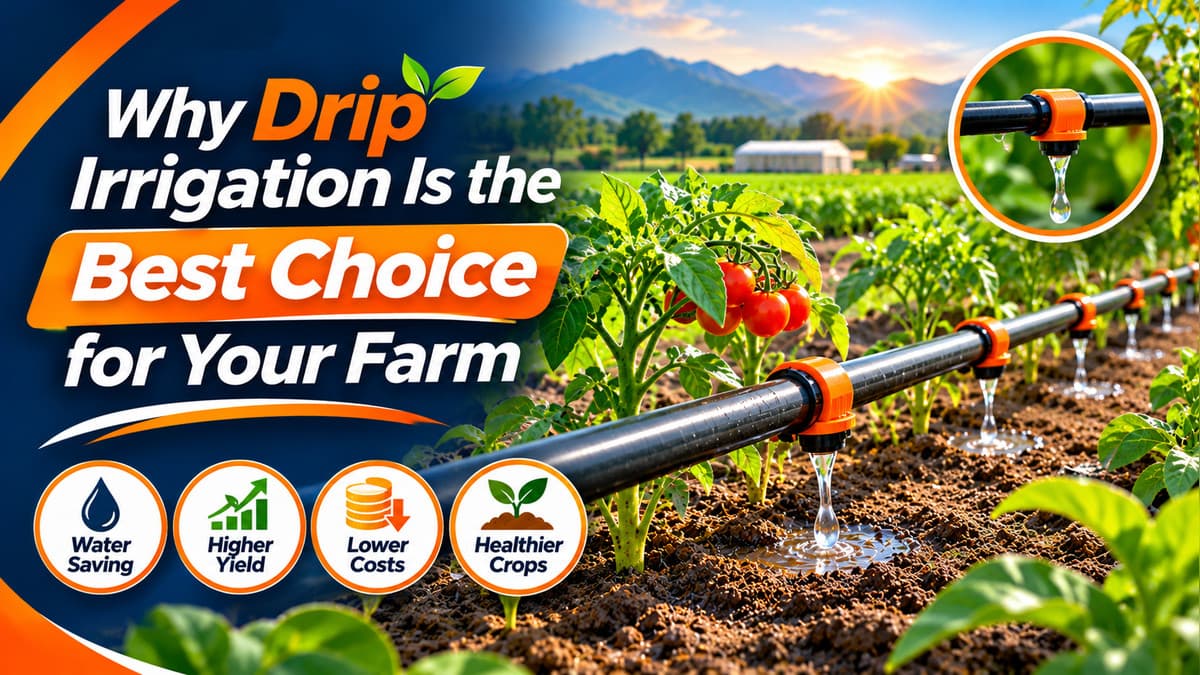
Why Drip Irrigation Is the Best Choice for Your Farm
Want higher yields with less water? See why drip irrigation outpaces traditional sprinklers by delivering water and nutrients directly to your crop roots.
Introduction:
Farming has always been a dance with nature. But farming's rhythm has gotten unpredictable. Modern growers are forced to ask themselves a tough question about shifting weather patterns and rising input costs. Additionally modern farmers also ask questions about escalating water scarcity. How do we produce more yield while using less water?
The answer isn't hidden in experimental tech; it’s running right along the soil. If you are looking to secure your farm’s profitability and long-term viability, transitioning to a drip irrigation system is arguably the single most impactful move you can make.
Here is exactly why this precision watering method outpaces traditional irrigation and why it is the smartest investment for your agricultural business.
What is Drip Irrigation:
We must first understand exactly what is a drip irrigation system is to truly appreciate its value. How is this system fundamentally changing how plants consume resources?
Drip irrigation is a micro-irrigation method. Unlike conventional overhead sprinklers that mimic rainfall or flood systems that submerge entire fields. Because this system is a highly engineered network of valves, pipes, tubing, and emitters. While specially designed to deliver water directly to the base of each individual plant. Instead of blasting water through the air and where much of your water evaporates? Before even the water touches the leaves in the specific field. Therefore this method applies the water slowly, drop by drop. In this way the water applies straight to the soil profile where the roots live.
What are the Benefits of Drip Irrigation?
Switching from traditional surface or sprinkler irrigation to a localized system is the best idea. Because it offers you transformative benefits for both your day-to-day operations and your bottom line.
1) Unmatched Water Efficiency
Traditional sprinklers can lose up to 30–40% of their water to wind drift and surface evaporation. Flood irrigation is even less efficient, leading to massive runoff and water logging. Drip systems routinely operate at over 90% water application efficiency. Because the moisture goes straight into the dirt, water loss is practically zero.
2) Targeted Nutrient Delivery (Fertigation)
You aren't just managing your water supply when you use a drip network. Because you are managing the nutrition of your plants or fields. Additionally liquid fertilizers can be injected directly into the water stream through a process called fertigation. Instead of broadcasting expensive fertilizers across the whole field (which feeds weeds just as much as crops). Basically you want to feed the specific root zone of your plants. So, this method reduces fertilizer waste by up to 30% and keeps chemicals out of nearby water tables.
3) Drastic Reduction in Disease and Weeds
Fungi and crop diseases thrive on wet foliage at first. Because drip systems keep the leaves entirely dry while fungal outbreaks drop yield significantly. Furthermore, because the spaces between rows remain dry, the weed seeds are starved of moisture. Therefore they need to germinate and save you thousands on herbicides and manual labor.
4) Energy and Labor Savings
Drip lines operate smoothly at much lower pressures. Basically drip lines operate usually under 15–30 PSI than heavy-duty overhead pivots or impact sprinklers. Therefore lower pressure means your pumps draw significantly less electricity or diesel. Additionally, because the entire system can be easily automated with timers and soil sensors. So, your manual labor costs will plummet in this way.
You can also read our previous post on arable farming!
Did You Know?
Agricultural data reveal incredible realities about this topic. Precision irrigation increases the average crop productivity by 30-50%. While this technique also simultaneously cuts your resource consumption in half. It is one of the rare farming upgrades where you spend less on inputs. But your harvest gives you substantially more output.
How Does Drip Irrigation Work?
The beauty of a modern setup lies in its elegant mechanics. It takes water from a central source and tames it into a controlled, uniform stream across acres of varying terrain. Here is how the magic happens step-by-step:
1) The Control Station: Water is drawn from a well, pond, or municipal supply. Before it travels anywhere, it passes through a critical filtration unit to remove sand, algae, and sediment that could clog the lines. A pressure regulator then dials down the force so it won’t burst the flexible tubing downstream.
2) The Delivery Lines: The filtered, low-pressure water travels through PVC mainlines and sub-mainlines, branching out into flexible polyethylene lateral tubes running alongside your crop rows.
3) The Emitters: Specially designed drippers or emitters are pre-spaced along the lateral lines. These tiny components release water at a highly calibrated rate—typically ranging from 1 to 4 litres per hour—ensuring that the plant at the very end of the line gets the exact same amount of moisture as the plant closest to the pump.
Here you can explore Intensive agricultural techniques!
Drip Irrigation: Powering a Sustainable Future:
Sustainability is no longer just a corporate buzzword; it is a survival strategy for global agriculture. Agriculture currently accounts for roughly 70% of all freshwater withdrawals globally. As underground aquifers deplete and regulations tighten, farming practices must evolve.
Drip technology provides a blueprint for climate-resilient farming. It actively prevents soil erosion and eliminates the nutrient leaching that often poisons local watersheds by minimizing runoff. It allows farmers to maintain and even expand their crop production during severe drought restrictions. Because farms ensure they will still have fertile and viable land to pass down to the next generation with conserving water today.
Drip Irrigation Around the World:
The global shift toward localized watering isn't a localized trend; it’s a global movement responding to unique regional challenges:
1) The Middle East: In arid regions like Israel, where modern drip tech was pioneered, precision watering has allowed hyper-arid desert sands to transform into thriving, export-quality orchards and vegetable fields.
2) North America: In places like California's Central Valley, severe groundwater regulations and historic droughts have driven widespread adoption of subsurface drip systems in high-value almond groves and vineyard operations.
3) Asia: Smallholder farmers across India and China are rapidly adopting affordable, gravity-fed drip kits. These low-cost setups are helping rural communities break the cycle of poverty by securing stable, year-round crop yields with minimal water reserves.
The Future of Drip Irrigation:
The next frontier of agriculture is defined by data, and drip infrastructure is perfectly positioned to serve as the backbone of smart farming.
We are already seeing the rise of Smart Drip Systems integrated with Artificial Intelligence (AI) and the Internet of Things (IoT). Instead of running on simple timers, tomorrow's systems use real-time soil moisture probes, localized weather forecasts, and satellite imagery to calculate the exact milliliter of water a crop needs at any given hour.
Furthermore, advancements in biodegradable tubing material and self-cleaning, anti-clogging emitters are making the systems cheaper to maintain and more accessible to farmers operating with lower-quality water sources.
The Bottom Line:
When you look closely at the math, investing in a drip irrigation system isn't an expense—it’s an insurance policy for your farm's future.
While the initial installation requires careful planning and upfront capital, the return on investment is incredibly swift. By slashing your water bills, reducing fertilizer costs, mitigating disease risks, and boosting your crop productivity by up to 50%, the system quickly pays for itself. If you want a farm that is more resilient, highly automated, and drastically more profitable, the choice is clear: it’s time to let it drip.
Frequently Asked Questions (FAQ)
What is the main purpose of drip irrigation?
The main purpose of drip irrigation is to maximize water efficiency by delivering water and essential nutrients directly to the root zones of plants. This targeted application drastically reduces water waste caused by evaporation, wind drift, and surface runoff compared to traditional sprinkler systems.
Is drip irrigation better than sprinklers for large farms?
Yes, drip irrigation is generally superior to overhead sprinklers for large-scale operations. While sprinklers lose significant water to wind and evaporation, a drip system boasts over 90% water efficiency. Additionally, drip irrigation lowers energy costs due to operating at a lower pressure (PSI), reduces weed growth between crop rows, and allows for direct root fertilization (fertigation).
What are the disadvantages of a drip irrigation system?
While highly advantageous, the primary drawbacks of drip irrigation are its higher initial upfront installation cost and the risk of emitter clogging caused by mineral deposits, algae, or sediment in the water. Systems also require regular filtration checks and maintenance to prevent damage from rodents or heavy farm equipment.
How often should a drip irrigation system run on a farm?
The running frequency of a farm drip system depends heavily on your crop type, growth stage, and soil composition. However, because drip systems release water slowly (typically 1 to 4 litres per hour), they generally run more frequently but for longer periods than traditional sprinklers—often daily or every other day during peak growing seasons to keep root zones perfectly moist.