Intensive Agriculture: Characteristics, Benefits And Drawbacks
Learn what intensive agriculture is, its key characteristics, advantages, disadvantages, and real-world examples, with insights into farming.
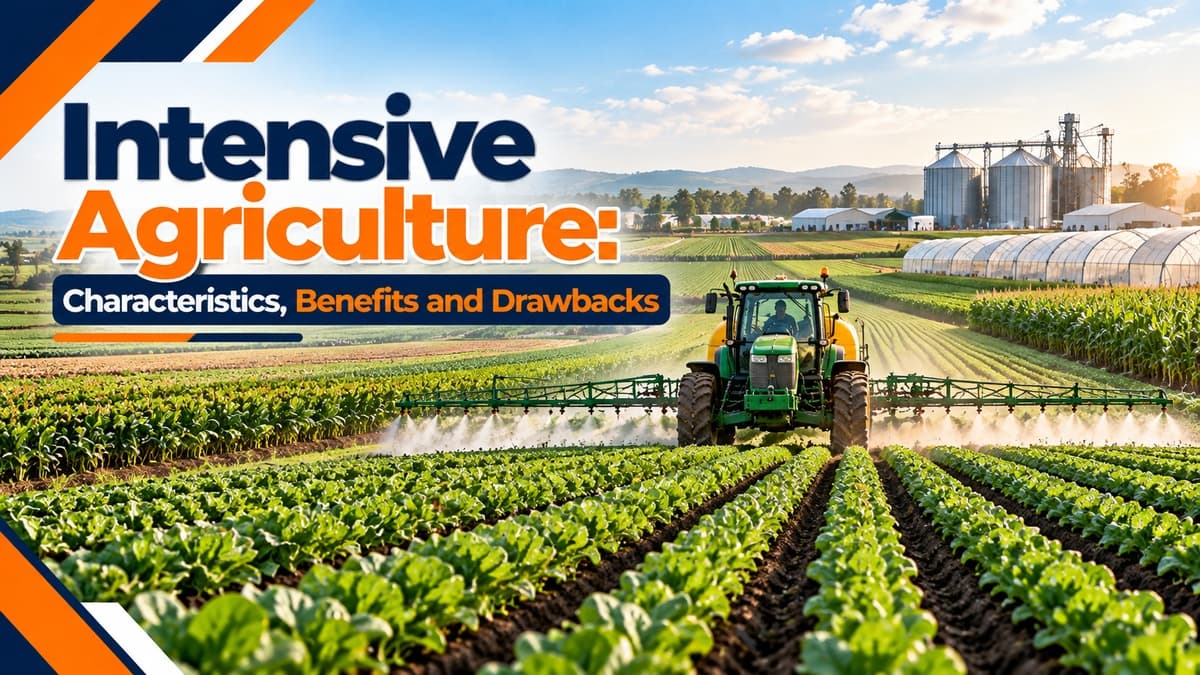
Intensive agriculture, also known as intensive farming, uses more labour, equipment, irrigation, improved seed, and other inputs on each hectare to produce more food from available land.
You can see it in irrigated rice fields, vegetable farms, greenhouses, and poultry operations. In Pakistan, where water costs and input prices matter as much as yield, farmers have to weigh the extra harvest against what it takes to produce it.
This guide explains how intensive farming works, how it differs from extensive farming, and where it is used. It also looks at its benefits and drawbacks, with examples from Pakistan and practical ways to protect soil and water.
Quick Answers:
1) Intensive agriculture aims for higher output per hectare through closer management and greater use of inputs.
2) Extensive agriculture generally uses fewer inputs per hectare across larger areas; yields vary by crop and conditions.
3) Typical examples are irrigated rice, wheat-rice rotations, vegetables, greenhouse farming, and poultry or dairy units.
4) The main advantage is more output from limited land. The main risks are soil and water damage and high input costs.
5) Higher yields are possible, but research-trial results should not be treated as a guarantee for every farm.
What Is Intensive Agriculture?
When land is limited, farmers may increase production by investing more in each hectare. Intensive agriculture often combines irrigation, improved varieties, fertilizer, machinery, and careful timing.
What makes a farm intensive is the level of inputs and management relative to its land area, not simply the size of the farm or the amount harvested.
Intensive farming and commercial farming are not the same thing. A family growing irrigated vegetables for its own use may farm intensively. A large, low-input ranch can sell everything it produces and still be extensive.
Key Characteristics
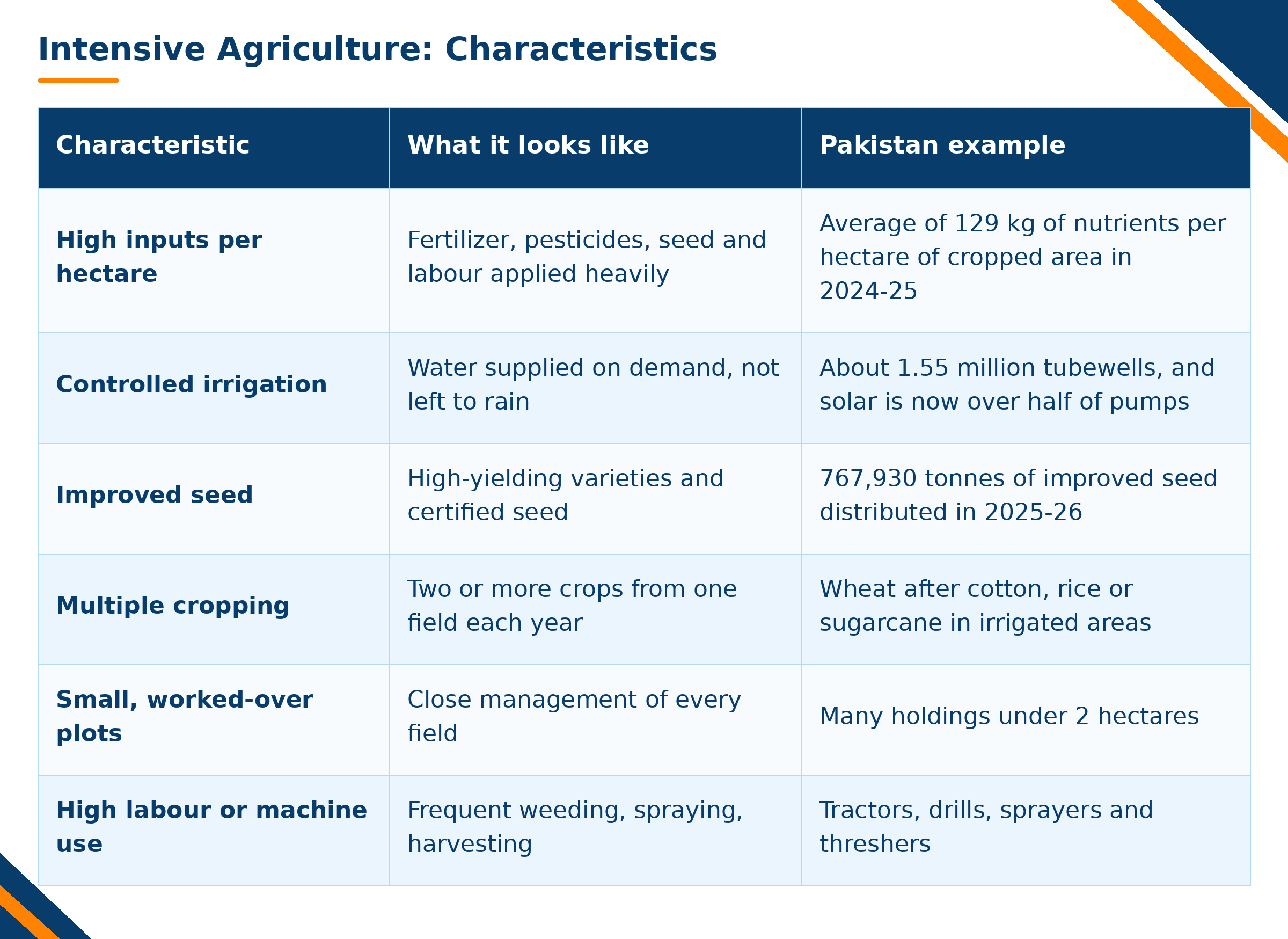
Here are Pakistan’s numbers in one place. The Economic Survey 2025-26 reports 24.24 million hectares of cropped area, and fertilizer nutrient offtake of 3.795 million tonnes in July to March, up 11.4%.
The Fertilizer Review 2024-25 from the National Fertilizer Development Centre (NFDC) puts average use at 129 kg of nutrients per hectare, with Sindh at 187 kg and Punjab at 148 kg. Improved seed is a big part of this, and you can compare certified options in the seed category.
Intensive vs. Extensive Agriculture
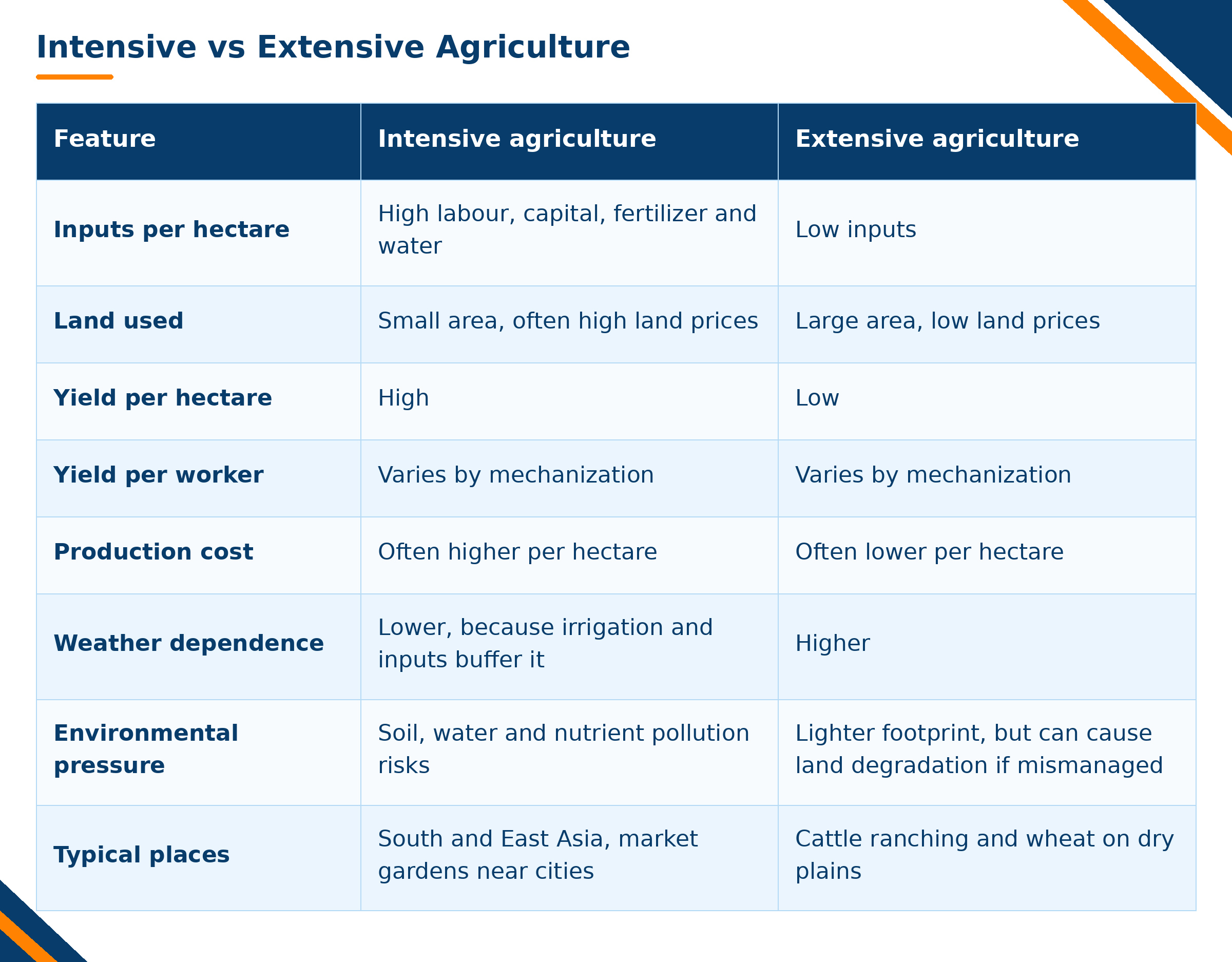
These approaches are not rigid categories. Irrigated farms in Punjab often use more inputs per hectare than rain-fed farms, while the right approach for any holding depends on water, soil, labour, and crop choice.
Examples and Crops of Intensive Agriculture
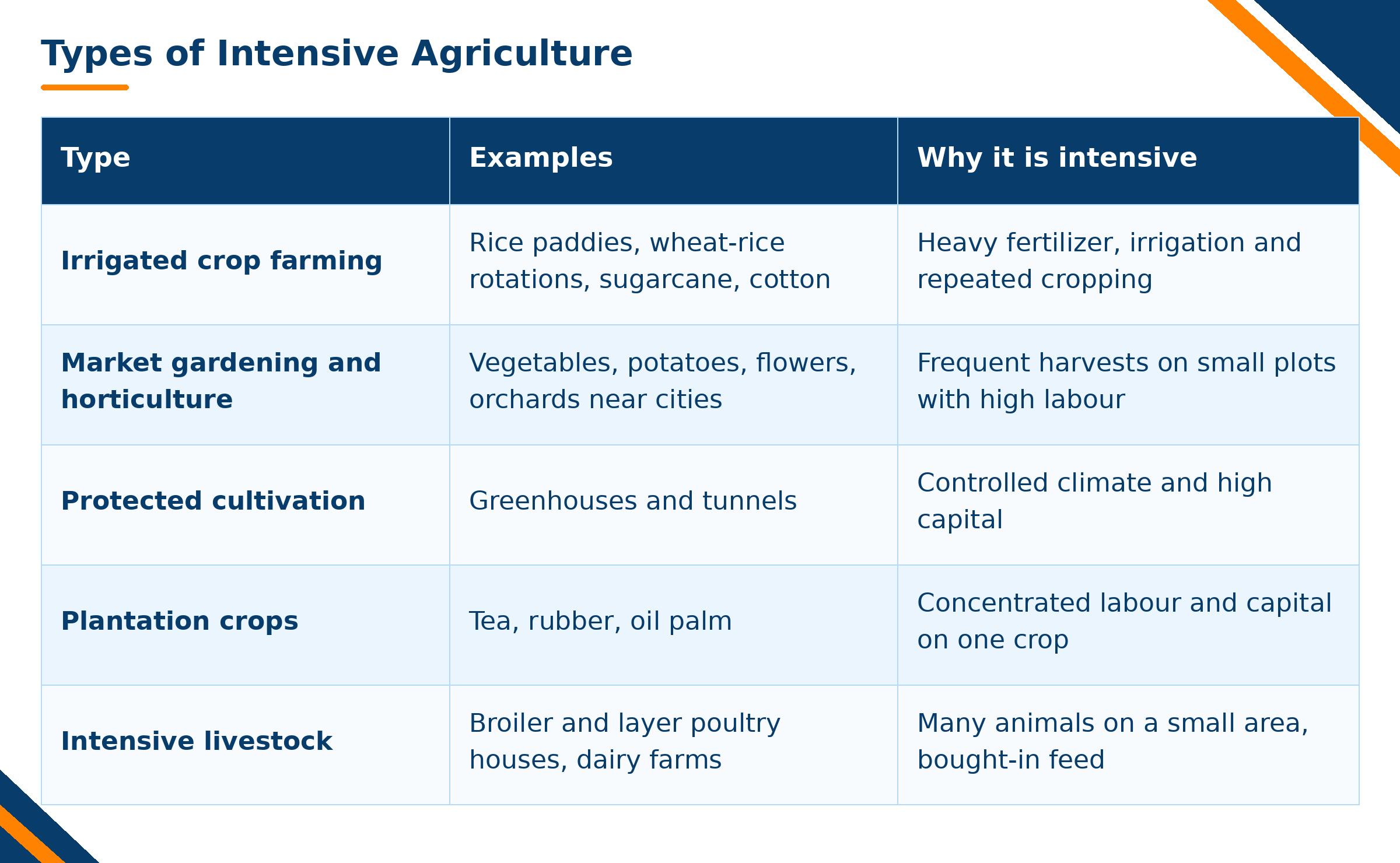
The crops that dominate Pakistan’s intensive systems are the big five. In 2025-26, the Economic Survey put wheat at 29.61 million tonnes on 9.48 million hectares, sugarcane at 89.45 million tonnes, rice at 9.99 million tonnes, and cotton at 7.05 million bales, with maize and cotton lower.
Wheat is the clearest case of heavy input use, and bulk buyers can see how it trades on Zarea's wheat listing.
Intensive livestock depends on feed grain too. A maize listing shows the kind of bulk grain poultry and dairy units buy, and maize is a major feed ingredient.
Advantages of Intensive Farming
1) Higher output per hectare: Farmers can produce more from limited land when crop management and growing conditions are suitable.
2) More cropping opportunities: Irrigation and suitable crop varieties may allow more than one harvest a year.
3) Better control over production: Reliable irrigation can reduce some rainfall-related risks, although heat, pests and water shortages still matter.
4) Employment and services: Some intensive systems create demand for skilled workers, machinery operators and farm advisers.
5) Potential food-supply gains: Closing realistic yield gaps can increase production without bringing more land under cultivation.
Pakistan’s wheat yields vary widely between fields and seasons. Research plots may outperform the national average, but results depend on soil, weather, and management.
For background on farm production models, see the agricultural marketplace. Higher yield only helps when the additional harvest covers its cost.
Disadvantages and Challenges
1) Soil health: Repeated cropping without enough organic matter or balanced nutrients can weaken soil structure and fertility.
2) Pressure on water: Irrigation-intensive crops can strain canals and groundwater, especially where pumping exceeds recharge.
3) Runoff and emissions: Excess nutrients and poorly managed pesticides can harm water quality and raise environmental costs.
4) Nutrient losses: Fertilizer is not fully taken up by crops; losses depend on the product, soil, weather, and application method.
5) Higher operating costs: Seed, water, fuel, fertilizer, and machinery can leave farmers exposed when prices rise or yields fall.
6) Reduced biodiversity: Repeated monocropping and unnecessary pesticide use can reduce beneficial insects and soil organisms.
Input prices decide what farmers actually do. In July to March 2025-26, nitrogen offtake rose 14.8% to 3.035 million tonnes, while phosphate fell 1.9% to 712,000 tonnes because of high prices.
By our arithmetic, that is about 4.3 kg of nitrogen for every kg of phosphate, which is a heavily urea-based mix. NFDC data show urea at 66.5% of all fertilizer offtake and DAP at 15.6%. You can track how fertilizer is priced in the fertilizer category.
Making Intensive Agriculture More Sustainable
Getting more from a field does not have to mean wasting resources. Choosing the right agricultural inputs matters, but soil testing and local advice should guide what a farmer applies. Practical steps include:
1) Start with a soil test, then apply nutrients according to crop need rather than relying on urea alone.
2) Consider coated or controlled-release fertilizers where local evidence and the added cost justify them.
3) Improve irrigation efficiency. Laser land levelling can reduce uneven watering, but savings vary by field and management.
4) Rotate crops, include legumes where practical, and return suitable organic material to the soil.
For phosphorus, a balanced fertilizer such as DAP helps correct the nitrogen-heavy mix. Our guide to how biofertilizers protect soil and boost plant yields covers a biological way to cut chemical use.
Water and energy matter too. Solar pumping is spreading fast. Pakistan’s 7th Agricultural Census 2024 counted 959,865 solar pumps, or 52% of all tubewells and lift pumps, according to ProPakistani.
Farmers weighing the switch can start with solar. Residues such as rice husk and straw can become fuel instead of being burned in the field, which we explain in agri waste-to-energy.
Buying Inputs and Tracking Prices
Zarea does not farm, and it is not an agronomy adviser. It is a commodity marketplace that lists the inputs and crops an intensive farm deals with. Bulk grain and pulse listings are in the grains and pulses category, and the daily price page tracks commodity prices.
Match fertilizer and seed choices to your own soil test and your local agriculture extension officer’s advice.
Frequently Asked Questions
What is the difference between intensive and extensive agriculture?
Intensive agriculture uses more inputs and closer management per hectare, while extensive agriculture generally uses fewer. Intensive systems often produce more per hectare but can carry higher costs and greater pressure on water and soil. The outcome depends on the crop and how the farm is managed.
What crops are grown in intensive agriculture?
Common crops include rice, wheat, maize, sugarcane, cotton, and vegetables. Fruit, flowers, and greenhouse crops may also be grown intensively. The defining factor is how the crop is managed, not the crop name alone.
Wrap-Up
Intensive agriculture can help farmers get more from each hectare, but higher yield is only worthwhile when the extra harvest covers the cost of producing it. Healthy soil, reliable water and sensible fertilizer use are essential for keeping that balance.
For growers and buyers, the practical starting point is straightforward: check soil needs, compare input prices and track returns per hectare rather than chasing yield alone.