Commercial Agriculture Types Characteristics and Examples
Explore commercial agriculture, its types, benefits and challenges, with examples from Pakistan and a practical guide to calculating farming costs per maund.
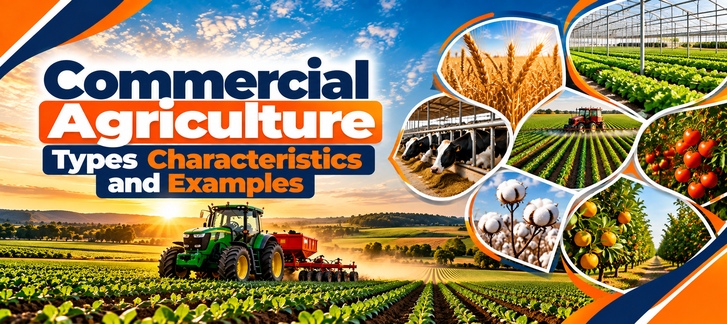
Commercial agriculture is farming for the market. You grow crops or raise animals mainly to sell them, and what you plant, how much of it and who you sell to all come down to demand, costs, and what you expect to earn.
That's the real test. Someone growing vegetables for the shops down the road is a commercial farmer. So is the owner of a big wheat farm selling to a flour mill. Land size, machines, and bank loans shape how each one runs the business, but they don't decide whether it's commercial. Selling is what does that.
In this guide, we'll cover the main features and types of commercial farming, look at examples from Pakistan and other countries, and weigh the benefits against the risks. We'll also work out a cost per maund, so you can compare buyer offers on the same footing.
What are the main characteristics of commercial agriculture
Commercial farms build their production around sales. They can be small or large, run by a family or a company, intensive or extensive. These are the traits you'll see on most of them.
Production for the market. Crops, milk, meat, and other products are grown mainly for buyers, whether that's households, retailers, wholesalers, mills or processors. Exporting is one option, but a farm doesn't have to export to be commercial.
Planned inputs and working capital. Growers have to budget for seed, nutrients, water, labour and harvesting before any sales money comes in. That money might come from savings, past profits, loans or investors. When you compare fertilizer, don't stop at the price of the bag. Nutrient content, how well the product suits your crop, transport, and timing all change what your nutrition plan really costs. Apply it according to what the crop needs and proper soil or agronomic advice.
Equipment that fits the farm. A grain farm might run tractors and combine harvesters, while a horticulture farm may depend mostly on skilled workers. You can own machinery or hire it by the job. Mechanisation isn't compulsory.
Quality and production targets. Buyers often set requirements for variety, moisture, cleanliness, grade, packaging or delivery date. Growing more only helps if what you grow meets a market that's actually there. So choosing seed should start with the crop, your local growing conditions, and who you plan to sell to. Check the variety, germination information, and certification where it applies. Don't assume every commercial crop needs hybrid seed.
Records and sales management. Keep track of cost per acre, saleable yield, buyer deductions, payment dates, and transport costs. A family-run farm can have this kind of discipline too.
FAO's farm management classification counts small, specialised family farms with a commercial focus alongside larger commercial farms and estates. That's why "commercial" shouldn't be treated as another word for "large-scale."
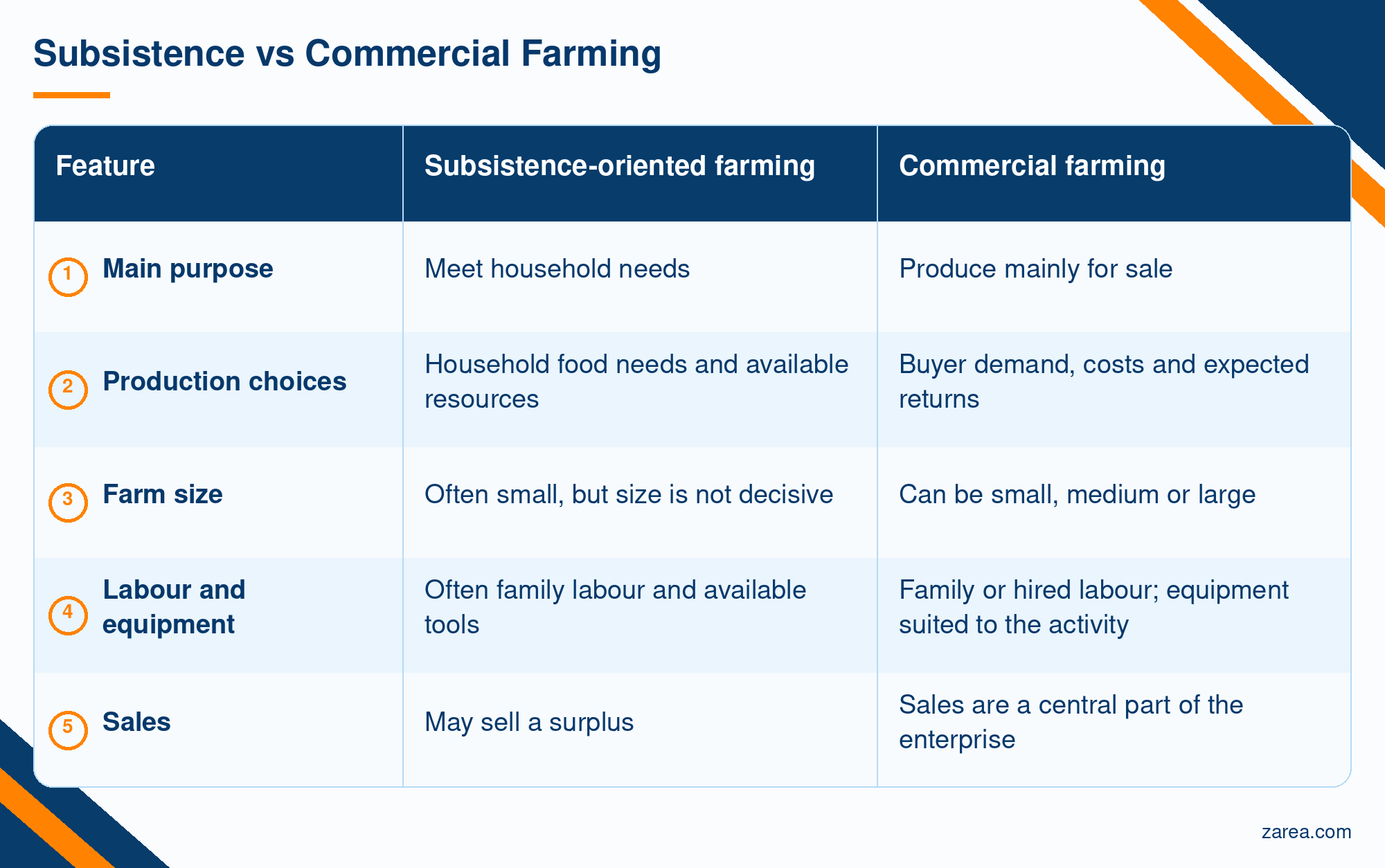
Commercial agriculture versus subsistence agriculture
The main difference is the purpose of production. Subsistence farming primarily supplies the household; commercial farming primarily supplies a market. Many farms combine household consumption with sales, so the distinction is a spectrum rather than a strict boundary.
Common Types of Commercial Agriculture
Six common categories are outlined below. They are useful descriptions, not an exhaustive classification. Commercial poultry, aquaculture and other specialised enterprises also produce for markets.
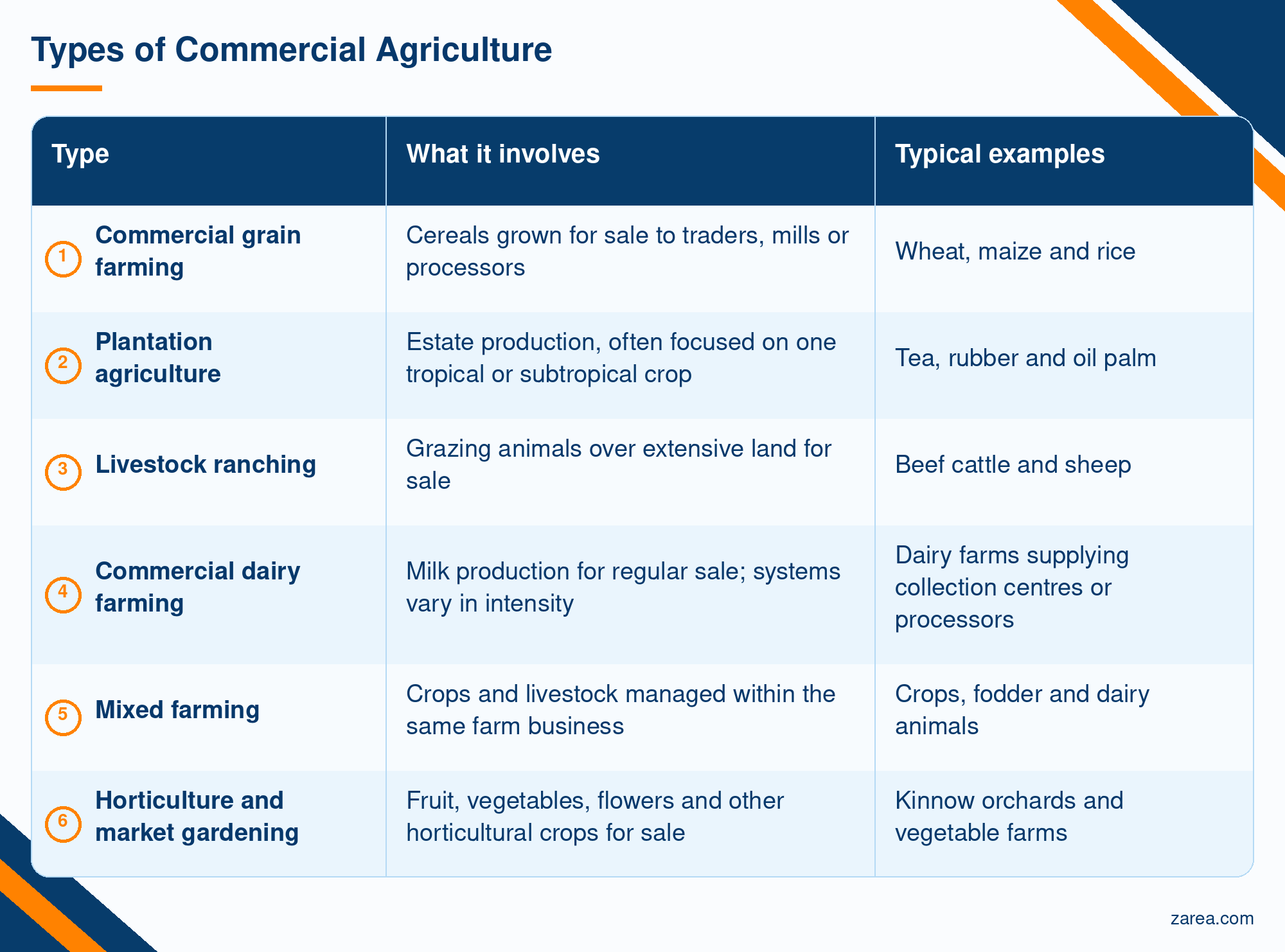
The categories can overlap. A farm that grows wheat and keeps dairy animals may be both a grain and mixed enterprise.
Growing several crops without livestock is crop diversification; it does not, by itself, meet the crops-and-livestock definition of mixed farming used here.
Commercial agriculture examples in Pakistan and worldwide
Pakistan’s farm-to-market chains show how agricultural products become food and industrial inputs. Wheat moves to flour mills, rice to traders and processors, sugarcane to sugar mills, and cotton to ginners and textile businesses.
The connection between cotton growers, ginners, and manufacturers makes cotton and yarn part of a wider commercial supply chain. The products change as they move through processing, but the chain begins with agricultural production.
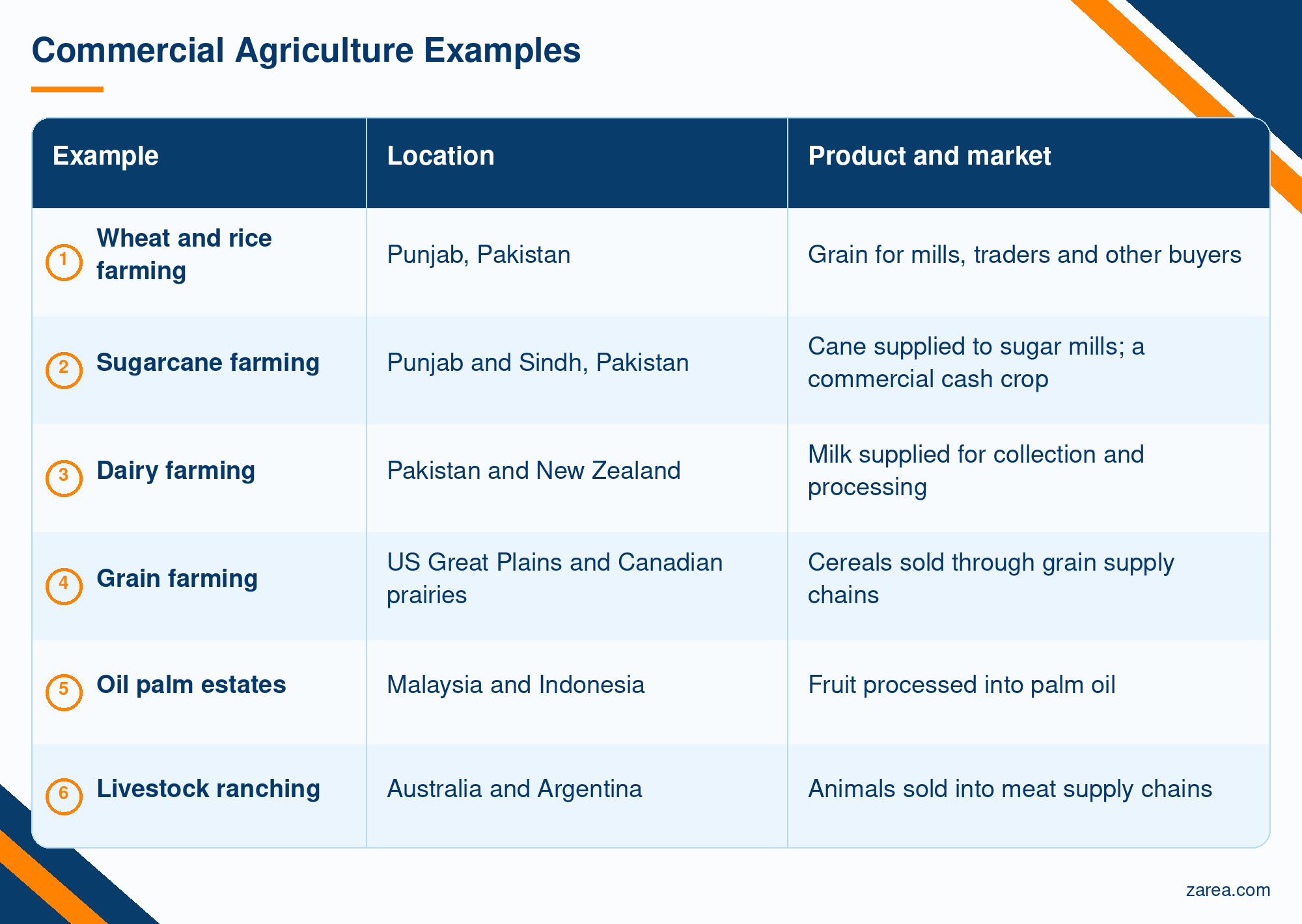
For buyers comparing grains and pulses, crop identity is only the starting point. Grade, moisture, quantity, and delivery location help determine whether two offers are genuinely comparable.
What Pakistan’s Agriculture Statistics Show
The Pakistan Economic Survey 2025–26 agriculture chapter reports agriculture at 23.4% of national GDP and 33.1% of employment. It gives wheat production of about 29.61 million tonnes and livestock’s contribution at 14.6% of GDP. Estimated gross milk production is 74.689 million tonnes, approximately 74.7 million tonnes.
These figures describe the whole agriculture sector, including commercial and subsistence-oriented activity. They do not measure commercial farming separately.
Gross milk production also differs from the amount estimated for human consumption; the survey identifies milk output as an estimate subject to revision.
What are the Benefits and Challenges of Commercial Farming
Commercial farming connects agricultural production with consumers and industry. Its benefits depend on efficient management, suitable production methods, and reliable markets; selling a crop does not automatically make it profitable.
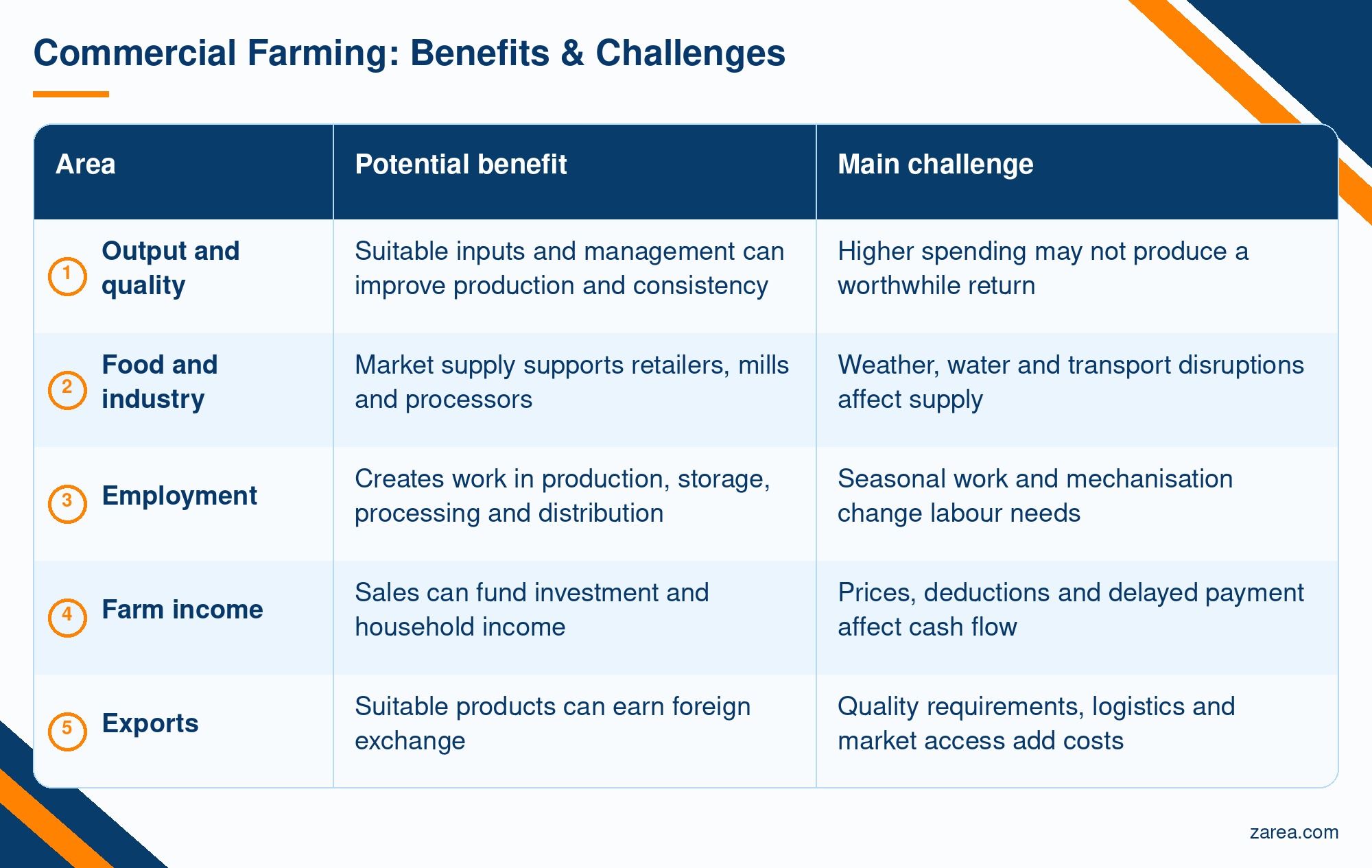
Don't overlook the environmental side. If you over-irrigate, put on more fertilizer than the crop needs, or grow the same crop on the same field year after year, the soil and water take the hit.
Rotating crops, applying only what the field needs, and managing water carefully all help, but what works depends on your land and your climate. And none of this is just a big-farm worry. A two-acre grower faces bad weather, tight money, and soil trouble just like a large estate does.
It's worth checking commodity prices before you sell, since it tells you roughly where the market stands. Just remember the number on screen isn't what ends up in your pocket.
Check the date it was posted, the grade and unit it refers to, and where it applies. Then ask the buyer what they'll deduct, because that's where the real figure gets decided.
How to Calculate Cost Per Maund Before Selling
Cost per maund shows how much it costs to produce a saleable unit. Use the same unit when comparing production costs and buyer prices. In the illustrative calculation below, one maund is treated as 40 kg; confirm the unit used in the actual transaction.
Cost per maund = total costs allocated to the crop ÷ saleable output in maunds.
Illustrative example only: suppose a one-acre crop costs PKR 120,000 to produce, harvest, and deliver, and produces 40 saleable maunds. These are assumed figures for explaining the calculation, not current prices, observed yields, or a forecast.
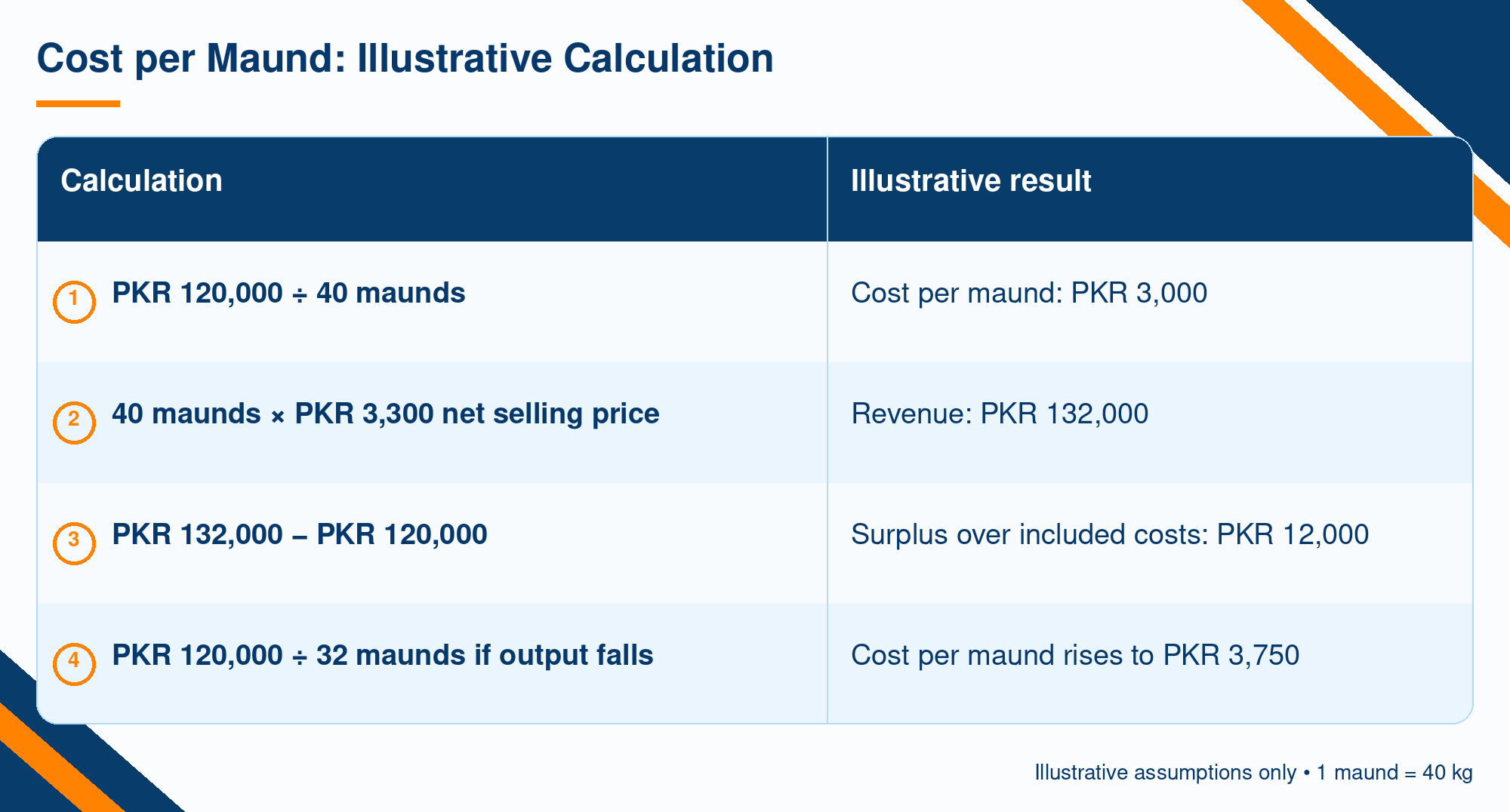
The final row shows why a lower yield can make the same buyer price unprofitable. Include seed, fertilizer, irrigation, labour, rent or land-use cost, finance, harvesting, storage and delivery as applicable.
If costs are omitted, the calculated surplus is not full business profit. Allocate shared costs consistently and avoid counting buyer deductions twice.
How to Compare Two Buyer Offers
Compare net receipts on the same basis, not headline prices alone. Check:
Product specification, grade, moisture, and the quantity accepted.
Whether the quote is per kg, per tonne, or per 40 kg maund.
Who pays for loading, transport, weighing, and storage.
How quality deductions, rejection, and weight disputes are handled.
Payment timing, payment risk, and the cost of waiting.
A business-to-business marketplace can help businesses explore suppliers and trade options. Buyers and sellers still need to confirm specifications, transaction terms, and responsibilities; a platform listing does not by itself establish the suitability of an offer.
How Technology Supports Commercial Agriculture
Precision agriculture is really about treating each part of a field according to what it needs. Farmers do this with GPS guidance, field maps, sensors, and variable-rate equipment.
Dairy farms follow the same idea when they use milk records and monitoring systems to keep an eye on each cow. Which tool makes sense for you depends on your type of farm, how reliable your data is, what your team can handle, and what you can afford.
If you want the bigger picture, FAO's digital agriculture overview shows where digital tools fit in the food system. On your own farm, though, I'd pick one real problem first, like water going to waste or records that never quite add up. Then decide up front how you'll tell whether the tool made a difference.
Crop residue links farms to industry as well. Rice husk, bagasse, and a few other leftovers can feed into agriculture biomass supply chains.
Whether that turns into extra income comes down to what it costs to collect, how dry the material is, what buyers insist on, and how far it has to travel. Before you sell any residue, ask yourself two things: does the soil need that cover, and will you want it for fodder?
Frequently asked questions
Can a small farm be commercial?
Yes. A small farm is commercial when production is organised mainly for sale. A vegetable plot supplying retailers or a small dairy supplying a collection centre can operate commercially without owning extensive land or heavy machinery.
What is another name for commercial agriculture?
Commercial farming and market-oriented farming are commonly used terms. Cash-crop farming refers specifically to crops grown for sale. Agribusiness is broader and can also include input suppliers, processors, traders, and distributors.
Does commercial agriculture mean export farming?
No. Commercial farms can sell into local, national, or export markets. A grower supplying a nearby mill or vegetable market is producing commercially even when none of the harvest is exported.
Is commercial farming always more profitable?
No. Profit depends on saleable output, total costs, net prices, and payment terms. Machinery or a larger farm can change efficiency, but neither guarantees profit. A budget should account for possible changes in yield and price.
Wrap Up
Commercial agriculture is farming done mainly to sell. A market garden, a dairy, a grain farm, a cattle ranch and a tea estate all count, even though they need very different amounts of land, labour and money. What matters is who the farm is producing for. Size isn't the test.
If you grow or buy in Pakistan, a few things are worth settling every season. Know exactly what you're selling. Work out what one saleable unit costs you. Compare every offer the same way.
Then agree on delivery and payment before anything moves. That's what turns good farming into a business that pays.