Subsistence Farming: Definition, Key Features, and Main Types
What subsistence farming actually means, its key features, the four main types practiced worldwide, and real examples from different regions.
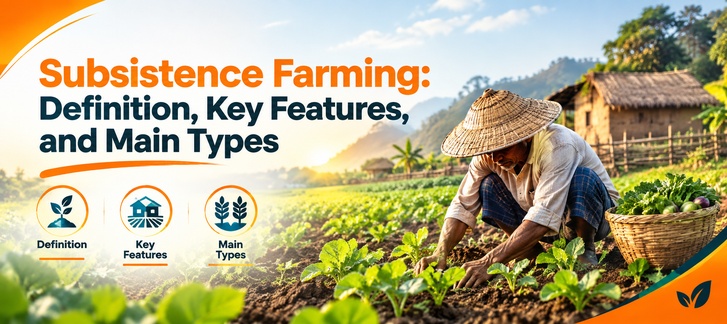
Most of us picture farming as big fields, tractors, and trucks hauling grain off to a mill; that's commercial farming. Subsistence farming is the older, quieter version that still feeds a huge share of the world's rural population, and it runs on a completely different logic.
A subsistence farmer isn't growing food to sell. They're growing it because that's what gets the household fed, and the animals looked after until the next harvest comes around, and if there's anything left after that, maybe it goes to market, maybe it doesn't.
It's still a massive part of global agriculture too, especially across Africa, South Asia, and Southeast Asia, and honestly it shapes a lot more than people realise: how land gets divided up, what actually gets planted in a given region, even how a village organises itself.
So that's what this piece gets into: what subsistence farming really means, what defines it, the main types you'll find practiced around the world, and where it's still very much alive today, Pakistan included.
Subsistence Farming Definition
Strip it down, and subsistence agriculture is just farming done to feed the farmer's own household rather than to turn a profit. There's no yield target aimed at a buyer somewhere; the whole point is having enough food to get through the year.
If something's left over once the family and the animals are fed, it might get sold or traded locally, but that's really a side effect, not the reason anyone's out there farming in the first place.
Put it next to commercial farming and the contrast is stark. Commercial operations plan everything around sellable output: what to plant, how much land to use, what equipment's worth buying. Subsistence farming was never built around that question at all.
Key Features of Subsistence Agriculture
A few things show up again and again on subsistence farms, no matter which country you're looking at.
Small landholdings. Usually just a few acres, worked by one family rather than hired hands.
Household consumption comes first. What gets planted depends on what the family actually eats, not what would sell best at market.
Heavy on labour, light on machinery. Most of the work still gets done by hand or with basic tools, since there's rarely spare money for equipment.
Not much in the way of fertiliser or improved seed. Those things cost money a subsistence household often just doesn't have.
Little surplus, and what there is comes irregularly. Most of what's grown gets eaten. Nobody's planning around a surplus that may or may not show up.
Completely exposed to local weather. No irrigation system or insurance to fall back on means a bad rainy season hits a subsistence household directly, in a way a commercial farm with a diversified supply chain usually rides out.
The Main Types of Subsistence Farming
Geographers tend to sort subsistence agriculture into four main categories, and which one shows up in a given place usually depends on the climate, the terrain, and how many people are actually living off that land.
1. Shifting Cultivation
Sometimes called slash-and-burn farming. A patch of forest gets cleared, farmed for a few years until the soil's worn out, then abandoned so it can recover while the farmers move on to a new patch.
You'll still find it across parts of tropical Africa, South America, and Southeast Asia, though it's been losing ground for years now as land gets taken over for logging, ranching, or cash crops instead.
2. Pastoral Nomadism
There's no farming involved in this one at all, just animals. Herders keep cattle, goats, sheep, sometimes camels depending on where they are, and they don't stay put. They follow the grass, basically, packing up and moving on once an area's grazed down and the season starts to turn.
You'll find this way of life across North Africa, Central Asia, and much of the Middle East, in places dry enough that crops just won't take, but where animals can still get by, provided someone keeps them on the move.
3. Intensive Subsistence Farming (Wet Rice)
This is the one pulling the most weight when it comes to actually feeding people, and it's centered mainly in East, South, and Southeast Asia. The plots themselves aren't big by any stretch, but farmers wring everything they can out of them, sometimes managing two harvests off the same ground in a single year.
When people picture this kind of farming, it's usually the wet rice paddy that comes to mind, rows of workers bent over the water, transplanting and harvesting by hand, on land that would look almost comically small next to a typical Western farm.
4. Intensive Subsistence Farming (Non-Rice)
This works the same way, small plots, long hours, hardly any machinery, except the crop changes when rice isn't an option. So farmers grow wheat, barley, maize, or pulses instead, whatever the local climate allows. You see a lot of this across the drier belts of South Asia, and honestly, a good portion of rural Pakistan fits this description.
Subsistence Farming Examples Around the World
Reading about this stuff is one thing. Actually pointing to it on a map is more interesting.
Amazon basin and Congo basin: Shifting cultivation is still keeping people fed here.
Mongolia, the Sahel, and parts of the Arabian Peninsula: Pastoral nomadism hasn't gone anywhere; herders are still moving livestock the way they always have.
Indonesia, Vietnam, and much of India: Wet rice farming remains central to daily life.
Pakistan: Smallholders across interior Sindh, southern Punjab, and pockets of Khyber Pakhtunkhwa grow wheat, maize, and pulses mostly to keep their own households fed. Whatever's left after a good harvest gets sold, and in a bad year, there isn't much left to sell at all.
Worth pointing out: true subsistence farming, the kind where literally nothing gets sold, barely exists anymore. Almost every smallholder today is doing some version of subsistence-plus: feed the family first, and if the season's kind, sell whatever's left over.
Subsistence vs. Commercial Farming: The Real Differences
From Household Plots to the Wider Supply Chain
Here's a part that doesn't get talked about enough. Even farmers who'd tell you they're growing food purely for their own household usually still touch the wider market more than the textbook definition lets on, mostly through two things: seed and surplus.
More smallholders are buying improved or hybrid seed these days instead of saving their own from last year's crop, simply because better seed tends to mean a noticeably bigger yield off the same small plot.
Zarea seed fits right into that shift, giving smallholders access to seed stock that's often a step up from what they'd otherwise save themselves.
And when a subsistence household ends up with grain or pulses left over after a decent season, that surplus doesn't just sit in storage; it flows into the same commodity channels commercial farmers use, just in smaller volumes.
Grains and pulses and broader agriculture and biomass categories track exactly this kind of produce: the staples that subsistence and semi-subsistence households across Pakistan grow, eat, and now and then sell into the wider market.
Frequently Asked Questions
What is another name for subsistence farming?
It's most commonly just called subsistence agriculture; people use the two terms interchangeably. You'll also sometimes see it called self-sufficiency farming, since the whole idea is producing enough to cover the household's own needs rather than to sell.
What is the best definition of a subsistence crop?
A subsistence crop is basically anything grown mainly to feed the farmer's own family or livestock, not to sell. Wheat, maize, rice, and pulses come up again and again in this context, and that's not really a coincidence.
They're filling, they keep well in storage, and they're staples in the local diet, which counts for a lot more here than whatever they might fetch at the market.
What are the differences between subsistence and commercial farming?
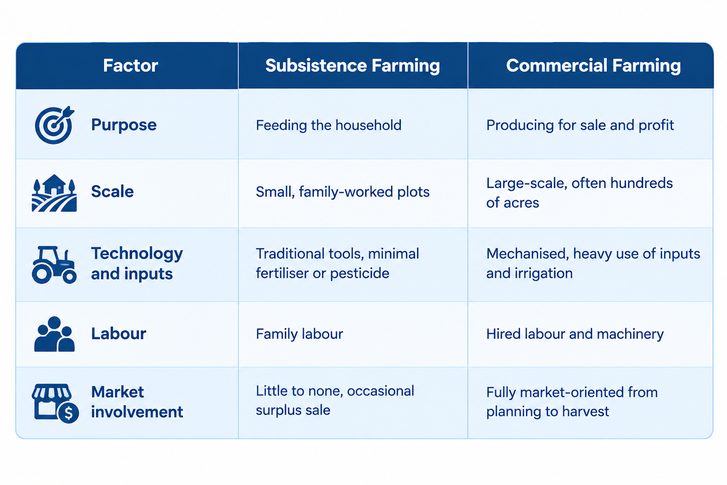
It really comes down to purpose, scale, and how much the market's actually involved. Subsistence farming stays small, family-run, and focused on feeding the household, with barely any mechanisation and little reason to interact with a market at all.
Commercial farming is the opposite end of things, large-scale, mechanised, built entirely around producing for sale, and leaning hard on inputs like fertiliser and irrigation to push yield as high as it'll go.
What are the four types of subsistence farming?
There's shifting cultivation, pastoral nomadism, and then intensive subsistence agriculture, which actually splits into two versions of its own, one centered on wet rice, the other on crops like wheat or maize for places where rice simply won't grow.
Which of these you'll actually find in a given region mostly comes down to the local climate, the terrain, and how many people are packed onto that land.
Wrap Up
Subsistence farming isn't some relic sitting in a history textbook; it's still how a huge share of the world's rural population actually eats, whether that's shifting cultivation deep in a tropical forest or wheat and pulse farming across rural Pakistan.
And once you see how often it blends into the wider commercial supply chain, through a seed purchase here, a surplus sale there, the whole picture of global agriculture looks a lot less like two separate worlds and a lot more like one continuous spectrum.