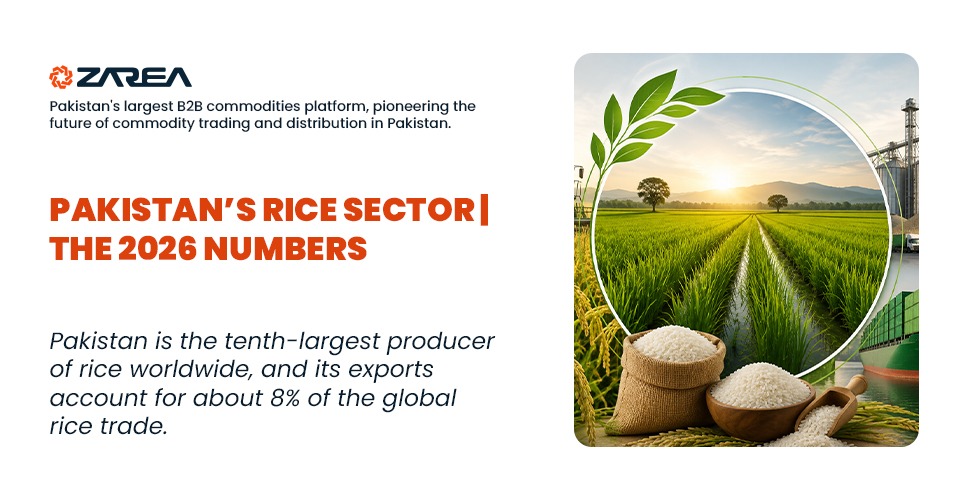
Pakistan’s Rice Sector | The 2026 Numbers
A complete look at Pakistan's rice industry, from Punjab and Sindh's paddy fields to Basmati exports, pricing factors, and digital B2B commodity trading.
Pakistan Rice: Inside the Global Supply Chain:
Rice isn't just food on the table in Pakistan. It's one of the country's largest agricultural exports and the backbone of a supply chain that runs through farmers, mills, traders, exporters, freight companies, and buyers scattered across the globe.
The story starts in the paddy fields of Punjab and Sindh, but it doesn't end there. Basmati rice has built a strong reputation in premium markets abroad, while non-Basmati varieties keep Pakistan competitive in the high-volume, price-sensitive segments many exporters actually rely on for steady business.
None of this happens in isolation. Rainfall, water availability, yields, grain quality, currency swings, freight rates, and shifting overseas demand all play a part in how competitive Pakistani rice ends up being in any given season.
So where does the industry stand right now? Where is the rice grown, where does it go once it leaves the country, and what should buyers and traders actually be watching? That's what this guide walks through.
Read More: Pakistan's rice exports fall
Why Rice Matters So Much to Pakistan's Economy:
Rice is one of Pakistan's most important agricultural commodities, and its role goes well beyond farming. Once the crop leaves the field, it passes through drying, milling, grading, packaging, storage, trading, and finally export, covering types of commodities and supporting its own set of businesses and jobs at each stage.
That's why a shift in rice production doesn't just affect farmers. It ripples out to millers, transporters, packers, and exporters too, since all of them depend on a steady flow of paddy coming in.
Prices move depending on variety, quality, location, season, and how tight or loose supply happens to be at the time. Businesses sourcing rice regularly tend to keep an eye on current rates, and rice prices in Pakistan page is one place to check them as part of routine market research.
Where Rice Is Actually Grown:
Punjab and Sindh do the heavy lifting here. Punjab is closely tied to Basmati production, while Sindh contributes significantly to the country's non-Basmati supply and remains an important growing region in its own right.
Irrigation access, soil quality, temperature, and general growing conditions are what make these two provinces so central to the crop. And rice farming doesn't stop at the field boundary either. It generates demand for seed, fertiliser, machinery, transport, and storage services, which is part of why rice stays such an important commodity for businesses well beyond agriculture itself.
Basmati Rice - Pakistan's Signature Export:
Ask most people about Pakistani rice and Basmati is usually the first thing that comes up. Its aroma, long grain, texture, and cooking qualities have earned it a solid place in premium international food markets.
But Basmati isn't just about grain length, and treating it that way undersells how much buyers actually scrutinise before they commit to an order. Serious buyers look closely at:
• Grain quality
• Broken grain percentage
• Moisture content
• Purity
• Aroma
• Processing quality
• Packaging
• Origin
• Consistency from one batch to the next
For exporters, consistency is arguably the hardest one to get right, and also the one that matters most. International customers expect each shipment to meet the exact specification they agreed to, not something close to it.
Non-Basmati Rice - The Volume Business:
Basmati gets most of the attention, but it isn't the whole story. Non-Basmati rice is a major part of Pakistan's export trade, and it serves a different kind of buyer, one looking for competitive pricing and reliable bulk supply rather than a premium aroma.
Having multiple varieties on offer gives exporters more room to manoeuvre when international demand shifts. It also means the real question for bulk buyers isn't simply "what's the price of rice?" It's what variety, quality, specification, quantity, and delivery terms are actually built into that price. That distinction is exactly where supplier quotations start to look very different from one another once you compare them side by side.
From Paddy Field to Port - How the Rice Actually Moves:
A lot happens between a farmer planting seed and a container leaving Karachi port. Roughly, it breaks down into six stages.
1. Cultivation
Farmers plant according to regional conditions, water availability, seed variety, and whatever farming practices work best in that area.
2. Harvesting
Once the crop matures, harvesting begins, and timing here has a real effect on both grain quality and how much is lost in the process.
3. Drying and Storage
Freshly harvested rice needs proper handling right away. Moisture management in particular can make or break the quality of the final product.
4. Milling and Processing
Milling strips the husk and processes the grain to spec, often followed by additional sorting and grading before it's packaged.
5. Trading
From here, rice passes through traders, wholesalers, exporters, and other commercial buyers before reaching its next stop.
6. Logistics and Export
Finally, the product is transported to its destination through domestic and international logistics networks. Every one of these six stages adds cost, and together they shape the price the end buyer actually pays.
Where Does Pakistani Rice Go?
Pakistani rice reaches a wide range of international markets. The Middle East remains a key destination, especially for Basmati, while Europe, Asia, and Africa all take meaningful volumes too. The diversity of the rice variety in Pakistan plays a role in determining which markets different types of rice can serve, depending on variety, price, quality expectations, and local consumption habits.
Export markets aren't fixed, either. A destination that's strong one season can cool off the next if prices move, regulations change, freight costs rise, or a competing supplier undercuts on price. That's exactly why exporters need more than production capacity to succeed. Reliable market information and a genuine read on international demand matter just as much.
What Actually Moves Pakistan Rice Prices
There's no single lever that sets the price of rice. It's a combination of several moving parts.
Crop Production
A bigger harvest loosens supply; a weaker one tightens it and pushes prices upward.
Domestic Demand
Local consumers, food businesses, wholesalers, and processors all compete for the same supply that could otherwise go to export.
Export Demand
When demand climbs in major importing countries, that pressure feeds straight back into the domestic market.
Quality and Variety
Premium varieties and tighter specifications generally command different pricing than standard bulk rice.
Currency Movement
Exchange rate swings affect how competitive Pakistani rice looks abroad and change the economics of every export deal.
Transportation and Logistics
Getting rice from farms and mills to warehouses, ports, and buyers costs money at every step, and that cost shows up in the delivered price.
Government and Trade Policies
Export regulations, import requirements, duties, and food safety rules can all shift trade flows with fairly little warning.
Given all of that, businesses comparing rice prices are better off looking well past a single quotation.
Why One Quotation Rarely Tells the Whole Story:
A buyer working from a single rice quotation only has one data point to go on. A buyer who checks multiple suppliers, reviews the exact specification, looks at current market conditions, and understands the delivery cost is working with a far better basis for a purchasing decision.
That matters even more on large orders. A small gap in the per-kilogram price can turn into a serious number once the order runs into several tonnes.
Daily commodity prices page is built for exactly this kind of check. The grains and pulses section covers rice alongside wheat, maize, barley, and pulses, so buyers can see how one commodity is moving relative to others.
For a wider view, commodity market analytics brings together trade data and broader market information that goes beyond day-to-day pricing.
For a wider view, commodity market analytics brings together trade data and broader market information that goes beyond day-to-day pricing.
How Digital Trading Is Changing Pakistan's Rice Supply Chain:
Commodity trading in Pakistan has traditionally run on personal relationships, phone calls, local dealers, and back-and-forth price negotiation. That's still true today, and those relationships aren't going anywhere. But digital tools are starting to make the process considerably easier to manage.
A B2B marketplace can pull supplier discovery, product information, quotations, and procurement into one structured environment instead of scattering them across calls and messages. Zarea positions itself as a digital platform connecting buyers and sellers of commodities, letting users register and verify their business, browse commodities, request quotes, transact, and manage payment and delivery from one place. For businesses sourcing agricultural commodities, that structure removes a good chunk of the friction that traditional procurement tends to carry.
Rice Byproducts Worth Knowing About:
The rice industry produces more than just the finished grain. Rice husk, rice straw, and rice polish all carry commercial value of their own.
Rice husk, a byproduct of milling, gets used in biomass energy, industrial applications, and agriculture. Rice polish, meanwhile, is a common ingredient in livestock and poultry feed and is available for bulk commercial orders.
Put together, these byproducts show the rice supply chain doesn't stop at the finished grain. Processing generates additional commodities that feed into agriculture, energy, animal feed, and industrial markets.
Challenges Still Facing the Industry:
Water and Climate
Rice cultivation is water-intensive, which makes water availability and unpredictable weather an ongoing concern for growers.
Quality Consistency
Export buyers expect specifications to hold from shipment to shipment. Differences in grain quality, moisture, impurities, or processing chip away at buyer confidence fast.
Supply Chain Costs
Transportation, storage, handling, milling, and export logistics all feed directly into how competitive the final price actually is.
International Competition
Pakistan isn't the only major rice exporter in the market, and price alone won't keep buyers loyal. Quality, reliability, service, and delivery all factor into the decision too.
Market Volatility
Commodity prices can shift quickly. Businesses working off outdated quotations risk making procurement calls based on numbers that no longer reflect the current market.
Where the Opportunity Lies:
Growth from here depends less on producing more rice and more on strengthening the supply chain around it. The clearest opportunities include:
Improving crop productivity and resource efficiency
Maintaining consistent rice quality across shipments
Modernising milling and storage infrastructure
Improving visibility across the supply chain
Expanding into new export destinations
Building stronger, longer-term relationships with international buyers
Using market data to sharpen procurement and pricing decisions
Increasing the commercial value of rice byproducts
Technology has a role to play across most of this list, particularly around market information, supplier discovery, procurement, and logistics. Zarea's current offering includes logistics support, trade services, import and export solutions, and data analytics built specifically around B2B commodity transactions.
Looking Ahead for Pakistan's Rice Industry:
Pakistan's rice industry has already built a solid connection between local agriculture and international markets. The next stage is about making that connection run more efficiently, not necessarily bigger.
Farmers need reliable markets to sell into. Traders need accurate information. Buyers need consistent quality at competitive prices. Exporters need efficient logistics and a real line of sight into international demand. Digital B2B platforms can pull several of these pieces into a more connected procurement process than the industry has traditionally relied on.
For businesses trading in rice, the real opportunity isn't just buying and selling more of it. It's making better decisions about what to buy, when to buy it, who to buy it from, and where to sell it on.
Final Thoughts:
Pakistan's rice trade runs from agricultural fields in Punjab and Sindh all the way to buyers scattered across the world. Basmati gives the country a recognised premium product, while non-Basmati varieties open up opportunities in broader, more price-driven markets.
Throughout all of it, prices and export competitiveness keep coming back to the same set of factors: production, quality, demand, currency movement, logistics, and overall market conditions.
For businesses operating in this space, better market information and tighter procurement can make a real difference to the bottom line. Ultimately, the future of Pakistan's rice industry will hinge not just on how much rice the country grows, but on how efficiently that rice moves from farm to mill, mill to market, and market to the world.
Frequently Asked Questions:
What is Pakistani rice known for?
Pakistan is best known for Basmati rice, prized for its aroma, long grain, texture, and cooking qualities. The country also grows and exports significant volumes of non-Basmati rice.
Where is most rice grown in Pakistan?
Punjab and Sindh are the two major rice-producing provinces, with Punjab particularly known for Basmati production.
Where does Pakistan export rice to?
Pakistani rice goes to markets across the Middle East, Europe, Asia, Africa, and beyond, with the importance of each market shifting based on variety, demand, pricing, and trade conditions.
What affects the price of rice in Pakistan?
Rice prices are shaped by crop production, domestic and export demand, variety, quality, exchange rates, transportation costs, storage, and government trade policy.
Why is Basmati rice so important to Pakistan?
Basmati holds a strong position in premium international markets thanks to its distinctive aroma, long grain, and cooking quality, giving Pakistan a recognisable, higher-value export product.
How can businesses keep track of rice prices?
Businesses can compare supplier quotations and check current market data. Rice market prices page provides up-to-date commodity pricing for rice alongside other grains and pulses.
References:
Wikipedia: Rice Production in Pakistan
Saremco: The Rice Cultivation in Pakistan