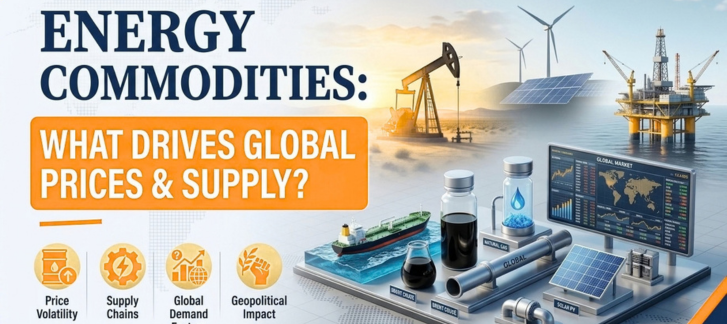
Energy Commodities: What Drives Global Prices and Supply?
Discover the primary forces shaping energy commodities. Learn how global supply, geopolitical events, and structural demand shifts drive market prices.
Introduction:
Every time you flip a light switch. Or you fill up your car's gas tank. Or you can order a product online. You are participating in a massive and invisible global dance. At the center of this dance are the energy commodities that are involved in it. These are the raw power sources that fuel human progress and cross-border trade. While these sources are also used in industrial output as well.
But what exactly are these resources? Why do their prices change so quickly? What forces dictate how they move across the globe? Let’s pull back the curtain on the world's most vital financial complex.
Different Types of Energy Commodities:
To understand how the global market operates, we must first break down the physical fuels that power our world. The energy complex is fundamentally split into two main buckets: traditional fossil fuels and clean transition assets. These are includes as types of commodities as well.
1) Crude Oil: The ultimate heavy hitter. Brent crude is often called "black gold." Because crude oil is the most heavily traded commodity on Earth. It is split into regional benchmarks. So primarily it is called West Texas Intermediate (WTI) in the US and Brent Crude in the international market. It is refined into everything from standard gasoline to aviation fuel and plastics.
2) Natural Gas: Natural gas is also called a bridge fuel. This commodity is highly favored for electricity generation and industrial manufacturing. Meanwhile it is also used for residential heating in some regions. Natural gas is priced regionally through hubs like Henry Hub in America and TTF Hub in Europe.
3) Coal: The legacy giant. While being phased out in many Western economies, thermal coal remains an anchored, foundational baseline for power generation in rapidly developing nations across Asia.
4) Uranium: Uranium is a zero-emission catalyst. Because uranium is the highly concentrated chemical input required for nuclear fission reactors. While it's also seen as a massive global resurgence. Because some countries seek it as reliable and carbon-free baseload power source.
5) Renewables & Alternative Inputs: This growing sector includes biofuels (like ethanol and biodiesel) and some other power infrastructure inputs. While electricity itself can be traded via regional futures, the raw materials behind green tech are quickly reshaping the asset class.
You can also explore our most traded top 5 commodities blog as well, if you want toknow more about commodities.
Transition & Alternative Energy Commodities:
As the global energy transition accelerates, secondary energy assets and structural environmental credits are becoming highly integrated into corporate commodity trading portfolios.
1) Electricity Future: We must render our power directly. This is because it's a trading asset that is based on megawatt-hours (MWh).
2) Biofuels: This includes Ethanol and Biodiesel. This may also include some fuels that are derived from corn or sugarcane and blended into retail gasoline.
3) Carbon Offsets / Allowances: Rather than physical fuels, some are strictly financial mechanisms that include them. Especially tools like EU Carbon Permits which work differently. These tools are traded as compliance commodities to cap greenhouse gas emissions.
Primary Price Drivers of Energy Commodities:
The value of energy commodities is intrinsically linked to four overarching structural forces:
1) Geopolitical Risk: Pipelines, shipping channels (e.g., Red Sea corridors, Strait of Hormuz), and conflicts involving key producers inherently dictate market premium risk.
2) Weather Seasons: Colder-than-expected winters spike natural gas and heating oil demand, while extreme summer heat creates high electricity load requirements for cooling systems.
3) Macroeconomic Output: Heavy manufacturing, infrastructure investment, and cross-border shipping directly alter consumption patterns for crude oil and industrial coal.
4) Storage Dynamics: Weekly inventory updates (such as those from the U.S. Energy Information Administration) report whether supply buffers are expanding or depleting.
What Is The Role Of Energy Commodities?
So, what are energy commodities in the context of the global economy? Beyond being raw physical matter, they serve as the underlying foundation for financial stability and corporate planning.
First of all, these commodities act as the universal denominator of production costs. For example, when oil or electricity spikes. Then the cost of manufacturing a smartphone rises. Same as the shipping cost of a container across the Pacific rises. While keeping a grocery store cold goes up instantly as well.
Second, they are a vital playground for the financial markets. Trading on massive international exchanges like NYMEX and ICE Futures Europeans can react. Because their energy contracts allow producers (like oil drillers) to lock in prices safely. While they also allow institutional investors to hedge against inflation. In simple terms, these energy commodities turn chaotic and unpredictable natural resources into structured. Therefore tradeable assets that keep the global supply chain or commodity chain could be immediately operational.
What are the Main Global Energy Trends?
The energy landscape is currently undergoing its most radical transformation since the Industrial Revolution. If you want to understand where prices are going, you have to watch these overarching trends:
1) The Dual-Track System: The world is caught in a fascinating Balancing Act. While trillions of dollars are pouring into wind, solar, and battery storage infrastructures. Therefore, the absolute demand for traditional fossil fuels like natural gas and oil continues to reach record highs. The transition is proving to be the addition of new energy sources rather than an immediate replacement for the old ones.
2) Geopolitical Fragmentation: Energy security has become a national security now and so on. Ever since regional conflicts disrupted the Russian pipeline's gas supply to Europe. So it could create bottlenecks in the Strait of Hormuz and Red Sea shipping lanes as well. Therefore those countries that are prioritizing localized energy independence and friend-shoring will divert their fuel supplies.
3) The Nuclear Renaissance: Nuclear power is no longer on the back burner of any country. Public and political sentiment has shifted dramatically. Heavy investments in Small Modular Reactors (SMRs) and massive life-extensions for existing nuclear plants are driving intense structural demand for uranium.
How Does Market Growth Impact Energy Demand?
Energy appetite is directly tied to global economic growth and technological advancement. Because millions of people enter the middle class and lead to a massive surge in commercial transit. Same as emerging economies expand with urbanization. Moreover residential power grid connections also expand with them.
However, the newest and most aggressive driver of energy demand isn't heavy manufacturing—it is computing power. Artificial intelligence's rapid expansion and cloud computing always require power. Therefore, hyper-scale data centers also require an astonishing amount of continuous and non-fickel electricity. This structural shift is forcing tech giants and utility companies to sign massive energy agreements. While long-term power purchase agreements and fundamentally alter local natural gas and nuclear power allocations require the same. When the broader market grows, its digital footprint demands a physical power surge.
What Drivers Control Global Prices and Supply?
If you look at an energy price chart, then you see it often looks like a roller coaster. Because four powerful and intersecting forces drive that volatility. You must contact commodity broker, if you want to trade in these goods.
1) OPEC+ Interventions: The Organization of Petroleum Exporting Countries OPEC (plus allies like Russia) is intervening in in global supplies. Thus this organization controls a massive share of the world's oil reserves. Therefore their coordinated decisions to cut or increase production can artificially alter global supply overnight.
2) The Weather Factor: Energy markets are completely at the mercy of meteorology or weather factors. Because a scorching summer spikes electricity demand especially for your air conditioning. While a freezing winter depletes natural gas storage reserves which can cause rapid price spikes.
3) Infrastructure Bottlenecks: It doesn't matter how much oil or gas is in the ground if you can't move it. Therefore ship channel disruptions instantly create localized price spikes and global supply pinches. For example, you can see the straight on Hormuz blockade and its effects on global fuel prices these days. Whereas some factors like pipeline constraints and refinery outages also do the same job.
4) Macroeconomic Health: During economic downturns or high-interest-rate environments. Where industrial manufacturing slows down and corporate travel also drops with it. Therefore overall consumption falls which drags commodity prices down with it.
Wrap Up:
The world of energy commodities is ultimately a living one. Therefore, it is a breathing ecosystem where political decisions are made. When you talk about the Middle East or a heatwave in Texas they create huge energy demand. Where a new data center build-out in Asia can instantly trigger a butterfly effect across global financial markets. As we move deeper into the energy transition. The same thing is the energy demand and vice versa. So understanding how these traditional and alternative assets interact is the key. Because this key is to navigating global trade future.
FAQ's:
What is an energy commodity?
An energy commodity is a raw material used to create power. While it is also a physical resource that creates heat or fuel which is bought. Additionally this commodity can also be sold and traded on global markets as well.
Common Energy Commodities
Crude oil: Crude oil is the most heavily traded global liquid fuel.
Natural gas: While natural gas is widely used for residential heating and electricity purposes as well.
Coal: Therefore, coal is a solid fossil fuel that powers industrial generation.
Electricity: Same as electricity, a secondary power distributed source that directly runs through our grids.
Renewables: Some renewable sources are emerging markets. These markets deal with solar, wind, and biofuels.
What are 5 examples of commodities?
Crude oil, gold, wheat, natural gas, and copper are five major examples of the most traded commodities.
5 Common Examples
Crude Oil: Crude oil is an energy commodity used to make polymers, gasoline, and diesel. Additionally, it is among the most traded materials worldwide.
Gold: Often used in jewelry, gold is a valuable metal. Additionally, some people use it as a safe-haven asset or as a financial investment. It is also utilized in various gadgets.
Wheat: Grown in fields, wheat is a soft agricultural crop. However, it's also used to prepare staples like pasta and bread.
Natural Gas: Extracted from the soil, natural gas is a source of energy. However, it is utilized for cooking, electrical generation, and building heating.
Copper: A valuable industrial base metal, copper is valued for its extensive use in the wiring, plumbing, and construction sectors.