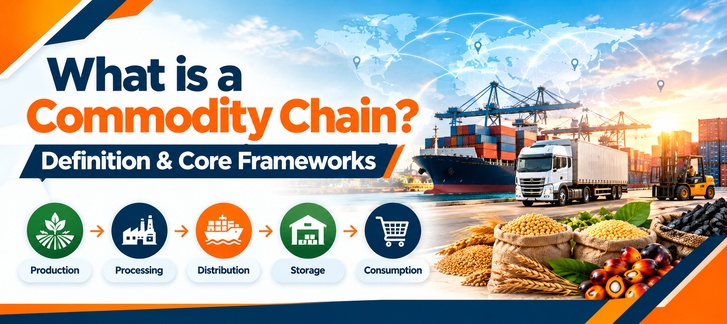
What is a Commodity Chain? Definition & Core Frameworks
What is a commodity chain? Discover its definition, core stages, and frameworks, plus how producer and buyer-driven chains shape today's global economics.
Introduction:
A product rarely travels from a farm or factory directly into a consumer's hands.
A bag of wheat may begin with a farmer planting seed, move through harvesting and storage, pass to traders and processors, travel across borders, and eventually become flour, bread or another finished product. Behind that journey is a complex network of economic activities known as a commodity chain.
But what is a commodity chain? Why does the commodity chain matter?
Understanding commodity chains helps you explain many things. How do raw materials move through the global economy? How the value of the chain created at different stages? Why events in one country influence commodity prices?
Why does this chain connect businesses to consumers somewhere else?
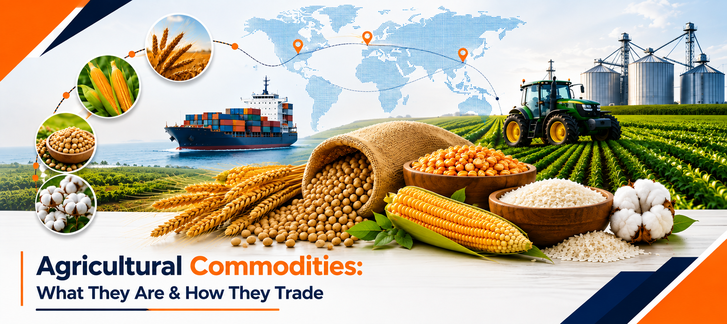
Whether you talk about agricultural commodities such as wheat, rice and cotton. Or whether you talk about energy resources and industrial raw materials? Commodity chains connect every field to each other. This includes producers, traders, manufacturers and distributors to consumers across borders.
What Is a Commodity Chain?
A commodity chain is the interconnected series of activities involved in producing, processing, distributing and consuming a commodity.
It follows a product through different stages of its economic journey.
A typical commodity chain may include:
Raw material → Production → Collection → Processing → Trading → Transportation → Distribution → Consumption
For an agricultural commodity, the chain may start with a farmer and end with a consumer purchasing a finished food product.
At each stage, the commodity can gain additional economic value.
For example, wheat harvested from a farm has one value. After cleaning, storage, milling and transportation, the resulting product can have significantly greater commercial value.
Commodity chains therefore help us understand not only where a product comes from, but also how it becomes valuable.
Why Do Commodity Chains Matter?
Commodity chains matter most in the modern era. Because modern economies and this chain are interconnected with each other.
Consumers often see only the final product, but they don't see the chain behind it. While the production networks behind it may involve dozens of companies in multiple countries.
Therefore understanding these connections is very important for several reasons.
1) They Connect Producers With Markets
Commodity chains allow farmers to reach domestic and producers to reach international buyers.
For example a wheat farmer may sell grain to a trader or processor. Rather than selling directly to the final consumer.
2) They Create Economic Value
Whether it's the storage or transportation process. Or the processing and packaging process. Or the most important ones the financing and distribution process. These are participants in different categories that add value to this chain.
Therefore the price paid at the final stage reflects much more than the original production cost.
3) They Support Global Trade
International commodity chains allow countries to specialize in producing resources. Or also allows products on which they have advantages. Because these products are traded with other economies.
4) They Create Employment
The commodity chains generate jobs across agricultural fields. This may include manufacturing, logistics, warehousing, trading and retailing like fields.
5) They Influence Prices
A disruption at one point in the chain can affect prices throughout the network.
A poor harvest, transportation disruption, export restriction or sudden increase in demand can influence commodity availability and prices far beyond the original location.
Commodity Chain Example - From Wheat Field to Consumer:
Commodity Chain Example: From Wheat Field to Consumer
A simple commodity chain example can be found in wheat.
Imagine a farmer growing wheat.
1) Production
The farmer purchases seed, fertilizer and other inputs before planting the crop.
The wheat grows and is eventually harvested.
2) Collection and Storage
After harvesting, the grain may be transported to a local buyer, warehouse, grain elevator or storage facility.
Proper storage helps maintain grain quality and reduces post-harvest losses.
3) Trading
A trader or commodity buyer may purchase the wheat and sell it to a processor, mill or larger commercial buyer.
At this stage, transportation and market information become particularly important.
4) Processing
A flour mill processes the wheat into flour and other products.
The raw agricultural commodity has now been transformed into a processed food ingredient.
5) Manufacturing
Food manufacturers can use the flour to produce bread, biscuits, pasta and other products.
6) Distribution and Retail
Finished products move through distributors, wholesalers and retailers before reaching consumers.
The journey that began with a seed in the soil can therefore end with a packaged product on a supermarket shelf.
This is the basic logic of a commodity chain.
Commodity Chains vs Supply Chain Management:
Commodity chains and supply chain management are closely related concepts, but they are not identical.
A commodity chain generally focuses on understanding the broader network through which a commodity moves—from production and processing to trade and consumption.
Supply chain management is more concerned with the practical coordination and optimization of that network.
Supply chain managers may focus on:
1) Procurement
2) Inventory
3) Transportation
4) Warehousing
5) Supplier relationships
6) Demand forecasting
7) Production planning
8) Distribution
9) Cost management
A commodity-chain perspective can therefore help explain the structure and relationships behind a product, while supply chain management focuses more heavily on managing those flows efficiently.
In simple terms:
Commodity chain = understanding the journey and value network.
Supply chain management = managing and optimizing the journey.
The two perspectives complement each other.
Key Things to Remember About Commodity Chains:
Several important principles can help explain how commodity chains work.
1) Value Is Added at Multiple Stages
The original producer is only one part of the overall economic process.
Storage, processing, transportation, packaging and distribution can all add value.
2) Different Participants Have Different Roles
Farmers, traders, processors, exporters, shipping companies, manufacturers and retailers each perform different functions.
3) Information Matters
Types of commodities and commodity markets depend heavily on information.
Prices, weather forecasts, crop estimates, transportation costs, demand and government policies can influence decisions throughout the chain.
4) Infrastructure Is Critical
Roads, ports, warehouses, railways and processing facilities determine how efficiently commodities can move.
Weak infrastructure can increase costs and losses.
5) Risks Can Travel Through the Chain
A disruption in one location can spread across the wider network.
This is particularly important for globally most traded commodities.
How Commodity Chains Connect Globally:
Modern commodity chains rarely stop at national borders.
A commodity may be produced in one country, processed in another and consumed somewhere else.
Consider a simplified global cotton chain:
Cotton farm → Cotton trader → Ginning facility → Yarn producer → Textile manufacturer → Garment exporter → Retailer → Consumer
Different countries can specialize in different stages.
One country may have favorable conditions for growing cotton. Another may have competitive textile manufacturing. A third may have strong consumer markets.
International trade connects these activities.
This is what makes a global commodity chain so important.
Global commodity chains distribute production across countries according to factors such as natural resources, labor availability, technology, infrastructure, capital and market access.
What Is a Global Commodity Chain?
A global commodity chain is a commodity chain in which production, processing, distribution or consumption takes place across multiple countries.
Global commodity chains are particularly common in agriculture, energy, minerals, textiles and manufacturing.
Examples include:
1) Wheat and food products
2) Cotton and textiles
3) Crude oil and petroleum products
4) Iron ore and steel
5) Coffee and processed beverages
6) Cocoa and chocolate
7) Copper and electronic products
The final product may have contributions from businesses operating in several countries.
This international structure creates opportunities, but it also creates vulnerabilities.
The Role of Commodity Traders:
Traders play an important role in many commodity chains.
They connect buyers and sellers, facilitate transactions and can help move commodities from areas of production to areas of demand.
Commodity trading can involve agricultural products, metals, energy resources and other raw materials.
Traders may also provide services related to logistics, financing, storage and market information.
In global markets, this coordination can be essential because producers and consumers are often geographically separated.
How Technology Is Changing Commodity Chains:
Technology is transforming commodity chains rapidly.
Digital platforms can connect buyers and sellers more efficiently. Satellite imagery can provide information about crop conditions. Blockchain and other digital systems can support traceability in certain applications.
Artificial intelligence and data analytics can also help businesses forecast demand, monitor markets and identify potential supply disruptions.
For agricultural commodities, digital tools can potentially improve traceability from farm to final buyer.
This is especially important as businesses and consumers increasingly ask questions such as:
Where did this product come from?
Who produced it?
How was it transported?
What happened between the farm and the final market?
Better data can make those answers easier to obtain.
Challenges in Global Commodity Chains:
Despite their benefits, commodity chains face significant challenges.
1) Climate Change
Extreme weather can disrupt agricultural production and affect commodity availability.
2) Transportation Disruptions
Problems at ports, shipping routes, roads or railways can delay deliveries and increase costs.
3) Price Volatility
Commodity prices can change rapidly because of shifts in supply, demand, weather, geopolitical events and economic conditions.
4) Trade Policies
Tariffs, export restrictions and import regulations can change the movement of commodities between countries.
5) Sustainability
Businesses face increasing pressure to reduce environmental impacts, improve resource efficiency and ensure responsible sourcing.
6) Traceability
Long and complex chains can make it difficult to determine exactly where products originated and how they were produced.
These challenges have increased interest in resilient, transparent and sustainable commodity networks.
Why Commodity Chains Are Important for Businesses?
For businesses dealing with agricultural and industrial commodities, understanding the chain can improve decision-making.
A buyer who understands where a commodity future originates. How it is processed and what factors affect its price can make better procurement decisions?
Likewise, producers can benefit from understanding downstream demand and identifying opportunities to move further along the value chain.
For example, a farmer may sell raw wheat, while another business may invest in cleaning, storage, milling or food manufacturing.
The greater the understanding of the chain, the easier it becomes to identify where value and opportunity exist.
Wrap UP:
A commodity chain is more than a route taken by a physical product.
It is a network of producers, traders, processors, logistics companies, manufacturers, retailers and consumers connected through economic activity.
A simple commodity such as wheat, cotton or sugar can travel through numerous stages before reaching its final destination. When those stages cross international borders, they become part of a global commodity chain.
Understanding these networks helps businesses identify risks, consumers understand where products come from, and producers recognize opportunities to create additional value.
In an increasingly interconnected economy, commodities do not simply move from farm to market.
They move through a web of relationships, technologies, markets and decisions. Therefore, the understanding that web is the key to understanding how global trade works.
FAQ's:
What is a commodity chain example?
A simple commodity chain example is wheat. Wheat can move from a farmer to a grain collector, storage facility, trader, flour mill, food manufacturer, distributor and retailer before reaching the consumer. Each stage contributes to the movement, processing or value of the commodity.
What are the main stages of a commodity chain?
The main stages of a commodity chain typically include raw-material production, collection, processing, trading, transportation, distribution and consumption. Not every commodity follows exactly the same path, but these stages provide a useful framework for understanding how products move through an economy.
Why are commodity chains important?
Commodity chains are important because they show how producers, businesses and consumers are economically connected. They help explain how products gain value, how international trade works, where costs occur and how disruptions in one part of a network can affect markets elsewhere.
What is the difference between a commodity chain and a supply chain?
A commodity chain describes the broader network through which a commodity moves from production to consumption, including the different participants and value-adding activities. Supply chain management focuses more specifically on coordinating and optimizing activities such as procurement, inventory, transportation, production and distribution.
What challenges affect global commodity chains?
Global commodity chains can be affected by climate change, extreme weather, transportation disruptions, geopolitical events, price volatility, trade restrictions, changing consumer demand and supply shortages. Because different stages are interconnected, disruption in one location can have consequences throughout the wider chain.