Agricultural Commodities: A Complete Overview
Discover the essentials of agricultural commodities. Learn about grain, livestock, and soft markets, pricing trends, and how global trading impacts food supply.
Introduction - Agricultural Commodities:
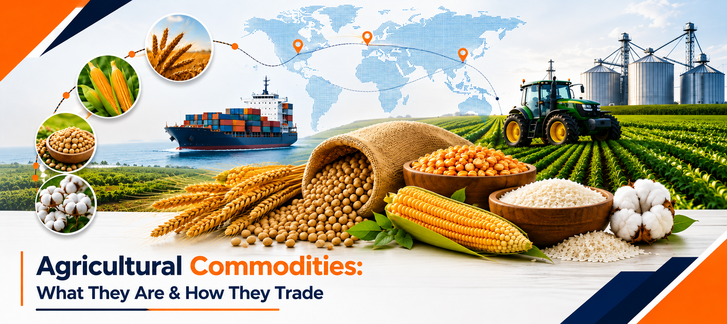
Agriculture is the foundation or backbone of the global food system. But agricultural importance extends far beyond farms and dinner tables. Because billions of people depend on agricultural products that are grown and harvested every day. Most people are also raised, processed, transported, and traded products in a vast agricultural economy. Wheat becomes flour and corn becomes food and animal feed. Same for cotton becomes clothing and soybeans become cooking oil and industrial products.
These products are also known as agricultural commodities.
An agricultural commodity is generally a raw or primary product. While these products are produced through farming or related agricultural activities. Because these products can be bought, sold, processed, or traded worldwide. Whether you talk about grains and oilseeds or livestock products and natural fibers. Every agricultural commodity plays a central role in global trade and economic development.
This guide provides a complete overview of agricultural commodities and their importance. Meanwhile we also discuss the major types of commodities and market dynamics of these commodities. Further we also describe price influences and the growing role of technology and the modern agri marketplace in this article.
What Are Agricultural Commodities?
A standardized product that may be exchanged on commercial marketplaces. Because these products come from farming, animal production, or other agricultural operations. This product is called an agricultural commodity.
An agricultural commodity is usually a raw material or a primary product. Unlike a finished consumer product that may go through further processing before reaching the final consumer.
For example:
1) Wheat can be processed into flour and bakery products.
2) Rice can be packaged and sold for household consumption.
3) Corn can be used for food, animal feed, starch, and industrial products.
4) Sugarcane can be processed into sugar, ethanol, and bagasse-based products.
5) Cotton can be transformed into yarn, fabric, and clothing.
Because many commodities are produced by multiple farmers and suppliers. While these commodities are often traded according to specific standards. These standards may relate to quality, moisture content, grade, size, origin, or other characteristics.
This standardization process makes commodities easier for buyers and sellers. Because in this way they conduct business in different locations and markets.
The Importance of Agricultural Commodities:
Agricultural commodities are essential to the global economy. This is because they support food production, manufacturing, employment, trade, and rural development in many countries.
1) Food Security
Food is the most obvious importance of agricultural commodities.
While staple crops provide essential nutrition for billions of people worldwide. This may include wheat, rice, maize, and pulses. Therefore the distribution of these commodities directly affects food availability. Also efficient production of commodities directly affects the affordability of food.
Major agricultural commodity supply disruptions can quickly influence food prices and consumer markets.
2) Supporting Major Industries
Some raw materials also count as agricultural commodities for numerous industries.
Because cotton supports the textile industry. While corn and soybeans are used in food manufacturing and animal feed. Same as sugarcane, which supports sugar and biofuel production in many industries. Vegetable oils are used in food products, cosmetics, industrial applications and many more industries.
What does this mean? This means the agricultural field is deeply connected to manufacturing and global supply chains.
3) Employment and Rural Economies
Agriculture remains a major source of employment in many developing economies these days.
There are a number of fields that all participate in the agricultural value chain. This may include farmers, transporters, warehouse operators, traders, processors, exporters, and retailers - all of them.
A strong agricultural commodity future market can support economic activity. Because this commodity market is far beyond the farms that produce them.
4) International Trade
Countries often produce different commodities based on many important factors. Those factors are climate, soil, geography, and agricultural expertise which directly affect commodities.
For example, one country may export rice while the other one imports edible oil. Another may export wheat or corn while importing coffee or tropical fruits.
International commodity trading allows countries to access products that may not be efficiently produced domestically.
Key Agricultural Commodities and Their Uses:
Agricultural commodities can be divided into several major categories.
1) Grains and Cereals
As we know grains are among always the world's most important agricultural commodities.
Major examples include:
1) Wheat
2) Rice
3) Maize or corn
4) Barley
5) Sorghum
Uses
1) Grains are primarily used for:
2) Human consumption
3) Flour and food processing
4) Animal feed
5) Industrial products
6) Biofuel production
Wheat, rice, and maize are very important commodities. Because they play a crucial role in forming a major part of the global food system.
2) Oilseeds
A crop grown from oil seeds is primarily used for their enrichment oil that contains in their seeds.
Common examples include:
1) Soybeans
2) Canola
3) Sunflower
4) Rapeseed
5) Sesame
6) Cottonseed
Uses
1) Oilseeds are processed into:
2) Cooking oils
3) Animal feed
4) Biodiesel
5) Food ingredients
6) Industrial products
The remaining material after oil extraction can also be used as livestock feed. While this remaining material is often known as meal or cake.
3) Sugar and Sugar Crops
Sugarcane and sugar beets are also important agricultural commodities. Because they are used primarily for sugar production and in many other industries as well.
However, sugarcane and sugar beets value extends beyond food.
Sugarcane can also contribute to:
1) Ethanol production
2) Electricity generation
3) Biomass energy
4) Biodegradable packaging
5) Paper and fiber products
These uses make sugar crops the most important part of the growing bioeconomy.
4) Livestock and Animal Products
Livestock commodities include:
1) Cattle
2) Poultry
3) Sheep and goats
4) Milk
5) Eggs
6) Leather and hides
These commodities directly support our food system. Because these commodities also supply raw materials for the manufacturing industry as well.
5) Natural Fibers
Natural fibers are agricultural products that are used primarily in textile and industrial manufacturing as well.
Cotton is the most important example of a natural fiber.
Uses of Cotton
Cotton is used to produce:
1) Clothing
2) Textiles
3) Medical products
4) Home furnishings
5) Industrial materials
Cotton is not only an agricultural commodity but a strategic industrial raw material. This is especially relevant for those countries that connect with major textile industries as well.
How Agricultural Commodity Markets Work:
Agricultural commodities move through a complex network that involves through many fields. Farmers, traders, warehouses, processors, exporters, and buyers are all involved in this network.
The journey generally begins with the production of commodities.
Step 1: Production
Farmers grow crops or raise livestock based on many important factors. These factors may include climate, expected demand, input costs, and potential profitability.
Step 2: Collection and Storage
Traders and cooperatives may collect commodities after harvesting. While processors and procurement companies are also involved in collecting these commodities.
Storage plays an important role in the grain market. Because these products are other products that can be held for future sale.
Step 3: Trading
This is where agricultural commodity trading becomes important these days.
Commodities may be traded through:
1) Local physical markets
2) Commodity exchanges
3) Direct business contracts
4) Import and export agreements
5) Digital trading platforms
The prices of commodities can vary according to many factors. These factors are quality, location, supply, demand, transportation costs, and market conditions etc.
Step 4: Processing and Distribution
Many commodities are processed well before they reach consumers.
For example, wheat becomes flour and soybeans become oil and meal before going to the market. Same as cotton which becomes textile products before reaching the consumer.
Commodities are processed well before they are distributed to wholesalers and retailers. While exporters and industrial supply chains also process goods.
The Growing Role of the Agri Marketplace:
Agricultural trade has traditionally depended heavily on physical markets and personal relationships with intermediaries as well.
Technology has changed this model today.
A digital Agri marketplace can connect farmers and suppliers through a single platform. While traders, processors, and institutional buyers also connect with each other through it.
Businesses can potentially use digital platforms to trade. Instead of relying entirely on phone calls and local networks od commodity trade.
1) Discover buyers and suppliers
2) Compare products
3) Access market information
4) Request quotations
5) Manage orders
6) Coordinate logistics
7) Improve price discovery
The growth of the Agri marketplace represents an important shift. This shift is toward more connected and transparent agricultural supply chain management.
Digital platforms can help reduce information gaps and improve market access. This is happening in countries that have fragmented agricultural markets.
Factors Influencing Agricultural Commodity Prices:
Agricultural commodity prices are rarely fixed. Because these prices can change due to a wide range of local and global factors.
1) Weather Conditions
Agriculture depends heavily on different weather conditions.
Because droughts and floods can reduce production and create supply shortages. While heatwaves and irregular rainfall can also affect goods.
Poor harvests can influence global commodity prices in a major producing country.
2) Supply and Demand
Commodities prices may decline when production increases faster than demand.
Commodities prices may rise when supplies become limited while demand remains strong.
This basic economic relationship remains one of the most important drivers of agricultural markets.
3) Input Costs
Farmers depend on inputs such as:
1) Fertilizers
2) Seeds
3) Fuel
4) Machinery
5) Labour
6) Water
Raising input costs for goods can increase production expenses. While these costs also influence commodity prices as well.
4) Government Policies
Import restrictions and export bans can significantly affect agricultural markets. Same as more subsidies, taxes, and price controls affect the goods market as well.
Government decisions can sometimes influence prices as strongly as changes in production.
5) Currency Exchange Rates
International agricultural commodities are often traded in major currencies like the dollar.
But a weaker or stronger local currency can affect the import costs and export competitiveness of goods.
6) Global Events
Wars and geopolitical tensions can interrupt agricultural supply chains badly. While trade disruptions and shipping problems especially like the Hormuz tensions also affect the supply chain.
Because agriculture is connected to global logistics events, these events can change its market. So major events that are thousands of kilometres away can eventually affect local food prices.
Sustainability and Ethical Considerations:
Agricultural commodities' future is closely connected to their sustainability.
Modern agriculture must produce enough food for a growing population. While modern agriculture also addresses challenges such as climate change and soil degradation issues. The same as water scarcity and biodiversity loss must be fixed.
Sustainable agricultural practices may include:
1) Efficient water management
2) Improved soil health
3) Reduced food waste
4) Precision agriculture
5) Responsible fertilizer use
6) Better crop rotation
7) Climate-resilient farming
Ethical considerations in modern agriculture also matter.
Consumers and businesses increasingly want greater transparency in these fields. How are agricultural products produced in modern agriculture? Issues such as fair treatment of farmers and labour conditions are gaining attention these days. While responsible land use and environmental impact are becoming more important across the agricultural supply chain.
These facts encourages greater interest especially in traceability and responsible sourcing of agriculture.
The Future of Agricultural Commodity Trading:
Agricultural commodity trading's future will likely be more digital and connected.
Technology is already transforming the industry through:
1) Artificial intelligence
2) Digital marketplaces
3) Real-time price information
4) Supply chain tracking
5) Smart warehousing
6) Precision agriculture
7) Data analytics
These technologies can help farmers and businesses make better decisions about important factors. These factors are production, procurement, storage, and sales.
An advanced agri marketplace may eventually connect multiple services within one ecosystem. Multiple services like commodity sourcing and logistics. Same as financing, quality verification, warehousing and market intelligence are also included in it.
This ecosystem could make agricultural trade faster and more transparent. While it's also reducing inefficiencies in the market.
Final Thoughts:
An agricultural commodity is much more than a crop or raw product. Because it is part of a global system that connects farmers and businesses with each other. While many industries, governments, and consumers also connect with this network.
Agricultural commodities provide the foundation for food systems and countless industries. Whether you talk about wheat and rice or cotton. Or sugarcane, oilseeds, and livestock everything counts in it.
Understanding agricultural commodity trading is increasingly important as markets become more connected. While global supply chains continue to evolve with these commodities.
The rise of the digital agri marketplace creates new opportunities at the same time. Because it improves market access and transparency. So basically logistics and price discovery also improve with the commodity market.
The future of agricultural commodities will depend on some major factors. How effectively will the world balance productivity with the sustainability of goods? Whether climate conditions change and global demand continues to grow worldwide. But smart supply chains and responsible farming will play an increasingly important role. Because technology-driven markets will change everything.
Agricultural commodities will remain at the heart of the global economy. Because it connects the soil. Whether you talk about farmers, traders, businesses, or consumers in the goods market. But a crop is grown in markets and industries around the world.