Agri Supply Chain Management: Everything You Need To Know
Boost efficiency and food safety. Learn everything about Agri Supply Chain Management, from farm inputs and cold storage logistics to consumer distribution.
Introduction - Agri Supply Chain Management:
Although agriculture begins with the soil. Yet getting food and agricultural commodities from the farm to the final buyer. Because it requires far more than growing a successful crop. Thus, between harvest and consumption lies a complex network of farmers and traders. Where warehouses, transporters, processors, distributors, retailers, and technology providers are also part of this network.
This network is known as the Agri supply chain.
An efficient agri-supply chain management system ensures that agricultural products move from producers to markets with minimal waste and reasonable costs. While ensuring reliable quality and timely delivery is also a part of this management. It is one of the most important systems that supports global food security and agricultural trade. Same for rural economies which are also a part of it.
Agricultural supply chains are becoming increasingly sophisticated these days. Because populations grow and consumer expectations change just because of this system. While technology, data, automation, improved logistics, and digital marketplaces are reshaping the system. Because agricultural commodities are bought, stored, transported, and sold in this way.
This guide explains everything you need to know about Agri supply chain management. This may include the major components, challenges, technological transformation, and the future of this management system.
What Is the Agricultural Supply Chain?
The agricultural supply chain is described as the complete journey of any agricultural product. As this starts at the point where inputs are sourced to the point where the final product reaches the consumer or industrial buyer.
The journey may involve a simple crop such as wheat. For example,
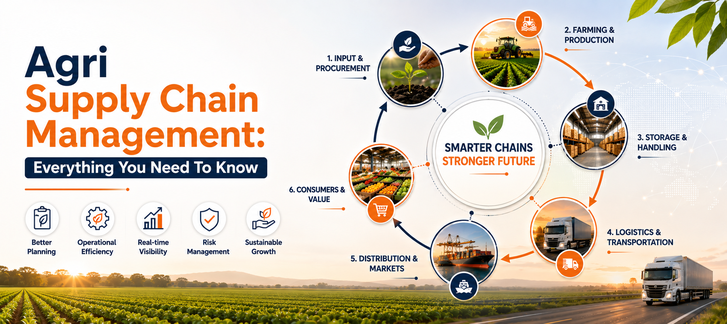
Seeds and agricultural inputs → Farming → Harvesting → Collection → Storage → Transportation → Processing → Distribution → Consumer
However, the modern agri supply chain is not a simple one like this.
Before reaching their final destination agricultural products may pass through multiple intermediary stages. A farmer may sell wheat to a local trader or the person who supplies a warehouse. While wheat may then be purchased from a flour mill and processed into flour. After that, it is distributed to wholesalers and eventually sold to consumers.
Each stage in the wheat supply chain adds value. But it can also introduce additional costs and delays. Same as quality risks and opportunities for waste of wheat also exist.
This is why effective Agri Supply Chain management is an essential part of this system. Its purpose is to coordinate these activities efficiently. While this management ensures that products maintain their quality and reach the right market at the right time.
Key Components of the Agri Supply Chain:
Understanding the agricultural supply chain requires looking at the different stages. Where the stages connect farm production with final consumption.
1) Agricultural Inputs
Supply chains are always beginning before a crop is planted in the field.
1) Seeds
2) Fertilizers
3) Pesticides
4) Machinery
5) Fuel
6) Irrigation equipment
7) Animal feed, in livestock operations
This is due to the fact that agricultural output is directly impacted by the quantity, cost, and quality of these inputs.
On the other hand, disruptions at the early stage of the supply chain can affect the entire agri supply chain.
2) Production
The process of production is the foundation of agriculture.
Farmers make critical decisions regarding crop selection and planting schedules. While they also consider irrigate, fertilizer use and pest management in the production process.
Weather conditions also play a major role in this process. Because droughts and floods may harm the crops. While heatwaves and changing rainfall patterns can significantly affect production volumes of crops.
Agriculture depends heavily on natural conditions unlike many industrial supply chains. Because it makes planning more complex.
3) Harvesting and Collection
Efficient harvesting techniques become more essential once crops are ready.
While delays in crop harvesting can result in quality deterioration or crop losses.
Agricultural commodities must be collected and moved to storage facilities. Or they can move to processing plants or markets after crop harvesting.
This stage remains fragmented in many developing agricultural economies. Because small farmers may lack direct access to large buyers. While they are creating a dependence on local intermediaries.
Improving collection networks is always an important part of modern supply chain management in agriculture.
4) Storage and Warehousing
Storage for crops is one of the most critical components of the agri supply chain.
Agricultural commodities are vulnerable to:
1) Moisture
2) Pests
3) Temperature changes
4) Mold
5) Contamination
6) Spoilage
Especially for grains such as wheat, rice, and corn. The poor storage can result in significant post-harvest losses.
Quality monitoring systems can help preserve product quality and reduce waste. While modern warehouses, silos and cold storage facilities can also play a part in this system.
Instead of having to sell them as soon as the crop is harvested. Efficient storage enables dealers and manufacturers to make control of their supply more strategically.
5) Transportation and Logistics
Agricultural products must often travel long distances between farms and warehouses. While these products also travel between processing facilities, ports and markets.
Transportation can involve:
1) Trucks
2) Railways
3) Ships
4) Refrigerated vehicles
5) Specialized bulk carriers
Logistics costs are particularly important in the agriculture process. This is because many commodities have relatively low margins and high transportation volumes.
A poorly designed logistics network can significantly increase the final cost of food in the market.
6) Processing and Value Addition
Many agricultural products are processed before reaching consumers.
Examples include:
1) Wheat becoming flour
2) Sugarcane becoming sugar
3) Milk becoming dairy products
4) Cotton becoming textiles
5) Oilseeds becoming edible oil
Because processing adds value and creates additional economic opportunities for people.
However, it also requires reliable access to raw materials. This makes coordination between producers and processors a critical part of supply chain management in agriculture.
7) Distribution and Market Access
The final stages involve connecting products with wholesalers, retailers, exporters, food companies, and consumers.
Market access determines whether agricultural producers can receive competitive prices.
Digital platforms are increasingly improving this process by connecting buyers and sellers more directly.
A modern agriculture supply chain management should not simply move products. It should also improve access to market information, demand forecasts, and fair commercial opportunities.
Why Does the Agri Supply Chain Matter?
The agricultural supply chain matters most. Because food security not only depends on producing enough food. But it also depends on moving it efficiently.
Although a country may produce large quantities of a crop. Yet poor storage and logistics can still result in shortages and price instability on the market.
Effective agri supply chain management can help:
1) Reduce post-harvest losses
2) Improve food availability
3) Lower logistics costs
4) Support farmer incomes
5) Maintain product quality
6) Improve price transparency
7) Strengthen food security
8) Increase agricultural exports
Improving supply chain management in construction can also create significant economic benefits. Especially in developing economies that have large agricultural sectors in them.
Key Challenges Faced by the Agri Supply Chain:
The agricultural supply chain faces several challenges despite its importance.
1) Climate and Weather Risks
The changing weather patterns expose directly agricultural fields.
Heatwaves and irregular rainfall can also disrupt crop production worldwide. While floods and droughts also affect crops and also create sudden supply shortages.
2) Fragmented Production
In many countries small farms dominate agricultural field.
Fragmented production can make collection difficult. The same as quality control and logistics makes it more difficult. While small farmers are essential to food production.
3) Poor Infrastructure
Limited roads and storage facilities can increase the cost of agricultural products. While cold chains and transportation networks can also increase the costs and product losses.
4) Price Volatility
Agricultural commodities prices can change rapidly due to the weather and global supply. Same as trade policies and currency movements can affect commodity prices.
These conditions make planning difficult for farmers, traders, and processors.
5) Food Waste
Agricultural production's significant amounts can be lost between harvest and consumption. This amount can be lost because of poor storage, handling, and transportation.
Reducing this waste is one of the biggest opportunities in agriculture supply chain management.
Building Skills for the Future of Agricultural Supply Chains:
The future agricultural workforce will require a combination of traditional agricultural knowledge and modern business skills.
Professionals working in supply chains will increasingly need their expertise in these:
1) Logistics
2) Data analysis
3) Commodity markets
4) Procurement
5) Warehouse management
6) Quality control
7) Digital technology
8) Sustainability
9) Risk management
Farmers will also benefit from greater access to market information and digital tools.
Governments have an important role in developing these skills. While educational institutions and private companies also have a role to play in developing these skills.
The agricultural supply chain of the future will require people with different fields. Especially those who understand both the farm and the marketplace.
The Role of Technology in Transforming the Agri Supply Chain:
Technology is rapidly changing and defining how agricultural commodities move through the economy.
Digital Marketplaces
Online platforms like Zarea connect farmers and suppliers. While traders and institutional buyers also connect with companies through this technology.
These platforms can also improve market access and price discovery of products.
Artificial Intelligence
AI can analyze large amounts of data to predict:
1) Crop yields
2) Market demand
3) Weather risks
4) Inventory requirements
This helps businesses make better decisions.
Internet of Things (IoT)
Smart sensors can monitor the temperature of agri products. The same as humidity and storage conditions in warehouses can be measured through these sensors.
This is particularly valuable for perishable goods and high-value agricultural products.
Blockchain and Traceability
Digital traceability systems can record many information about agri products. People also know where and how agricultural products are produced and transported.
This can improve the transparency of agri products. Further it can also help businesses meet quality and regulatory requirements according to the system.
Automation
Automated warehouse and sorting systems can improve efficiency. While precision farming technologies reduces operational costs.
The Future of the Agri Supply Chain:
The future of the transparent agri supply chain will be more connected and data-driven.
Buyers will increasingly share information across a connected ecosystem. Rather than operating in separate stages with farmers and logistics providers in the system. While warehouses and processors are also included in this system.
Future B2B supply chains may use real-time data to determine many aspects:
1) When crops should be harvested
2) Where products should be stored
3) Which markets offer the strongest demand
4) What transportation routes are most efficient
5) How much inventory should be maintained
That's why sustainability will also become increasingly important now a days.
Consumers and businesses are demanding greater transparency when it comes to the agri supply chain. While it's regarding environmental impact, product origins, and farming practices.
As a result, agri supply chain management will increasingly focus on reducing waste. While this management also improves resource efficiency and lowers emissions.
Final Thoughts:
Agriculture does not end at the farm gate. While this journey starts from producer to consumer. Because it depends on a complex network of people. Further, infrastructure, technology, and commercial relationships also depend on this network.
Effective agri supply chain management connects these elements. While it ensures that agricultural products move efficiently from production to market.
The agricultural sector is entering a period of rapid transformation these days. Whether it's from improved storage and modern logistics to digital marketplaces or artificial intelligence.
The future of agri supply chains will belong to resilient and transparent systems. Further technological advancements and sustainability will also improve this management. Investing in these systems is not simply about improving logistics for agricultural economies. Because it is about reducing waste and strengthening food security around the world. While supporting farmers and creating a more efficient path from the farm to the world.