Commodity Futures: How They Work, Trade & Manage Risk
Learn how commodity futures work, why prices move, and how traders manage risk.
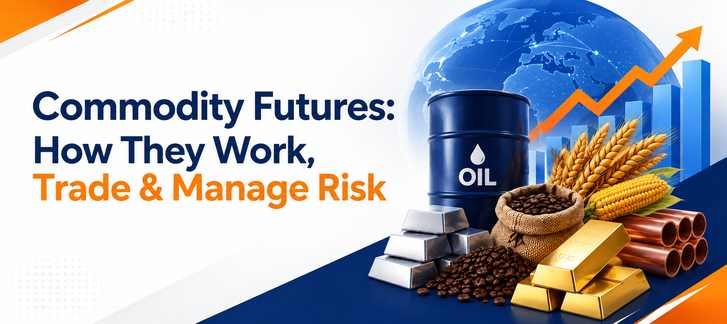
Commodity futures are standardized exchange-traded contracts wherein two parties come to an agreement today on the price of a commodity, whether it is gold, crude oil, wheat, cotton, steel or any other commodity.
The commodity is then supposed to be settled or delivered on a specified future date. The business world uses commodity futures to hedge, speculators use them for profit-making, while the whole market uses commodity futures to get an idea of future price levels.
One of my friends who is heading a small trading desk in Karachi mentioned a point last year which stuck with me. In essence, most people who discuss future of commodity have never gone through the experience of receiving a margin call before.
This is a term that is often discussed in the financial media but rarely explained properly. For someone who deals in buying and selling physical goods or who wants to understand why cotton prices or steel prices change the way they change, it is important.
What Are Commodity Futures?
The definition of a commodity futures contract is a standardized exchange-based agreement to purchase or sell a certain quantity and grade of a commodity at an agreed upon price and on a future date.
"Standardized" is the critical term here since the exchange determines the contract size, grade, and delivery details in advance, meaning that a buyer in Lahore is buying exactly the same thing as the seller in Chicago.
Internationally, the most famous platform is the CME Group, where derivatives are traded on a range of items including oil and natural gas, corn, and copper.
Pakistan also has its own exchange in the form of Pakistan Mercantile Exchange (PMEX) which was set up in 2005 and comes under the Securities and Exchange Commission of Pakistan (SECP).
Futures vs. Forward Contracts
It is simple to group these contracts, but they are not exactly alike. A forward contract is a bilateral agreement between two parties, with terms agreed upon through bilateral negotiations, no exchange involved, and limited remedy in case of default by either party.
A futures contract is a standardized form of forward contract; in this kind of contract, the terms of the transaction are determined by the exchange, a clearinghouse stands as an intermediary to back up both sides of the trade, and the settlement of positions happens daily, not just at the end of the trade.
Why Are Commodity Futures Used?
1- Hedging
Hedgers are commercial producers and users with real exposure to a commodity's price — farmers, importers, manufacturers. A flour mill that knows it needs wheat in six months can lock in today's price now, so a bad harvest somewhere else in the world doesn't blow up its cost base later.
2- Speculation
Speculators never intend to take delivery of anything. They're betting on where the price goes, using leverage to control a large contract value with a comparatively small deposit.
They get criticized a lot, but they do serve a function — they add liquidity, which makes it easier for hedgers to get in and out of positions without moving the price against themselves.
3- Price Discovery
Futures prices reflect what thousands of buyers and sellers collectively expect a commodity to be worth on a given date. That gives everyone a signal about where prices are heading, including people who will never open a futures account themselves.
How Do Commodity Futures Work?
1- Contract Terms and Margin
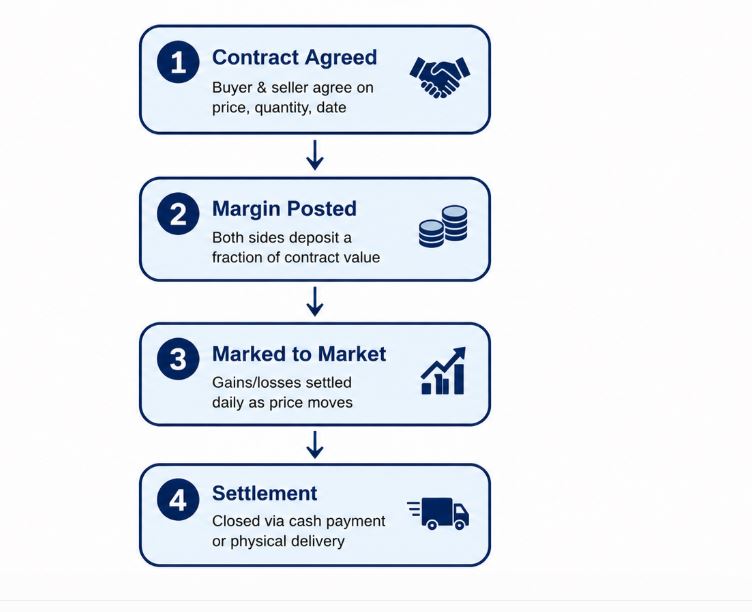
Buying a futures contract doesn't mean paying the full value of the commodity upfront. Both sides post margin instead — a deposit that's only a fraction of the contract's total value.
The exact percentage varies quite a bit by commodity, exchange, broker, and market conditions, so treat any specific number you see quoted as a starting point rather than a rule.
That fraction is what makes leverage possible: a relatively small amount of capital controls a much larger position, which is also what makes losses move fast in both directions, since gains and losses are calculated against the full contract value, not just the margin deposit.
Mark-to-Market and Margin Calls
Every trading day, the exchange marks positions to market, meaning your account is credited or debited based on that day's price movement rather than waiting until the contract ends.
If losses eat into your margin below a maintenance threshold, you get a margin call: a demand to top up funds or have the position closed out for you, sometimes within hours.
Expiration and Settlement
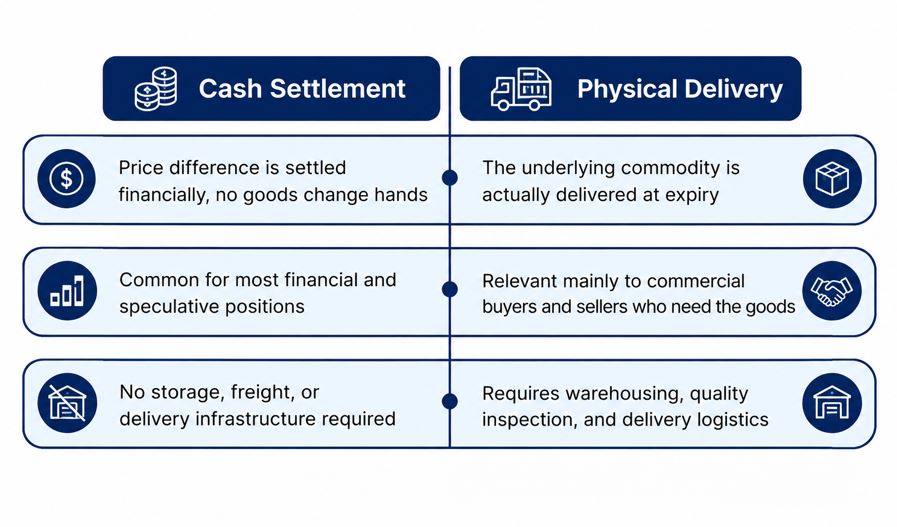
At expiration, most contracts are closed out through cash settlement rather than physical delivery. A trader who bought a crude oil contract almost never wants a tanker showing up at their door, so the price difference is settled in cash instead.
Physical delivery still exists and matters most to businesses that actually need the underlying commodity. This is especially relevant when trading different types of commodities, such as agricultural products, metals, or energy, where commercial buyers may require the actual goods.
SECP has also been directing PMEX toward physically deliverable agricultural contracts, aimed at giving farmers a more direct route to buyers.
Cash Settlement vs. Physical Delivery
Cash settlement settles the price difference financially, while physical delivery involves the actual transfer of the underlying commodity at expiry.
Commodity Futures vs. Spot Prices
A futures price and a spot price answer two different questions, and mixing them up is a common source of confusion for anyone new to the market.
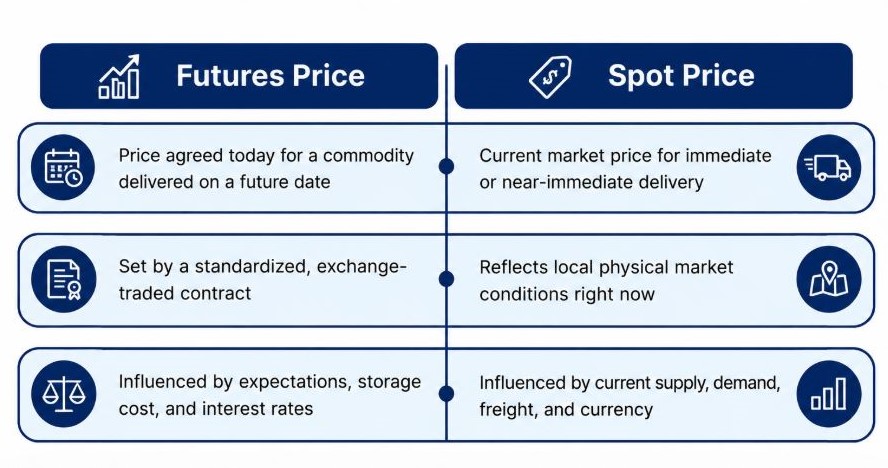
This matters in practice: the international futures price for cotton or crude oil is not the same number a Pakistani buyer will actually pay for the physical goods, because currency movement, import duties, freight, and local supply all sit between the two.
What Are the Risks of Commodity Futures?
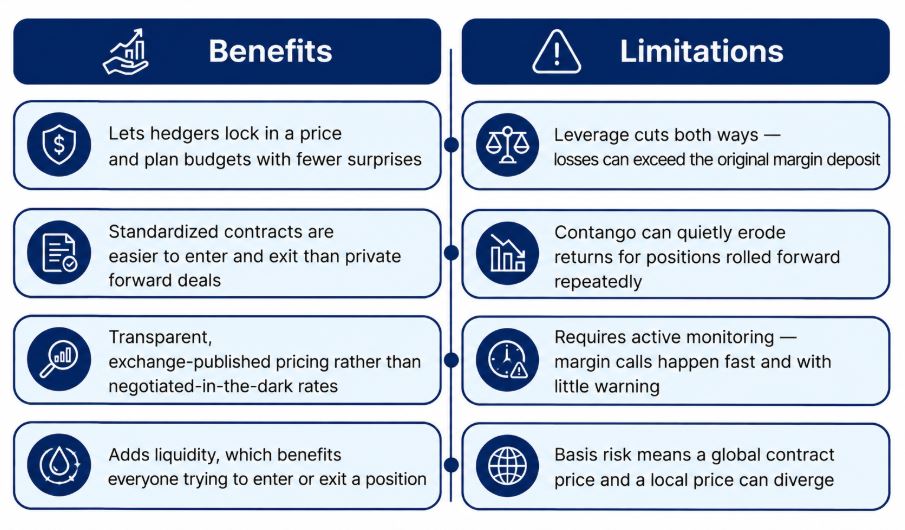
Leverage is the first risk, and it's the one that catches new traders off guard, because gains and losses are calculated on the full contract value, a small adverse price move can wipe out a margin deposit quickly, and losses can exceed what was originally deposited.
Margin calls follow directly from that: they can arrive with very little warning and demand funds fast.
Contango is a subtler risk. It's a situation where a futures price sits higher than the expected near-term or spot price, which usually reflects the cost of storage, financing, and insurance built into the contract.
For someone who keeps rolling a position forward into new contracts, contango can quietly erode returns over time even if the underlying commodity's price hasn't actually fallen.
Basis risk is the one that matters most for physical buyers rather than traders. It's the gap between a global futures price and the actual local price you pay, driven by currency swings, freight costs, duties, and regional supply and demand.
A Pakistani buyer can watch an international futures price move one way while the local physical price moves differently for reasons that have nothing to do with the global contract at all.
On top of these, ordinary market volatility, liquidity risk in thinner contracts, and, for anyone using delivery contracts — the logistics of actually taking or making delivery are all worth weighing before getting involved.
Where Futures Prices Show Up in Local Pricing
You don't have to trade futures yourself to feel their effect. Steel and cement prices in Pakistan move partly on the back of international input costs — iron ore, coking coal, energy — that are themselves priced through futures markets abroad.
Gold futures set a reference price that local jewellers and bullion dealers use to quote same-day rates, and cotton futures influence what textile mills pay ginners, which eventually shows up in the cost of yarn and fabric.
If you're sourcing steel and want to see how today's numbers compare to last week's, current steel rates are a local snapshot of the same forces futures markets price in advance, and the cement price works the same way for construction buyers.
If You Just Need the Physical Goods
Not everyone reading this needs a trading account. If you're procuring steel, cement, cotton, or grain for a business, futures prices are still useful as a leading indicator, even if you never place an order through an exchange.
Watching how commodity futures move gives you a rough sense of where a supplier's next quote is headed before it happens, which is a genuinely useful edge in procurement conversations.
If you buy physical commodities rather than trade futures, Zarea's daily commodity price is a straightforward way to compare current market rates across categories like steel, cement, grains, and other inputs so you're not caught off guard by a move professional traders priced in days earlier.
A Local Shift Worth Watching
Pakistan's commodity futures market is quietly changing shape. In June 2026, SECP directed PMEX to build out physically deliverable agricultural futures contracts, backed by an electronic warehouse receipt system linking warehouses directly to the exchange.
The goal is straightforward: give farmers a transparent, direct route to sell crops to buyers without the price uncertainty that usually comes from going through several layers of middlemen.
Earlier in the year, PMEX had already launched a simplified, no-leverage trading account aimed at making regulated futures trading more accessible to newer participants.
Together, these point toward Pakistan's regulators treating commodity futures as infrastructure worth building out, not just a product for speculators.
Anyone sourcing agricultural commodities regularly may want to keep an eye on Zarea updates as this rolls out, alongside primary sources like PMEX and SECP directly, since it will likely affect how grain and cotton get quoted at the physical level too.
Benefits and Limitations, Side by Side
Neither side of this tells the whole story on its own, so it's worth weighing what futures actually offer against what they cost in risk and attention.
Wrap Up
Commodity futures aren't just a trading-floor abstraction — they set the tone for prices that eventually land on real invoices, whether that's a construction firm buying steel or a mill buying cotton.
Understanding roughly how they work, who actually uses them, and where the risk sits makes the rest of the commodity market a lot less mysterious, even for someone who never places a trade themselves.
Frequently Asked Questions
What's the difference between hedging and speculating in commodity futures?
While hedgers utilize futures contracts for protection from a price change that they are already vulnerable to, such as an agriculturist who is protecting themselves before harvesting by locking in a price for wheat, speculators have no vulnerability at all, since they are betting on the price change itself.
Are commodity futures the same as buying the physical commodity?
No. Futures are financial instruments where payment is made according to the price of a commodity. They are mostly paid in cash, not physical form. There are physical delivery futures, but these are primarily for businesses that require the commodities, like a mill which requires wheat.
What is a margin call?
A margin call happens when losses on an open position push your account balance below the exchange's required maintenance level. The broker demands you deposit more funds, or your position gets closed out automatically to limit further loss.
What happens when a commodity futures contract expires?
Most contracts are closed out before or at expiration through cash settlement, where the price difference between the entry and exit price is paid or received. A smaller share of contracts, mostly held by commercial buyers and sellers, go to physical delivery of the underlying commodity instead.
Can individuals trade commodity futures in Pakistan?
Yes, through the Pakistan Mercantile Exchange, which is regulated by the SECP. Accounts are opened through PMEX-registered brokers, and simplified, lower-risk options — including accounts with no leverage — have been introduced recently to make entry easier for newer traders.