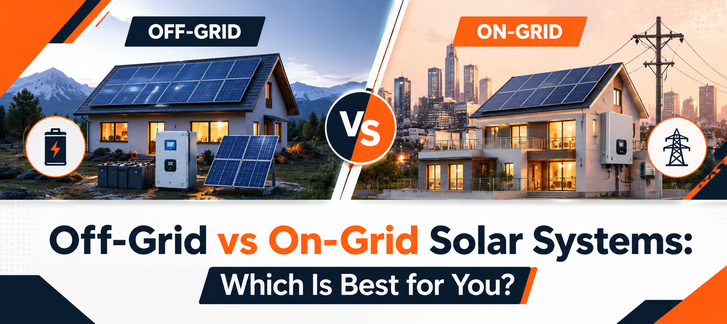
Off-Grid vs On-Grid Solar Systems: Which Is Best for You?
Confused about an off-grid and on-grid solar system? Discover key differences, upfront costs, and pros to find the perfect renewable energy setup for a home.
Introduction - Off-Grid and On-Grid Solar System
The best solar system depends on your electricity needs and the requirement for backup power. While your budget and grid reliability is also an important part of a solar system. Therefore an on-grid solar system is usually the most cost-effective choice if you have a reliable electricity connection. But it also depends upon reducing of your electricity bills. An off-grid solar system is better for remote locations without dependable grid access. Because an off-grid system operates independently using battery storage. A hybrid solar system combines on- and off-grid as both approaches. As it allows you to use solar power and remain connected to the grid. This system is also excess energy stored in batteries for later use.
You must understand the difference between off-grid and on-grid solar system options. It is important before you invest in solar panels. While all three systems can generate clean electricity from the sunlight and provide energy independence for you. Because they differ significantly in how they handle excess power and battery storage during grid outages.
We will explain off-grid and on-grid solar systems in this guide. We will also describe how each system works and how net metering works with on-grid systems. Further, you will know the advantages and disadvantages of each option. In this way you will be able to decide which solar solution is right for your home. Or you want to install the system in your farm or business.
What Is an On Grid Solar System?
An on-grid solar system, also called a grid-tied solar system. While this system is connected directly to the local electricity grid.
As we know types of solar panels generate electricity during daylight hours. So the electricity is converted through an inverter and the property uses it. If the solar system produces more electricity than the property needs, it moves to the grid. Therefore the extra electricity can export to the grid under applicable net-metering. Or the energy could move to other distributed-generation arrangements.
The criteria work differently when solar production is insufficient. For example, the property can draw electricity from the grid at night or during periods of low sunlight.
This system makes on-grid solar relatively straightforward for everyone. Because the electricity grid acts as a source of supplemental power in this kind of system.
Main Components of an On-Grid System
A typical system includes:
1) Solar panels
2) Grid-tied inverter
3) Mounting structure
4) Electrical protection equipment
5) Monitoring system
6) Grid connection
Meanwhile batteries are not necessarily required as compared to an off-grid system.
Advantages of On-Grid Solar
The biggest advantage is cost.
Because solar batteries are optional, an on-grid system can generally have a lower upfront cost than a comparable off-grid system.
It can also provide substantial savings when solar generation offsets electricity purchased from the grid.
However, there is an important limitation to this system. Because standard grid-tied systems normally shut down when the electricity grid fails. So, this safety feature prevents the solar system from sending electricity to a grid that may be undergoing maintenance.
In simple words if you have solar panels it does not guarantee that you will have electricity during a grid outage.
What Is an Off Grid Solar System?
An off-grid solar system is not required for the public energy grid to function.
An off-grid system normally uses batteries to store electricity that is generated during the day. Instead of relying on the grid when solar production is unavailable this system operates independently.
When solar production is low the stored energy can then be used at night or during periods.
An off-grid system is particularly useful in locations where grid electricity is unavailable. It is also available in locations where electricity is unreliable, or extremely expensive to extend.
Main Components of an Off-Grid System
A typical off-grid installation includes:
1) Solar panels
2) Batteries
3) Solar charge controller or suitable integrated equipment
4) Off-grid inverter
5) Mounting structures
6) Electrical protection equipment
7) Monitoring equipment
The battery bank is a critical part of an off-grid system.
Advantages of Off-Grid Solar
Off-grid systems' primary advantage is energy independence.
Because a properly designed off-grid system can continue supplying electricity without a connection to the public grid.
This can be valuable for:
1) Remote homes
2) Farms
3) Rural facilities
4) Telecom installations
5) Remote businesses
6) Areas with limited grid access
Therefore, off-grid solar can also provide greater control over electricity generation and consumption.
Limitations of Off-Grid Solar
The main challenge with an off-grid system is the cost and complexity of its energy storage.
Solar panels only generate electricity when sufficient sunlight is available for the system. Therefore batteries need to store enough energy to cover periods of low solar production.
In simple words, the off-grid system's size is very important.
If a household uses large amounts of electricity at night, an undersized battery system may not provide sufficient backup.
What Is a Hybrid Solar System?
A hybrid solar system combines both features like an on-grid-connected and off-grid system.
This system normally uses solar panels and batteries to operate. While this system also maintains a connection to the electricity grid.
Solar energy can power the property and charge the batteries especially during the day. Therefore excessive energy may be exported to the grid. This is the portion where regulations and the system arrangement permit.
The system can use its own stored battery energy when solar production falls back. If the battery becomes depleted or demand exceeds available solar and battery power. In this situation the grid can provide additional electricity to the system.
Hybrid solar systems' flexibility makes them attractive for users. Especially for those who want both savings and backup power at the same time.
Why Choose a Hybrid System?
A hybrid system can provide:
1) Solar energy generation
2) Battery storage
3) Backup during outages, depending on system design
4) Grid connectivity
5) Greater energy-management flexibility
The disadvantage is the higher initial investment compared with a basic grid-tied system. Because batteries and more advanced inverter equipment also add to the system cost.
Off Grid and On Grid Solar - Key Differences:
Understanding the basic differences makes the decision easier.
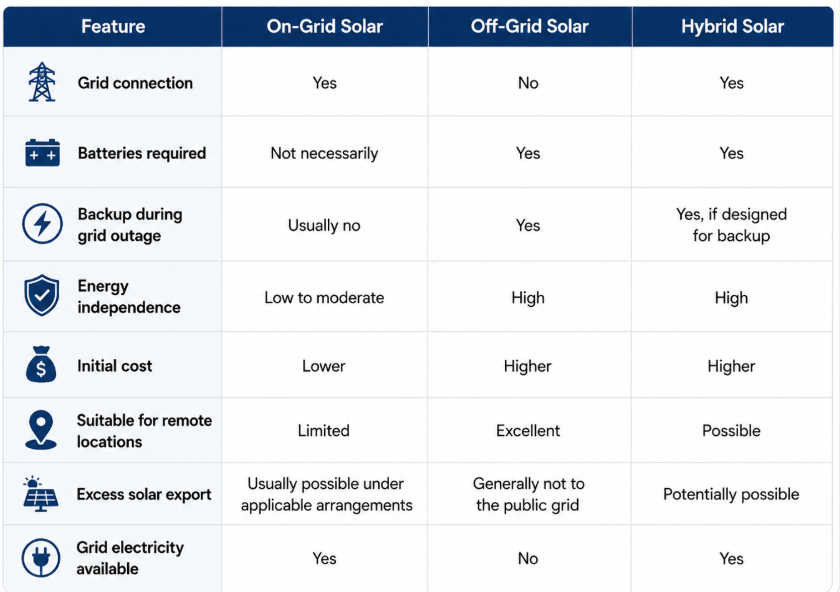
The best option depends on what you actually need from your solar installation.
How Net Metering Works with On-Grid Solar?
Net metering has traditionally been an important reason for installing grid-connected solar in many markets.
The basic concept is straightforward.
Suppose your solar panels produce more electricity than your required energy during the day.
Because the solar system can export it to the electricity grid under the applicable regulatory framework. Instead of allowing that excessive electricity to go unused.
When your solar system is producing less than your consumption, you can draw electricity from the grid.
The meter or associated billing mechanism records electricity flows according to the rules established by the relevant utility or regulator.
For example:
Solar generation > household consumption → excess electricity exported
Household consumption > solar generation → electricity imported
The financial treatment of exported electricity depends on the country's regulations, utility policies, contract structure, and applicable tariff.
This matter is particularly important for everyone. Because the net-metering rules can change over time.
Therefore, anyone considering an on-grid solar investment should check the latest regulations. While people also consider the compensation mechanism before calculating expected financial returns.
Which Solar System Is Right for You?
There is no universal answer when comparing off grid and on grid solar power.
Your choice should be based on several factors.
Choose On-Grid Solar If...
An on-grid system may be appropriate if:
1) You already have reliable grid electricity.
2) Your main goal is reducing electricity bills.
3) You want a lower upfront solar investment.
4) You do not require battery backup.
5) Your property is connected to the electricity grid.
grid-tied solar can be a practical starting point For many urban households and businesses.
Choose Off-Grid Solar If...
An off-grid system may be better if:
1) Your property has no grid connection.
2) You live in a remote location.
3) Grid expansion is impractical or expensive.
4) Energy independence is a major priority.
5) You are prepared to invest in sufficient battery storage.
However, an off-grid system must be carefully designed around your actual electricity consumption.
Choose Hybrid Solar If...
Hybrid solar may be the better choice if:
1) You want to reduce electricity purchases.
2) You want battery backup.
3) You experience frequent power interruptions.
4) You want to use solar energy at night through battery storage.
5) You want the flexibility of maintaining a grid connection.
Hybrid systems can offer an attractive middle ground system. This system is for households who want both savings and resilience.
What About Solar During a Power Outage?
This is one of the most misunderstood aspects of off grid and on grid solar.
A conventional grid-tied solar system generally does not continue to operate. Especially during a grid outage.
The inverter normally disconnects the solar installation from the grid for safety reasons. Even maybe the sun is shining in the sky.
You need a system specifically designed to provide it if backup power is important.
Hybrid systems can use batteries and appropriate backup functionality to supply selected loads during an outage.
Meanwhile off-grid systems are designed to operate independently of the grid.
This distinction is important when you are comparing solar systems for homes and businesses. This highlights those areas where electricity interruptions are common.
How to Choose the Right Solar System
Before purchasing a solar system, consider the following questions:
1) How much electricity do you use?
Review your electricity bills and then identify your average and peak consumption.
2) How reliable is your grid connection?
A simple on-grid system may be sufficient if outages are rare. While battery storage may become more valuable if outages are frequent.
3) What is your budget?
On-grid systems generally require less upfront investment in them. Because batteries are not essential in this scene.
4) Do you have access to the grid?
Off-grid solar may make more economic sense if you are located far from the electricity network.
5) How much backup do you need?
A battery system should be sized according to the appliances or equipment you need to operate during outages.
6) What are the local regulations?
Always investigate the current rules concerning grid connections and applicable tariffs. Same as distributed generation and electricity export also matter in this scene.
The Future of Off Grid and On Grid Solar Power:
The distinction between off-grid and on-grid solar power is becoming less rigid. Because solar power technology developed that changes it.
Modern hybrid solar inverters and digital monitoring are creating more flexible solar installations. Therefore, increasingly capable batteries and smart energy-management systems also play a role in it.
Future systems may automatically decide whether electricity should be:
1) Used immediately
2) Stored in batteries
3) Exported to the grid
4) Drawn from the grid
Artificial intelligence and smart energy management may further improve these decisions. Because AI analyzes electricity prices and battery conditions. Additionally it predicts weather forecasts and consumption patterns.
This could transform solar systems into intelligent energy-management platforms. Rather than simple electricity generators.
Final Thoughts:
On-grid solar is generally best for people who want lower electricity costs. While off-grid solar is best for energy independent users. But hybrid solar is best for users who want both grid connectivity and battery backup at the same time. The right choice ultimately depends on your electricity consumption and the backup requirements of your system. Same as budget, location, grid reliability also matter in this scene.
Understanding the off-grid and on-grid solar system options carefully. Before you invest that can help you to avoid choosing a system. Especially a system that does not match your actual needs.
Solar panels and energy management technologies continue to improve day by day. Same as batteries and inverters, they improve. Therefore off-grid and on-grid solar power will become increasingly flexible and accessible for users. Additionally, the most successful solar investment is not necessarily the largest system. Because it is the one that is properly designed around how you generate and consume electricity.