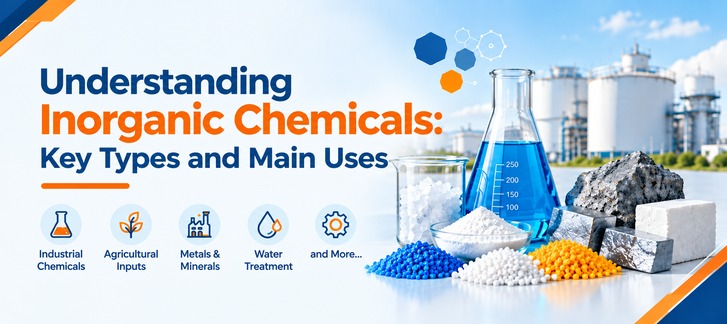
Understanding Inorganic Chemicals: Key Types and Main Uses
Master the basics of inorganic chemicals. Dive into this guide covering core types, essential properties, and major industrial applications.
Introduction:
Chemistry is often divided into two basic types. These types are called organic and inorganic chemistry. While organic chemistry is strongly associated with carbon-based compounds or life systems. But inorganic chemicals cover a much broader group of different types of substances. This includes minerals and metals to acids. Where some salts, bases and other industrial compounds are also included in it.
These chemicals may not always be visible to us. Yet they are involved in many everyday products and industrial processes. Therefore energy production and healthcare products all depend on inorganic substances in different ways. Moreover water treatment, agricultural products, construction, manufacturing and electronics also rely on these compounds.
So, what are inorganic chemicals? How are these chemicals different from organic chemicals? You will find answers to these questions in this complete guide.
Inorganic chemistry focuses on substances that generally do not have the characteristics of carbon-hydrogen in simple terms. Because these frameworks are associated with organic chemistry. There are some important exceptions and overlaps in this field. So its distinction is based on chemical classification. As compared to the simpler one where a substance contains carbon.
Let's explore the major types, inorganic chemicals examples, their history and their growing importance in modern industry.
What Are Inorganic Chemicals?
Inorganic chemicals are those chemical substances which are generally studied in inorganic chemistry. This field includes coordination compounds and many other substances. Where minerals, metals, acids, bases and salts also rely on these compounds. Additionally some of these chemicals are also called as basic chemicals.
Common examples include:
1) Sodium chloride
2) Calcium carbonate
3) Hydrochloric acid
4) Sulfuric acid
5) Sodium hydroxide
6) Ammonia
7) Sodium carbonate
8) Hydrogen peroxide
9) Silicon dioxide
10) Iron oxides
Some inorganic substances occur naturally in rocks and minerals. Or some substances found in water and in living systems as well. While other substances are manufactured for industrial applications where they are required.
One important misconception is that "inorganic" means "man-made chemicals." That statement is not totally correct. Because many naturally occurring substances are found naturally. This may include some minerals and salts, which are inorganic but naturally found.
Not every carbon-containing compound is automatically classified as organic, but likewise. Because inorganics are solely based on the carbon's presence. But some compounds such as carbon dioxide and carbonates are traditionally treated as inorganic substances.
Types of Inorganic Compounds:
Inorganic chemistry covers numerous categories of compounds. Some of the most important compounds are acids, bases, and salts. While some oxides and metals are also included in it.
1) Acids
Inorganic acids are not only used in industrial processing. But they are also used in the chemical manufacturing process.
Examples of these compounds include hydrochloric acid, sulfuric acid and nitric acid.
They can be used in processes such as pH adjustment and metal treatment. While some are used in mineral processing and other chemical productions.
2) Bases and Alkalis
Bases can react with acids to make salt. Therefore they are very important in neutralization and industrial processing.
Sodium hydroxide is called caustic soda commonly. This compound is one of the most important industrial alkalis.
It is used in industries including textiles, pulp and paper. Where some of the chemical manufacturing, cleaning and water treatment processes also depend on it.
3) Salts
Salts are ionic compounds that can be formed through reactions between acids and bases.
Sodium chloride or common table salt is a familiar example of it.
Other industrially important salts are used in agriculture and food processing. While it is also used in water treatment, manufacturing and chemical production.
4) Oxides
Oxides are those compounds in which oxygen is chemically combined with another element.
Examples of oxides include iron oxide, calcium oxide and silicon dioxide.
Oxides have applications ranging from construction materials to pigments and glass. Whereas some ceramics and industrial processing materials also use them.
5) Metals and Metallic Compounds
Metals also cover a major area of inorganic chemistry.
Iron, copper, aluminum, zinc and other metals are essential to construction. While they also play an essential role in transportation and electronics. While some machinery related and energy infrastructure related fields also depend on these metals.
Metallic compounds also play an important role in the catalyst process. Because pigments, batteries and some of the advanced materials all rely on these compounds.
Examples of Inorganic Compounds and Substances:
There are thousands of inorganic compounds, but several are particularly familiar because of their widespread applications.
1) Sodium Chloride
Sodium chloride is commonly known as table salt. Beyond food use, it is an important industrial raw material for producing chemicals such as chlorine and sodium hydroxide.
2) Hydrochloric Acid
Hydrochloric acid is a strong acid used in chemical processing, metal treatment, pH control and other industrial applications.
3) Sodium Hydroxide
Sodium hydroxide, or caustic soda, is a strong alkali used in chemical manufacturing, pulp and paper, textiles, cleaning products and water treatment.
4) Sodium Carbonate
Sodium carbonate, commonly called soda ash, is widely used in glass manufacturing, detergents and chemical processing.
5) Calcium Carbonate
Calcium carbonate occurs naturally in materials such as limestone, chalk and marble. It is used in construction, paper, plastics, paints and numerous other applications.
6) Hydrogen Peroxide
Hydrogen peroxide is an inorganic peroxide and a strong oxidizing agent. It has applications in bleaching, disinfection, water treatment and industrial processing, depending on concentration and grade.
Where Is Inorganic Chemistry Used?
Inorganic chemistry has applications across a remarkable number of industries.
1) Agriculture
Inorganic compounds are important in fertilizer production and soil management. Nutrients such as nitrogen, phosphorus and potassium are essential for plant growth and are supplied through various fertilizer compounds.
2) Water Treatment
Water-treatment operations use inorganic chemicals for processes such as disinfection, pH adjustment, coagulation and contaminant removal.
3) Construction
Construction materials rely on numerous inorganic substances.
Cement, concrete, glass, ceramics and many mineral-based materials depend on inorganic chemistry.
4) Manufacturing
Manufacturers use acids, bases, salts, metals and other inorganic compounds as raw materials, processing agents and functional ingredients.
5) Electronics
Modern electronics depend heavily on inorganic materials such as silicon and various metals and semiconductors.
6) Energy
Batteries, solar technologies, fuel cells and other energy systems use a range of inorganic materials.
7) Healthcare
Inorganic compounds can be found in pharmaceutical formulations, medical materials, diagnostic applications and healthcare-related manufacturing.
This broad range of applications demonstrates why inorganic chemistry is fundamental to modern industrial civilization.
Organic vs Inorganic Chemicals: What Is the Difference?
One of the most common chemistry questions is the difference between organic vs inorganic chemicals.
The traditional distinction is based primarily on the chemistry of carbon.
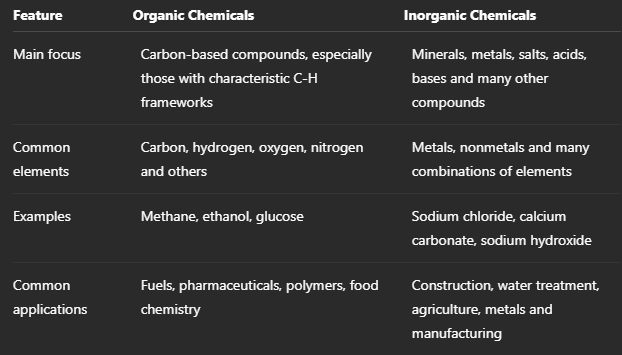
However, this distinction is not absolute.
Carbon dioxide, carbon monoxide, carbonates and bicarbonates contain carbon but are traditionally classified as inorganic compounds.
Therefore, the presence of carbon alone does not provide a complete answer to whether a substance is organic or inorganic.
History of Inorganic Chemicals:
The history of inorganic chemistry stretches back thousands of years because humans have always interacted with minerals, metals, salts and naturally occurring materials.
Ancient civilizations used metals such as copper, bronze and iron to make tools, weapons and structures. Mineral pigments were used in art, while salts and naturally occurring substances found applications in preservation and manufacturing.
As scientific chemistry developed, researchers began systematically studying the properties and reactions of inorganic substances.
During the Industrial Revolution, this knowledge became increasingly important.
Large-scale production of sulfuric acid, soda ash, chlorine and other chemicals helped support the rapid development of glass, textiles, metallurgy, fertilizers and other industries.
Modern inorganic chemistry has expanded even further, moving into semiconductors, nanomaterials, catalysts, batteries, advanced ceramics and other high-technology applications.
Modern Usage of Inorganic Chemicals:
Today, inorganic chemicals are not limited to traditional industrial processes.
They are increasingly important in advanced technologies.
1) Advanced Materials
Scientists use inorganic compounds to develop ceramics, catalysts, coatings, pigments and specialized materials with specific physical and chemical properties.
2) Renewable Energy
Solar cells, batteries and energy-storage technologies rely on materials developed through inorganic chemistry.
3) Catalysis
Inorganic catalysts can help accelerate chemical reactions while improving efficiency and selectivity.
4) Environmental Technologies
Inorganic chemistry contributes to pollution control, water purification, carbon-management technologies and environmental remediation.
5) Nanotechnology
Inorganic nanoparticles and nanostructured materials are being researched for applications in electronics, medicine, energy and advanced manufacturing.
Why Are Inorganic Chemicals Important?
The importance of inorganic chemicals comes from their versatility.
They provide the fundamental materials and chemical reactions needed for many sectors of the economy.
A single inorganic substance can sometimes have applications across multiple industries. For example, sodium hydroxide is relevant to chemical manufacturing, textiles, pulp and paper, cleaning and water treatment.
This versatility makes inorganic chemicals essential components of industrial chemical supply chains.
The Future of Inorganic Chemistry:
The future of inorganic chemistry is closely connected with the world's demand for cleaner technologies, efficient manufacturing and advanced materials.
Researchers are investigating new catalysts, battery materials, semiconductor compounds, sustainable manufacturing processes and materials for renewable energy.
The industry is also under increasing pressure to reduce energy consumption, waste and environmental emissions.
This means the next generation of inorganic chemistry will not only focus on what can be produced, but also on how efficiently and sustainably it can be produced.
Wrap Up:
So, what are inorganic chemicals?
They are a broad family of substances studied in inorganic chemistry, encompassing acids, bases, salts, metals, oxides, minerals and many other compounds.
From the sodium chloride in our kitchens and calcium carbonate in limestone to the silicon used in electronics and chemicals used in water treatment, inorganic substances are deeply embedded in modern life.
Understanding inorganic chemicals examples also makes it easier to appreciate the difference between organic and inorganic chemistry. More importantly, it reveals how chemistry connects seemingly unrelated industries—from agriculture and construction to electronics, healthcare and renewable energy.
As technology advances, inorganic chemistry will continue to provide the materials and chemical solutions needed to build the next generation of products, infrastructure and technologies.
FAQ's:
1) What are examples of inorganic chemicals?
Common inorganic chemicals examples include sodium chloride, hydrochloric acid, sulfuric acid, sodium hydroxide, sodium carbonate, calcium carbonate, hydrogen peroxide, silicon dioxide and iron oxides. These substances are used in industries such as agriculture, construction, manufacturing, water treatment and electronics.
2) What is the difference between organic and inorganic chemicals?
The main distinction between organic vs inorganic chemicals is based on their chemical structures. Organic chemistry primarily focuses on carbon compounds, especially those containing carbon-hydrogen frameworks, while inorganic chemistry covers minerals, metals, salts, acids, bases and many other substances. Some carbon-containing substances, such as carbon dioxide and carbonates, are traditionally classified as inorganic.
3) Are inorganic chemicals naturally occurring?
Yes. Many inorganic chemicals occur naturally in minerals, rocks, soil and water. Examples include calcium carbonate in limestone, silicon dioxide in quartz and sodium chloride in salt deposits and seawater. Other inorganic chemicals are manufactured for industrial and commercial applications.
4) What is the history of inorganic chemistry?
The history of inorganic chemistry can be traced to ancient uses of metals, minerals and salts. The field became more systematic as modern chemistry developed, while industrialization accelerated large-scale production of substances such as sulfuric acid, soda ash and chlorine. Today, inorganic chemistry also covers semiconductors, catalysts, batteries, nanomaterials and advanced ceramics.
5) What is the future of inorganic chemicals?
The future of inorganic chemicals is closely connected to advanced materials, renewable energy, batteries, semiconductor technology, catalysts and environmental applications. Research is increasingly focused on improving performance while reducing energy consumption, waste and environmental impacts during production.