How to Choose the Right Industrial Chemical Suppliers
What industrial chemical suppliers actually provide, how to vet one for purity and safety, and where to source chemicals in Pakistan.
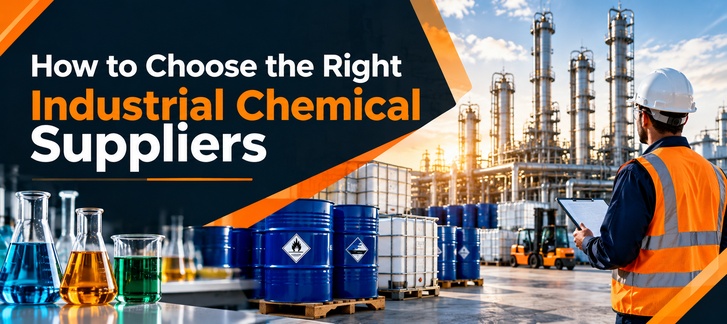
Industrial chemical suppliers are just the businesses that get chemicals from wherever they're made to wherever they're actually needed, whether that's importing them or manufacturing the stuff themselves.
A textile mill needs acid to prep fabric. A soap manufacturer is going through caustic soda by the tonne. Simple enough in theory.
Where it stops being simple is when the supplier gets it wrong.
This isn't like a late shipment of printer paper. If a batch shows up off-spec, contaminated, or just mislabeled, you're not looking at an annoyance; you're looking at a production line shutting down or, worse, an actual safety incident. I've seen how fast that can spiral once it starts.
So that's the point of this guide. What these suppliers are actually providing, which chemicals businesses tend to order most and what they're for, how you'd go about checking if a supplier's actually trustworthy before you commit to them, and what all of this looks like specifically if you're sourcing in Pakistan or in other countries.
What Do Industrial Chemical Suppliers Actually Provide?
At the simplest level, a supplier's job is getting a chemical from wherever it's produced to wherever it's needed, at the right purity, in the right packaging, on a schedule that doesn't leave a production line waiting.
Some manufacturers of industrial chemicals themselves. Others import and distribute, particularly for chemicals that aren't produced locally in the volume or grade a buyer needs. Many do both, depending on the product.
What separates a supplier from just a middleman reselling drums is documentation and consistency. A batch of hydrochloric acid should test the same way this month as it did last month.
A certificate of analysis should actually match what's in the container. That sounds obvious, but it's exactly the part that gets skipped by suppliers cutting corners on cost.
Common Industrial Chemicals and What They're Used For
A handful of chemicals show up in almost every manufacturing sector you can name, and knowing what each one's actually for helps more than just comparing price sheets does:
Hydrochloric acid: This is a widely used industrial acid, particularly for removing scale and rust from metal, chemical processing, and pH adjustment in water treatment. The hydrochloric acid for applications where consistent quality and purity matter. Purity is important because a lower-grade batch can leave unwanted residue behind instead of properly cleaning the surface.
Chlorine granules: This is widely used for water disinfection in municipal water supplies, swimming pools, and industrial wastewater treatment. Zarea sells chlorine granules in a 25 kg product pack, making them suitable for applications where maintaining a consistent chlorine level is essential for effective and reliable water disinfection.
Hydrogen peroxide: It can be used differently depending on its concentration. Industrial grades are commonly used for bleaching textiles and paper, disinfection, and as an oxidizing agent in chemical processes. What people often underestimate is how much concentration and storage stability matter when handling and using hydrogen peroxide, especially for industrial applications.
Sodium bicarbonate: This is commonly sold in 25 kg bulk bags and used in food processing, pharmaceutical applications, and flue gas treatment to help reduce acidic emissions. The grade of sodium bicarbonate you need depends largely on the specific application and required quality standards.
Caustic soda: You can say sodium hydroxide might be the most versatile chemical on this whole list, honestly. Soap, detergents, textile processing, paper, water treatment, and once purity's high enough, even food-grade uses like oil refining. And it's usually the chemical that outs a bad supplier the fastest, since impure caustic soda tends to cause problems you can actually see in whatever it goes into.
Soda ash: You can say sodium carbonate is a core ingredient for glass, detergents, and water softening. This tends to be one of those chemicals buyers just order on repeat rather than picking up once and moving on.
How to Vet an Industrial Chemical Supplier
Price is the easiest thing to compare, and honestly it tells you almost nothing about whether this supplier's still going to be reliable six months from now. Before committing to a large order, there's a handful of things actually worth checking:
Certificate of Analysis (COA). A real supplier hands you batch-specific test results, not some generic spec sheet that's been sitting on file for years.
Safety Data Sheets (SDS). These need to be current and actually match the product in question, not a boilerplate document that vaguely covers handling, storage, and emergency steps.
Packaging and labelling. This isn't just there to satisfy a regulator. Proper labelling is what stops someone in the warehouse from accidentally storing two chemicals next to each other that really shouldn't be.
Consistent supply. If a supplier can't commit to steady volume, they're a liability the moment your process depends on that input showing up on schedule.
Transport and storage handling. Corrosive and reactive chemicals need to be moved properly, and if a supplier gets vague when you ask how delivery actually works, that's worth pausing on.
Why Purity and Certification Matter More Than Price
A cheaper drum of caustic soda that's 92 percent pure instead of 98 percent isn't really cheaper once it's used in a process calibrated for the higher grade.
The extra impurities can throw off a reaction, leave residue in a finished product, or, in food and pharmaceutical applications, create a genuine compliance problem. This is where asking for a certificate of analysis on every batch, not just the first one, actually pays for itself.
Grade matters too. Industrial-grade, food-grade, and pharmaceutical-grade versions of the same chemical can differ significantly in cost and in what they're actually cleared for. Ordering industrial-grade sodium bicarbonate for a food application, for instance, isn't a shortcut worth taking.
Sourcing Industrial Chemical Distributor
Pakistan is actually making a decent chunk of its own basic industrial chemicals; caustic soda and soda ash both come out of domestic chlor-alkali producers, while an industrial chemical distributor may still source plenty of other chemicals from overseas, depending on demand and how much local capacity there is to meet it.
What that means in practice is lead times swing a lot depending on which chemical you're ordering, so it's worth just asking a supplier straight up whether something's made locally or coming in from abroad rather than assuming either way.
Zarea keeps current rates for this category on its chemicals pricing page, and if you're comparing quotes, it's worth checking daily chemical prices first, since these are commodity-linked inputs and the numbers can move more between quotes than people expect.
Frequently Asked Questions
What are the top 5 industrial chemicals?
Depends who you ask, but by sheer production volume it's sulfuric acid, ethylene, caustic soda, nitrogen or ammonia, and propylene. Sulfuric acid's not even close, honestly: over 200 million tonnes a year worldwide, and most of that's going straight into fertiliser production.
Who is the best chemical supplier in Pakistan?
Honestly, there's no one right answer to this. It really comes down to which chemical you need, what grade and certification, and how much volume you're ordering. A supplier that's great for bulk caustic soda isn't necessarily who you'd want for a small, specialised order of something niche.
What actually helps more than chasing a "best" is checking a supplier's certifications, how they handle batch testing, and their delivery track record against whatever you specifically need.
Zarea's one option buyers use to compare verified chemical listings and pricing in one place, but it's worth doing that homework regardless of who you're considering.
Who are the top 10 chemical distributors in the world?
C&EN put out their 2026 Global Top 50, and BASF, Sinopec, and PetroChina came out on top by chemical sales. Dow's in there too, along with LyondellBasell, SABIC, Formosa Plastics, ExxonMobil Chemical, INEOS, and then Linde and Air Liquide round things out on the industrial gas side.
Just worth saying, these aren't distributors in the regional sense; they're enormous global manufacturers, and honestly the order moves around year to year depending on how the petrochemical market's holding up.
What are the 7 types of chemical industries?
There isn't really one official list here, but ask around, and you'll keep hearing the same seven come up. Petrochemicals, the basic inorganic stuff, specialty chemicals, agrochemicals for farming, pharmaceuticals, polymers and synthetic materials, and then everything that falls under consumer or cleaning products.
I've seen people lump a couple of those together depending on what they're writing, so don't be shocked if the count's slightly off somewhere else.
Wrap Up
Sourcing industrial chemicals isn't really a category where the cheapest quote deserves to win by default. The chemical still has to do its job in whatever process it's feeding into, and a batch that's slightly off-spec or a delivery that's chronically late costs a lot more than the money saved on the invoice.
Ask for the certificate of analysis. Check whether the supplier can actually hold volume steady. That's most of what separates a supplier worth building a relationship with from one that's going to cause a problem eventually.