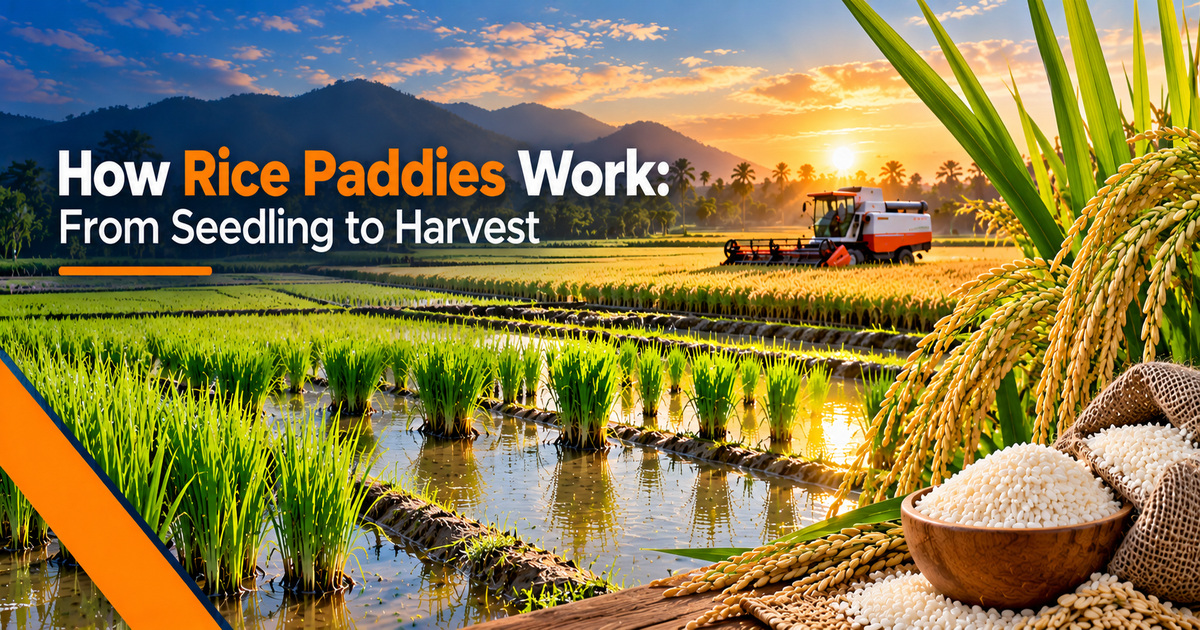
How Rice Paddies Work: From Seedling to Harvest
Explore the lifecycle of a rice paddy. Learn how farmers manage water, plant seedlings, and harvest the world's most important staple crop.
Introduction:
Have you ever looked at a bowl of perfectly fluffy white rice? Have you ever wondered about the journey rice took to get to your plate? Rice lives an extraordinary life underwater long before it reaches your kitchen.
The story of rice is written in the landscape of rice paddy. Because it's a brilliant combination of human engineering and natural symbiosis. Let's explore the world of paddy rice and find out the intricate anatomy of a paddy field. We can also exactly describe to you how this vital crop transforms from a fragile seedling into a golden harvest.
What is a Paddy?
We have to start with the word itself to truly understand how rice grows. The term "paddy" originates from the Malay word padi. This word translates to the rice plant while it is still growing in the field. Or the rice plant's with unhusks of grain after harvest.
A paddy field is a flooded parcel of arable land specifically designed to cultivate semi-aquatic rice. In this way, we can describe a paddy field in modern agricultural terms. While rice grows on dry soils and flooded land. That's why it offers a massive evolutionary advantage to farmers. It provides the heavy moisture rice craves. Because paddy naturally suffocates competing with weeds and pests that cannot survive underwater.
The Anatomy of a Rice Paddy:
A rice paddy is a high value one as compared to a muddy puddle. In fact, it is a highly sophisticated and closed-loop ecosystem. You will find several key structural components if you look closely at a functional paddy.
1) The Bunds (Dikes): These are the raised earthen walls that outline the perimeter of a paddy field. They act as natural dams in your paddy. Because these dikes keep the water locked inside the specific plot.
2) The Level Basin: The paddy floor must be perfectly flat for high yields. If the paddy ground slopes and water pools at one end. This situation leaves the other end dry and the paddy vulnerable to weeds.
3) The Hardpan Layer: Beneath the soft and ploughable topsoil, there is another layer. This is a compacted and impermeable clay layer that lies beneath the soft one. This layer prevents water from draining too quickly into the earth. Additionally this layer also holds the floodwater in place like a giant concrete pool liner.
4) Irrigation Inlets and Outlets: Farmers use small gates or channels in the bunds to carefully control the water level. While these bunds let fresh water in or drain the fields entirely when it is time to harvest.
You can also explore top 5 explort quality rice variety in Pakistan!
Key Differences Between Paddy and Rice:
People often use the terms "paddy" and "rice" interchangeably. But they mean very different things in the agricultural and culinary worlds.
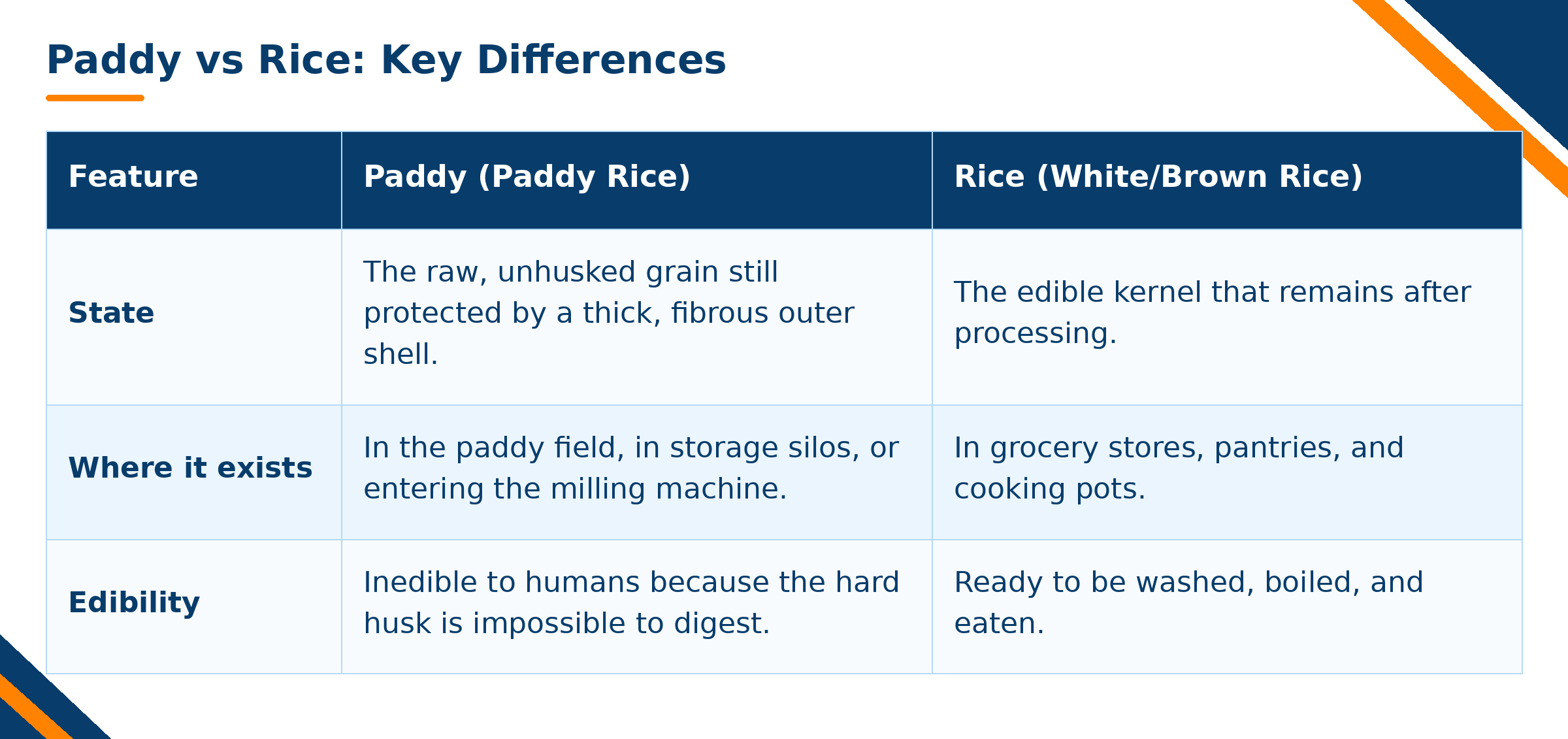
Think of it this way: paddy is the raw and rugged armor that protects the delicate treasure inside. In this way we eventually call called it rice.
Types of Rice Paddy Cultivations:
Depending on the geography, climate, and available resources, farmers across the globe utilize different methods to manage their paddy rice:
1) Lowland (Wetland) Paddies: These paddies show the classic image of rice farming. Because these flat fields rely on heavy rainfall or river irrigation networks. In this way, these lowland fields keep their soil completely submerged throughout the growing season.
2) Terraced Paddies: These types of land are found in mountainous regions. This includes Bali, the Philippines, or northern Pakistan's rice sector. These breathtaking steps are carved directly into the hillsides. Therefore, these lands utilize gravity to allow water to trickle smoothly down from one level to the next one.
3) Deepwater Paddies: Farmers grow specialized varieties of rice that can survive in water up to several meters deep in areas that are prone to intense seasonal flooding. In this way these stalks rapidly elongate to keep their leafy heads above rising water.
Here you can find out about rice bran!
The Lifecycle: From Seedling to Harvest:
Growing rice is a labor of love that requires precision timing. The cycle generally spans four distinct phases:
1) Preparation and The Nursery
Before a single seed hits the main paddy field, it is soaked and germinated in a specialized nursery bed. Meanwhile, the main paddy is flooded and plowed aggressively—a process called "puddling." Water buffaloes or tractors churn the soil into a thick, creamy mud texture that seals the hardpan beneath.
2) Transplanting
Once the nursery seedlings reach about 15 to 20 days old, they are pulled up and bundled. Farmers then wade into the muddy, flooded paddies to hand-plant the seedlings into the muck, spacing them evenly to ensure optimal sunlight and airflow.
3) The Flooded Growth Phase
For the next few months, the rice grows rapidly. The water depth is carefully maintained between 5 to 15 cm. The field turns into a sea of vibrant, neon green.
4) Draining and The Golden Harvest
As the grain heads fill up and mature, they change from green to a rich, heavy gold. At this point, the farmer opens the outlet gates and drains the paddy completely. Drying out the soil signals the plant to finish ripening and makes the ground firm enough for workers or heavy combine harvesters to cut the stalks.
Check outPakistan's best sella rice!
The Future of Rice Paddy in Pakistan:
As one of the world's top exporters of premium Basmati rice, Pakistan relies heavily on its paddy field infrastructure, particularly across the fertile plains of Punjab and Sindh. However, traditional farming faces massive challenges due to shifting climate patterns and severe water scarcity.
The future of the rice paddy in Pakistan lies in agricultural innovation. Forward-thinking farmers are transitioning to Alternate Wetting and Drying (AWD). Instead of keeping fields permanently flooded, they let the soil dry for a few days before re-flooding. This simple shift cuts water usage by up to 30% and significantly reduces greenhouse methane emissions.
Additionally, the adoption of Direct Seeded Rice (DSR)—where seeds are planted directly into dry soil rather than being transplanted into flooded mud—is gaining traction. It saves immense amounts of manual labor and precious water, proving that Pakistani agriculture can adapt to sustain future generations.
The Bottom Line:
The humble rice paddy is an absolute marvel of traditional agriculture that continues to feed billions of people every single day. From the meticulous leveling of the mud to the golden glory of the final harvest, it represents a perfect partnership between human ingenuity and nature. As global climates evolve, the methods we use to manage our paddy rice will change, but the essential role of the paddy field in global survival remains completely irreplaceable.
Frequently Asked Questions:
What is the difference between a rice paddy and a paddy field?
There is no difference between a rice paddy and a paddy field. Both terms refer to the same thing: a flooded parcel of arable land specifically engineered for planting, growing, and cultivating semiaquatic rice crops.
Why are rice fields kept flooded with water?
Rice fields are kept flooded primarily for natural weed and pest control. While rice plants can survive in waterlogged soil, most competing weeds and invasive bugs cannot. The water also regulates soil temperature and ensures the crop receives constant moisture.
Can you grow rice without a paddy?
Yes, rice can be grown without a flooded paddy using a method called "upland rice farming." In this process, rice is planted in dry soil on hillsides or flat fields and relies entirely on rainfall. However, upland farming yields significantly less rice than traditional wetland paddy farming.
What are the main types of rice cultivation?
The three main types of rice cultivation are lowland paddies (flat fields flooded by rain or rivers), terraced paddies (stepped fields carved into mountain slopes using gravity irrigation), and deepwater paddies (fields in flood-prone areas where long-stalk rice grows in deep water).
How long does it take from planting a seedling to harvesting rice?
It typically takes between 105 to 150 days (roughly 3.5 to 5 months) for rice to grow from a nursery seedling to a fully mature, golden crop ready for harvest, depending heavily on the specific rice variety and local climate.