Top 5 Major Crops of Pakistan: Production, Seasons & Uses
Want to know about the major crops of Pakistan? Dive into our comprehensive guide covering cultivation seasons, production yields, and industrial uses.
Introduction:
You aren't just looking at the borders of a random country when you look at a map of Pakistan. You are looking at a vast and living tapestry of green fields. You can also look at winding rivers and sun-drenched plains as well. Because agriculture is the absolute heartbeat of our country. Pakistan doesn't just feed its population only. Because it employs over 37% of the national labor force. While it contributes roughly a fifth to the entire country's GDP.
The answer lies in five powerhouse plants if you have ever wondered what keeps this agrarian engine running. Let’s dive deep into the world of Pakistani farming to explore the primary crops of Pakistan. These crops shape the economy, the culture, and the daily lives of millions of people.
What Are the Major Crops of Pakistan?
Distinct and deeply rooted canal network drives Pakistan's agricultural landscape. Because Pakistan's climate offers intense summer heat and crisp winter chills. When experts refer to the economic pillars of the rural economy they are talking about Pakistan's major crops.
These crops aren't just plants that are grown only for local subsistence. In fact, they are high-yielding and heavily traded commodities that dictate national trade balances. Because they don't only fuel massive industrial textile mills, but they determine the country's food security status as well. Pakistan's industrial and economic machinery would grind to a halt without these core crops.
Overview of Major Crops and Other Notable Crops:
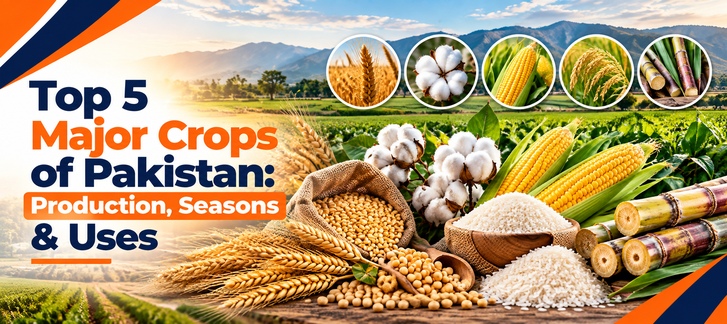
There are five distinct giants in Pakistan at the center of our green revolution. This includes wheat, rice, cotton, sugarcane, and maize. They occupy the vast majority of the country's fertile lands together. So particular these crops spread across the flat and alluvial plains of Punjab and Sindh.
The Big Five Crops:
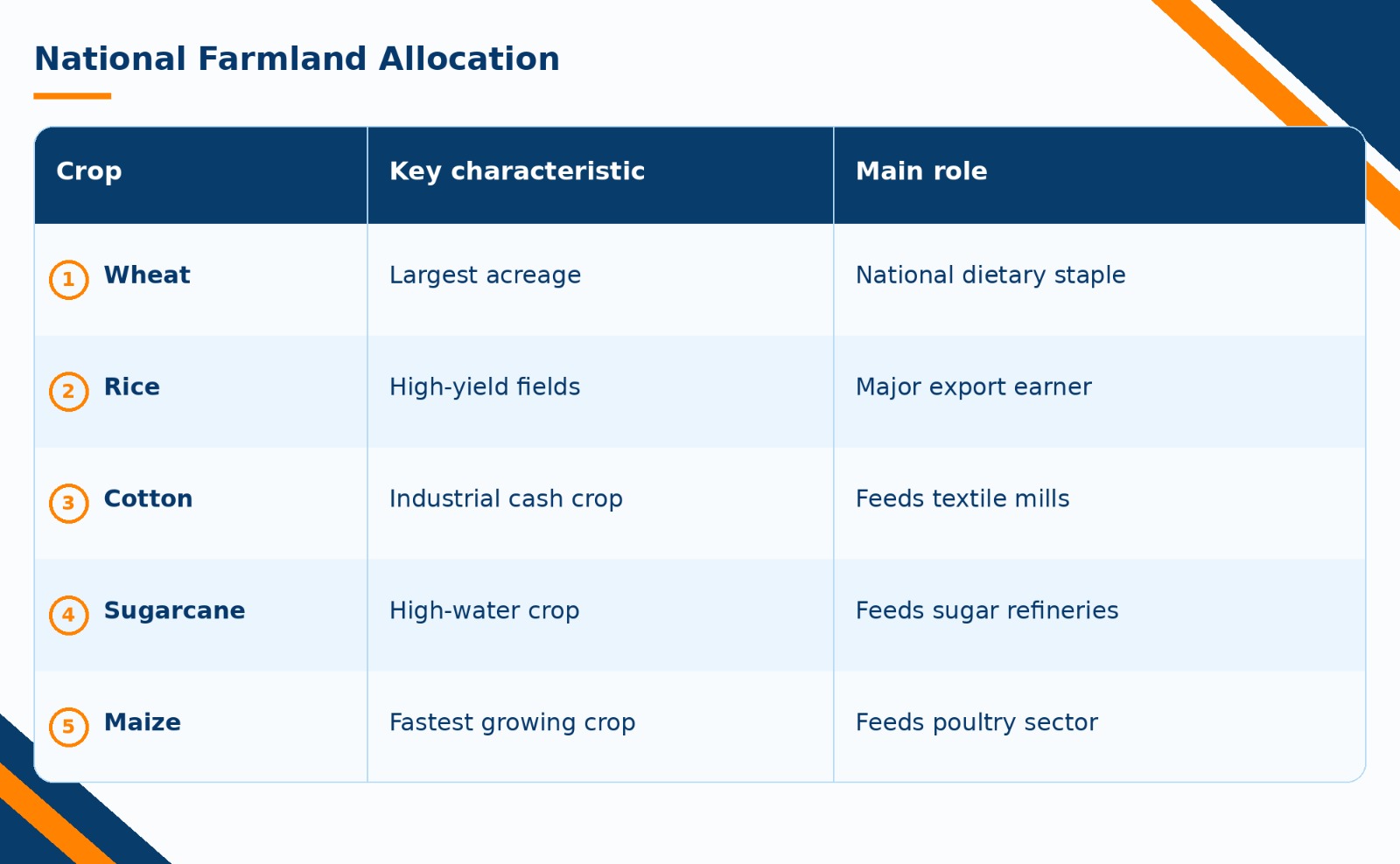
• Wheat: Wheat is the undisputed king of the kitchen table and the ultimate dietary staple in Pakistan.
• Rice: Rice is Pakistan's premium culinary export crop. While it's also celebrated worldwide in the form of fragrant basmati.
• Cotton: Cotton is locally called the "white gold" crop in Pakistan. Because it serves as the lifeblood of the massive domestic textile industry.
• Sugarcane: Sugarcane is a very important crop in Pakistan that keeps the country's massive sugar mills spinning.
• Maize: Maize is a rapidly expanding crop in Pakistan. Because it drives the poultry, livestock and starch industries in our country.
Other Notable Crops:
Pakistan's fertile soil yields a rich variety of secondary crops beyond the big five. There are gram (chickpeas), lentils, and mung pulses that fill the domestic protein gap in the country. While some oil seeds like mustard, canola, and sunflower dot the fields with bright yellow blooms. Furthermore, the country is a massive global producer of premium horticultural items as well. This includes sweet citrus (Kinnow) from Sargodha and world-class mangoes from Multan and Mirpurkhas.
The Production of Major Crops of Pakistan:
The sheer volume of agricultural output is a testament to Pakistan's farmers' hard work. While it's also a testament to the Indus Basin irrigation system's richness.
1) Wheat Production: Wheat occupies the largest area of cultivated land in Pakistan. Because it has annual outputs regularly crossing 28 to 30 million metric tons. These numbers place Pakistan among the top ten wheat producers globally.
2) Rice Production: Rice roughly produces 9 to 10 million tons annually in our country. Because the unique climate of the Kallar tract in Punjab gives Basmati rice its signature aroma. This uniqueness makes our rice a hot commodity on international markets.
3) Cotton Production: Cotton is a very sensitive crop in Pakistan. Because changing weather patterns though heavily affect it. But Pakistan remains a top global cotton producer. This crop pulls in millions of bales annually to keep its textile factories alive.
4) Sugarcane Production: Sugarcane is annually yielded between 80 and 88 million tons in Pakistan. This makes it a massive industrial cash generator for the rural elite crop.
5) Maize Production: Maize production has skyrocketed over the last decade in Pakistan. Therefore, this crop is consistently crossing 10 million tons of production. This is due to the adoption of high-yielding hybrid seeds.
Seasons for Pakistani Crops:
Farming in Pakistan revolves around two main agricultural seasons. The monsoon and the Indus River system's water flow entirely dictate these seasons.
1) The Kharif Season (Summer/Monsoon)
The Kharif season in Pakistan is seen between April and July. Kharif crops depend on high temperatures and heavy monsoon rains to be ready. Therefore, they are harvested in the late autumn (October to December).
1) Crops grown: Rice, Cotton, Sugarcane, and Maize are the major crops of this season.
2) Climate factor: These crops require long, sunny days and massive volumes of water as well.
2) The Rabi Season (Winter/Spring)
The Rabi season in Pakistan is seen in the cooler months between October and December. The Rabi crops rely on winter showers and lingering soil moisture. Therefore, these crops are harvested in the hot spring of March and April months.
1) Crops grown: Wheat, chickpeas, barley, and mustard are the major crops that grown in this season.
2) Climate factor: These crops require mild winter temperatures and ripen rapidly in the bright spring sun.
Uses of Major Crops: From Kitchens to Factories:
The journey of these crops in Pakistan doesn't end at harvest. Because each crop serves a vital purpose in our country. Therefore each crop bridges the gap between rural farms and urban consumer markets.
1) Wheat: Wheat is ground into fine flour (atta) to make flatbreads like rotis and naan for us. In fact, it satisfies the core daily caloric needs of nearly 250 million Pakistani people.
2) Rice: Rice serves as a luxury food item domestically. Therefore, it acts as a massive foreign exchange earner through global exports.
3) Cotton: Cotton has raw fibers that are spun into yarn and woven into fabrics. While it is also tailored into the garments that have driven Pakistan’s number one export sector: textiles.
4) Sugarcane: Sugarcane is beyond our table sugar. Because it has a by-product of molasses which is transformed into ethanol. While its leftover crushed stalks are called bagasse. Bagasse is burned to generate eco-friendly biomass power for industrial grids.
5) Maize: Maize is acting as the primary ingredient in high-protein poultry feed. This crop directly stabilizes the prices of chicken and eggs on the local market.
Future of Major Crops of Pakistan:
Pakistani agricultural's road ahead is both exciting and incredibly challenging. Because climate change poses a severe threat and brings unpredictable monsoons that damage crops. While intense heatwaves and sudden floods that can devastate standing fields in a matter of hours.
Pakistan is actively shifting to modern agricultural practices to secure its future. Drain irrigation's widespread adoption is saving precious water resources in arid regions. Meanwhile, local research institutions are developing heat-tolerant and drought-resistant seed varieties in Pakistan. These steps are taken to safeguard yields from rising global temperatures in our country. Corporate farming initiatives and digital apps provide real-time weather forecasts. Smallholders that adopt this technique are steadily modernizing the ancient Indus valley.
The Bottom Line:
Ultimately, the major crops of pakistan form the literal lifeblood of the country. From the morning roti on the table to the cotton shirt on your back, these five crops touch every single aspect of Pakistani life. By empowering local farmers, investing in modern agricultural tech, and building climate resilience, Pakistan can protect its historic breadbasket and ensure prosperity for generations to come.