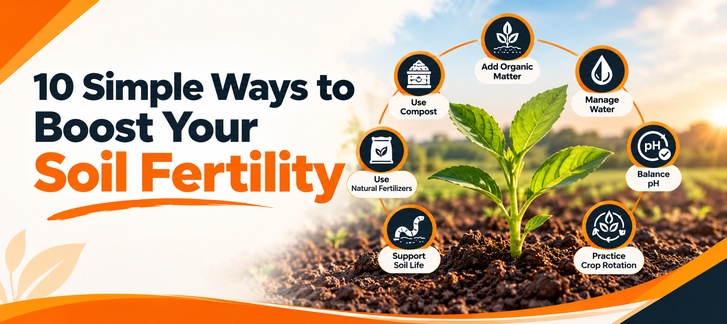
10 Simple Ways to Boost Your Soil Fertility
Boost your soil fertility naturally with these 10 simple tips. Learn how to improve soil health, enrich nutrients, and get higher crop yields.
Introduction:
Healthy crops begin long before the first green shoot appears above the ground. Because beneath every productive field there is a living system of minerals and organic matter. While some microorganisms, water and air are also available in our soil. These conditions of that system largely determine how well crops can grow.
That's why soil fertility is called the foundation of successful agriculture.
Fertile soil provides plants with nutrients and physical support. They will also provide moisture for better seed development. Because seeds need to develop strong roots. So they easily produce healthy yields. But soil fertility is not permanent in every season. This is because continuous cropping and poor fertilizer management can gradually reduce fertility levels. Additionally erosion and nutrient depletion through excessive tillage also reduce the productive capacity of your farmland.
But we have good news for you! Sounds interesting? Yes, your soil can be improved.
From adding organic matter and rotating crops to using fertilizers intelligently. Because these are the keys to success in this mission. While protecting your soil from erosion can also help your soil to improve. Farmers have many practical options in this field. Here are 10 simple ways to improve your soil's fertility. These simple ways will also build healthy farmland in the long term.
What Is Soil Fertility?
Soil fertility refers to the ability of soil to provide plants with nutrients. This also requires water and the physical conditions for healthy growth of your crop.
Some plant nutrients include macronutrients such as nitrogen and phosphorus that play an important role. While potassium is along with secondary and micronutrient also important for soil.
However, fertile soil is about more than nutrients. Good soil fertility also depends on:
1) Organic matter
2) Soil structure
3) Water-holding capacity
4) Drainage
5) Biological activity
6) Appropriate soil pH
7) Nutrient availability
Soil can contain nutrients but still produce poor crop yields. Especially if the soil structure is damaged or its pH is unsuitable for crops. Or its nutrients are unavailable to plants, it affects your crops.
Why Is Soil Fertility Important?
Soil fertility directly influences crop establishment and plant quality. It also influences plant growth and its yield.
Farmers may need greater quantities of external inputs to maintain production when soil fertility declines. Because poor soil can also become more vulnerable to erosion and nutrient losses to your crop.
Therefore maintaining fertility can help farmers improve their crop productivity. While it also protects one of their most valuable agricultural resources as well.
Healthy soil also supports microorganisms and other organisms. Because these factors contribute to the nutrient cycling. Additionally, these factors can improve the ecosystem functioning of your crops.
In simple terms, you could say that fertile soil is an investment in every future harvest.
10 Simple Ways to Improve Soil Fertility:
1) Add Organic Matter
Increasing organic matter in the soil is one of the most effective ways to improve its health.
Because crop residues and other organic materials can contribute carbon to the soil. While compost and well-decomposed manure can contribute nutrients to the soil.
Organic matter can improve soil structure and water retention in soil. While helping the soil become more resilient as microbial activity.
The key to success is using properly prepared organic materials for your soil. While applying these materials according to crop and soil requirements is also necessary.
2) Practice Crop Rotation
The answer lies in soil diversity. If you are wondering how crop rotation improves soil fertility.
Growing the same crop repeatedly can remove similar nutrients from the soil. This practice also encourages the build-up of particular pests and diseases on your crop. Therefore crop rotation changes the demands that are placed on your soil.
For example, beans or other nitrogen-fixing crops including legumes such as peas. While the rotation technique can contribute nitrogen to the organic farming system. As it works through biological nitrogen fixation.
Different crops also have different root systems. Some crops explore deeper soil layers. While other crops have shallower roots. This root system creates a more diverse nutrient uptake patterns.
Therefore a well-designed rotation technique can support the nutrient cycling of your crop. While this practice also breaks pest cycles and improves overall soil health.
3) Use Cover Crops
Cover crops are grown primarily to protect your soil. While it also improves your soil rather than directly harvesting into it.
Cover cropping techniques can protect the soil surface from rainfall and wind erosion. While it also adds organic matter especially when it is incorporated or left as residue.
Cover crops can also help suppress weeds depending on species. Because it improves soil structure and captures important nutrients that might be lost otherwise.
Legume cover crops can be particularly useful for crops where nitrogen management is a priority.
4) Use Fertilizers Based on Soil Needs
Fertilizers can play an important role in soil fertility management. But more fertilizer does not necessarily mean that you have more fertile soil.
The objective should be to provide nutrients in the appropriate amount and location for your soil. While the form and timing of the nutrients also matter in this scene.
Soil testing can easily help you identify nutrient deficiencies in the soil. While it also guides fertilizer decisions for your crops accordingly.
Farmers should consider crop requirements and existing soil nutrient levels when developing a fertiliser program. Because it helps farmers boosting crop yields.
Balanced fertilization can improve crop productivity for farmers. While it also reduces unnecessary input costs and nutrient losses for crops.
5) Protect Soil From Erosion
Topsoil is an extremely valuable part of the soil. Because it contains organic matter and important nutrients with some biological activity as well.
While wind and water erosion can remove this upper most productive layer.
Farmers can reduce erosion through practices such as:
1) Maintaining crop residues
2) Planting cover crops
3) Contour farming
4) Terracing where appropriate
5) Reducing excessive tillage
Protecting soil that already exists is often an easier factor. Because it's cheaper than trying to rebuild it after severe degradation of the soil.
6) Reduce Excessive Tillage
Tillage is another useful technique for preparing seedbeds. Because it manages certain field conditions for you. But excessive soil disturbance can damage the soil structure. While it also accelerates organic matter loss in the soil.
Conservation tillage and reduce-tillage systems aim to minimize unnecessary disturbance to the soil. While maintaining conservation tillage creates productive conditions for your crops.
Keeping crop residues on the soil surface can also provide protection against erosion. Additionally you can also manage temperature fluctuations with this technique.
The appropriate tillage system depends on soil type and farm equipment. While this system also depends on crop and climate conditions. So, there is no universal formula that always maintains this system.
7) Maintain the Right Soil pH
Generally soil pH influences many plant nutrients' availability.
Certain nutrients may become less available to plants if the soil becomes too acidic or too alkaline. Even when they are physically present in the soil.
The soil testing process can easily identify pH problems. Agricultural lime or other soil amendments can be used to correct the acidity problem where appropriate.
The important point is to test your soil first rather than applying amendments that are based on guesswork.
8) Encourage Beneficial Soil Microorganisms
The soil is always alive.
Because billions of microorganisms participate in the decomposition process. While including bacteria and fungi which also play a part in the nutrient cycling process.
Reduced unnecessary soil disturbance is favorable for beneficial soil organisms. While also maintaining diverse plant growth which can help to create healthier conditions for the soil.
For example mycorrhizal fungi can form associations with plant roots. Where it also contributes to nutrient and water acquisition in many agricultural systems.
A healthy microbial community is an important part of long-term soil fertility.
9) Manage Water Carefully
Water management and soil fertility are closely connected.
Excessive irrigation can cause nutrient leaching, waterlogging and other soil problems. Insufficient water can limit nutrient uptake because plants require adequate moisture to transport nutrients through their tissues.
Efficient irrigation, good drainage and maintaining soil organic matter can help create a better balance.
The objective is not simply to provide more water but to provide the right amount at the right time.
10) Diversify Your Farming System
Diversity can make agricultural ecosystems more resilient.
Growing multiple crops, integrating livestock where appropriate, maintaining beneficial habitats and using different types of cover crops can create more complex nutrient and biological cycles.
Diversification can also reduce dependence on a single crop and provide farmers with additional production or income opportunities.
What Are the Pillars of Regenerative Agriculture?
Regenerative sustainable agriculture places particular emphasis on rebuilding soil health while maintaining productive agricultural systems.
Although approaches vary, several commonly emphasized principles include:
1) Minimizing soil disturbance
2) Keeping soil covered
3) Maintaining living roots
4) Increasing plant diversity
5) Integrating livestock where appropriate
6) These principles overlap significantly with soil-fertility management.
The central idea is to move beyond simply maintaining soil and instead create farming systems that can gradually improve soil structure, biological activity and nutrient cycling.
The Role of Fertilizers in Soil Fertility:
Fertilizers provide concentrated sources of plant nutrients and can be essential for replacing nutrients removed through crop harvests.
There are three broad categories worth understanding: organic fertilizers, inorganic fertilizers and biofertilizers.
Organic Fertilizers
Organic fertilizers include materials such as compost, animal manure and plant-derived amendments.
They can contribute nutrients while also adding organic matter, depending on the material.
Their nutrient concentrations can vary, so farmers should consider both nutrient content and application rates.
Inorganic Fertilizers
Inorganic or mineral fertilizers provide specific nutrients in relatively concentrated and predictable forms.
Nitrogen, phosphorus and potassium fertilizers are widely used in agriculture.
Their effectiveness depends heavily on proper application. Excessive or poorly timed applications can increase nutrient losses and environmental risks.
Biofertilizers
Biofertilizers contain beneficial microorganisms that can help improve nutrient availability or support plant nutrient acquisition.
Examples include microbial products involving nitrogen-fixing bacteria or microorganisms associated with phosphorus availability.
Biofertilizers are not necessarily replacements for all conventional fertilizers. Their effectiveness depends on the microorganism, crop, soil conditions and management practices.
How Is Soil Fertility Enhanced?
The best answer to "how is soil fertility enhanced?" is through a combination of practices rather than one single input.
A strong soil-fertility program may combine:
Soil testing + organic matter + crop rotation + balanced fertilization + cover crops + erosion control + appropriate irrigation + reduced soil disturbance.
This integrated approach addresses both nutrient supply and the physical and biological health of the soil.
Long-Term Benefits of Fertile Soil
Investing in soil fertility can provide benefits far beyond one growing season.
Healthy, fertile soil can support:
1) More consistent crop growth
2) Better nutrient availability
3) Improved water retention
4) Greater resistance to erosion
5) Increased biological activity
6) More efficient fertilizer use
7) Improved resilience to environmental stress
8) Sustainable long-term productivity
9) Perhaps the greatest benefit is continuity.
A farmer who protects soil fertility today is protecting the productive potential of tomorrow's farm.
Wrap Up:
Soil fertility is not something that can be created overnight. It is built gradually through thousands of small interactions between roots, microorganisms, organic matter, minerals, water and careful farm management.
The simplest strategy is to stop thinking of soil as an inert growing medium and start treating it as a living agricultural resource.
Add organic matter. Rotate crops. Keep the soil covered. Protect it from erosion. Test before fertilizing. Manage water carefully. Reduce unnecessary disturbance and encourage biological diversity.
These practices may look simple individually, but together they can transform the way farmland performs over time.
Ultimately, the goal of soil fertility management is not merely to produce a bigger harvest this season. It is to create soil capable of supporting healthy crops, efficient farming and productive harvests for years to come.
Reference:
Wikipedia: Soil Fertility
Science Direct: Soil Fertility a An Overview
FAQ's:
1) What exactly is soil fertility?
Soil fertility is the natural capacity of soil to sustain agricultural plant growth. Because it provides essential nutrients and an optimal chemical environment for the soil. While water provides balanced proportions to the soil. It not only reflects on the soil's ability to support clean and productive plant growth. But it can be free of toxic levels of harmful minerals as well.
2) What are 5 ways to increase soil fertility?
1) Organic Manure: Added compost or farmyard manure or poultry waste to your soil. Because it enriches the humus and soil microbial lives which are essential for soil health.
2) Crop Rotation: Alternate harvesting of different crop techniques can prevent specific nutrients depletion in the soil. For example, especially integrating nitrogen-fixing legumes like beans or peas.
3) Use of Green Manure: Growing specific crops (like alfalfa or clover) and then plowing them back into the soil. This practice can grow green building organic matter.
4) Balanced Chemical Fertilizers: You must apply N-P-K (Nitrogen, Phosphorus, Potassium)-based fertilizers to your soil. Because exact soil testing can result in fixing specific deficiencies in soil.
5) Cover Cropping: Planting off-season crops in order to protect the topsoil from wind and water erosion. Because these crops can retain nutrients that are good for your soil.
3) What are the two types of soil fertility?
1) Inherent (Natural) Fertility: Soil's natural nutrient capacity can possess from its native parent rock. Or it can possess it from geological formations and exist without human intervention.
2) Acquired Fertility: Soil's enhanced fertility can be gained over time through artificial or human management. Such as irrigation, tillage, and fertilizer application for crops.
4) What are the three main principles of soil fertility?
1) Right Source and Right Rate (Nutrient Balance): Supplying all essential macro and micronutrients in the correct chemical form to your soil. Because specific plants have specific quantities required according to your crops.
2) Optimal Soil pH and Chemistry: You must maintain a stable soil pH (typically between 6.0 and 7.0) for better results. So that basic nutrients remain available chemically to your root system. Rather than you being locked them up.
3) Organic and Biological Health: Preserving organic matter content efficiently. Because they not only contribute to the cycle of nutrients. But they also promote active soil biology (bacteria, fungi, and earthworms) and maintaining soil structure as well.