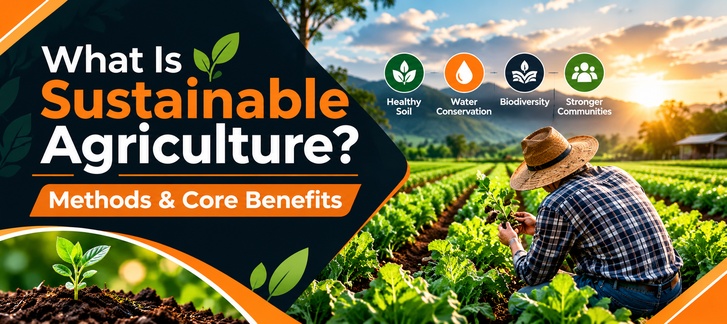
What Is Sustainable Agriculture? Methods & Core Benefits
Learn how sustainable agriculture boosts green farming. Explore key eco-friendly methods, practices, and vital environmental benefits in our complete guide.
Sustainable Agriculture As a Farming Approach:
As we know, agriculture feeds the world. But can it produce enough food for a growing population? This statement comes with a difficult question. How can we grow more without exhausting our land? How can we grow more without exhausting the water and natural resources? How can we grow more without exhausting the farming resources?
The answer increasingly points toward sustainable agriculture practices.
Sustainable agriculture is a farming approach that aims to produce more food profitably. While it's protecting the soil and the people who depend on agriculture. Further this practice is also protecting our water and biodiversity. It is not about going backwards or abandoning modern farming techniques. Instead, it combines traditional knowledge with technology and smart resource management.
Whether you talk about crop rotations or water conservation techniques. Or whether you talk about precision agriculture and renewable energy. Sustainable farming offers practical ways in order to make agriculture more productive and resilient in this field.
What Is Sustainable Agriculture?
Sustainable agriculture is a farming system that is designed to meet today's food and economic needs. This system is designed without compromising the ability of future generations to produce food.
Unlike other farming models that focus primarily on short-term production. Sustainable agriculture systems consider the long-term health of the entire agricultural system.
A sustainable farm aims to balance three important goals:
1) Protecting the environment
2) Supporting farmers and rural communities
3) Maintaining economic viability
This means a farmer needs healthy soil and a profitable business. While the farmer also needs reliable water and productive crops. If one of these elements continuously suffers in this system. Then any kind of farming system becomes difficult to sustain.
Sustainable agriculture is not only practiced in small family farms. But it is also practiced in large commercial operations. The specific techniques may differ depending on the crop climate and available resources. On the other hand soil also plays a part in different specific techniques.
Why Is Sustainable Agriculture Important?
Agriculture is closely connected to some of the world's biggest environmental challenges. While it also faces some economic issues as well.
Basically farming requires land and water both at the same time. On the other hand agricultural activities can influence soil health and greenhouse gas emissions. Whereas biodiversity is also connected to agricultural activities. Therefore farmers face unpredictable weather and growing pressure to produce more food. Additionally some changing input costs and pests also challenge the farmers.
That's why sustainable agriculture matters in today's times.
1) Conserving Water
Water scarcity has become a major concern in many agricultural regions. Especially when you talk about major agricultural water-related issues around the world. Therefore sustainable farming encourages many farmers to use water more efficiently through drip irrigation as well. While rainwater harvesting and soil-moisture monitoring systems also encourage farmers to improve irrigation scheduling.
2) Supporting Biodiversity
A fully productive farm does not exist in an isolated environment. Because pollinators and other organisms can contribute to healthy agricultural ecosystems. The ecosystem is where earthworms, microorganisms and birds all contribute to a productive farm.
Maintaining field margins and protecting natural habitats can help support biodiversity. While planting diverse crops can also support the ecosystem.
3) Improving Farm Resilience
Extreme weather conditions can also disrupt agricultural production around the world. So sustainable systems can improve their resilience. Because diversifying crops and reducing dependence on a single resource can improve the system. Same as conserving soil moisture can upgrade your farm's production method.
The Pillars of Sustainable Agriculture:
Sustainable agriculture systems are often understood through three interconnected pillars. These pillars are environmental sustainability, economic sustainability and social sustainability in agriculture.
1) Environmental Sustainability
The pillar of environmental sustainability always focuses on protecting natural resources.
Farmers can improve their environmental sustainability through some practices. While these practices reduce soil erosion and minimize unnecessary agricultural pollution. Environmental sustainability focuses on conserving water and managing nutrients carefully to protect biodiversity.
The goal is not simply to produce a crop today. But the goal is to maintain the land's ability especially to produce better crops for tomorrow.
2) Economic Sustainability
A farm cannot remain sustainable. If farmers cannot make a living off a farming system.
So economic sustainability means improving farm productivity and profitability. While managing production costs and risks on farms are also economic sustainability examples.
Efficient irrigation and access to reliable grains markets can all contribute to a healthy agricultural business. Also the precision application of fertilizers and reducing post-harvest losses can help use better crop varieties on your farms.
3) Social Sustainability
Agriculture depends on people. Therefore farmers and rural communities are all part of our food system. While farm workers, traders and processors also play a part in our food system.
Social sustainability in agriculture focuses on fair working conditions and maintaining viable rural economies. Moreover social sustainability is also connected to food security and community development.
These three pillars are interconnected to each other. On the other hand environmental degradation can eventually increase the production costs of your farm. Bad economic conditions can make it harder for farmers to invest in sustainable practices.
Principles of Sustainable Agriculture:
Several fundamental principles guide the sustainable agricultural systems.
1) Resource Conservation
Natural resources according to your farm should be used efficiently rather than treated as unlimited. Because long-term productivity is in our mind. So we need to manage our soil, water and energy.
2) Soil Health
Healthy soil will always support your healthy crops. Therefore sustainable farmers focus on maintaining organic matter and biological activity on their farms. Additionally they also focus on nutrient balance and soil structure for healthy yields.
3) Biodiversity
Agricultural diversity strengthens our ecosystems. While this practice can also help to reduce vulnerability to pests and changing environmental conditions on your farms.
4) Efficient Resource Use
Applying the right amount of water and fertilizer at the right time can reduce waste. While applying other inputs can also improve your farm efficiency.
5) Resilience
A sustainable agricultural system should also be able to cope with droughts and other disruptions. Additionally the system should also be able to face floods, heat, pests and market fluctuations.
6) Responsible Innovation
Technology has an increasingly important role in agriculture as well. But innovation should solve the real problems of your farm rather than simply adding complexity. Therefore the best solutions can improve farm productivity. While also reducing resource use and environmental pressure on your farms.
Common Sustainable Agriculture Practices:
There is no single recipe for sustainable farming. Farmers can combine different practices according to their local conditions.
Crop Rotation
Growing different crops in succession can improve nutrient management and disrupt pest and disease cycles.
For example, including legumes in a crop rotation can contribute nitrogen to the farming system while diversifying production.
Conservation Tillage
Conservation tillage reduces the amount of soil disturbance compared with conventional intensive tillage.
Keeping more crop residue on the soil surface can help reduce erosion and protect soil moisture.
Cover Crops
Cover crops are planted primarily to protect and improve the soil rather than for direct harvest.
They can help reduce erosion, suppress weeds, improve soil structure and contribute organic matter.
Integrated Pest Management
Integrated pest management, or IPM, combines monitoring, biological controls, cultural practices and carefully targeted pesticides when necessary.
Instead of automatically treating every pest problem with chemicals, IPM focuses on preventing and managing pests efficiently.
Drip Irrigation
Drip irrigation delivers water close to the plant's root zone. This can improve water-use efficiency compared with less targeted irrigation methods.
Composting
Composting converts organic materials into a useful soil amendment. It can return nutrients and organic matter to agricultural soils while reducing organic waste.
Top Innovations in Sustainable Agriculture:
Technology is changing what sustainable farming looks like.
Some of the top innovations in sustainable agriculture include precision agriculture, artificial intelligence, agricultural drones, satellite imagery, smart irrigation and automated farm machinery.
1) Precision Agriculture
Precision agriculture uses data to understand differences within a field.
Satellite imagery and farm-management software can help farmers identify infected areas. Or those areas that require different amounts of water or fertilizer or crop protection.
Instead of treating an entire field identically to farms. Farmers can increasingly make decisions that are based on actual field conditions.
2) Smart Irrigation
Smart irrigation systems can combine weather information and automated controls to determine when crops need water.
This system can help reduce unnecessary irrigation on farms. While this system also maintains adequate moisture levels for crops.
3) Agricultural Drones
Drones can capture aerial images of fields that can help farmers identify crop stress and other issues. Drones can also verify irrigation problems and pest damage on farms.
Early detection can allow farmers to respond before a small problem becomes a major loss.
4) Artificial Intelligence
AI is increasingly helping crop monitoring and farm decision-making these days. Additionally, it helps with disease detection, yield prediction and weather analysis around your farm.
The long-term opportunity is to turn large volumes of agricultural data into practical recommendations for farmers.
Best Ways to Support Sustainable Agriculture:
Sustainable agriculture is not only our farmers' responsibility. Because businesses, governments and consumers all have a role to play in this system.
Some of the best ways to support sustainable agriculture include:
1) Buying responsibly produced agricultural products
2) Reducing food waste
3) Supporting local farmers where practical
4) Investing in efficient irrigation and agricultural technology
5) Promoting soil-health practices
6) Encouraging responsible water management
7) Supporting research into climate-resilient crops
8) Improving agricultural supply chains
9) Helping farmers access markets and modern technology
Responsibility-sourced agricultural commodities can also support sustainability. Because businesses can reduce agri supply-chain waste and work with farmers on efficient production systems.
The Future of Sustainable Agriculture:
The future of agriculture will likely be defined by a combination of biology, data and technology.
Farmers will continue to need conventional agricultural knowledge, but they will increasingly have access to tools that allow them to make more precise decisions.
Satellite monitoring can reveal crop conditions from above. Sensors can provide information about soil moisture. AI can process enormous datasets. Improved crop varieties can help farmers deal with environmental stress. Renewable energy can reduce dependence on conventional power sources in some agricultural operations.
However, technology alone cannot make agriculture sustainable.
The most successful systems will combine modern innovation with fundamental agricultural principles: healthy soil, efficient water use, biodiversity, responsible resource management and profitable farming.
Wrap Up:
Sustainable agriculture is ultimately about creating a better balance between food production and resource conservation.
The objective is not simply to grow more food. It is to build agricultural systems that can continue producing food while protecting the soil, water, ecosystems and communities that make farming possible.
From crop rotation and conservation tillage to precision agriculture, smart irrigation and AI-powered farm management, today's farmers have more tools than ever to make production smarter and more efficient.
As climate pressures, resource constraints and global food demand continue to evolve, sustainable agriculture will become increasingly important. The farms of the future will not necessarily be those that use the most resources, but those that learn to produce more value from every drop of water, every hectare of land and every unit of input.
That is the real promise of green farming: productive agriculture today, without sacrificing the resources needed for tomorrow.