Top Agriculture Innovations and Technologies for Farmers
Explore the top agriculture innovations and technologies transforming farming. Discover smart tech, AI, and autonomous tools boosting yield and efficiency.
Introduction - Agriculture Innovations:
Agriculture has always evolved with human civilization over the period. Whether you talk about the first irrigation system or today's modern tractors. Therefore, every major technological breakthrough has changed the way farmers produce food for us. However, agriculture is entering a particularly transformative era today.
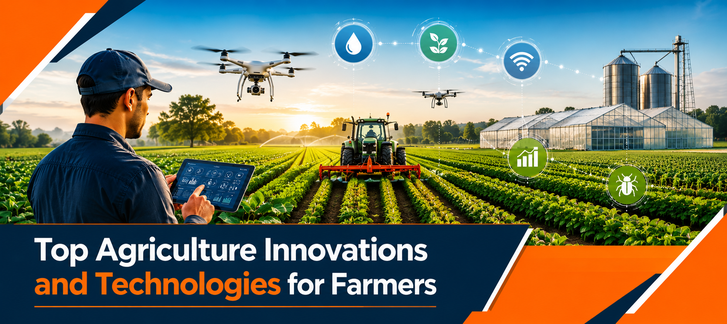
Farmers face rising input costs and an increasing demand for food in the field nowadays. Meanwhile, farmers also face unpredictable weather conditions, water scarcity and soil degradation. Important technologies such as artificial intelligence and smart irrigation are creating new possibilities for farmers at the same time. Also robotics, sensors, drones and GPS systems are making new ways into agriculture.
Therefore, agricultural innovation is playing an increasingly important role in the world's survival.
Modern farming is no longer simply about putting seeds in the ground and waiting for the harvest. Because it's becoming data-driven, automated, and an increasingly precise operation for farmers. The combination of agricultural innovation and technology can help farmers produce more efficiently reduce agricultural waste and conserving resources. That's why these techniques make farmers take better decisions for a better tomorrow.
Here are some of the most important innovations that are transforming agricultural field.
What Is Agriculture Innovation?
Agricultural innovation refers to new technologies and techniques that transform the agriculture. While some new products and approaches are designed to improve farming and agricultural production.
These innovations can address different parts of the agricultural process in the field:
1) Crop production
2) Irrigation
3) Farm machinery
4) Pest management
5) Livestock production
6) Soil monitoring
7) Harvesting
8) Storage
9) Supply chain management
10) Market access
Modern farming techniques are not necessarily replace traditional farming. While modern agriculture innovation can combine agricultural knowledge with technology. Because modern techniques make farming more productive, efficient and sustainable for farmers.
1) Farm Automation
Farm automation techniques are one of the most visible developments in modern agriculture.
Because farming has depended heavily on manual labour for its activities traditionally. Some techniques such as planting, spraying, harvesting, and sorting are the most important ones. Rising labour costs and shortages have encouraged farmers to explore automated alternatives to agriculture.
Modern agricultural machinery can now perform many operations with greater precision techniques.
Automated Tractors
Modern tractors can follow predetermined routes across the fields. Because these tractors are equipped with GPS and advanced navigation systems. Some systems can operate with limited human intervention in the fields. While these systems help farmers to maintain accurate planting and harvesting patterns in agriculture.
Robotic Harvesting
Robots have increasingly developed systems to identify and harvest crops. Moreover computer vision allows machines to distinguish between ripe and unripe produce in fields.
Although robotic harvesting techniques are still developing for many crops. Yet it has significant potential for labour-intensive agriculture.
Automated Weed Control
Agricultural robots can identify weeds in the fields. These robots can also remove or treat weeds without applying chemicals across an entire field.
This practice can potentially reduce herbicide usage on farms. While it also protects your crops in the long run.
Farm automation demonstrates how agriculture innovations and technology can reduce repetitive work. Same as how automation techniques improve the operational efficiency of farming.
2) Precision Agriculture
Precision agriculture is another major area of modern agriculture innovation.
If every part of your field had identical conditions. Instead of treating an entire field, what should you do? You can use precision agriculture and its data to understand variation within individual fields.
Farmers can use:
1) GPS technology
2) Satellite imagery
3) Drones
4) Soil sensors
5) Weather data
6) Yield monitoring systems
7) Artificial intelligence
Where do the crops need more water, fertilizer, or attention? Basically these tools can help farmers to determine many things.
How Precision Agriculture Works?
Imagine a farm on 100 acres.
Traditional farming may apply approximately the same amount of fertilizer across the entire field of the farm.
But precision agriculture can identify areas where soil nutrients are already sufficient. It also identifies other areas where additional fertilizer may be required.
Therefore farmers can then adjust their applications according to their farm.
This approach can help:
1) Reduce input waste
2) Improve crop productivity
3) Lower production costs
4) Protect soil health
5) Improve resource efficiency
The ability to make decisions based on field-level data. While this data has become one of the defining characteristics of modern agriculture.
3) Drones and Satellite Technology
Drone technology has become a more powerful tool for agricultural monitoring of fields.
Agricultural drones can capture detailed images of the fields. Because they are equipped with cameras and specialized sensors for better results.
Farmers can use this information to identify:
1) Crop stress
2) Pest infestations
3) Water shortages
4) Nutrient deficiencies
5) Disease symptoms
6) Uneven crop growth
Satellite imagery technology provides another layer of information about your farm.
Farmers and agricultural professionals can monitor field conditions remotely through these techniques. Instead of physically inspecting every part of your large farm.
These technologies can help identify future potential problems when they are combined with artificial intelligence. But before they become widespread.
4) Artificial Intelligence in Agriculture
Artificial intelligence is becoming an important part of agricultural innovation these days.
That's why AI systems can process large amounts of information from farms. While it also identifies patterns which may be difficult to detect manually by farmers.
For example, AI can be used to analyze:
1) Weather conditions
2) Soil information
3) Historical crop performance
4) Market trends
5) Satellite images
6) Pest and disease patterns
This information can help farmers make more informed decisions about farms.
AI-powered systems may also provide recommendations regarding irrigation and planting schedules. These systems may also provide crop protection and harvesting information for farms.
The combination of AI and agricultural machinery could create increasingly autonomous farming systems. Because modern sensors and robotics technology will make better decisions about fields in the future.
5) Livestock Farming Technology
Agriculture innovation is not only limited to your crops.
Because technology is also transforming livestock farming for a better future.
Farmers can use sensor technology to track animals' health. Farmers can also use digital monitoring systems to track animals' behaviour.
These systems may monitor:
1) Movement
2) Feeding behaviour
3) Body temperature
4) Reproductive cycles
5) Milk production
6) General health indicators
Early detection techniques can allow farmers to identify animals' potential health problems. Before these problems become serious.
Smart Dairy Farming
Automated milking systems in dairy operations can reduce manual labour. While this system also monitors milk production of cattle.
Digital systems can also help farmers manage their individual animals. Rather than treating them as an entire herd or as one unit.
This type of technology can improve productivity in a cattle farm. While it also supports better animal management on your farm.
6) Water Management Technology
As we know, water is always one of agriculture's most valuable resources.
Therefore increasing water scarcity makes efficient irrigation essential for farming. Because scarcity is a central priority for farmers around the world.
Traditional irrigation techniques can sometimes result in significant water loss. Because this loss happens through evaporation, runoff, or over-watering in the fields.
But modern irrigation technologies aim to deliver water more precisely to the field.
Drip Irrigation
Drip irrigation techniques can deliver water directly to the plants root zone in fields.
This method can significantly improve water-use efficiency compared to some other conventional irrigation methods etc.
Smart Irrigation
Smart irrigation systems combine soil moisture sensors and automated controls. While these systems also provide weather information for your farm.
Farmers can adjust watering according to the actual crop and soil conditions of their fields. Instead of irrigation according to a fixed schedule for their farms.
This represents an important example of agricultural innovation for future farms. But other modern technologies are working together to conserve resources of farmers.
7) Smart Soil Monitoring
Healthy soil is fundamental to the field of successful agriculture.
Therefore, farmers can now use digital soil sensors to monitor different conditions on fields such as:
1) Soil moisture
2) Temperature
3) Nutrient levels
4) Salinity
5) pH
Regular monitoring of fields can help farmers to understand what is happening beneath the surface of farms.
Farmers use real-time or near-real-time information to increasingly make decisions about their farms. Instead of applying inputs based entirely on different assumptions.
This technology can improve the nutrient management of farms. While it also potentially reduces unnecessary fertilizer use in farms.
8) Agricultural Biotechnology
Biotechnology is another major area of agricultural innovation nowadays.
Modern plant breeding and biotechnology research is used to develop crop varieties with different characteristics. Same as genetic technique also makes a difference such as:
1) Improved disease resistance
2) Better drought tolerance
3) Higher productivity
4) Improved nutritional qualities
5) Greater resistance to environmental stress
However, agricultural biotechnology also involves the important scientific and consumer considerations in agriculture. But environmental and regulatory systems have a different role in agriculture.
Therefore, appropriate research and transparent communication accompany agriculture's development needs. While testing and regulation techniques also play the same role in agriculture.
9) Vertical Farming and Controlled Agriculture
Vertical farming represents a different approach to agricultural production.
Instead of growing crops across large horizontal fields, plants are cultivated in stacked indoor systems.
Controlled environments can regulate:
1) Temperature
2) Humidity
3) Lighting
4) Water
5) Nutrients
Hydroponic and aeroponic systems can also grow plants without conventional soil in the field.
But vertical farming is particularly interesting especially in urban areas where land is limited.
Although this type of farming is not suitable for every crop or agricultural environment. Yet it demonstrates how modern agriculture innovation can rethink traditional production models in farms.
10) Digital Agriculture and Market Access
Technology is also changing everything especially what happens after crops leave the farm.
Digital platforms can connect farmers with traders and other commercial buyers. Where processors, retailers and exporters also connect with farmers through digital platforms.
An online agricultural marketplace can potentially improve:
1) Price discovery
2) Buyer access
3) Commodity sourcing
4) Order management
5) Logistics coordination
6) Market information
This technology is particularly important in fragmented agricultural markets. Where farmers and buyers may struggle to find each other efficiently.
So the digital transformation of agriculture can extend beyond production. Because it can connect farming with modern supply chains and agricultural commodity markets.
Why Agriculture Innovation Matters:
Agriculture innovation's importance rises day by day. Because it goes beyond increasing the production of farms.
Farmers need to produce more food for survival. While they are using resources more efficiently for better results.
Technology can help address several major challenges, including:
1) Climate change
2) Water scarcity
3) Labour shortages
4) Rising input costs
5) Soil degradation
6) Food waste
7) Pest and disease pressure
8) Growing food demand
No single technology is a solution or can solve all these problems for farmers.
Agriculture's strongest results are likely to come from the combination of multiple technologies that work together to solve problems. Therefore, a farmer might use satellite imagery to monitor a field and soil sensors to measure moisture levels. That's why digital platforms like AI analyzes crop conditions. While automated irrigation delivers water to the fields and sells the resulting harvest.
These techniques create an interconnected agricultural ecosystem for farmers.
The Future of Modern Agriculture Innovation:
The next generation of farmers will likely become increasingly connected with new techniques.
Farm machinery and digital marketplaces will generate enormous quantities of agricultural data. While sensors and modern software also play a vital role in agriculture, the same as drones and satellites do.
Artificial intelligence can also turn important data into useful recommendations for farmers. While automation can turn recommendations into action to advance agriculture.
The result could be a farming model according to these techniques. Where decisions are increasingly based on real-time information rather than assumptions.
However, access to the farms will remain critical.
Advanced technology must be affordable and practical for every size of farmer. But innovation should also benefit small or medium-sized farmers. Rather than high costs excluding the farmer or technological complexity do it.
Farmer's training and digital literacy will be just as important as technology itself.
Final Thoughts:
Agriculture is entering a new technological era nowadays.
Whether you're talking about autonomous machinery or precision farming, or a smart irrigation system, everything is included in it. While livestock monitoring and digital marketplaces have changed agriculture innovation and technology. Same as artificial intelligence and biotechnology are changing almost every stage of the agricultural value chain. Moreover drones can inspect farms for better results.
The objective is not simple as just making farms more technologically advanced. But it is to make farms more productive and sustainable ones. Because in this way the agricultural field becomes more efficient and resilient.
Adopting the right technologies can mean better resource management for farmers. Because the right technologies have improved decision-making and strengthened productivity of farms. Same as it reduces waste which is good for the environment.
Technology continues to develop agriculture markets and logistics in the modern day. While modern agriculture innovations will increasingly connect the fields to data and consumers. So, future farms may look very different from those that exist today. But their fundamental purpose will remain the same as today's farming. As innovations produce more value from the land. While also protecting the resources that are needed for generations to come.
References:
Science Dirtect: Agricultural Innovation
Wikipedia: Agriculture