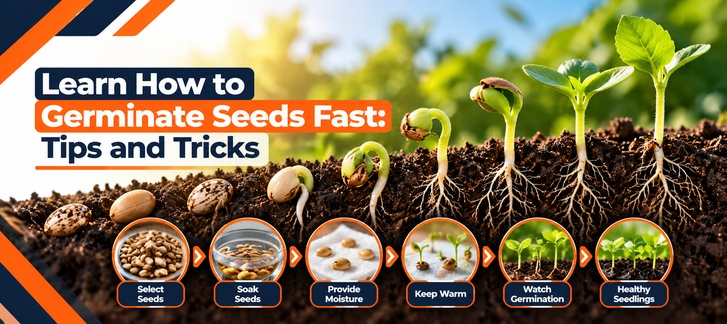
Learn How to Germinate Seeds Fast: Tips and Tricks
Stop waiting weeks for sprouts! Learn how to germinate seeds fast with these easy tricks that guarantee a higher, healthier sprouting success rate.
Introduction:
There is an invisible magic hidden inside a dry, wrinkled seed. Seed looked completely lifeless and a tiny one to the naked eye. Because it's hardened to a speck and is indistinguishable from a pebble. But don't let its quiet exterior fool you. While inside that protective shell a fully formed embryonic plant lies that is packed with energy. The inside life of a seed is waiting for the perfect moment to wake up.
A profound biological transformation occurs when that moment arrives on a seed. Understanding the seed germination process isn't just a fascinating journey for plant lovers. It is the absolute foundation of any successful gardening process. You are in the right place. If you are tired of staring anxiously at a small pot of soil waiting for a green speck to appear. By mastering the intricate seed germination stages and applying a few clever hacks, you can dramatically accelerate this timeline. Let’s look at how to jumpstart nature’s clock and get your seeds sprouting in record time.
What is Seed Germination?
When a plant embryo grows out of its dormant state that is called seed germination. While it is a biologic process and developing into a self-sustaining seedling as a result. Just imagine a seed as a tiny and natural time capsule. Basically, a seed contains three primary components. This includes the embryo (the baby plant), the endosperm (the food storage pack) and the testa (the protective seed coat).
The seed remains in a state of suspended animation until it senses. This process is known as dormancy. This is because its surrounding environment is very safe for its survival. The germination process officially begins in the second stage when the seed detects the presence of three vital triggers. This includes moisture, oxygen and the right temperature for development. The embryo begins to metabolize and store food while cell division accelerates once these conditions are met. After that the tiny plant physically breaks through its outer shells to seek the sun.
Here you can find out about our blog on Regenerative Agriculture!
How Long Does It Take for Seeds to Germinate?
Your patience is a virtue if you plant seeds in the traditional way. Because most standard garden seeds complete the natural seed germination process within 7 to 14 days on average. This process occurs under normal conditions. However, the natural timeline of germination varies widely across the plant kingdom.
1) The Speedsters: Radishes, cucumbers, and brassicas (like broccoli and cabbage) seeds can sprout naturally in just 2 to 4 days.
2) The Patient Planners: Peppers, tomatoes, and carrots often take 10 to 21 days to show signs of life.
3) The Deep Sleepers: Certain perennial flowers and hot peppers possess intense dormancy mechanisms. Because it can take months to decide when to wake up.
You can cut these timelines in half when you learn how to germinate seeds fast using specialized tricks. Slow-sprouting pepper seeds can be coaxed into emerging in just a few days rather than weeks for instance.
Here you can explore about crop rotation in agriculture!
Interesting Fact: The 2,000-Year-Old Sprout:
Did you know that seeds could survive in deep dormancy for thousands of years? In fact, scientists successfully germinated a Judean date palm seed in 2005. The special thing is that the seed was recovered from an ancient archaeological fortress in Masada, Israel. The seed was roughly 2,000 years old! Miraculously when scientist gave the seed water and warmth the magic happened. Because its internal machinery worked perfectly despite two millennia of sleep. That ancient seed has grown into a thriving and fruit-bearing tree today. This story proves us just how resilient the design of a seed truly is.
The Core Seed Germination Stages:
First you have to understand how the seed functions to speed up its system. The journey from an inactive seed to a vibrant seedling is a complex process. While this process unfolds in five beautifully synchronized seed germination stages.
1) Imbibition (The Big Drink): The dry seed rapidly absorbs moisture from its surroundings through a microscopic opening. The seed is swelling significantly at first. After that, the swelling causes the tough outer seed coat to soften and then crack open.
2) Enzyme Activation (The Internal Wake-Up Call): Internal cells of the seed release enzymes that break down stored starches. These enzymes also break down proteins into simple but digestible sugars once hydrated. This provides the immediate energy burst for the seed that is required for growth.
3) Radicle Emergence (The Anchoring Root): The very first physical structure pushed out of the ruptured seed coat is the radicle (embryonic root). So, it grows downward anchoring the plant and drinks underground water that is gravity guided.
4) Shoot Elongation (Reaching for Light): The embryonic shoot begins stretching upward from the seed with a firm anchor in place. While this anchor is fighting its way through the soil particles toward the surface.
5) Seedling Establishment & Photosynthesis: The seed anchor unfurls its first seed leaves as the shoot breaks into open air. These leaves are also called cotyledons. These leaves trigger photosynthesis from the moment when they catch sunlight. The old seed coat of seed falls away and an independent seedling is officially born from it.
How to Germinate Seeds Fast: Professional Tips and Tricks:
You need to actively optimize the environment to accelerate the seed stages if you want to bypass the waiting game. Here are the ultimate insider tricks to make seeds sprout rapidly in your garden or field.
1) The Paper Towel Method (The Ultimate Speed Hack)
This trick is the fastest way to kickstart germination. Because it provides 100% controlled humidity without heavy soil resistance.
• Dampen a paper towel with warm water first. Because it should be moist with seed like a wrung-out sponge but not dripping wet.
• After that space your seeds an inch apart on one half of the towel. Then you have to fold the other half of the towel over the seeds.
• Later on, we sealed the towel inside a clear plastic zip-top bag. Because it creates a mini greenhouse that locks in moisture.
• Finally, place this bag in a warm place in a dark spot (like the top of a refrigerator). You will often see roots emerge in just 48 to 72 hours. So check them daily!
2) Seed Scarification (Breaking the Shell)
Some seeds have a shell so thick that water takes days just to penetrate it. You can manually weaken the shell and speed up the imbibition stage. Take a piece of fine-grit sandpaper and gently rub the outer coat of tough seeds (like beans, peas, or nasturtiums). Rub gently just enough to scuff the surface of the seed. This allows the water to rush in instantly.
3) The Overnight Warm Water Soak
A simple pre-soaking works wonders for medium-sized seeds. Drop your seeds into a bowl of warm water (around 110°F / 43°C) and let them sit for 12 to 24 hours before planting. This practice completely bypasses absorbing ground moisture in the slow initial phase. While it also wakes up the seed's internal enzymes overnight.
4) Deploy Bottom Heat
Seeds do not need light to germinate properly. But they are incredibly sensitive to temperature. Therefore, consider investing in a cheap waterproof seedling heat mat to place under your starter tray. It will keep the root zone temperature at a consistent level between 70°F and 80°F (21°C to 27°C). This ambient warmth signals to the embryo that it is safe to grow. This technique cuts down the seed's emergence time significantly.
What We Can Achieve with Fast Seed Germination:
First you have to master accelerated germination techniques. Because they go far beyond saving time for hobbyist gardeners. We can bring seeds to life and unlock incredible global solutions if we optimize seeds efficiently.
• Maximizing Short Growing Seasons: Germinating seeds rapidly indoors allows farmers to get a massive head start on the season. Especially in regions that have short summers or unpredictable frosts. This technique ensures a full harvest before the cold returns.
• Rapid Food Security: Fast-germinating crops (like microgreens and sprouting grains) provide dense concentrations of bioavailable vitamins. While these crops also provide protein and antioxidants for communities in mere days. This technique will help you in the wake of natural disasters or supply chain disruptions like periodic.
• Efficient Urban Farming: Vertical farms and hydroponic facilities rely on hyper-efficient seeds. First you have to make some predictable germination schedules to rotate crops seamlessly. Because it will maximize yield per square foot.
The Future of Seed Germination:
Scientists are currently developing "smart seed coatings" that are made of biodegradable and nutrient-dense hydrogels. These engineered coatings will protect the seed from fungi and other environmental effects. While the seed coating perfectly regulates water absorption in the seed. Because it forces rapid germination even in drought-prone soils.
Furthermore, NASA is actively studying how microgravity and cosmic radiation alter the cellular growth of seeds. Especially during the initial sprouting phase of seeds. Because space agencies are looking at long-term space exploration. Learning how to efficiently sprout crops in extraterrestrial and climate-controlled pods will be the definitive key for us. Because these studies are vital to sustain human life on Mars during future journeys.
The Bottom Line:
Every towering tree and every backyard vegetable patch started its life journey the exact same way: as a humble, sleeping seed. While nature has its own slow timeline, you don't have to be a passive bystander. By utilizing simple hacks like the paper towel method, pre-soaking, and bottom heat, you can easily manipulate the environmental triggers to force rapid, healthy growth. Grab a packet of seeds, try out these tricks, and watch your garden come to life in record time!
Frequently Asked Questions (FAQ)
What is the fastest way to germinate seeds?
The fastest way to germinate seeds is the Paper Towel Method. Dampen a paper towel with warm water, place your seeds inside, fold it over, and seal it inside a clear plastic zip-top bag. Keep the bag in a warm, dark place like the top of a refrigerator. This setup locks in 100% humidity and ambient heat, forcing seeds to sprout roots in as little as 24 to 72 hours.
Do seeds need light or darkness to germinate?
Most seeds germinate best in complete darkness. During the initial stages of the seed germination process, the embryo relies entirely on its internal stored food reserves to grow its first root and shoot. Sunlight is not required until the plant breaks through the soil surface and develops its first true leaves to begin photosynthesis.
Does soaking seeds in water make them germinate faster?
Yes, soaking seeds in warm water for 12 to 24 hours significantly accelerates germination. This process rapidly softens the tough outer seed coat and activates the internal enzymes overnight. However, do not leave seeds submerged for longer than 24 hours, as they can drown from a lack of oxygen.
What temperature do seeds need to sprout?
Most standard garden seeds sprout best at a consistent temperature between 70°F and 80°F (21°C to 27°C). While some cold-hardy crops like spinach can germinate in cooler soils, tropical plants like peppers and tomatoes require warm ambient temperatures to break dormancy. Using a waterproof seedling heat mat is the easiest way to maintain this warmth.
Why are my seeds taking so long to germinate?
Seeds usually take too long to germinate due to low soil temperatures, inadequate moisture, or old seeds. If the environment is too cold, the seed's internal enzymes remain dormant. Conversely, if the soil dries out even once after the seed has begun absorbing water, the embryonic plant inside will stop growing and die.
Source:
Wikipedia: Seed Germination