Regenerative Agriculture: Definitions, Benefits & Guide
What is regenerative agriculture? Learn about definitions, key environmental benefits, and practical farming tips in this comprehensive beginner’s guide.
Introduction:
Imagine a farming system that doesn’t just take from the earth. But the farming system actively gives you back in return. Our global food system relies on extraction and depleting topsoil for decades. While the food system also relies on pumping fields with synthetic chemicals and clearing ecosystems to maximize yields. But a quiet revolution is taking root below the surface.
It’s called regenerative agriculture, and it is changing everything we know about growing food.
If you are wondering how this movement works, why it matters, and how it differs from traditional green farming, you are in the right place. Let’s dive into the ultimate guide to farming for the future.
What is Regenerative Agriculture?
Regenerative agriculture is a holistic and outcome-focused farming philosophy in simple words. Because it aims to rehabilitate and revitalise your farm's entire ecosystem. Therefore, regenerative agriculture focuses heavily on restoring soil health. Instead of merely sustaining a depleted landscape. Because it's boosting biodiversity and capturing carbon in the ground on your farm.
Think of it as a copy-past of nature’s original blueprints. Ecosystems thrive on their own through complex relationships with plants and microbes. Ecosystems also have complex relationships with insects and animals. Because long ago ecosystems existed as compared to industrial tractors and synthetic fertilizers. Regenerative farming brings these natural checks and balances back into modern food production.
What Are the Benefits of Regenerative Agriculture?
Transitioning away from heavy machinery and chemical inputs might sound risky. But this practice's rewards are profound. Therefore, we trigger a massive domino effect of positive change when we heal the soil.
1) Superior Soil Health and Nutrient Retention
Healthy soil is alive. Where a single teaspoon of healthy soil contains more microorganisms than there are people on Earth. That's why regenerative practices nourish this underground microscopic universe. It naturally creates a spongy texture that retains water when soil biology thrives. In fact, just a 1% increase in soil organic matter allows an acre of land to hold thousands of gallons of additional water. In this way, it protects your crops from severe droughts and catastrophic floods.
2) High-Quality, Nutrient-Dense Food
Healthy soil yields healthy crops. So basically, plants grown in biologically diverse and organic rich soil develop deeper root systems. While this system allows rich soil to absorb a wider spectrum of essential minerals and micronutrients. The result? Food that tastes better and is measurably better for human health.
3) Lower Operational Costs for Farmers
Conventional farming is expensive. Farmers must buy costly chemical fertilizers and heavy fuels to till their land every single year. On the other hand, regenerative farmers help nature to do its work and dramatically reduce these overhead costs. Because they use cover crops for fertilizer and beneficial insects for pest control.
Here you can read our article on Sustainable Agriculture!
What Are the Principles and Practices of Regenerative Agriculture?
Regenerative farming is not a strict or rigid set of rules. While it is an adaptive framework built upon core principles that are tailored to a farm's unique climate and geography.
Here are some practical regenerative agriculture practices that drive real ecosystem recovery:
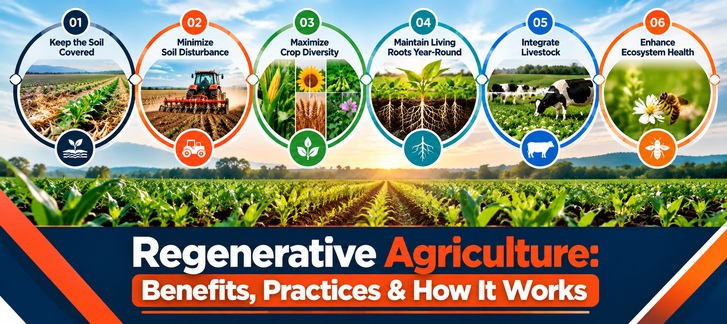
1) Minimizing Soil Disturbance (No-Till Farming): The process of tilling or ploughing of the earth rips apart the vital fungal networks (mycorrhizae) in the soil. Because this network helps plants absorb nutrients. On the other hand regenerative farmers leave the soil undisturbed. While they plant seeds directly into the ground to protect its delicate structural integrity.
2) Keeping the Soil Covered (Soil Armor): Bare soil is vulnerable to erosion in baking heat, and heavy winds as well. Therefore, farmers use bedding to cover their crops. Or they leave their crops' residues in the field to act as a natural blanket. This practice keeps the ground cool, moist, and protected.
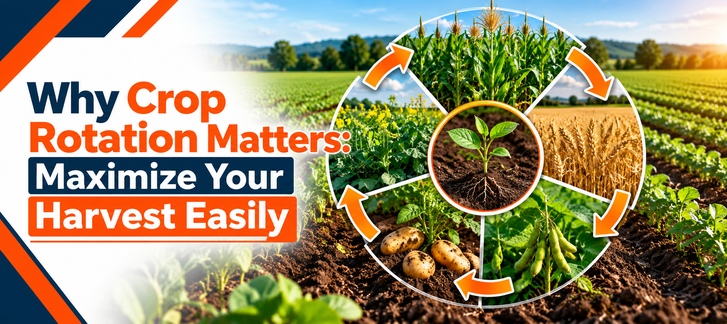
3) Maximizing Crop Diversity: Monoculture means growing just one crop on hundreds of acres. While it invites pests and saps specific nutrients from the earth. On the other hand, farmers will naturally break the pest cycle and enrich their soil. This includes rotating a diverse variety of crops or planting multi-species companion crops in the same field.
4) Maintaining Living Roots Year-Round: Living roots exude carbon-based sugars that feed the microbial community underground. Therefore, keeping roots in the soil through cover crops during the off-season is good practice. This practice ensures the underground ecosystem never starves.
5) Integrating Livestock (Holistic Managed Grazing): Animals are crucial to natural land cycles. Livestock move quickly across pastures and mimic wild herds through managed rotational grazing. They trample organic matter into the ground and stimulate plant growth. This practice naturally fertilizes the soil with manure without overgrazing.
Can Regenerative Agriculture Reverse Climate Change?
The short answer is that it is one of the most powerful tools we have against climate change.
Climate change is fundamentally a carbon imbalance problem. So, we have too much carbon in the atmosphere and not enough in the ground. Plants are the natural carbon vacuums in the world. Because they pull carbon dioxide "CO2" out of the air via photosynthesis. While it also pumps CO2 down through their roots to feed soil microbes.
The process of tilling releases trapped carbon right back into the sky in conventional farming. However, regenerative practices lock carbon deep inside the soil's organic matter. While also turning global farmland into a massive carbon sink. In simple words it may not single-handedly reverse all global emissions. But the widespread adoption of regenerative methods could sequester billions of tons of carbon dioxide annually. Basically it's buying humanity a crucial time to transition to clean energy.
How is Regenerative Agriculture Different to Organic Farming?
People often confuse "organic farming" with "regenerative farming," but they focus on different aspects of sustainability.
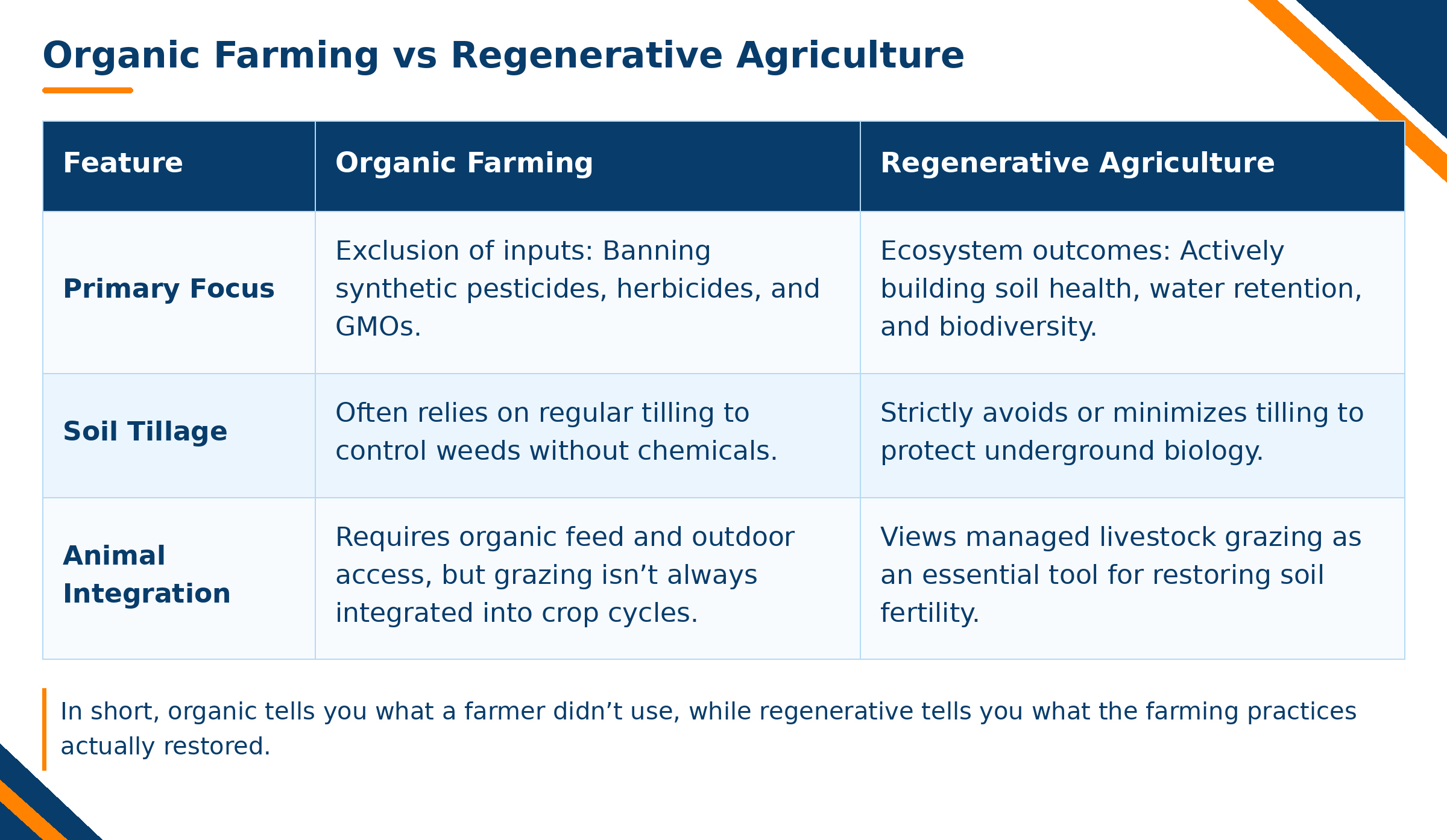
In short, organic tells you what a farmer didn't use, while regenerative tells you what the farming practices actually restored.
The Future of Regenerative Agriculture:
The future importance of agriculture lies in scaling these practices from small, independent operations to major supply chains. Global food conglomerates, fashion brands, and governments are beginning to realize that their long-term survival depends on healthy topsoil.
We are seeing a rapid rise in regenerative supply chains, verified by certifications like the Regenerative Organic Certified (ROC) standard. As artificial intelligence, drone mapping, and soil sensors advance, farmers can now measure carbon sequestration and microbial health in real-time, proving the economic and environmental validity of their work to global markets.
The Bottom Line:
Regenerative agriculture is far more than just a passing buzzword; it is a vital return to common-sense stewardship of the earth. By prioritizing soil health, encouraging biodiversity, and working alongside natural systems, we can secure a resilient food supply, revitalize rural economies, and actively heal the planet. The path to a sustainable future isn’t found by looking at the skies. While it is found by looking right beneath our feet.
Frequently Asked Questions:
1) What is the main goal of regenerative agriculture?
The main goal of regenerative agriculture is to restore and revitalize ecosystem health, with a primary focus on rebuilding degraded topsoil, increasing biodiversity, improving water retention, and naturally sequestering carbon in the ground.
2) Does regenerative agriculture use pesticides?
Regenerative agriculture strongly minimizes or eliminates synthetic pesticides and fertilizers, choosing instead to rely on natural alternatives like multi-species cover crops, diverse crop rotations, and biological pest controls to manage insects and weeds.
3) Why is regenerative agriculture good for the climate?
Regenerative agriculture helps the climate by drawing down atmospheric carbon dioxide through photosynthesis and trapping it securely underground within the soil organic matter, turning global farmlands into active carbon sinks.
4) Is regenerative agriculture economically viable for farmers?
Yes, regenerative agriculture is highly viable because it drastically cuts input costs for expensive synthetic chemicals and heavy machinery fuel while building resilient soil that stabilizes crop yields during extreme weather events like droughts.
5) What is the difference between sustainable and regenerative agriculture?
Sustainable agriculture aims to maintain the status quo and prevent further damage to the land, whereas regenerative agriculture actively works to repair, rebuild, and improve ecosystems that have already been degraded by industrial farming.