The 4 Core Principles of Organic Farming: Complete Guide
Discover the 4 core principles of organic farming. Learn how health, ecology, fairness, and care shape sustainable agriculture in this complete guide.
Introduction - Principles of Organic Farming
Organic farming is more than synthetic pesticides and fertilizers. It is an approach to pure agricultural fields. While it also aims to work with nature rather than against it. Organic agriculture focuses on building an upgraded farming system that remains always productive. While this system maintains the health of people and the environment as well. Whether you're talking about improving soil fertility or protecting biodiversity everything is connected through farming.
But what exactly are the principles of organic farming? How do they influence the way crops are produced and livestock?
We explore the four core principles of organic farming in this complete guide. We will also discuss common organic practices and the major advantages of this approach. Same as the history of farming and farming techniques.
What Is Organic Farming?
Organic farming is a natural agricultural production system. This system emphasizes natural processes and responsible resource management. While biodiversity and soil health are also considered as the main components of natural farming.
Organic farmers use methods such as composting and natural soil amendments. While they also use crop rotation, green manure and biological pest control methods for natural growth. Pesticides and other chemical inputs are the main components of this method. Instead of depending heavily on synthetic fertilizers.
Producing food goes beyond that when you ask the aims of organic farming. The broad goal of natural farming is to create a sustainable agricultural system. Therefore a sustainable agricultural system maintains soil fertility and supports ecosystems as well. Another speciality of this system is to produce food responsibly.
Whether it's a small family farm or a large commercial or operational farm, it doesn't matter. Because you can practice every size of farm in organic farming.
The 4 Core Principles of Organic Farming:
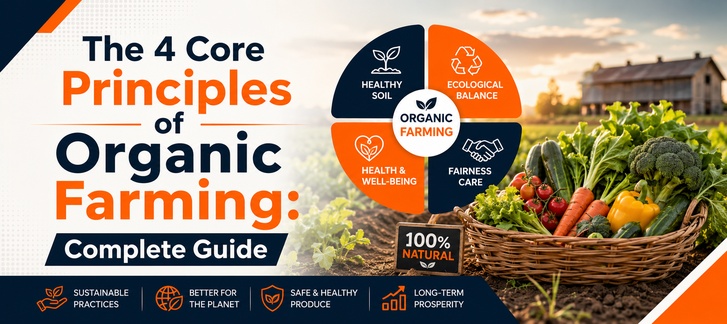
Organic agriculture's philosophy is built around four fundamental principles. These principles are health, ecology, fairness and care.
1) Principle of Health
The first principle recognizes that healthy soil and plants are closely connected to each other. Same as animals, people and the whole planet are also included in this principle.
Organic agriculture aims not only at maintaining the entire agricultural ecosystem's health. But also improving its health. Therefore, healthy soil supports stronger plants and fields. While healthy plants provide better nutrition for your farm. As it also contributes to a more balanced ecosystem for your farm.
That's why organic farmers focus heavily on soil fertility as an important component. Crop residues and other organic materials can be used to improve the soil structure. Same as compost and animal manure can be used for biological activity etc.
The principle of health essentially ask farmers to look beyond the immediate harvest of their farm. Because this principle considers the long-term health of the entire food system.
2) Principle of Ecology
The second principle is heavily based on working with natural ecosystems.
Organic farms are designed to imitate the natural processes of farming wherever possible. For example, instead of treating a farm as a factory or an organic agricultural field, they view it as an interconnected ecosystem. Or an individual inputs to a farm to produce a specific output from it.
Crop rotation is a good example of this second principle. Because growing the same crop repeatedly can deplete certain nutrients. While this practice is also increasing pest pressure on a farm. Therefore rotating crops helps break pest and also disease cycles. While this technique improves soil management on your farm.
Other ecological practices include maintaining natural habitats and reducing soil unnecessary disturbance. Same as using cover for your crops and protecting beneficial insects are also included in this practice.
3) Principle of Fairness
Organic agriculture systems recognize the importance of agriculture fairness throughout the food system.
This includes fair relationships between farmers and workers. While consumers, animals and our environment also have a relationship with this principle. Therefore agricultural production should provide decent conditions for people. Especially those people who are involved in natural farming while respecting animal welfare as well.
Fairness also means considering the future generations that relate to agriculture. Agricultural resources should not be exploited today. Because these resources travel in a way that leaves future farmers with degraded soil. Or polluted water or damaged ecosystems.
This makes fairness an important part of organic farming's benefits and objectives. So, particularly, the fairness principle is important from a social and environmental perspective.
4) Principle of Care
The fourth principle emphasizes responsible decision-making.
Agriculture involves uncertainty. As we know weather patterns change and environmental conditions can be difficult to predict in farming. While in some cases evolving pests are also unpredictable on farms. Therefore, organic farming encourages farmers to make careful decisions especially in their fields. Because these decisions can protect agricultural systems' health and productivity.
The principle of care encourages responsible use of agriculture technology and agricultural inputs. New methods should be evaluated not only for their ability to increase production but also for their potential effects on people, animals and the environment.
Together, these four principles provide the philosophical foundation of organic agriculture.
Examples of Organic Farming Practices:
Organic farming can involve a wide range of techniques. These techniques depend on the crop, climate and farming system of your fields.
Some common examples include:
1) Crop rotation: You must change your growing crops in a field from season to season.
2) Compost: Must recycle your organic material into nutrient-rich soil amendments for healthy soil.
3) Green manure: Must grow your plants in incorporated soil to improve your farm's fertility.
4) Biological pest control: You must use natural predators and biological methods to manage pests on your farm.
5) Cover crops: Must be planted crops to protect the soil between major production cycles on your farm.
6) Natural fertilizers: Must use compost and approved mineral amendments for your farm's manure.
7) Integrated livestock systems: Must combine your crop and livestock production to recycle nutrients on your farm.
8) Weed management: Use mechanical cultivation and other non-chemical approaches on your farm. Also use mulch on your farm for weed management.
These practices can work together for a better agriculture tomorrow. Rather than functioning as isolated techniques that can limit your farm.
History of Organic Farming:
Although the term “organic farming” looks modern to us. Yet many of its practices have existed for a number of centuries.
Farmers rely heavily on manure and locally available natural resources to maintain their productivity. While farmers also rely on crop residues and crop rotations in fields. Before the widespread availability of synthetic fertilizers and pesticides on farms.
The modern organic movement developed during the 20th century. Because it is concerned growing about industrial agricultural practices and their environmental consequences as well.
Scientists and agricultural organizations have begun exploring production systems especially for farmers. So they have placed greater emphasis on soil biology and sustainable resource management. While scientists and agricultural organizations have also worked on ecological balance.
Organic agriculture has been an established part of the global food system over time. Because it has established itself with organic products that are available on markets around the world.
Farming Techniques in Organic Agriculture:
Successful organic agriculture requires careful farm management. Because farmers have fewer conventional chemical tools available, prevention becomes particularly important.
1) Crop Rotation
Crop rotation is one of the most important organic farming techniques. Different crops have different nutrient requirements and interact with soil organisms in different ways.
For example, legumes can contribute nitrogen to agricultural systems, making them useful in rotations with crops that require significant nutrients.
2) Composting
Compost transforms organic waste into a valuable soil amendment. Properly produced compost can improve soil structure, water retention and nutrient availability.
It also provides an opportunity to recycle agricultural and household organic materials rather than sending them to waste.
3) Biological Pest Management
Organic farmers often focus on preventing pest problems rather than simply eliminating pests after they appear.
Beneficial insects, natural predators, habitat management, crop diversity and resistant varieties can all contribute to pest management.
4) Mulching and Cover Crops
Mulches can help suppress weeds and reduce moisture loss. Cover crops protect soil from erosion while contributing organic matter and supporting soil life.
These techniques are particularly valuable in maintaining soil quality over the long term.
What Are the Advantages of Organic Farming?
The organic farming benefits and objectives extend across environmental, agricultural and economic areas.
1) Improved Soil Health
Organic farming places strong emphasis on maintaining soil fertility. Adding organic matter and using crop rotations can support soil structure and biological activity.
2) Biodiversity Protection
Diverse crops, natural habitats and reduced reliance on broad-spectrum pesticides can create more favorable conditions for insects, birds and other organisms.
3) Reduced Chemical Dependency
Organic systems aim to minimize reliance on synthetic agricultural inputs and instead use biological and ecological approaches.
4) Better Resource Management
Composting and nutrient recycling can help farmers make better use of materials already available on the farm.
5) Long-Term Sustainability
One of the central aims of organic farming is to maintain agricultural productivity without continuously degrading the resources on which farming depends.
Organic Farming vs Conventional Farming
Organic and conventional agriculture are not simply two identical systems with different fertilizers. They represent different approaches to farm management.
Conventional farming may rely on synthetic fertilizers, pesticides and other modern inputs to maximize production efficiency. Organic farming puts greater emphasis on ecological processes, biological diversity, soil health and preventive management.
However, the suitability of either system can depend on crop type, climate, soil conditions, market demand, farmer resources and certification requirements.
The key question is therefore not simply which system produces more, but which combination of practices can produce food efficiently while maintaining the resources required for future production.
Wrap Up:
The four principles of organic farming—Health, Ecology, Fairness and Care—provide a framework for understanding what organic agriculture is really trying to achieve.
Organic farming is not simply about replacing one fertilizer or pesticide with another. It is a holistic approach that considers the relationship between soil, crops, animals, farmers, consumers and the wider environment.
Through crop rotation, composting, biological pest control, cover crops and responsible resource management, organic farmers aim to build agricultural systems that remain productive while protecting natural resources.
As concerns about soil degradation, biodiversity, food production and sustainable agriculture continue to grow, understanding the aims of organic farming, its techniques and its potential advantages is becoming increasingly important.
Ultimately, organic agriculture is built around a simple idea: healthy food begins with a healthy agricultural ecosystem.