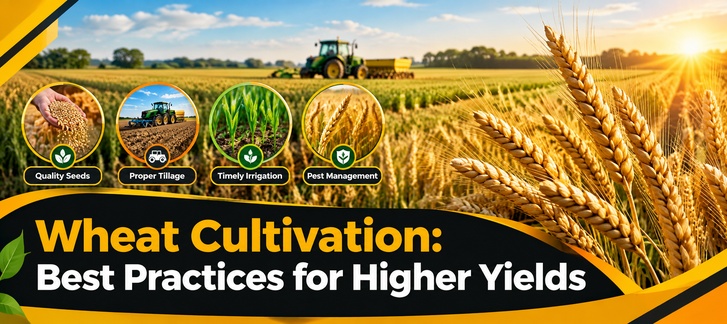
Wheat Cultivation: Best Practices for Higher Yields
Discover essential techniques for high-yield wheat cultivation. Master expert tips on soil preparation, optimal sowing, smart irrigation, and harvesting now.
Introduction:
Wheat may look simple when it reaches your kitchen table. But producing a healthy crop is a carefully timed process. Whether you choose the right variety or prepare the soil to manage irrigation for cultivation. Or whether you are controlling diseases and harvesting at the right moisture level in your fields. So every decision can influence the final grain yield of this crop.
Successful wheat cultivation is not simply about putting the seed into the soil for farmers. It is about understanding what the crop requires. This requirement makes the right decision at every stage of its growth.
Wheat is one of the world's most important cereal crops. Because it's a major source of food for billions of people. It also plays an important role in food security in countries such as Pakistan. While rural incomes and the agricultural economy are also connected to this crop.
This guide explains wheat cultivation methods and irrigation requirements. We also describe some major diseases and important harvesting practices in it. Therefore productivity recommendations and common mistakes farmers should avoid.
Best Wheat Varieties for Wheat Cultivation:
Like other agricultural commodities choosing the right variety of wheat is one of the first decisions that is made. Because these decisions can determine wheat crop success.
An ideal wheat variety should be suited to the local climate and soil conditions. While seeing windows and water availability also are the factors that affect wheat yield. Farmers should also consider disease resistance and expected yield potential. Same as they must consider grain quality and the maturity period of the crop.
Modern wheat varieties have been developed to provide improved performance under specific environmental conditions. However, the "best" variety of this crop is not necessarily the same everywhere.
Local agricultural research institutions recommend varieties is important for farmers. Because this crop is irrigated in wheat-growing regions. Certified seeds of wheat can also help maintain varietal purity and improve crop establishment.
A high-yielding variety can only perform well when it is nutritional. Where water and management requirements also play a part in better yields.
Irrigation Requirements and Water Scheduling:
Water management is one of the most important components of wheat production.
Because wheat requires adequate moisture at several critical growth stages. But excessive irrigation in farming can be just as problematic as insufficient water. Therefore waterlogging can reduce aeration and create favorable conditions for certain diseases in wheat. But in some cases it damages crop roots.
The exact irrigation schedule depends on soil type and water availability. Where rainfall, temperature and crop variety also affect the irrigation schedule.
Particular attention should be given to moisture during crown root initiation and grain development. So generally wheat moisture levels are also checked before tillering and flowering. The crown root initiation stage is especially important in the whole process. Because inadequate moisture at this stage can negatively affect plant establishment and yield potential.
Farmers should avoid simply following a fixed irrigation calendar without considering field conditions. Because sandy soils may require more frequent irrigation systems. While heavy soils can retain moisture for longer periods.
Applying the right amount of water at the right time is called an efficient water management system.
Major Wheat Diseases and Their Control:
Before farmers realize there is a serious problem with their crop. Diseases can quietly reduce wheat yields.
Some important wheat diseases include rust and other fungal diseases. Some major problems also include powdery mildew and loose smuth. While these problems depend on the production region and environmental conditions of the crop.
1) Wheat Rust
Wheat rust can cause significant damage under favorable conditions. Rust symptoms may appear as characteristic of rust-colored or dark pustules on plant tissues.
Planting of resistant wheat varieties is one of the most effective strategies for reducing disease risk. Regular field monitoring can also help farmers in order to identify crop disease development early.
2) Loose Smut
Loose Smut can affect wheat heads and is particularly associated with infected seeds as well.
Using certified and appropriate seed-treatment practices can help reduce risk. While using disease-free seeds also helps with better yields.
3) Powdery Mildew
Powdery mildew appears as a characteristic of white fungal growth on leaves and other plant parts. High humidity and favorable temperatures can increase disease pressure in dense crops.
4) Integrated Disease Management
The best approach to this field is not always relying on a single control method.
Integrated disease management can combine:
1) Resistant varieties
2) Certified seed
3) Proper crop rotation
4) Balanced fertilization
5) Field monitoring
6) Appropriate seed treatment
7) Timely fungicide application when recommended
Farmers should use crop protection products according to your local recommendations. Rather than applying them routinely without identifying the problem and labeling instructions.
Harvesting, Threshing, and Post-Harvest Practices:
Harvest timing can make a major difference to grain quality.
When the crop has reached its physiological maturity. Or until the grain has dried sufficiently for efficient harvesting and storage. Then the wheat should generally be harvested.
Harvesting too early can result in higher grain moisture or additional drying requirements for the crop. But waiting too long can increase the risk of crop shattering and other losses. In some cases lodging and weather damage happens in late harvest.
Wheat may undergo threshing to separate grains from wheat straw and other plant material once harvested.
Post-harvest management is equally important as other management during harvesting.
Therefore healthy grain should be cleaned and dried to a safe storage moisture level. Because it protects the crops from insects and excessive humidity. While it also protects the crops from rodents and fungi-like diseases.
Poor storage can turn a successful harvest into an economic loss for the farmer.
Farmers should therefore think about the crop as a complete production cycle:
Seed → Soil → Crop Management → Harvest → Storage → Market
A strong yield has little wheat value if a significant portion is lost after harvest.
Recommendations for Higher Wheat Productivity:
High wheat yields come from several good decisions working together rather than one "secret" technique.
1) Use Quality Seed
Certified seed from a reliable source starts with its cleaning. While Good seed supports uniform germination and crop establishment of the crop.
2) Follow the Recommended Sowing Window
Planting too early or too late seeds can expose the crop to unfavorable temperatures. Especially during the critical growth stages of the crop.
Region and variety vary the optimal growing window for the crop. Therefore farmers should follow local agricultural recommendations for better yields.
3) Prepare the Seedbed Properly
A well-prepared seedbed provides suitable conditions for germination and root development for the crop.
However excessive tillage can waste fuel and disturb the soil structure of the crop. Therefore the goal should be adequate seed-to-soil contact for the crop. Rather than unnecessary soil manipulation which is a poor practice.
4) Maintain Balanced Nutrition
Nitrogen is particularly important for wheat growth and grain production. But wheat also requires phosphorus, potassium and other wheat nutrientional benefits for better yields.
Crop requirements are more effective than simply applying more fertilizer to the crop. Because applying fertilizer is based on soil conditions as well.
Excessive nitrogen can increase lodging and may create other management problems for crops.
5) Control Weeds Early
Another problem is that weeds compete with wheat especially for water and nutrients. Additionally sunlight and space are also competition causes for both.
Early weed identification can help reduce its competition with wheat with appropriate control. Before weeds become difficult to manage.
6) Monitor the Crop Regularly
Walking in the field is still one of the simplest management tools. While this method is most valuable under many conditions.
Regular monitoring can reveal:
1) Pest infestations
2) Disease symptoms
3) Weed pressure
4) Nutrient deficiencies
5) Water stress
6) Uneven crop establishment
Early detection gives farmers more options.
Common Farmer Mistakes and How to Avoid Them:
When basic management decisions are overlooked even good farming practices can fail.
1) Sowing Too Late
Delayed sowing practices can expose wheat to unfavorable temperatures. Especially during the later developmental stages of the crop.
Solution: Before the recommended sowing period starts plan land preparation and seed procurement.
2) Using Poor-Quality Seed
Cheap or uncertified seeds can result in poor crop germination. These seeds also develop weak crop establishment and disease problems.
Solution: To fix it you must purchase quality seed from reliable sources.
3) Over-Irrigation
More water does not automatically mean more wheat yields.
Because excessive irrigation can increase the production costs of the crop. Or it may also contribute to waterlogging and disease problems for the crops.
Solution: You must schedule an irrigation system according to your crop stage and weather conditions. Where soil type also matters in this case.
4) Excessive Fertilizer
Applying more fertilizer than the crop requires can waste money. This practice also creates environmental problems for your crop production.
Solution: You must use soil testing and locally recommended nutrient-management practices for better results.
5) Ignoring Weeds
During early growth, you allow weeds to compete with your wheat. It can reduce the yield potential of your crop.
Solution: You must monitor fields early and use appropriate integrated weed-management strategies for your crop.
6) Harvesting at the Wrong Time
Harvesting too early or too late can increase losses or reduce the grain quality of wheat.
Solution: You must monitor grain maturity and moisture to adjust harvesting operations according to your crop.
Difference Between Rice and Wheat Cultivation:
The difference between rice and wheat cultivation largely depends on their contrasting climatic requirements. Or it can also depend on land and water materials for their weather requirements.
Rice is generally associated with warm growing conditions in many production systems. Because rice require substantially more water for growth and saturated fields.
Wheat is primarily a cool-season cereal. While it generally requires well-drained soil rather than prolonged standing water for its growth.
Wheat and rice production calendars can also complement one another in some regions. Especially in those regions where farmers practice rice-wheat rotations as well. Rice is grown during the warm season in some parts of South Asia. While wheat follows the cooler season especially for its production.
However, intensive rice-wheat rotations can create challenges related to soil health and water use. Where residue management and seed schedule in rice-wheat rotations also create challenges. Improved irrigation and appropriate crop establishment techniques can help address some of these issues. The same as better residue management also resolves some issues.
How Does Wheat Cultivation Impact Ecosystems?
The question "how does importance of wheat impact ecosystems?" has no single answer. Because the environmental impact depends heavily on how the crop is produced on the fields.
Wheat cultivation can support food security and rural livelihoods as well. But wheat intensive production can also place pressure especially on soil and water plus biodiversity.
Potential environmental concerns include:
1) Excessive water consumption
2) Soil degradation
3) Nutrient runoff
4) Pesticide impacts
5) Loss of biodiversity
6) Greenhouse-gas emissions
7) Crop-residue burning
Sustainable wheat production focuses on reducing these pressures through efficient irrigation. While integrated pest management and improved residue management also play a part in it. Additionally balanced fertilizer use and conservation agriculture also reduce pressure on your crop with diversification practices.
Productive farming and environmental responsibility do not have to be opposing goals in other words.
History of Wheat Cultivation:
Wheat cultivation's history stretches back thousands of years (the bronze age).
Wheat was among the earliest crops that were domesticated in the fertile Crescent. Where ancient agricultural communities began cultivating wild grass. Ancient people gradually selecting those plants that had characteristics that were favorable to farming.
Wheat spread across multiple continents for thousands of years. Therefore this crop evolved into numerous varieties as well. Moreover wheat adapts to different climates and production systems over the years.
Modern wheat production is very different from early agricultural practices. Plant breeding and digital farming technologies have transformed the way wheat is grown. Where its mechanization and irrigation system have also evolved with some fertilization techniques.
Yet the fundamental challenge remains the same for wheat production. Because its production is a reliable harvest from limited land and its resources.
Wrap Up:
Successful wheat cultivation is an exercise in timing, observation and balance.
The right variety must be matched with the right environment. Seed must be sown at an appropriate time. Water and nutrients need to be available when the crop needs them most. Diseases and weeds must be identified early, while harvesting and storage need just as much attention as crop establishment.
For farmers seeking higher productivity, there is no single shortcut. Quality seed, timely sowing, balanced nutrition, efficient irrigation, effective crop protection and careful post-harvest management form the foundation of a strong wheat production system.
As agriculture faces increasing pressure from water scarcity, climate variability and rising production costs, the future of wheat farming will depend not only on growing more grain, but on growing it more efficiently and sustainably.
The most successful wheat farmer is not necessarily the one who uses the most inputs. It is the one who understands the crop well enough to give it exactly what it needs, exactly when it needs it.