What is Biomass to Liquid? Steps, Benefits & Challenges
Discover the complete breakdown of biomass to liquid technology. Learn the crucial conversion steps, environmental benefits, and active industry challenges.
Introduction:
Imagine a world where we no longer drill into the Earth for crude oil purposes. Instead, we harvest yesterday’s wheat straws and even the morning’s municipal trash for fuel purposes. Or we use last week’s forest residue for this purpose. Then we convert them into clean and high-performance jet fuel and diesel. This isn't a futuristic dream; it is the reality of biomass to liquid fuel technology.
Traditional biofuels like corn ethanol are facing heavy scrutiny as the global push for net-zero carbon intensifies. Therefore, land usage and food supply conflict with each other. When we enter into the Biomass to Liquid (BtL) process, the thing goes in a different way. It's a sophisticated suite of thermochemical processes designed to transform non-edible organic matter into drop-in synthetic hydrocarbons.
Let’s break down exactly how this revolutionary technology works in different fields. What biomass to liquid can do? Because it changes real-world hurdles. So it must be cleared to change our energy landscape as well.
What is Biomass to Liquid Fuel (BTL)? BTL Process & Variants:
Biomass to Liquid is a process that converts solid organic materials into liquid hydrocarbons. Unlike a simple fermentation process. Because this process only utilizes sugars or starches present in the plant. While BTL relies on high-temperature thermochemical reactions. This allows it to break down the lignocellulose of the plant. It's the tough and structural cellular wall of plants that normal microbes cannot digest.
Therefore, since it can process the entire plant structure. Rather than just the edible portions of the plants. BTL represents a massive leap forward in biofuel efficiency and sustainability.
The Thermochemical Path of (BTL):
The premier and industry-standard route for producing synthetic fuel from biomass follows three steps. While these steps are distinct and tightly controlled phases of BTL.
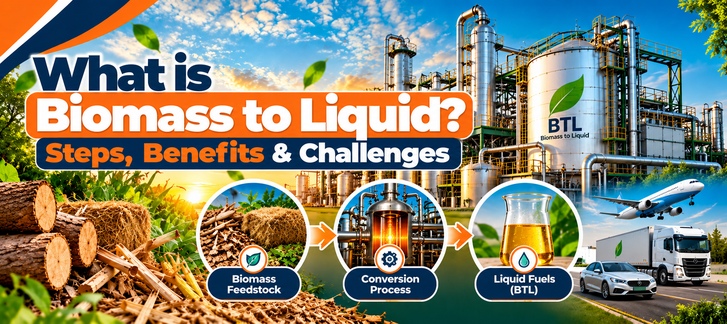
[Solid Biomass] ➔ (Gasification) ➔ [Raw Syngas] ➔ (Cleaning/Conditioning) ➔ [Purified Syngas] ➔ (Fischer-Tropsch Synthesis) ➔ [Liquid Fuel]
1) Gasification
When at feeding pretreated dried biomass into a high-temperature reactor (typically between 800°C and 1300°C) then the journey begins. This procedure takes place under strictly controlled and oxygen-deficient conditions. Where biomass does not simply burn. Instead, it its molecular bonds and turn the solid material into crude. Where it converts into a specific product into hot synthesis gas. This gas is universally known as syngas.
2) Syngas Conditioning
Raw syringe is a rough mixture of carbon monoxide (CO), hydrogen (\[H_{2}\]) and methane. Whereas some impurities like tar and sulfur compounds are also a part of this gas. It undergoes rigorous scrubbing and filtering before it can move forward. A water-gas shift reaction is often used to tune the precise balance of hydrogen ones. While it also tunes carbon monoxide molecules that are required for the final chemical reaction.
3) Fischer–Tropsch Synthesis
The purified syngas is introduced to metallic catalysts. This catalyst is typically iron or cobalt which is inside a pressurized reactor. Where it runs through the magic of Fischer–Tropsch synthesis. This is a process where carbon and hydrogen atoms recombine into long-chain paraffin hydrocarbons. This synthetic crude oil is then hydrocracked and refined into ultra-pure and sulfur-free diesel. Or it can be converted into gasoline or sustainable aviation fuel (SAF).
Alternative Routes - Pyrolysis and Direct Liquefaction:
While the gasification-to-FT pathway is the most mature biomass to liquid fuel technology, scientists have developed alternative chemical routes to bypass certain steps or optimize specific feedstocks.
1) Flash Pyrolysis: This method heats biomass rapidly in the total absence of oxygen to around 500°C, followed by rapid cooling. The primary yield is a dark, dense liquid known as bio-oil, alongside bio-char. The bio-oil requires extensive chemical upgrading to match fossil-fuel standards but holds massive potential for heavy marine applications.
2) Direct Liquefaction: Operating at lower temperatures (250°C to 330°C) but under immense pressure, Hydrothermal Liquefaction (HTL) mimics the natural geological forces that created fossil fuels, compressing the timeline from millions of years into just tens of minutes. It is incredibly efficient for wet biomass inputs.
3) Catalytic Pyrolysis: By introducing a catalyst directly into the pyrolysis reactor, developers can strip oxygen away from the organic vapors early in the process. This produces a much higher quality, more stable bio-oil right out of the gate.
Emerging Hybrids - The Next Frontier:
The biggest limitation of classic BtL is that a portion of the biomass carbon is lost as \[CO_{2}\] during the gasification phase. Next-generation hybrid configurations aim to fix this inefficiency.
1) PBtL (Power + Biomass to Liquid): By injecting external green hydrogen (produced via water electrolysis powered by solar or wind energy) into the syngas stream, a PBtL facility can lock down nearly 100% of the biomass carbon into liquid biomass fuel. This effectively doubles the fuel yield per acre of biomass energy used.
2) Hydrogen-Enhanced Gasification: Introducing supplementary hydrogen directly to the gasification stage allows operators to bypass the water-gas shift reaction entirely, dramatically shrinking the physical footprint and complexity of processing plants.
What Feedstock Works — From Agricultural Waste to MSW to Energy Crops:
One of the greatest triumphs of biomass to liquid systems is their sheer dietary flexibility. They do not compete with agricultural food supplies. Instead, they thrive on secondary and tertiary agri waste into energy:
1) Agricultural Residues: Wheat straw, corn stover, rice husks, and sugarcane bagasse left over after harvests. These residues also called as agri biomass.
2) Forestry Residues: Thinning materials, bark, sawdust, and logging slash from sustainable timber management.
3) Municipal Solid Waste (MSW): The non-recyclable biogenic fraction of everyday household trash, preventing it from rotting in landfills and releasing methane.
4) Energy Crops: Fast-growing, resilient crops like switchgrass, miscanthus, and short-rotation willow that grow beautifully on degraded land where food crops fail.
Benefits & Promise of Biomass to Liquid Fuel:
Why are international logistics giants and airlines keeping a close eye on BtL? The answers lie in its massive environmental and operational advantages:
1) True Drop-in Capability: Synthetic BtL fuels possess a chemical structure nearly identical to conventional petroleum. They require zero modifications to modern aircraft, semi-trucks, fueling stations, or pipeline networks.
2) Deep Carbon Reductions: Because the carbon released from the tailpipe was captured from the atmosphere by the plants during their growth cycle, BtL fuels offer up to an 85–90% reduction in net greenhouse gas emissions compared to fossil alternatives.
3) Clean Combustion: BtL fuels contain virtually no sulfur, aromatics, or heavy metals. Burning them results in fewer particulate matters (soot) and cleaner urban air quality.
Why BtL Has Not Scaled — Key Technical, Economic & Sustainability Barriers:
Despite its incredible promise, biomass to liquid fuel technology is not yet dominating your local gas pump. Several daunting structural barriers remain:
1) High Capital Expenditure (CapEx): Building a facility that handles massive solid materials, manages extreme temperatures, and operates high-pressure chemical synthesis requires immense capital investments, making investors hesitant without long-term policy guarantees.
2) Supply Chain & Logistics: Collecting, transporting, and storing thousands of tons of low-density solid biomass scattered (biomass briquette) across rural areas is an expensive logistical puzzle.
3) Energy Efficiency Losses: Converting solid wood into gas and then back into high-grade liquid fuel inherently loses energy at each stage, yielding a net thermal efficiency of roughly 40% to 55%.
Uses of BtL Fuels:
The premium quality of BtL fuels makes them particularly valuable for hard-to-abate transport sectors that cannot easily rely on heavy electric batteries:
1) Sustainable Aviation Fuel (SAF): Long-haul aviation cannot run on batteries. BtL jet fuel is the most promising pathway to decarbonize global commercial flight networks.
2) Heavy Duty Marine & Road Freight: Cargo ships and transcontinental shipping trucks rely heavily on the energy density of liquid hydrocarbons, where BtL excels.
3) Chemical Feedstocks: Beyond fuels, BtL synthetic crudes can replace petroleum in the production of green plastics, lubricants, and solvents.
Future of Biomass To Fuel:
The future of biomass to liquid lies in regional optimization and hybrid power systems. As carbon taxes rise and mandates for sustainable fuels take effect globally, the economic gap between fossil fuels and synthetic biofuels will inevitably close. By integrating green hydrogen into the gasification loop, tomorrow's refineries will maximize efficiency, turning waste management sites directly into renewable fuel hubs.
BtL technology successfully bridges our carbon-heavy past with a net-zero future. By transforming the waste we leave behind into the fuels that move us forward, it offers a circular economic solution that proves we can keep the world moving without costing the earth.
Wrap Up:
Biomass to Liquid (BtL) is an advanced thermochemical conversion process that transforms solid organic waste and energy crops into fuel. Because it transform forestry residues into high-quality and synthetic liquid hydrocarbon fuels like diesel. Or it can also be transformed into gasoline and sustainable aviation fuel.
The standard BtL pathway relies on gasification and catalytic synthesis rather than simple fermentation, allowing it to use entire plant structures (lignocellulose) instead of just edible sugars or starches. : Solid biomass such as wood chips, straw, or agricultural waste is dried and reduced in size to ensure smooth feeding into the reactor. : The prepared biomass reacts at high temperatures (800°C to 1300°C) under controlled, oxygen-deficient conditions to break down complex molecules into a crude synthesis gas (syngas), composed mainly of carbon monoxide (CO) and hydrogen (H₂).
The raw gas passes through filters, scrubbers, and water-gas shift reactors to remove impurities (like tars, dust, and sulfur) and adjust the precise H₂-to-CO ratio required for fuel synthesis. The purified syngas flows over metallic catalysts (such as cobalt or iron) inside an FT reactor, where the molecules recombine into long-chain paraffin hydrocarbons. The raw synthetic crude is hydrocracked and refined into premium-grade transportation fuels, including synthetic diesel, kerosene, and jet fuel, which match or exceed standard fossil fuel specifications.