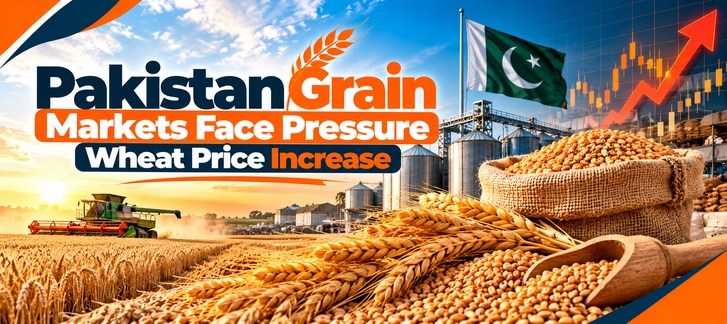
Pakistan Grain Markets Face Pressure | Wheat Price Increase
Wheat price increase pressure Pakistan’s grain market despite global supply abundance. Learn how rising costs affect local consumers.
Introduction – Wheat Price Increase:
With increased supply outlooks weighing on international prices, the global wheat market is seeing further pressure. Local millers and consumers in Pakistan, meanwhile, are dealing with the opposite trend: a wheat price increase brought on by smuggling, inefficient supply wheat value chains, and growing import expenses. The disparity between local price inflation and global weakness highlights the difficulties Pakistan’s grain market faces, where price stability and food security continue to be extremely delicate topics.
Following a decline in local output and an increase in wheat supply pressures. Therefore Pakistan has increased its imports of wheat to release pressure. SUPARCO estimates that the current season's wheat crop will be around 27.48 million tons. As compared to a target of 29.6 million tons and that the yearly consumption is mind-blowing. Because these estimates will be roughly 30 million tons of wheat.
Delays in government purchases from nearby farms have made the situation worse. Authorities had the chance to purchase wheat at reduced rates during the spring and summer harvest periods. However, disagreements between the federal government and provincial administrations told a different story. Because these diagnoses caused a significant portion of the grain to slip into private hands. This situation led to increased flour prices in September.
Global Wheat Trends – Abundant Supply Keeps Prices in Check:
Chicago wheat futures have declined globally as supply forecasts are strengthened by better harvest circumstances in major producing nations, especially Russia. Alongside the International Grains Council’s predictions of a robust global crop in 2025–2026, the Russian consultant IKAR has increased its expectation for wheat cultivation output.
Through tenders, foreign customers like Jordan are still able to get wheat at cheap prices, with U.S. supplies showing special appeal. However, economists point out that even robust demand hasn’t been enough to counteract the effects of massive global supply, which has kept wheat prices low globally.
The administration authorized emergency imports of one million tonnes of wheat. This is due to the growing threat of winter scarcity of this crop. The state-run Trading Corporation of Pakistan (TCP) has lowered its initial purchase objective. A rough estimate of this objective is 750 THSD tons to 550 THSD tons. After Punjab and Sindh changed their wheat requirements.
TCP has also issued a second contract for 185 tons of wheat. The bids are expected to be accepted by the end of September in order to meet its remaining demands. When Pakistani demand for imported grains has increased because of acquisitions that were made at a time.
The present price of imported wheat is between $320 and $325/t CFR in Karachi. But the ultimate cost will increase due to freight and interior transportation costs. Where as some port fees are also included in it. Although they are unlikely to result in a major drop in flour prices. Yet, emergency purchases are anticipated to help Pakistan avoid shortages. So Pakistan must survive until the 2027 crop.
Visit Zarea today to see product listings, place bulk purchases, and get the best deals! It is the biggest business-to-business (B2B) commodities marketplace in Pakistan. It’s also establishing the benchmark for future commodity distribution and commerce in the country.
Pakistan’s Local Market – A Contrasting Picture:
Pakistan is dealing with wheat price increase as a result of a mix of internal and foreign reasons, even though global trends indicate that wheat prices would remain steady or decline:
Growing Costs of Imports: Due to freight expenses, currency devaluation and finance obstacles Pakistan’s reliance on imports is growing more costly. Meanwhile global prices for wheat are also declining.
Gaps in the supply chain: supply distortion and artificial scarcity in some areas are the main gaps in the supply chain. Meanwhile procurement delays, stockpiling, and unofficial market activity all affect this process badly.
Smuggling Pressures: Smuggling wheat over international borders to nearby nations increases shortages and drives up domestic prices.
Production Shortfalls: Due to domestic yields’ inability to meet growing demand, there is now a higher need for imports.
As a result, although foreign purchasers are benefiting from record low costs, Americans are paying more for wheat and flour products.
Implications for Food Security and Industry:
The wheat price increase has far-reaching consequences for Pakistan’s economy and its people:
The rising cost of flour for consumers lowers their purchasing power in both urban and rural families and adds to total food inflation.
Millers and traders must balance government price limits with growing procurement expenses in order to control wheat prices. Thus, it may result in narrow profits.
Unfortunately, government officials are under pressure to provide a consistent supply at reasonable prices. That’s why it calls for more imports and more stringent laws against hoarding and smuggling.
As we know Pakistan’s primary grain is wheat. Therefore, persistent price fluctuations run in the danger. This situation seriously causes civil unrest and economic instability nationwide.
The Way Forward:
Pakistan must use a multifaceted approach to overcome the growing disparity between local and global market dynamics:
Increasing domestic production through effective water management, mechanisation, and better seed quality.
simplifying imports to ease financial and logistical constraints and guarantee that declining worldwide costs are translated into affordability locally.
Stricter border and local supply chain surveillance and enforcement will help curb smuggling and hoarding.
Coordinating federal and provincial policies to provide uniformity in the distribution and acquisition of wheat.
Final Thoughts:
Pakistan must contend with a wheat price increase driven by structural inefficiencies, growing expenses, and outside forces, while the global wheat market is seeing price relief due to an abundance of supply. Local industries and consumers will continue to suffer the most from this disparity until immediate action is made to boost domestic output and simplify imports.
Effective wheat market management is crucial for Pakistan’s national food security and social stability in addition to being economically necessary.
FAQ’s:
Why is the price of wheat rising?
Due to a mix of supply and pricing issues, Pakistani wheat prices have continued to rise in recent months. Nationwide the costs of fuel, fertilizer and transportation have increased dramatically for all farmers. Meanwhile it has a direct effect on the output costs of wheat. The market is now more susceptible to changes in the price of wheat globally at the same time. That’s why interruptions in domestic supply chains and dependence on imports are affected.
Consumers in Pakistan are suffering the input growth brunt and delivery costs consequently. This is the main cause that makes wheat-based food more costly in Pakistan. Both local production limitations and the larger demands of global grain markets are reflected in the total rise.
What is the prediction for wheat?
The highest since 2020-21 is 25 million bushels this month, up to 875 million. Robust pace of export sales and competitive pricing are expected to boost U.S. wheat exports.
What is the wheat price issue in Pakistan?
Pakistan had a debilitating wheat crisis that lasted for almost three years from late 2019 to June 2023. Domestic wheat and wheat flour prices surged during that time. In result, it reached a historic high of Rs7,000 per 40kg bag in various regions of the nation.
What is the wheat forecast for 2025?
According to the government, $42 million, or a 2% production yield was recorded in 2025. So we have compared it to 2024 output which is 1,971 million buses. As a result, all wheat production predictions were down this year. It would be the fourth highest crop in the previous 10 years and compared with 2,785 million bus as the record high yield in 1981.
What is wheat future?
Wheat is one of the most often cultivated crops in the United States. So basically wheat futures contracts are among the most traded agricultural commodity futures contracts. Moreover wheat has several applications on the market. This may include coatings, adhesives, flour, animal feed and much more.