How to Start an Import-Export Business: A Complete Guide
Learn how to start import export business the right way, from picking a product to handling documentation, with practical steps and a realistic look at costs.
What should I trade, and who will buy it? is the smaller issue that most people who seek for how to start an import export business are asking.
Because the concept of international trade is fascinating before you have selected a product, verified genuine demand, or comprehended the paperwork involved in transferring items across borders, that section is frequently overlooked.
This tutorial focuses on what you need to determine prior to your first shipment, such as if products are worthwhile, how to verify demand, what documentation you might require, how much operating capital to budget for, and the most typical hazards for one-time traders.
What Does It Actually Involve to Start Import and Export Business?
Buying goods in one market and reselling them in another. That's the short version. The longer version involves managing sourcing, demand, documentation, shipping, customs, payment, and the relationships on both ends of the deal.
Strip it back further and you either bring goods into your country to sell locally, or you take goods from home and sell them somewhere else. Plenty of traders end up doing both once they've got a bit of experience behind them.
You're not making anything yourself here. Finding a product at a reasonable price, determining where consumers want it, and managing everything in between—sourcing, quality assurance, documentation, shipping, and payment—are all part of the job.
People lump "import-export" together like it's one skill. It isn't. Importing leans on sourcing well and catching quality problems before they land on your desk.
Exporting leans harder on market research, and on convincing someone overseas to trust you before they've ever met you. Figure out early which side plays to your strengths, and the first few months get a lot less stressful.
Which Type of Import-Export Business Should You Run?
Before picking a product, it helps to know there isn't just one way to structure this business. Three models come up most often:
Merchant importer-exporter: You buy goods on your own account and resell them at a markup. You take on the inventory risk yourself, but you also keep the full margin. This is the model most of this guide focuses on.
Export management company (EMC): You oversee the export procedure on behalf of a domestic producer, managing logistics, locating distributors, and arranging shipping, as opposed to trading on your own account. Instead of receiving a product markup, you receive a charge or commission, and you never truly own the products.
Export trading company (ETC): You work the opposite direction from an EMC: you find foreign buyers first, then source the goods domestically to fulfill that demand. It suits people who are stronger at building buyer relationships than at sourcing.
None of these is objectively better. It comes down to whether you'd rather carry inventory risk for a bigger margin (merchant model), or earn a steadier fee by connecting other people's goods to buyers (EMC or ETC).
Most people starting out default to the merchant model since it's the most direct, but it's worth knowing the alternatives exist before you commit.
Why Start an Import-Export Business?
A few things pull people toward this line of work.
There's the lower overhead compared to manufacturing, since you're not running a factory or a production line, just moving goods that already exist. There's the cross-market gap: something that's easy to find in one place can be genuinely scarce, or pricier, somewhere else, and that gap is where the money sits.
Relationships end up mattering more than most people expect too. Strong ties with suppliers, buyers, distributors, and freight partners can carry a trader further than a bigger bank balance ever would. And exporting specifically opens up demand you'd never see if you only sold at home.
None of that makes it easy money, though. Cash flow trips up a lot of new traders, mostly because suppliers want payment before they ship while buyers can take weeks to pay. If you overlook that planning gap, even a purchase that seems great on paper could put stress on your company while you wait for the money to arrive.
How Do You Know You're Ready to Start?
There's no calendar date for this. But a few things usually need to be true before someone's ready rather than just excited.
You've settled on a specific product category instead of "international trade" as a vague ambition. You've spoken to a few potential suppliers or buyers and gotten real answers back, not just browsed listings.
You know your cost stack, product price, shipping, duties, taxes where they apply, financing, and whatever else eats into margin. You've got enough working capital to survive a full shipment cycle without needing that first sale to land on time.
And you understand what registration, licensing, and documentation your country and product actually require. Missing two or three of those? Slow down before you spend real money.
How to Start an Import-Export Business: 6 Steps to Follow
Follow these six practical steps to learn how to start an import-export business and provide a strong foundation for long-term success.
1. Pick a Product, Then Actually Check the Demand
Go narrow, not broad. Look for something with a genuine supply or price gap in one market, and clear demand in another. Pull trade data, talk to people already working in that industry, study your competitors, and where possible, talk to potential buyers directly instead of guessing what they want.
Don't skip validation because a product "obviously" seems in demand. That assumption gets expensive fast, and it's usually the first mistake new traders make.
Before placing an order, it helps to know who's buying, what they're currently paying, how often they buy, who the existing suppliers are, what quality standard they expect, what shipping adds to the final cost, and whether a sustainable margin survives once all of that is accounted for.
2. Register the Business the Right Way
Pick a business structure that fits and register it with whoever handles that in your country. Depending on where you're based, that can mean business registration, tax registration, sorting out banking, and any import-export permissions your country requires.
Don't leave this until after your first order lands. Get clarity on what's needed before you commit to a shipment, not while the goods are already in transit and you're scrambling.
3. Sort Out Licenses and Documentation Early
New traders underestimate this workload more than almost anything else. Depending on your country, product, and destination, you might need specific licenses, certifications, customs documents, commercial invoices, packing lists, certificates of origin, or other trade paperwork.
Regulated categories like food, agriculture biomass, chemicals, and machinery usually carry extra requirements on top of the basics.
Requirements shift enough by product and country that it's worth confirming directly with your national trade authority, rather than trusting a generic checklist pulled from a random website.
The International Trade Centre, a joint agency of the WTO and the United Nations, maintains country-by-country market access requirements that are a genuinely useful starting reference for this kind of research.
4. Vet Whoever You're Buying From or Selling To
If the person on the other end is unreliable, a good product can still become a bad deal. Before placing a big order, request samples. Check references and business details where you can. Get specifications agreed in writing, not just over a phone call you'll half-remember later.
If you're exporting, build some kind of credible online presence too, since overseas buyers will usually look you up before sending money to someone they've never met.
Both sides should be clear, going in, on product specifications, quantity, quality requirements, price, delivery terms, payment terms, inspection process, and who's on the hook if something goes wrong.
5. Lock Down Logistics and Payment Terms
Choose the mode of transportation for the goods—air, sea, road, rail, or a combination—as well as who will be in charge at each stop along the way.
Freight expenses, transit time, customs clearance, insurance when applicable, warehousing, tariffs and taxes, and transporting the items to their destination must all be included in your logistics plan.
Terms of payment should be carefully considered. Decide who is responsible for what, when it is due, and what happens in the event of a delivery or quality issue. An otherwise good arrangement can be ruined by a payment dispute.
6. Start Small, Then Scale
Keep your first few shipments small enough that a mistake doesn't wipe you out. Use those early runs to learn your real costs, delivery timelines, quality issues, payment cycles, and what buyers expect from you. Once the process holds up consistently, scale from there.
The first shipment isn't about chasing the biggest possible profit. It's about learning how the whole transaction works without betting the business on it.
How to Start an Import-Export Business in Pakistan
The basic procedure is essentially the same in Pakistan, but prior to your first shipment, you must verify the current regulations on registration, taxes, customs, banking, and product-specific licensing needs.
Do not assume that the requirements from the previous year still apply because these details change over time and differ per product.
Registration with the Trade Development Authority of Pakistan (TDAP) is usually the first step for exporters in particular.
It provides access to trade facilitation services and export incentives, issues a unique exporter registration number, and is frequently necessary prior to obtaining a certificate of origin, export finance, or Chamber of Commerce membership.
Additionally, sector-specific registrations can be applicable, therefore it is important to find out what your specific product category needs.
A practical starting sequence for a Pakistan-based business:
Choose a specific product and target market
Validate demand with real buyers or market data
Work out the complete cost of the transaction
Confirm current registration and documentation requirements, including TDAP registration if exporting
Verify if there are any import or export restrictions on the product.
Organize trustworthy vendors, purchasers, freight partners, and service providers.
Before shipping, decide on the conditions of payment and delivery.
Test the process with a manageable first shipment
Verify current requirements for your specific product rather than assuming every transaction follows the same playbook, because it usually doesn't.
Import vs Export: What Actually Differs
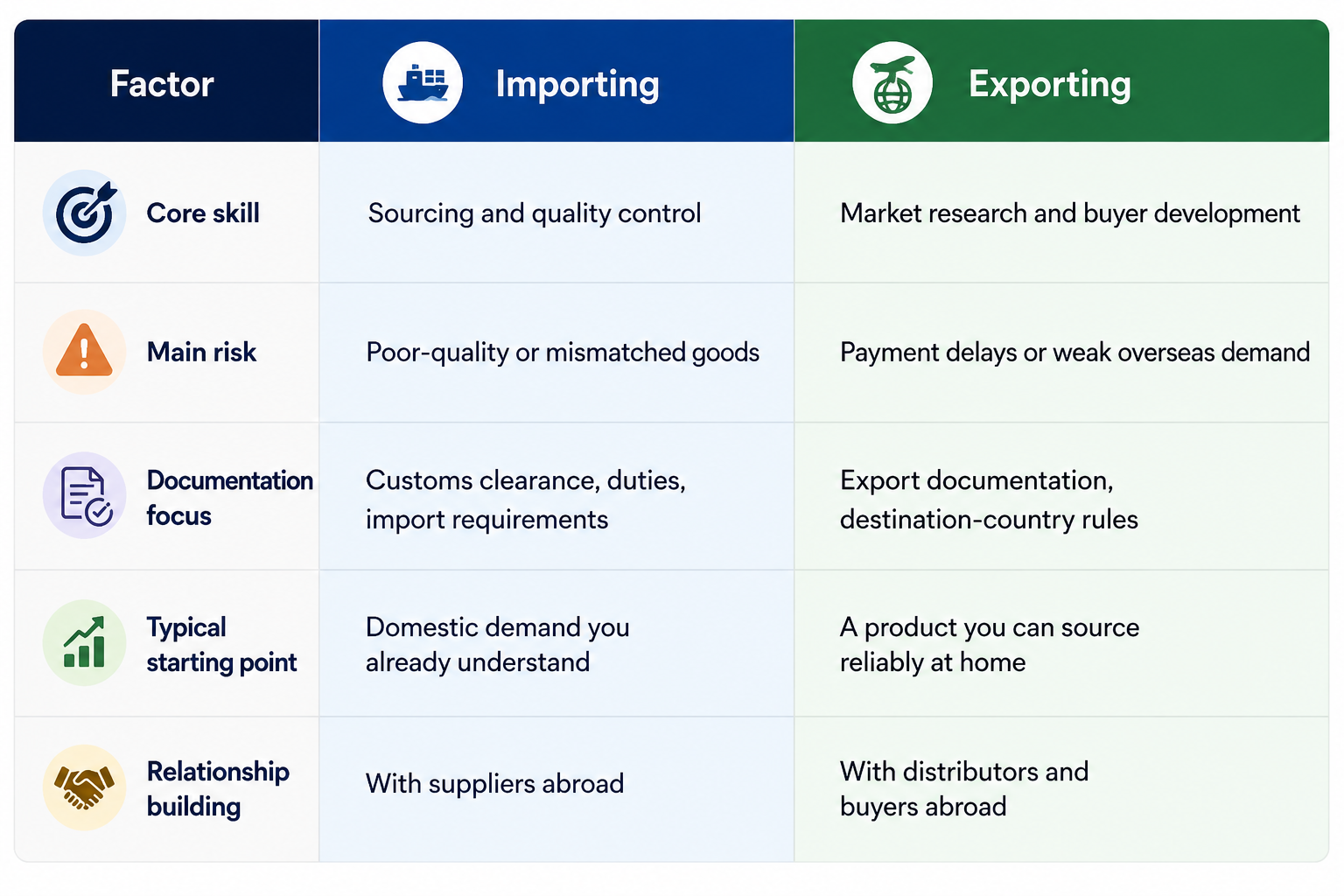
Neither wins by default. It all boils down to where your product's opportunity is and your ability to handle the associated expenses, risks, and connections.
Real-World Import-Export Business Example
Say an agricultural commodity is priced noticeably lower in one region than what buyers elsewhere are currently paying. That price gap is a starting point, not a business plan.
You'd still need to confirm the quality holds up, work out shipping costs and timelines, understand any applicable duties, and agree on payment terms that don't leave either side exposed.
This is where digital B2B trade platforms earn their keep. Platforms such as Zarea allow businesses to buy and sell commodities, browse verified supplier and buyer listings, tap into flexible trade credit, and access structured trade documentation and logistics support.
Technology expedites certain steps in the process, but it doesn't take the place of trade contacts, product research, due diligence, or cost calculations—all of which are necessary for a deal to succeed.
Common Mistakes First-Time Traders Make
New import-export companies frequently go into the same few issues repeatedly.
Placing a large order before confirming quality with a sample. Underestimating how long international payments take to clear. Ignoring licensing or documentation requirements because it seems like extra work.
Not building any cushion into pricing for currency movements. Choosing a product because it's exciting rather than because the demand data supports it.
Calculating profit off the supplier price alone instead of the full landed cost. Scaling up before the first few transactions have proven the process even works.
The underlying lesson is straightforward: a lucrative transaction and a promising product are not the same thing.
How Much Does It Cost to Start an Import-Export Business?
There's no universal starting figure. What you'll need depends on the product, order size, supplier terms, shipping method, duties, destination, payment terms, and how much working capital bridges the gap between paying your supplier and getting paid by your buyer.
Before you start, calculate the full cost of one realistic transaction: product cost, packaging, freight, insurance where applicable, customs and duties, taxes or other charges, banking and payment costs, warehousing or handling, local transport, and some contingency for the things you didn't see coming.
Knowing your real landed cost upfront is what tells you what price you can actually offer.
Is Import-Export Business Profitable?
It can be, but there's no standard margin that applies across every deal. Profitability depends on the product, your buying and selling prices, shipping costs, duties, financing, currency movements, payment terms, competition, and how efficiently each transaction gets run.
A product can look profitable at the supplier's quoted price and turn unattractive fast once you've worked out the full cost of getting it to the customer. That's why the traders who stay in business focus on total transaction economics, not the product price sitting on its own.
Wrap-Up
If there's one thing worth taking from all this: how to start import export business isn't a checklist problem, it's a preparation problem. The steps people rush past, choosing the right product, validating demand, getting documentation sorted properly, protecting cash flow while payments are in transit, checking who you're actually dealing with, are exactly the ones that decide whether a business makes it past its first year.
Instead of pursuing one-time deals, the traders that stick around start small, discover their true numbers early, and develop sincere relationships. To start, a large operation is not necessary.
Before you attempt to grow it, you need a product with actual demand, a feasible cost structure, trustworthy trading partners, sufficient operating capital, and patience with the process.
FAQs
What are the first steps to start an import-export business?
The first steps include choosing a specific product, confirming demand, calculating the total transaction cost, checking registration and licensing requirements, screening suppliers or buyers, deciding on logistics and payment terms, and testing everything with a manageable first shipment.
Is import-export business profitable?
It might be. The goods, selling price, shipping and tariffs, terms of payment, currency fluctuations, competition, and the effectiveness of each shipment's management all have a role in profitability.
How much capital is needed to start an import-export business?
It depends on the product and the quantity of the cargo; there is no one figure. The operating capital required to pay for sourcing, shipping, and customs before the buyer's cash is received is frequently underestimated by new merchants.
Do I need a license to start an import-export business?
Products and countries have different requirements. Before shipping, find out what applies to your particular transaction. You might need trade authorization, business registration, tax registration, customs paperwork, or certifications relevant to your product.
Which is more profitable, import or export?
By default, neither prevails. The location of the demand opportunity, your ability to source the product with reliability, the total cost of the transaction, and the risk associated with payment and transportation all play a role.
While some traders find it easier to import because they are already familiar with domestic demand, others perform better when exporting goods that they can dependably obtain domestically.
What documents are needed for import and export?
Commercial invoices, packing lists, customs paperwork, certificates of origin, and product-specific certificates or permissions are examples of this, however it varies depending on the nation, product, shipping, and destination. Before shipping, confirm the current specifications for your particular shipment.