Top Agriculture Subsidy Programs to Fund Your Farm
Discover top agriculture subsidy programs to fund your farm. Learn how to secure financial aid, lower your input costs, and boost crop yields today.

Introduction:
Modern farming is as much about managing a business as. Because it is about tending to the land. Between volatile weather patterns and rising fuel prices. The same goes for skyrocketing input costs as well. Because operational expenses can quickly eat into your hard-earned profits. Thankfully, you do not have to shoulder this financial burden alone.
Because the Pakistani government offers you substantial farm subsidies. While these subsidies are designed to lower production risks and promote modern farming practices. Transitioning to efficient water systems is one of the smartest moves you can make. If you are looking to modernise your farm setup. Therefore, government subsidies are leveraging a targeted for farmers. So you can secure the necessary financial backing to upgrade your infrastructure without draining your savings.
Let's dive into the top agriculture subsidy programs available right now to help fund your farm and future-proof your land.
1) Improvement of Watercourses:
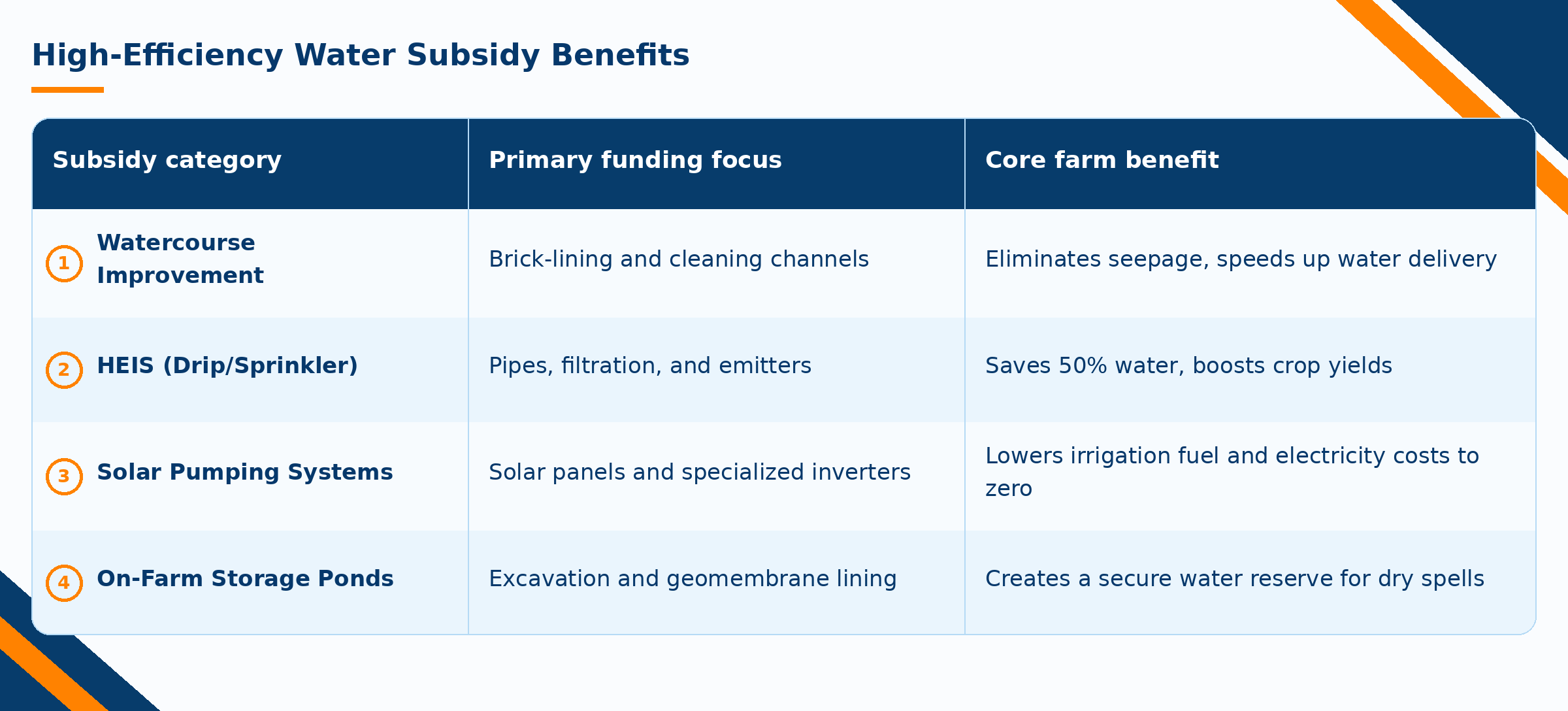
Water is the lifeblood of any farm. But traditional earthen watercourses are notoriously inefficient for farmers. That's why millions of gallons of water are lost every year due to seepage and evaporation. While weed overgrowth also consumes a large quantity of water before they ever reach the root of a crop. This waste forces the pump to run longer, which will spike your electricity and diesel bills.
Specialized watercourse improvement programs offer excellent Agri subsidies to tackle this issue. Because it helps farmers to line and brick their channels.
1) The Financial Impact: These initiatives typically cover a major portion of raw material costs (like cement and bricks). Therefore farmers often provide local labor as well.
2) The Long-Term ROI: Lining your watercourses drastically speeds up your water delivery times. Because it reduces conveyance losses by up to 30% and ensures that tail-end farmers receive their fair share of water.
Investing in watercourse improvements will save both your water and power from day one.
2) Installation of High Efficiency Irrigation Systems (HEIS):
Flood irrigation is rapidly becoming an outdated practice in commercial agriculture. It wastes water and washes away valuable soil nutrients. While it also creates an ideal environment for diseases to thrive. Therefore, upgrading to a High Efficiency Irrigation System (HEIS) is the logical next step. If you want to maximize your crop yields while conserving resources.
HEIS technologies, specifically drip and sprinkler irrigation deliver water and liquid fertilizer directly to the root zone of plants.
• Why Use an Agriculture Subsidy Here? The primary barrier to adopting HEIS is the high upfront cost of pipes and valves. While some emitters and filtration units are also barriers to adoption. Fortunately, high-efficiency farm subsidies frequently offer 70% to 80% cost-sharing grants to make this tech accessible.
• The Benefits: You can cut your water usage when you switch to drip irrigation. Because it will save up to 50% of your water and increase your crop yields by 20% to 100%. In simple words it gives you complete control over your field's microclimate.
3) Installation of Solar Systems for Operating HEIS:
While a drip or sprinkler system is incredibly efficient, running the high-pressure pumps required to operate it can quickly become expensive if you rely solely on grid electricity or diesel generators. This is where combining your irrigation setup with solar energy pays off.
Many green government subsidies for farmers now bundle HEIS installation with matching solar-coupled pumping grants.
• How the Subsidy Helps: The government offsets a major portion of the capital required to purchase solar panels, inverters, and mounting structures.
• True Energy Independence: Once installed, your operational cost for watering crops drops to near zero. You no longer have to worry about rising fuel prices or unpredictable grid power outages during critical watering stages.
Solar-powered irrigation creates a truly self-sustaining ecosystem for your farm business.
4) Construction of On-Farm Water Storage Ponds/Tanks:
Climate change has made rainfall patterns incredibly erratic. Relying purely on seasonal canal schedules or falling groundwater tables can leave your crops vulnerable during a sudden dry spell. To guarantee a steady supply of water, building on-farm water storage ponds or concrete tanks is essential.
Because digging and lining large reservoir ponds requires heavy machinery and significant capital, governments offer targeted agri subsidy options for water storage infrastructure.
• Strategic Water Banking: These funds allow you to excavate and line storage ponds with high-quality geomembrane sheets to prevent seepage.
• Smart Integration: You can collect rainwater or store your scheduled canal water share during low-demand periods, creating a reliable reservoir.
• The Ultimate Backup: When paired with your solar-powered HEIS, an on-farm storage pond acts as a battery, giving you total control to irrigate your crops exactly when they need it most.
Quick Comparison: High-Efficiency Water Subsidy Benefits:
The Bottom Line:
Securing an agriculture subsidy is not just about getting free financial aid; it is about making a strategic investment to build a resilient, high-yielding business. By taking advantage of farm subsidies for watercourse improvements, solar power, and advanced drip irrigation, you can transition your farm away from unpredictable operating costs and move toward reliable, automated profitability.
Don't let the paperwork hold you back. Visit your local district agriculture extension office, check the latest eligibility criteria, and secure the funding your farm deserves to grow smarter.
Frequently Asked Questions:
What is an agriculture subsidy for irrigation?
An irrigation agri subsidy is a government-funded financial program designed to help farmers adopt water-saving technologies. It heavily reduces the upfront cost of installing modern setups like drip irrigation, sprinklers, and solar-powered water pumps.
How do government subsidies for farmers help reduce solar costs?
Governments offer cost-sharing grants that typically cover 70% to 80% of the total expense required to install solar panels and matching pumps. This helps farmers shift away from expensive diesel fuel.
Who qualifies for High Efficiency Irrigation System (HEIS) farm subsidies?
Eligibility varies by location, but generally, small-to-medium landholders who have access to a reliable water source (like a borehole or canal share) and are willing to contribute their matching share of the project cost can qualify.