Hydraulic Fluids: Types, Uses & How to Choose the Right Oil
Explore hydraulic fluids, their types, uses, ISO viscosity grades, hydraulic oil prices in Pakistan, and tips for choosing the right fluid for your machinery.
Hydraulic fluids are the liquids that carry power through a hydraulic machine. A pump pushes the fluid, the fluid pushes a piston or motor, and a lever movement becomes tonnes of force.
Most of them are mineral-oil-based, which is why people say hydraulic oil, but the family also includes water-glycol, phosphate-ester, and biodegradable fluids made for special jobs.
This guide explains what hydraulic oils are, what they do, the main types and real examples, how to choose a grade of hydraulic oil, why “hydraulic fuel” is the wrong word, and what hydraulic fuel costs in Pakistan.
The specs come from ISO standards and industry guides, and the prices are dated listings, so check the pack in front of you.
Quick Answers
1) What They Are: Liquids that transmit force in hydraulic systems while also lubricating, sealing, cooling, and cleaning.
2) Main Types: Mineral oils (HL, HM, HV), fire-resistant fluids (water-based and synthetic), and biodegradable ester fluids.
3) Most Common Grade: An anti-wear HM oil in ISO VG 46, with VG 32 for cold or fast systems and VG 68 for heat and heavy loads.
4) Contamination Risk: Particles, water, and air can damage pumps and valves. Set cleanliness targets from the equipment manufacturer rather than relying on a single failure-rate estimate.
5) Price in Pakistan: The sample listings below work out to roughly Rs 550–770 per litre. These are indicative examples, not verified live quotations.
What are Hydraulic Fluids?
What are hydraulic fluids, in plain terms? They’re the working liquid inside a hydraulic circuit.
Liquids barely compress, so when a pump pressurises one end of the circuit, the force shows up at the other end almost instantly.
That’s how an excavator arm, a tractor lift or a press moves.
Because the fluid is under pressure and constantly moving through tight clearances, it can’t be just any liquid.
It has to flow in cold weather, hold a film on metal when hot, and stay stable for thousands of hours.
Additives do part of that work, and the base fluid does the rest.
What Hydraulic Fluids Actually Do
The oil does more than move a cylinder. While the pump builds pressure, the fluid also has to protect moving parts and carry heat away.
1) Transmits power. It carries pressure from the pump to the actuator.
2) Lubricates. It keeps a film between pump gears, vanes, pistons, and valve spools.
3) Seals clearances. It fills the tiny gaps inside pumps and valves so pressure doesn’t leak past.
4) Carries away heat. It moves heat from the pump and valves to the reservoir and cooler.
5) Carries contaminants to the filter, so particles end up in the element and not in the pump.
If any of the five fails, the others follow. Dirty fluid wears the clearances, wear leaks pressure, leaks make heat, and heat breaks the fluid down.
Hydraulic Fluid Types: The Main Families
ISO 6743-4 groups hydraulic fluids by composition and performance.
These are the main families you may see on a product data sheet; operating limits vary by formulation and equipment.
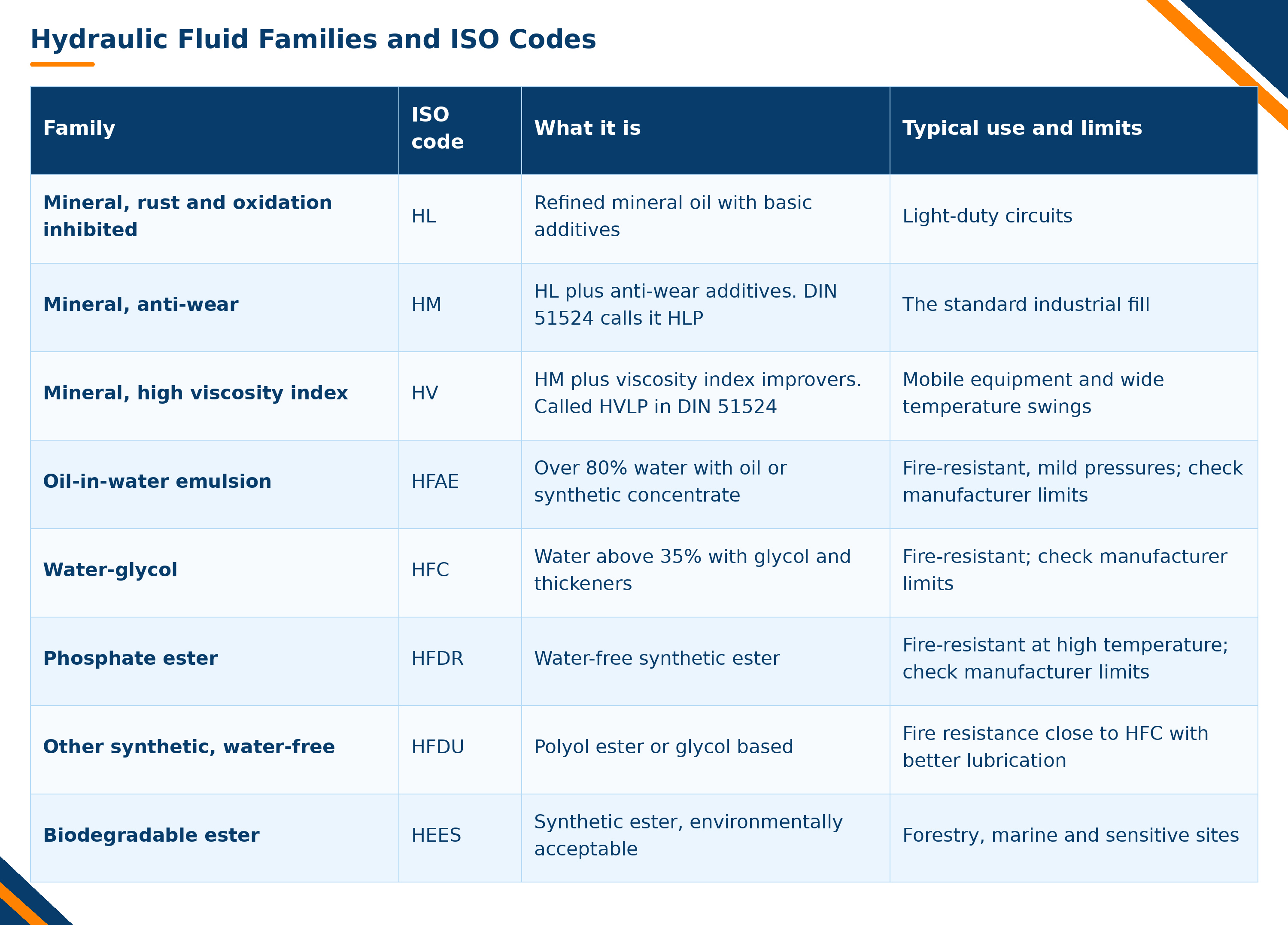
Mineral oil is the default because it’s cheap, lubricates well, and works with common seals.
The other families exist because of a problem it can’t solve.
Mineral oil burns, so steel mills, die-casting shops, and mines use fire-resistant fluids.
It also isn’t biodegradable, so forestry and marine work may specify ester fluids.
Never swap one family for another without checking seal compatibility, because the wrong chemistry swells or hardens seals.
Examples of Hydraulic Fluids You Will Actually Meet
In workshops and industrial plants, this fluid is selected for the machine, not simply by the name on the drum.
The examples below show where different formulations may be specified.
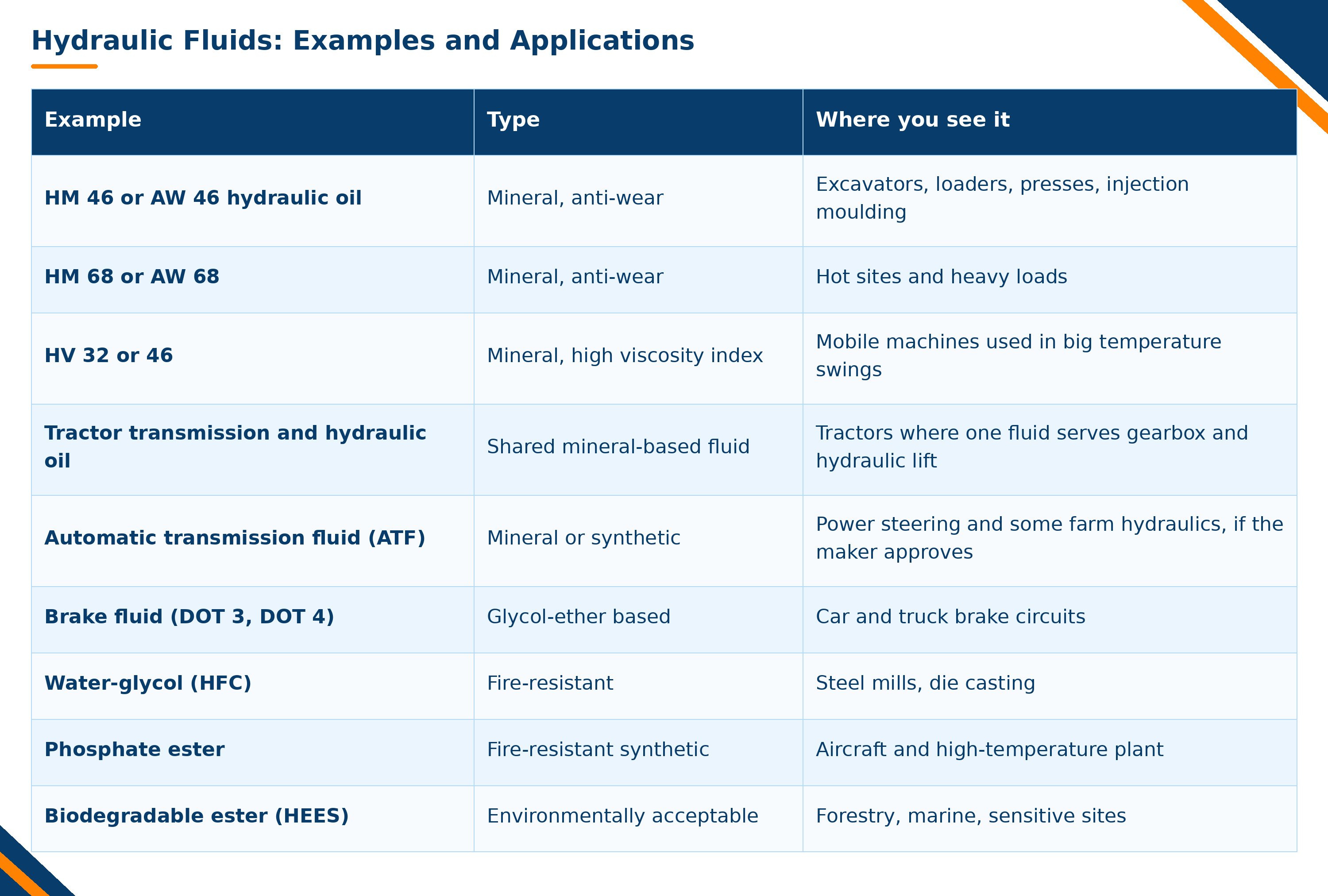
Brake fluid works hydraulically, but DOT 3 and DOT 4 are not substitutes for mineral hydraulic oil.
Likewise, automatic transmission fluid (ATF) is appropriate for certain hydraulic applications only when the equipment manufacturer explicitly approves it.
Never choose a fluid because it looks similar or has the same colour.
Zarea’s Energy and Petroleum category includes lubricants and fuels used by trade buyers.
Its engine-oil listings are useful for comparing products within that category, but engine oil must not be treated as a substitute for hydraulic oil.
Confirm whether the required hydraulic or transmission fluid is actually available before ordering.
Hydraulic Oil: Grades, Viscosity And How to Choose
Hydraulic oil is classified in two ways. The ISO VG number tells you how thick it is, and the letters tell you what additives it carries.
An oil called HM 46 is an anti-wear mineral oil with a viscosity of 46 centistokes (cSt) at 40°C, within a band of plus or minus 10%.
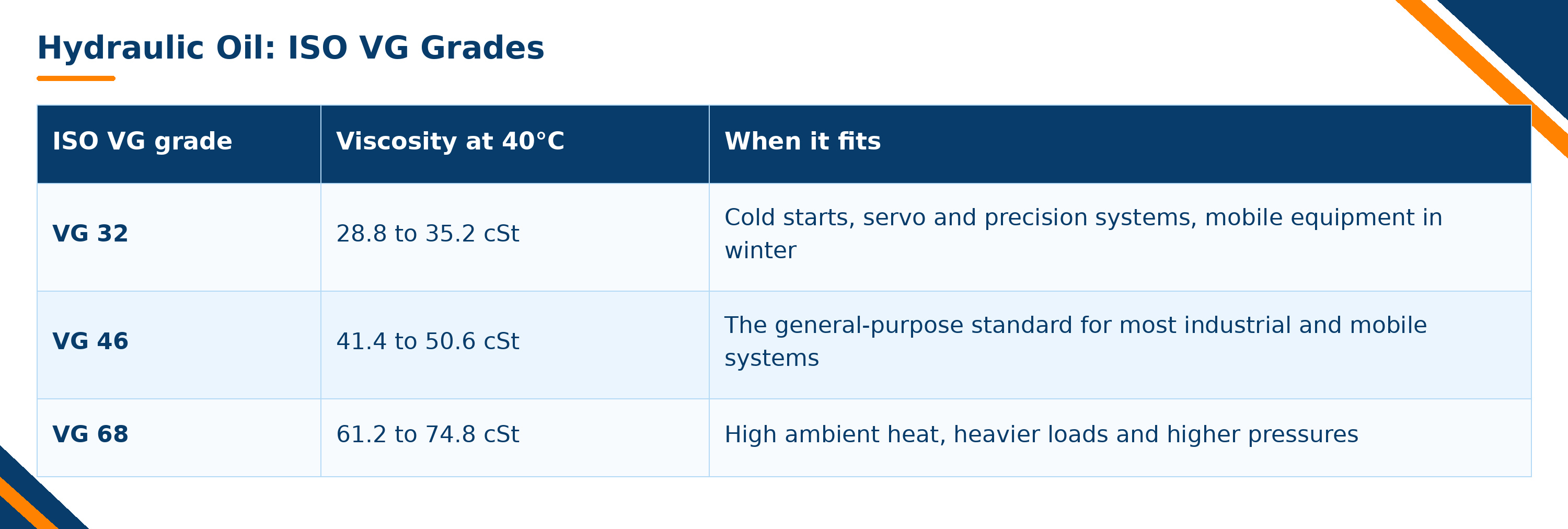
Temperature affects oil viscosity, but ambient temperature alone cannot determine the right grade.
Check the machine manual, operating oil temperature, pump requirements, and start-up conditions before considering VG 32, VG 46, VG 68, or a high-viscosity-index formulation.
A short checklist before you buy:
1) Specification: Match the OEM grade and code, such as HM 46, not just “hydraulic oil”.
2) Seals: Mineral oil suits common seal materials, while water-glycol and phosphate ester need compatible seals.
3) Climate and Duty: Choose VG 32, 46, or 68 by temperature, pressure, and load.
4) Source: Buy sealed packs from a known distributor, and check batch codes and caps.
5) Pack Size: Compare the delivered cost per litre and your expected usage. Larger packs can cost less per litre, but only if you can store the fluid correctly and use it within the supplier’s recommended period.
Hydraulic Fuel: Why “Fuel” is the Wrong Word
People often search for hydraulic fuel, but hydraulic systems don’t burn anything. The fluid carries pressure and isn’t consumed like diesel in an engine.
In an excavator, the diesel engine drives the hydraulic pump, so the machine has fuel in one tank and this fluid in another.
They must never be mixed. Diesel or petrol in a hydraulic reservoir thins the oil, attacks seals, and can ruin a pump.
Fuel and hydraulic fluid serve different jobs. For example, LPG is sold as an energy source for suitable equipment, not as a hydraulic-system fluid.
Zarea has a separate LPG Gas product listing for buyers who need fuel rather than lubricating oil.
Hydraulic Fluid Oil Price in Pakistan
Hydraulic fluid prices depend on grade, manufacturer, pack size, and supplier. The figures below come from sample Pakistani listings noted in November 2026.
Because the individual offers were not retained as verifiable quotations, use this table only for rough budgeting and request a current price for the exact specification.
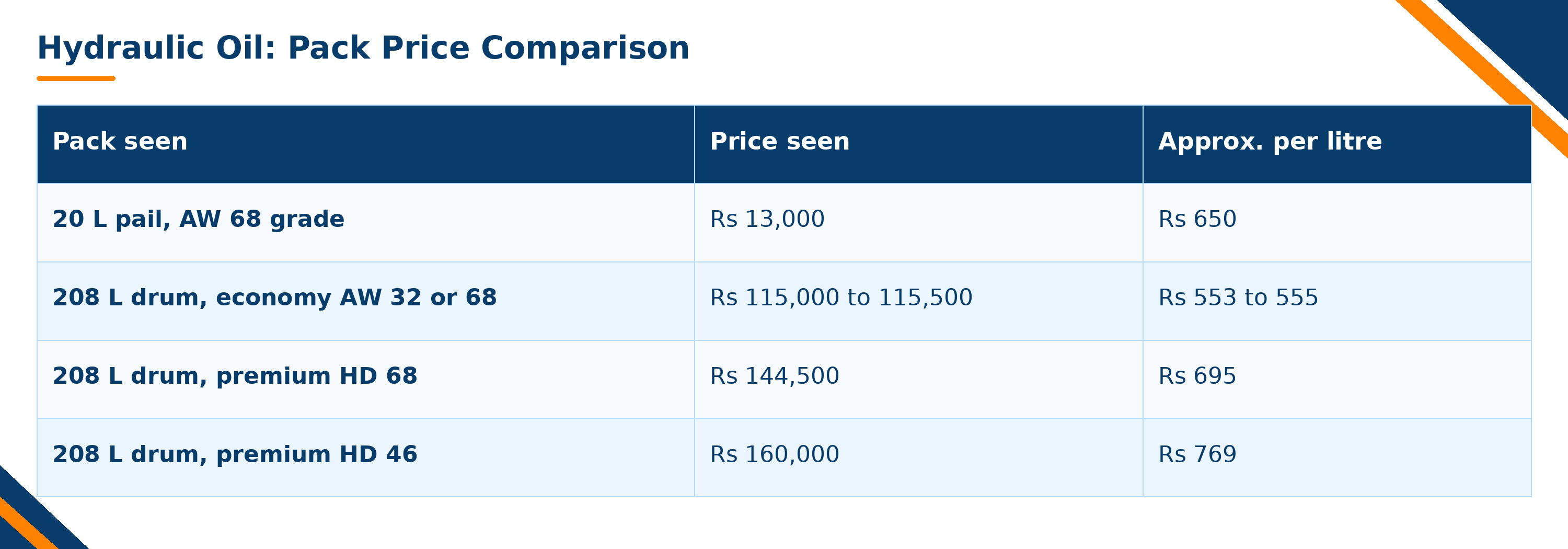
The per-litre amounts are calculated from the sample pack prices. They exclude delivery, taxes, and any handling charges that may apply.
Confirm the pack volume and whether the quote is for genuine, sealed stock.
In these examples, the large drums have a lower unit price than the 20-litre pail.
That does not mean a more expensive oil will automatically last longer: drain intervals depend on the equipment, contamination, operating conditions and the oil analysis programme.
Where Hydraulic Fluids are Used?
Hydraulics sits behind a lot of Pakistan’s working machinery.
1) Construction: Excavators, loaders, cranes and concrete pumps rely on hydraulic oil, usually HM 46 or 68.
2) Agriculture: Tractor lifts, loaders and implements use hydraulic or shared transmission oil. Seeders and other attachments draw on the same system.
3) Manufacturing: Presses, injection moulding machines and machine tools run on hydraulic power.
4) Automotive: Brakes, power steering and some transmissions are hydraulic.
5) Aviation, Marine and Forestry: Fire-resistant and biodegradable fluids are common here.
Heat changes the choice. Steel and foundry work, where a burst hose can spray oil near molten metal, often uses fire-resistant fluids.
If you source for steel plants or rolling mills, that’s the fluid family to ask about.
Hydraulic presses also appear in some briquetting and pellet-making operations.
If you are exploring that application, Zarea’s biomass briquettes explains the production process; it is background reading, not a hydraulic-fluid specification.
Keeping It Clean
Contamination is a major cause of hydraulic wear.
Small particles can damage pumps and precision valves long before the oil looks dirty, so use the cleanliness level recommended for your equipment.
ISO 4406 describes particle cleanliness using three counts for particles at or above 4, 6, and 14 micrometres.
Each increase of one code number represents approximately twice as many particles.
The target code depends on component sensitivity and the manufacturer’s recommendations; do not apply a single target to every system.
Water can also damage hydraulic components and accelerate oil degradation. Its acceptable level depends on the fluid chemistry, temperature, and equipment.
Check for leaks and condensation, maintain breathers and seals, and use laboratory oil analysis when the machine is critical.
A note on safety. A pinhole leak in a pressurised line can inject fluid under the skin, and it needs urgent medical care.
Never check for leaks with your hand, and dispose of used oil properly instead of dumping it.
Buying Hydraulic Fluids for a Business
For a business purchase, start with the equipment manual and a written specification: fluid family, ISO VG grade, required performance standard, pack size, quantity, and delivery city.
Ask the seller for the technical data sheet and confirm compatibility before changing brands or formulations.
Zarea’s Energy and Petroleum category can help businesses explore related lubricants and fuels.
For example, its Mobil Delvac MX 15W-40 listing is a diesel engine oil, not a hydraulic-fluid recommendation.
Match each product to the system it was designed for rather than choosing by brand alone.
If you distribute industrial lubricants, confirm your product specifications and availability before offering them to buyers.
A clear technical data sheet is more useful than broad claims about performance.
FAQs
What is the Most Common Hydraulic Fluid?
Mineral-based anti-wear hydraulic oil is widely used in industrial and mobile equipment.
HM/HLP fluids, often in ISO VG 46, are common examples, but the correct fluid is whatever the equipment manufacturer specifies.
What are the Four Types of Hydraulic Fluid?
Four broad groups are mineral-oil fluids, water-based fire-resistant fluids, water-free synthetic fluids, and biodegradable fluids.
Standards provide more detailed classifications within these groups.
What is ISO 46 Hydraulic Oil Used for?
ISO VG 46 is a viscosity grade commonly specified for hydraulic pumps, industrial presses, and some mobile equipment.
It describes viscosity at 40°C, not the complete performance or additive specification.
Wrap Up
Hydraulic fluids look like a commodity, but they’re really a component of the machine.
Match the family and grade to the specification, keep the oil clean, and treat the price per litre as only part of the cost.
A cheap oil that lets contamination in will cost far more than a good one that keeps the pump alive.
Treat the figures here as a snapshot, and always follow your equipment maker’s manual.