Short Term Business Loan: How It Works, Costs & Benefits
Learn what a short-term business loan is, how it works, and the main types available in Pakistan, including trade credit for commodity buyers
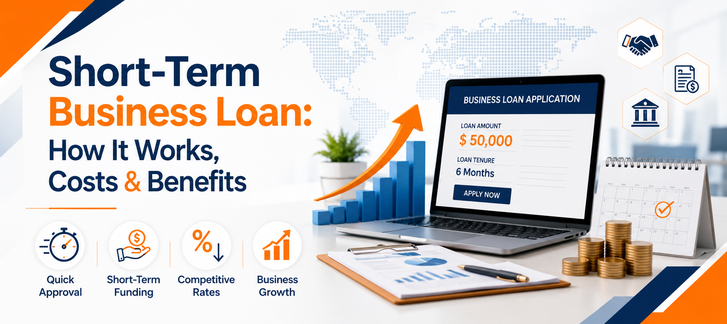
Say you run a small trading business. You've just landed a bigger order than usual, but the supplier wants payment before the goods leave the warehouse, and your customer isn't paying for another six weeks.
That gap, money going out now, money coming in later, is exactly what a short-term business loan is built for: cash you borrow and pay back quickly, usually inside a year, to get past a crunch rather than fund some five-year expansion plan.
It sounds simple, and mostly it is. But there are a few different ways this actually plays out depending on who's lending and what you're borrowing against.
This guide walks through what a short-term business loan actually looks like, why businesses reach for one, the main types you'll find in Pakistan, and where a newer option, trade credit tied directly to a purchase, like what's available to commodity buyers on Zarea, fits into all of it.
What Is a Short-Term Business Loan?
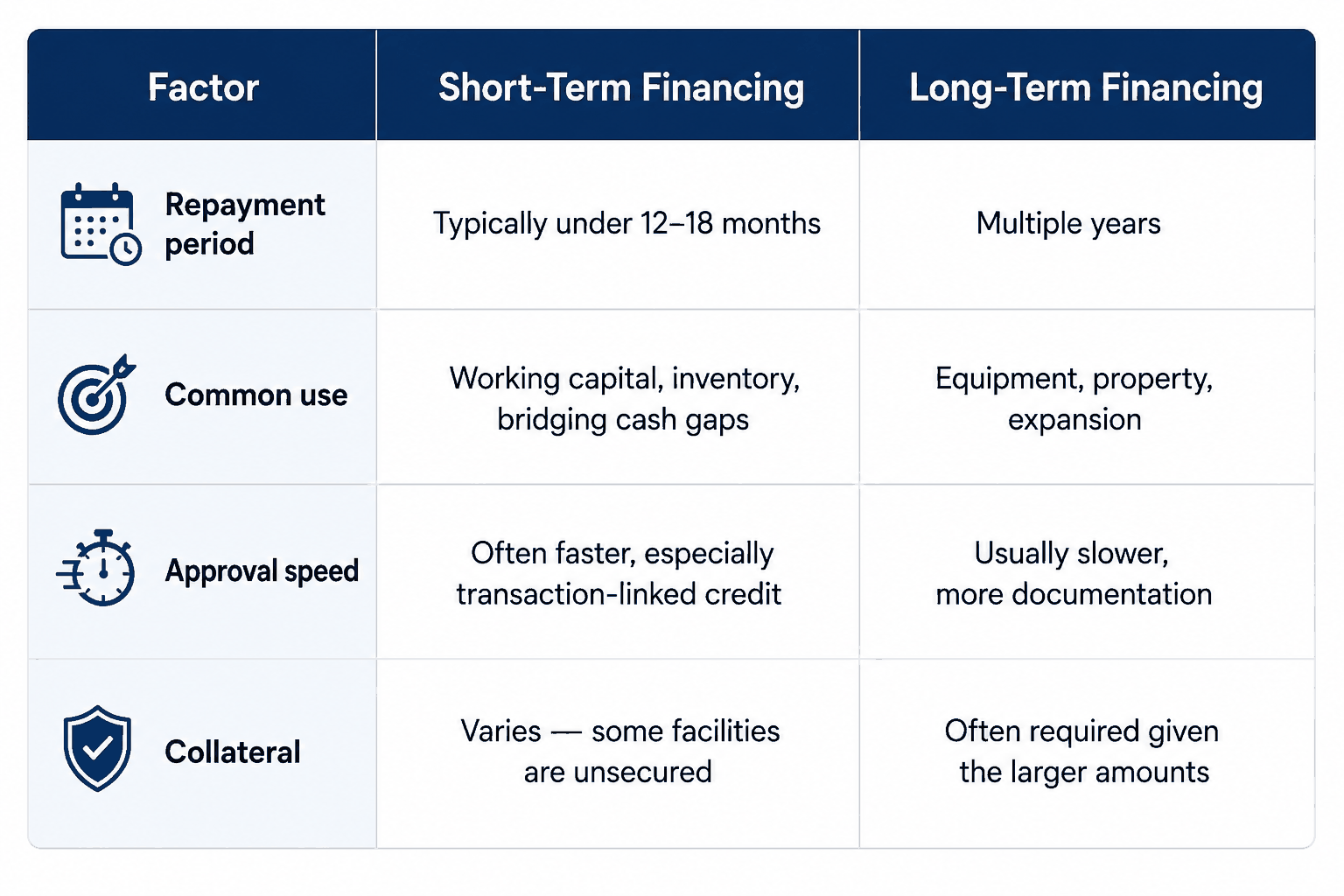
At its simplest, it's borrowed money you're expected to pay back fast, usually inside twelve months, sometimes stretched to eighteen depending on the lender.
Compare that to a long-term loan, which might fund a new warehouse or a fleet of trucks over several years. A short-term loan isn't trying to do that. It's there to patch a temporary hole in your cash flow and then get out of the way.
How that actually gets structured varies. Sometimes it's a lump sum you pay back on a fixed schedule. Sometimes it's a revolving line you draw from and repay as needed, not unlike a credit card for your business.
And increasingly, it's credit tied directly to one specific purchase or invoice rather than a general-purpose loan at all. Different shape, same job: solve a near-term cash problem without locking you into years of repayment.
Why Businesses Take Out Short-Term Loans
Cash flow almost never moves in a straight line, which is really the whole reason this kind of financing exists.
The most common trigger is a mismatch in payment timing, you're waiting 30, 60, sometimes 90 days to get paid by a customer, while your supplier wants the money now or on delivery.
Seasonal buying causes the same squeeze: stocking up on inventory or raw material ahead of a price jump or a demand spike means spending money before it's coming back in.
Then there's the stuff nobody plans for, a machine breaks down, a shipment gets delayed, input costs jump overnight, and suddenly there's a hole in the budget that wasn't there last week.
Or you simply land a bigger order than your current cash can comfortably cover, which, annoyingly, is usually a good problem to have and a stressful one at the same time.
How Short-Term Business Loans Work
The mechanics look pretty similar no matter who's lending, even if the paperwork differs. A lender goes through the business's financials, bank statements, tax registration, sometimes collateral or a personal guarantee, figures out roughly what can realistically be paid back, and sets a limit along with a repayment schedule.
From there, the money either lands as one lump sum or gets released against specific invoices and purchase orders as they come in, and repayment happens either through fixed instalments or, for a revolving line, just by chipping away at the balance as revenue arrives.
Approval speed and collateral requirements vary a lot. Traditional bank loans in Pakistan can take anywhere from a few days to a few weeks depending on documentation, while digital-first platforms built around a specific transaction type, such as trade credit tied to a commodity purchase, can move faster, since the lender already has visibility into exactly what's being financed and where the money is going.
Businesses that track current commodity prices as part of routine planning are usually better positioned to know when a short-term facility actually makes sense versus when it's better to wait.
Types of Short-Term Business Financing in Pakistan
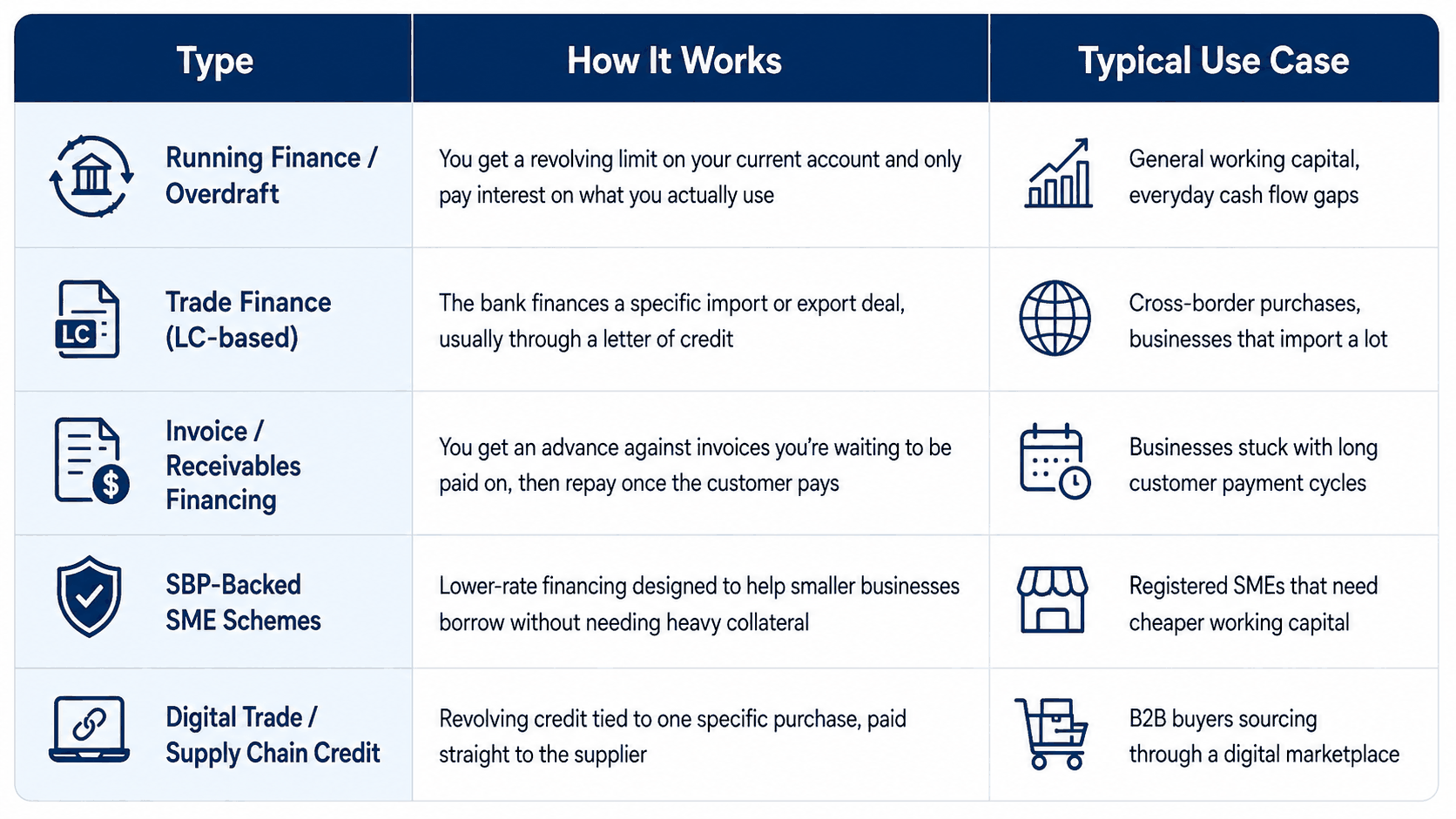
The State Bank of Pakistan has been actively pushing banks toward the last category. Under current SBP prudential regulations for SME financing, banks are required to offer Digital Supply Chain Financing to SMEs, tying credit directly to an actual transaction reduces risk for the lender and generally speeds up approval for the borrower.
Short-Term vs. Long-Term Business Financing
Real-World Example: Financing a Commodity Purchase
Imagine a wholesaler receives a large customer order but needs to pay Rs. 5 million to a supplier before the goods are delivered. The business has only Rs. 2 million available and expects to receive payment from its customer after the sale.
A short-term, transaction-linked credit facility can bridge this gap. The financing is used to pay the supplier, the business receives the goods and fulfills the order, then repays the facility when the customer payment arrives.
For wholesalers, distributors, and commodity buyers, this can provide the working capital needed to complete profitable purchases without tying up all their
available cash.
Benefits and Limitations of Short-Term Business Financing
Short-term financing solves a real problem, but it isn't free of trade-offs.
Benefit — Speed: decisions and disbursement typically happen much faster than long-term financing.
Benefit — No equity given up: unlike raising investment, the business ownership stays untouched.
Benefit — Matches irregular cash flow: revolving facilities in particular flex with how the business actually earns and spends.
Limitation — Cost adds up if rolled over: repeatedly renewing short-term credit instead of resolving the underlying cash gap can get expensive.
Limitation — Tight repayment windows: a short repayment period can strain cash flow if revenue doesn't arrive on schedule.
Limitation — Still requires documentation: "no collateral" doesn't usually mean "no paperwork", most lenders still want bank statements and proof of business registration.
What Lenders Typically Ask For
Requirements vary by lender, but most short-term financing applications in Pakistan converge on a similar core document set: proof of business registration or incorporation, tax registration, roughly six to twelve months of bank statements to establish cash flow, and, particularly outside formal bank channels, a post-dated cheque or personal guarantee as security.
Having these ready before applying is usually the single biggest factor in how fast a decision comes back.
Short-Term Credit for Commodity Buyers
For businesses that buy commodities rather than sell directly to consumers, the short-term financing conversation looks a little different, the cash gap usually sits between placing a purchase order and actually needing the goods on hand.
Zarea's credit facility is built around exactly that gap: a revolving, no-collateral credit line that lets approved buyers receive product without paying the full cost upfront, with funds disbursed directly to the supplier once an order and invoice are submitted.
It's currently available for agricultural biomass commodity purchases on the platform, with credit decisions typically returned within 72 hours. The application asks for much the same core documents most short-term lenders in Pakistan expect, a tax registration certificate, company incorporation certificate, a year of bank statements, a post-dated cheque, and a formal credit request outlining the amount and purpose.
Buyers sourcing other categories, such as grains and pulses or steel, can still track daily pricing to plan cash flow around purchases, even where the credit facility's current scope doesn't yet extend.
Frequently Asked Questions
What documents do I need to apply for a short-term business loan in Pakistan?
Most lenders want to see proof that your business is actually registered, a tax registration certificate, and about six to twelve months of bank statements so they can get a feel for your cash flow. Some will also ask for a post-dated cheque or a personal guarantee instead of the collateral a bigger loan might require.
Is a short-term business loan the same as a line of credit?
Not quite. A loan typically disburses as a lump sum repaid on a fixed schedule. A line of credit is revolving, you draw funds as needed and repay them, then can draw again up to your limit. Both can be structured as short-term financing.
How fast can a business get short-term financing in Pakistan?
It depends heavily on the lender and how complete the documentation is. Traditional bank loans can take anywhere from a few days to a few weeks. Digital, transaction-specific credit facilities tend to move faster since the lender already has visibility into what's being financed, some return decisions within 72 hours.
What is the difference between a short-term loan and a line of credit?
A short-term loan gives you a lump sum that you repay on a fixed schedule. A line of credit lets you draw funds as needed, repay them, and borrow again up to your approved limit.
Wrap Up
Matching the right type of short-term financing to the actual cash gap matters more than chasing the lowest advertised rate. A running finance facility solves a different problem than trade credit tied to a specific purchase, and using the wrong tool tends to cost more in the long run than taking a little extra time to pick the right one.
Whether that's a bank's working capital line or transaction-specific credit through a digital marketplace, the goal stays the same: keeping the business moving without the cost of the financing outweighing the benefit of the cash.