Top 5 Metal Fabrication Techniques Used by Experts Today
Discover the top 5 metal fabrication techniques used by industry experts today. Learn how cutting, bending, and welding shape our modern world.
Introduction:
Check out your environment. They all have one thing in common! The steel beams holding up your office and the sleek casing of your laptop. Or the complex exhaust system of your car and even the heavy machinery harvesting your food. They exist because someone took these raw, unyielding blocks or sheets of metal and made them functional.
This is not magic, it’s metal fabrication.
If you are an engineering student. Or you are a business owner looking for a manufacturing partner or a curious mind? This offers an exhaustive guide to the basic techniques that experts use to shape our physical universe.
What Is Metal Fabrication?
Metal fabrication is the value-added process of building machines and structures from raw metal materials. Fabrication shops take stock of metals-like sheet metal and bars. This also includes rods and billets. Instead of assembly lines that put pre-made parts together. Because this process bends and molds the steel items together into brand-new shapes.
Think of this process as the ultimate in industrial origami. Because it turns raw and rigid elements into precise ones. Or it could turn steel into high-performing components as well. Almost every modern industry today directly or indirectly relies on metal fabrication work. Whether you are talking about aerospace and the defense field. Or you can talk about medical devices and home appliances all included in it.
The Big Three - Understanding the Industry Types:
their types. Because they help us understand that not all metal fabrication is the same. The industry is generally divided into three major sectors of fabrication. These three sectors are based on the scale and application of the project.
1) What is Industrial Metal Fabrication?
Industrial fabrication focuses on creating heavy-duty components and large-scale machinery. These are the parts that keep factories running and power plants from generating electricity. Additionally, refineries and process materials also rely on these parts. Whether you think of massive storage silos and large conveyor systems for the industry. Or you could think of industrial tanks and pressure vessels. These types of work require materials that can withstand extreme heat and corrosive environments to perform. While they also require intense pressure. That's why industrial fabrication is important for every industrial work.
2) What is Structural Metal Fabrication?
If you have ever watched a skyscraper go up in the sky. You have seen structural metal fabrication in action. This sector deals entirely with the load-bearing steel skeletons of buildings and infrastructure. Even bridges also rely on this type of fabrication. Fabricators in this niche take massive I-beams and platforms to perform their work. They also have girders and truss systems for additional help. They use these materials to cut and weld them into hyper-precise blueprints. Importantly there is zero room for error in this type of work. Because human life's structural integrity always depends on this work.
3) What is Commercial Metal Fabrication?
Commercial fabrication is what we interact with the most in our daily lives. Because it encompasses small and often aesthetically pleasing metal goods. It is also highly precise work. Restaurant-grade stainless steel kitchens and electronic enclosures all fall under this umbrella. Additionally retail shelving units, custom stairs and some decorative railings also rely on this work. That's why this fabrication combines durability with visual appeal.
What is The Metal Fabrication Process?
How does a giant flat steel sheet become a complex machine component? What are the main metal fabrication processes? Every project follows a structured lifecycle to ensure accuracy and structural integrity.
1. Design and Engineering: This process always begins with a digital blueprint. While it is usually created via Computer-Aided Design (CAD) software.
2. Material Selection: The right alloy metal is chosen for the process that is based on strength and weight. This alloy might be aluminum, stainless steel, mild steel or carbon steel according to your budget.
3. The Fabrication Stage: This is the stage where the actual cutting, shaping, and joining phases happen.
4. Finishing: Finally the metal is sandblasted and painted for protection purposes. While sometimes metal is powder-coated or galvanized to protect it from rust and wear.
5. Quality Control: The final metal product is tested against rigorous industrial standards before deployment.
Top 5 Metal Fabrication Techniques Used by Experts Today:
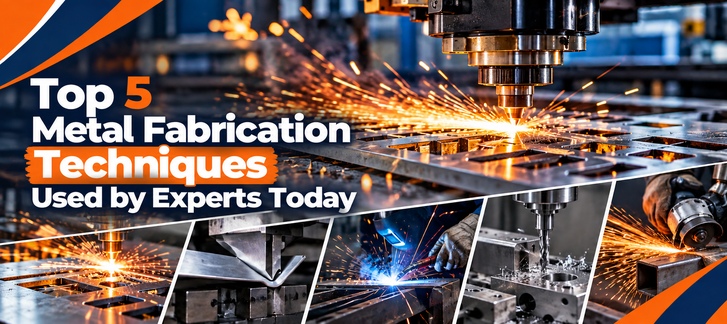
Industrial experts rely on five foundational techniques to achieve the precision that is required for modern applications.
1) Cutting (Laser, Plasma, and Waterjet)
You have to cut raw materials down to size before you can build anything. Traditional saws are still used at this time. But modern experts rely on high-tech advanced cutting methods.
1) Laser Cutting: This technique uses a highly focused and computer-controlled light beam. Because this beam melts metal with pinpoint accuracy. While it is ideal for intricate shapes and thin sheets.
2) Plasma Cutting: This technique utilizes a super-heated stream of electrically ionized gas that is called plasma. Therefore it slices through incredible thick steel plates like butter.
3) Waterjet Cutting: This technique employs an ultra-high-pressure water stream that mixes with abrasive particles. Therefore it prevents the metal from warping or changing its molecular properties because it uses no heat.
2) Forming and Bending
Once the metal is cut, it often needs to be shaped. Bending is the art of deforming metal without removing any material.
The most common tool used here is the press brake. This is a flat piece of metal that is placed over a V-shaped die and a heavy punch presses down one. Because this tool forces the metal to bend at a specific angle. This tool is used for circular shapes, tubes, or cylinders of type. Fabricators use roll forming and run the metal through a series of heavy rollers to gently curve it into these shapes.
3) Machining (Milling and Drilling)
Machining is a subtractive process, meaning it removes unwanted metal from a solid piece to create highly complex features.
1) Drilling: Creates clean, precise holes for bolts, wiring, or fasteners.
2) Milling: Uses rotating cutting tools to shave off microscopic layers of metal.
Modern fabrication shops use CNC (Computer Numerical Control) machines. A computer guides the drills and mills down to the micrometer, ensuring that thousands of identical parts can be made perfectly every single time.
4) Welding (MIG, TIG, and Stick)
Welding is the ultimate way fabricators join two separate pieces of metal together permanently. By applying intense heat to the joint, the metals melt, fuse, and cool into a single solid bond.
1) MIG (Metal Inert Gas): Fast, efficient, and great for thicker metals like structural steel.
2) TIG (Tungsten Inert Gas): Slower, but offers unmatched precision and clean aesthetics. It is widely used for aluminum and stainless steel projects.
3) Stick Welding: The old-school, rugged method that works beautifully outdoors or on rusty materials.
5) Assembling
The final major technique is assembling—putting all the cut, bent, machined, and welded parts together into the finished product. This stage often incorporates mechanical fasteners like rivets, bolts, and screws. Assembling requires incredible attention to detail, ensuring that moving parts line up perfectly, electrical components fit snugly, and the structural integrity of the final unit is completely sound.
The Future of Metal Fabrication:
The future of metal fabrication is defined by widespread automation, artificial intelligence-driven quality control, and sustainable, eco-friendly manufacturing processes. As the global market advances toward hyper-efficient smart factories, traditional mechanical workshops are transforming into digitally intelligent ecosystems.
Core Technological Shifts of Metal Fabrication:
1) Smart Automation & Cobots: Collaborative robots work side-by-side with human operators to handle heavy lifting, repetitive cutting, and precise welding, reducing human error and injury.
2) AI and Vision Inspection: Artificial intelligence algorithms monitor machine health for predictive maintenance, while vision-based systems inspect cuts and welds in real-time.
3) Additive Manufacturing: Metal 3D printing allows for rapid prototyping and the creation of intricate, complex geometries that traditional machining cannot achieve.
4) Fiber Laser Technology: High-powered fiber lasers continue to replace legacy plasma and mechanical saws, providing faster speeds and tighter nesting to minimize material waste.
5) Sustainable Operations: Eco-conscious fabrication emphasizes high-yield nesting software, extensive scrap metal recycling, and non-toxic surface treatments.
Wrap Up:
The modern world would grind to a halt without metal fabrication. Whether yo talk about the massive industrial tanks that keeping factories online. Or you can talk about the precise laser-cut enclosures that protect our electronics. Therefore metal fabrication work bridges the gap between digital imagination and physical reality. By mastering these top five techniques, you can easily cutting, bending, machining, welding, and assembling of metal. While experts continue to build a safer, stronger, and more efficient future.