What Are Cash Crops? Top Examples, and Their Impact
What are cash crops and why do farmers grow them? Get a clear definition alongside major global examples driving modern commercial agriculture today.
Introduction:
Agriculture is often romanticized as a peaceful lifestyle of living off the land. Because it defines where a family grows what they eat and eats what they grow. While that beautiful picture perfectly describes subsistence farming techniques. That's why modern global agriculture runs on a completely different engine like cash crops.
From the morning coffee that fuels your day to the cotton t-shirt on your back, cash crops are the invisible threads holding the global economy together. But what exactly makes a plant a "profit crop?" How do these profit crops shape nations like Pakistan?
Let's find out about the fascinating world of commercial agriculture. Because here we can describe you real-world examples. This means you can easily look closely at the future (and even the dark side) of these high-stakes plants.
What Are Cash Crops?
Any agricultural crop that is grown specifically to be sold for profit on local or international markets is called a "Cash Crop". Rather than the farmers or their livestock personally consuming it.
The distinction between a food crop and a cash crop isn't a biological one. While it is an entirely intentional purpose. It is a staple or subsistence crop, if a smallholder farmer grows a patch of corn to feed their family and chickens for instance. However, a commercial farmer plants hundreds of acres of the exact same corn to sell to an ethanol plant. Or he sells his corn to a multinational food corporation. Then this crop transforms into a cash crop.
Historically, these crops have been the main driving force behind global trade routes. Because these crops also stood behind colonial expansions and the nation's industrialization. Therefore, these crops represent the peak of agricultural commercialization today.
Cash Crops of Pakistan - The Backbone of an Economy:
First of all you need to look at Pakistan's economic landscape. Because it will help us to understand how cash crops shape an entire country. Because agriculture is the ultimate lifeblood of Pakistan. Its major cash crops contribute heavily to national GDP. Additionally agriculture also acts as a primary source of our foreign exchange.
Pakistan's unique geography and fertile Indus River plains make it a fertile country. While its extensive canal irrigation network also makes it a powerhouse for specific high-value crops. The nation routinely ranks among the top global producers of several crucial commodities.
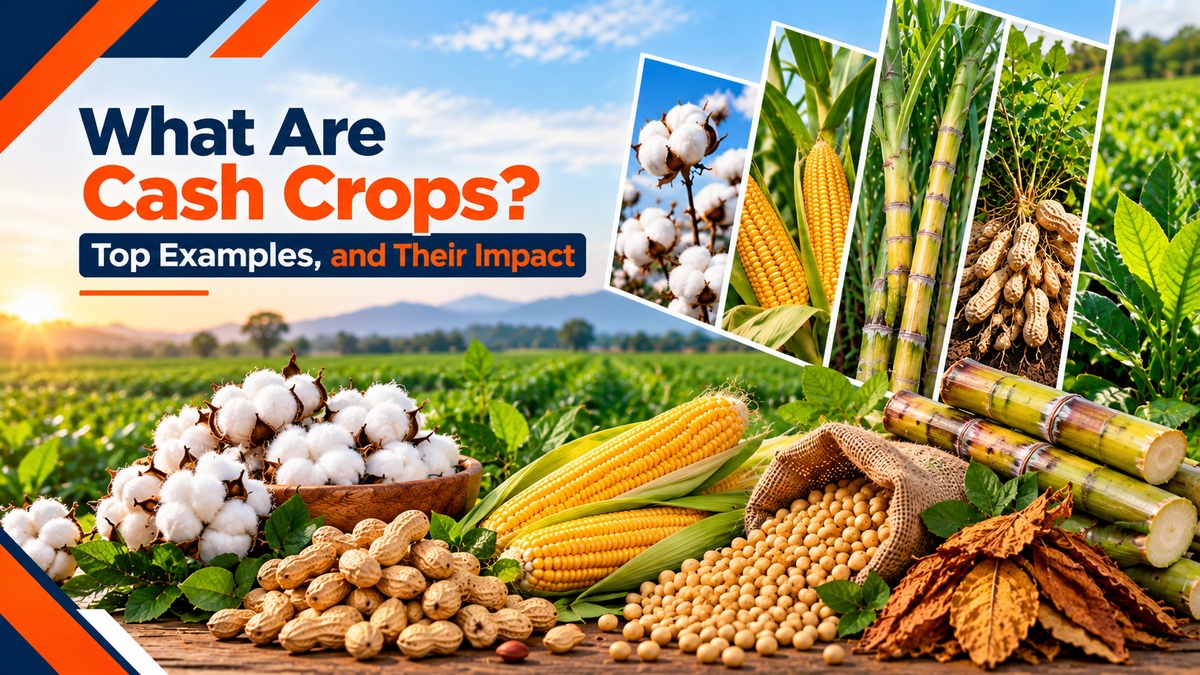
1) Cotton (The Silver Fiber): Cotton is the absolute crown jewel of Pakistani cash crops. Because it feeds the country's massive textile sector. While this sector accounts for more than half of Pakistan's total export earnings as well. Whether you talk about garments or raw yarn. Or you can discuss cotton which keeps millions of people employed in the country.
2) Sugarcane: This crop is cultivated across millions of hectares in Pakistan. Basically, the sugarcane crop drives the domestic sugar mill industry to its peak. That's why Pakistan ranks as the 5th largest sugarcane producer globally. This fact has turned this giant grass into a massive economic driver for Pakistan.
3) Wheat: Wheat feeds the entire world's population because it doubles as a staple food. On the other hand its commercial scale makes it a heavily traded domestic cash crop. In this way wheat stabilizes the agricultural sector.
4) Rice (Particularly Basmati): The rice crop is renowned worldwide for its aroma and long grains. Moreover Pakistani basmati rice is a premium export product. This is because it brings billions of dollars into the national Treasury every year.
Why Are Cash Crops So Important?
If subsistence farming feeds the stomach, cash crops feed the economy. They are vital for several core reasons:
1) Generating Foreign Exchange
Developing nations rely heavily on exporting high-value agricultural products to earn foreign currency. This revenue allows governments to import technology, energy, and goods they cannot produce domestically.
2) Industrial Raw Materials
Cash crops are the starting point for countless industrial manufacturing supply chains. Without cotton, there is no clothing industry; without sugarcane or oilseeds, food processing sectors grind to a halt.
3) Rural Employment and Poverty Alleviation
Large-scale commercial farming creates millions of jobs. It employs tractor drivers, field hands, processors, logistics experts, and exporters, injecting vital capital directly into rural communities.
Local vs. Global Cash Crops:
Not all cash crops travel across oceans. Agriculture operates on two distinct levels: local and global.
1) Local Cash Crops
These are perishable or regionally specific items grown for nearby urban centers. Think of fresh vegetables, local fruits (like Pakistan’s famous Chaunsa mangoes), and flowers. Farmers sell these at regional markets (mandis) for quick cash returns. They have low transport costs but are highly dependent on immediate local demand.
2) Global Cash Crops
These are highly traded, easily storable, non-perishable commodities bought and sold on global futures exchanges like Wall Street. Coffee, cocoa, soybeans, and rubber are perfect examples. A frost in Brazil can instantly skyrocket the price of coffee in Europe, making global cash crops incredibly lucrative but highly vulnerable to international geopolitical and market volatility.
The Hidden Side: The Black Market of Cash Crops:
When we think of cash crops, we usually picture fields of wheat or rows of tea leaves. However, the definition of a crop grown purely for profit also extends into the dark, unregulated world of illicit agriculture.
The "black market" cash crops—most notably opium poppy (used to produce heroin) and canna-bis—are technically some of the most profitable cash crops on earth per acre. In unstable or highly impoverished regions globally, poor farmers are often coerced or economically incentivized to grow these illicit plants because traditional crops like corn or beans cannot compete with the massive payouts offered by criminal networks.
While legitimate cash crops build economies, black market crops fuel parallel economies, funding instability and presenting massive challenges for international law enforcement and agricultural development organizations trying to introduce legal alternatives.
The Future of Cash Crops: Climate and Technology:
The traditional way of growing cash crops is facing an unprecedented crossroad driven by two major forces: climate change and agritech.
1) The Climate Threat
Cash crops are notoriously sensitive to weather patterns. Rising temperatures, erratic monsoons in South Asia, prolonged droughts, and shifting pest populations are threatening yields. A crop like cotton requires specific water windows, and sudden flooding can wipe out an entire season's economic security overnight.
2) The Technological Solution
To survive, the future of cash crops lies in sustainable innovation.
1) Climate-Resilient Seeds: Scientists are developing drought-resistant and heat-tolerant crop varieties to withstand erratic weather.
2) Precision Agriculture: Drones, IoT soil sensors, and AI-driven weather forecasting allow farmers to use less water and fertilizer while maximizing profit.
3) Regenerative Farming: Moving away from heavy chemical use to preserve soil health ensures that the land remains fertile enough to support profitable cash cropping for generations to come.
The Bottom Line:
Cash crops are far more than just plants growing in dirt; they are the financial engines of rural societies and global trade networks. While they come with environmental challenges and expose small farmers to volatile market swings, their role in economic survival—especially in agrarian nations like Pakistan—is undeniable.
As the world transitions toward smarter, greener technology, the goal is clear: we must optimize how we grow these high-value crops to ensure they continue to fuel our economies without depleting the planet.
Frequently Asked Questions (FAQs)
What is the main difference between a cash crop and a subsistence crop?
The primary difference lies in the intent of production. A cash crop is grown explicitly to be sold for profit on local or global markets. In contrast, a subsistence crop is cultivated by a farmer primarily to feed their own family and livestock, with little to no surplus left for sale.
What are the 5 major cash crops of Pakistan?
The five major cash crops driving the economy of Pakistan are cotton, sugarcane, wheat, rice (particularly premium Basmati varieties), and maize (corn). Among these, cotton serves as the ultimate backbone for the country’s massive textile export industry.
Why do some farmers avoid growing cash crops?
While cash crops offer high profit margins, they require significant up-front capital for expensive seeds, fertilizers, and intensive irrigation systems. Smallholders often avoid them due to the high risk of market price volatility, lack of financial safety nets, and vulnerability to climate-driven crop failures.
Are fruits and vegetables considered cash crops?
Yes, fruits and vegetables are classified as local or horticultural cash crops if they are grown with the primary intent of being sold for income in local urban markets (mandis) rather than being consumed on the farm.
What is the most profitable legal cash crop per acre?
Globally, high-value specialized crops such as saffron, ginseng, vanilla, and legal cannabis (for medicinal or industrial hemp use) rank among the most profitable legal cash crops per acre due to their high market value and dense consumer demand.