After Trump Declares He is Growing Impatient with Iran | Oil Prices Climb!
Following President Donald Trump's declaration that he would not be much more patient with Iran, oil prices increased by more than 1%.
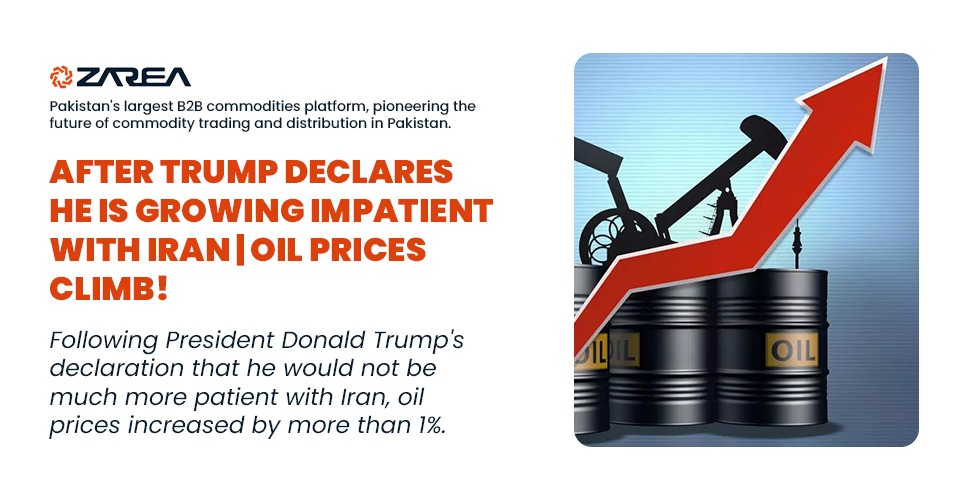
Brent-Crude Oil Prices High:
Brent crude oil futures increased $1.32, or 1.25%, to $107.04 per barrel. Concerns over ship attacks and seizures continued despite Tehran's claim that about 30 vessels had crossed the Strait of Hormuz, and oil prices increased more than 1% after President Donald Trump stated he would not be much more patient with Iran.
By 0425 GMT, Brent crude oil futures had increased by $1.32, or 1.25%, to $107.04 per barrel. At $102.50, U.S. West Texas Intermediate futures were up $1.33, or 1.31%.
The Uncertainty and WTI Prices:
1) Due to the uncertainty surrounding the precarious ceasefire in the Iran conflict, Brent has increased by almost 6% for the week, while WTI has increased by more than 7%.
2) In an interview that was broadcast on Fox News on Thursday night, Trump stated, "I am not going to be much more patient." "They ought to reach an agreement."
3) In an interview with Bloomberg on Friday morning, U.S. Trade Representative Jamieson Greer stated that China was being very practical about its participation with Iran and that it was crucial for China to have the Strait of Hormuz open.
Trump Visit's China:
On Friday, Trump and President Xi Jinping of China will meet to conclude a two-day official visit that has included economic transactions and extravagance.
According to Vandana Hari, founder of oil market analysis firm Vanda Insights, "market focus is back on the deadlock and a blockaded Strait with a tail risk of renewed military escalation, with the Beijing summit not delivering any breakthrough on Iran."
Trump stated that China wants to purchase oil from the United States, one of the agreements the market was anticipating from the conference.
Key Details of the Energy Agreement:
China has agreed in principle to buy American crude oil, according to U.S. President Donald Trump. Additionally, he was announcing a significant energy concession from his bilateral conference with Chinese President Xi Jinping in Beijing that the world's markets had eagerly awaited.
1) Target Hubs: According to Trump, China will send transport ships straight to Alaska, Texas, and Louisiana to carry American petroleum.
2) Strategic Drivers: The deal takes advantage of China's enormous energy needs as well as a shared goal to lessen China's dependency on extremely unstable Middle Eastern supply channels. This is particularly the Strait of Hormuz, which is prone to violence.
3) Broader Commitments: According to media sources from The Hill and The White House, the oil deal is a component of a larger trade package. This might involve Chinese pledges to buy more than only LNG from the United States. In addition, there are 200 Boeing commercial airplanes and agricultural products like soybeans.
Market Reaction and Background:
Price Increase:
Global oil benchmarks reacted instantly to Trump's Fox News interview. At $106.89 a barrel, Brent oil futures increased by 1.11%. West Texas Intermediate (WTI) in the United States increased 1.09% to $102.27.
Context of Trade:
This is a major turning point in the two countries' energy flows. In the meanwhile, since May 2025, large-scale US crude exports to China have fully stopped. This is because during the bilateral trade war, a hefty 20% retaliatory tariff was levied. Additionally, market analysts point out that the actual restart of these shipping movements depends on the removal or lowering of these particular taxes.
Indian Cargo Ship Tregedy:
In events near the Strait of Hormuz, an Indian cargo ship transporting animals from Africa to the United Arab Emirates was sunk on Wednesday in waters off the coast of Oman, and a ship was reportedly taken by Iranian soldiers off the United Arab Emirates and headed toward Iranian waters on Thursday.
According to the White House, Trump and Xi have reached a consensus over the necessity of maintaining the shipping channel.
According to Iran's Revolutionary Guards, 30 ships have crossed the Strait of Hormuz since Wednesday night. This is a significant increase if verified, but it is still significantly less than the 140 that were common every day prior to the conflict.
Haitong Future's Analyst Statement:
According to Yang An, an analyst at Haitong Futures, the primary factor influencing oil prices is still limited supply.
"Oil prices fluctuated multiple times yesterday, but they ended close to the day's peak," he stated.
"Some market concerns were alleviated by ships passing through the strait, but not enough to reverse the strong trend driven by tight supply."
Final Thoughts:
A practical change in U.S.-China economic relations is indicated by this energy accord. Additionally, it is using America's enormous production of crude oil to reduce the bilateral trade imbalance. But whether the Trump administration would formally remove the 20% tariff barrier will determine the agreement's actual success.
Anchor consistent demand for American producers if it is fully fulfilled. As a result, these energy flows will alter international shipping lanes and give Beijing a vital strategic buffer against supply interruptions in the Middle East.