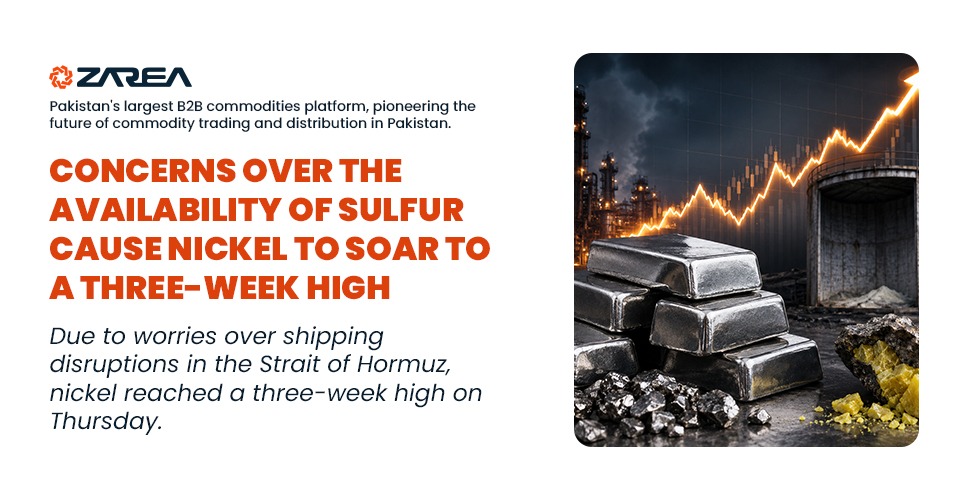
Concerns Over The Availability of Sulfur Cause Nickel To Soar To A Three-Week High
Due to worries over shipping disruptions in the Strait of Hormuz, nickel reached a three-week high on Thursday.
Nickel Prices Rises in International Markit:
As worries about a sulfur shortage were sparked by shipping disruptions in the Strait of Hormuz, nickel reached a more than three-week high on Thursday. Thus, it may have an impact on Indonesian metal producers.
On Thursday, LME nickel shot up 2.3% to $17,195 per metric ton. Fears of a sulfur scarcity brought on by shipping difficulties in the Strait of Hormuz are driving it to a three-week intraday high of $17,370. The operations of Indonesian High-Pressure Acid Leaching (HPAL) are directly threatened by this supply chain constraint. In order to turn low-grade nickel ore into chemicals suitable for batteries, it also largely depends on sulfur.
At 1600 GMT, benchmark three-month nickel on the London Metal Exchange was up 2.3 percent at USD 17,195 a metric ton. Earlier, the metal used to create rechargeable batteries and stainless steel increased by up to 3.4 percent to reach its highest price since June 23 at USD17,370.
"Expectations regarding the tightness of the sulfur supply are growing again. According to a statement from analysts at broker Jinrui Futures, "this primarily means an upward shift in cost expectations for the high-pressure acid leaching (HPAL) process," which is a method of extracting nickel from ore.
The Sulfuric Acid And Nickel:
About 75% of the sulfur needed to manufacture sulfuric acid for leaching is imported from the Middle East to Indonesia, the world's largest producer of nickel. Shipments have been hampered by US and Iranian blockades of the Strait of Hormuz.
These individuals in Indonesia were at the very bottom of the cost curve. During a webcast this week, Macquarie analyst Jim Lennon stated, "They're now right at the top." However, pointing out that the surge in sulfur prices had led to an increase in HPAL production costs of USD 10,000 per ton.
Lennon said that Indonesia is attempting to limit the distribution of nickel ore to HPAL manufacturers. The market was thus awaiting the outcome of mid-year applications for additional supply.
The Copper Markit:
Cooling US inflation figures helped LME copper rise 0.1% to $13,587 per ton. A tighter inventory situation and a more dovish Federal Reserve are anticipated. Additionally, it draws attention to structural supply weaknesses. Approximately 20% of the world's refined copper production comes from leaching processing.
In other news, lower US inflation statistics and expectations of a more dovish Federal Reserve helped LME copper rise 0.1 percent to USD13,587 per ton. Leaching accounts for around 20% of the world's supply of refined copper.
Recent withdrawals from LME warehouses provided additional support for the metal. However, exchange statistics on Thursday revealed an additional 18,150 tons of canceled copper warrants. At 300,600 tons, LME copper stockpiles are at their lowest level since March.
The LME complex as a whole was trading higher. Zinc increased by 1.3% to USD3,592, while aluminum increased by 1.3% to USD3,190. Lead, on the other hand, increased 1.2 percent to USD 1,873 on Wednesday after hitting a 15-month low due to skyrocketing stockpiles. However, tin increased by 0.8% to USD53,210.
Crucial Blind Spots to Watch:
1) 0Alternative Sourcing: Keep tabs on if Indonesia moves its sulfur sourcing to domestic refineries or East Asia in order to avoid the Middle East.
2) NPI Discount Spreads: Keep an eye on if the price difference between battery-grade nickel sulfate and stainless steel-grade nickel pig iron (NPI) increases as a result of this supply shock.
The Bottom Line:
Critical supply chain vulnerabilities in the Middle East are now driving global base metal markets. However, the Federal Reserve's changing monetary policy is another factor. As a result, elements like nickel have higher production costs. The possibility of significant price volatility is further increased by declining copper and nickel warehouse stockpiles. See the most recent sector analysis for further information.