Doubts about a US-Iran peace cause Copper Price drop
Copper lost ground on Monday as concerns about economic growth were rekindled by the Strait of Hormuz closing to marine trade once more.
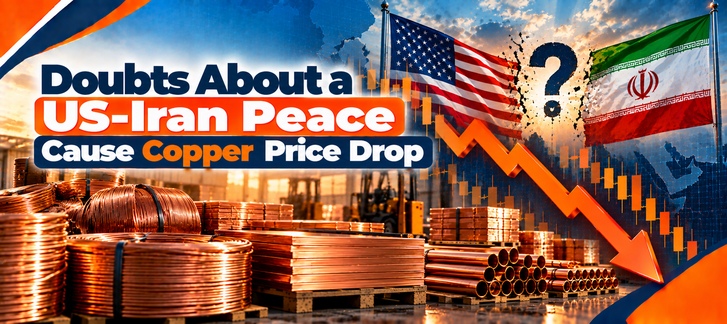
As a precarious ceasefire between Iran and the United States appeared to be in risk and the Strait of Hormuz once again closed to maritime commerce, Copper lost momentum on Monday, rekindling concerns about economic development.
Copper Price Drop Today:
Copper prices quickly dropped on Monday, April 21, 2026. The Middle East's geopolitical unrest exacerbated the world economy. On the London Metal Exchange (LME), the benchmark three-month copper fell 0.8% to $13,235 a metric tonne. Because of this, this turnaround came after a brief uptick in hope over a 15-day ceasefire deal mediated by Pakistan last week.
In official open-outcry trading, benchmark three-month copper on the London Metal Exchange fell 0.8 percent to USD 13,235 a metric tone. Due to confidence that the truce may endure and Iran's announcement on Friday that the Strait had been reopened to commercial boats, the metal had increased by 3.9 percent last week.
Inventory as a Shield: LME stocks' 12-year high serves as an essential shock absorber. The market would probably be in a blind panic over shipping disruptions without those 400,000 tonnes; instead, the surplus allows traders to concentrate on slowing economic development.
The Growth Paradox: At the moment, geopolitics are a double-edged sword for copper. Supply networks are threatened by war (bullish), while the ensuing economic uncertainty and "risk-off" mood boost the US dollar and reduce industrial demand (bearish). The bearish side is prevailing in this case.
Iran US war:
Tehran, meanwhile, pledged to react when the US detained an Iranian cargo ship that attempted to conduct its own blockade of the strait and declined to participate in more peace negotiations for the time being.
Prices were impacted by the dollar's strengthening, which made metals denominated in dollars more costly for holders of other currencies. At around 400,000 tonnes, LME copper stockpiles are still close to a 12-year high.
However, the decline was restrained by robust demand in China, the world's largest metals consumer. At 240,456 tonnes on Friday, copper stockpiles at Shanghai Futures Exchange warehouses dropped 9.8 percent week over week and are down over 45 percent since March 13.
Geopolitical Tensions:
The following events are mostly responsible for the market decline:
Closure of the Strait of Hormuz: Following a brief reopening, Iran formally reinstated restrictions on April 18, 2026. According to Tehran, the shutdown is a reaction to the continuous naval blockade of Iranian ports by the United States.
Ceasefire in Jeopardy: The U.S. detention of the Iranian cargo ship Touska has put tremendous strain on the precarious ceasefire between the United States and Iran, which is scheduled to expire on April 22.
Stalled Peace Talks: Iran has lately declined to participate in a second round of peace negotiations in Islamabad unless a framework of understanding is agreed, citing "unconstructive signals" from Washington.
Impact on the Market and Mitigating Factors:
Dollar-denominated metals were affected by concerns about the expansion of the world economy, but a few things kept the fall from being more severe:
Resilient Chinese Demand: Strong demand in the world's biggest metals consumer is shown by the 9.8% decline in copper stockpiles at Shanghai Futures Exchange (SHFE) warehouses last week and the roughly 45% decline since mid-March.
Sulphuric Acid Revenue: Despite declining treatment costs, Chinese smelters have been motivated to sustain high output levels due to the high pricing of sulphuric acid, a byproduct of copper smelting.
Currency Strength: The LME price was further pressured by the strong U.S. dollar, which increased the cost of copper for customers using foreign currencies.
The Largest Burden on Copper:
The enormous inventory overhang is arguably the largest burden on copper at the moment, but the dollar's rise has undoubtedly provided a considerable headwind. The fact that 400,000 tonnes are lying in LME warehouses—levels not seen in more than ten years—indicates that the physical market is now oversupplied despite the geopolitical unrest.
Despite the closing of the Strait of Hormuz, a complete price surge is probably being avoided by this "buffer" of stock. Although supply chain interruptions often result in skyrocketing costs, consumers aren't immediately experiencing the "squeeze" for actual metal since warehouses are almost filled.
Aluminum News:
In other news, Aluminum dropped 0.4 percent to USD 3,552 a tone, continuing a 2.2 percent decline on Friday after supply concerns were allayed by the reopening of the Strait of Hormuz.
According to preliminary statistics released on Monday by the International Aluminium Institute, primary Aluminium output in the Gulf decreased by 6% last month compared to February. However, final figures may indicate an even greater decline.
In a letter, broker Marex stated,
"Positioning and risk (are) so much reduced across the metals arena amid that conflict between production issues versus recessionary threats and demand destruction."
Zinc Market:
Lead decreased by 0.3% to USD1,957, zinc decreased by 0.3% to USD3,436 per tonne, and tin decreased by 0.7% to USD50,330. The only base metal to climb was nickel, which saw a 0.3 percent increase to USD 18,165 as local producers warned that a new ore pricing formula will dramatically raise production costs due to concerns about sulphuric acid shortages.
An Expert Opinion:
This situation exemplifies a traditional struggle between physical fundamentals and geopolitical risk. Although the possibility of violence in the Middle East and the closure of a crucial trade route like the Strait of Hormuz usually cause prices to rise owing to "fear premiums," a major supply surplus is now stabilising the copper market.
Final Thoughts:
At the moment, copper is trading less as a strategic commodity and more as an economic indicator. Investors are indicating that they are less concerned about a real scarcity of the red metal and more concerned about a worldwide recession brought on by rising energy prices and regional conflict.
Clearly, the market is pricing in a diplomatic collapse. Even record-high supplies may not be sufficient to prevent a price surge if the negotiations brokered by Pakistan fall down and the US-Iran conflict intensifies beyond a naval blockade.