How Cement Is Made: Raw Materials, Steps & Process
How cement is actually made, from quarrying limestone to grinding clinker with gypsum, plus what separates cement from concrete.
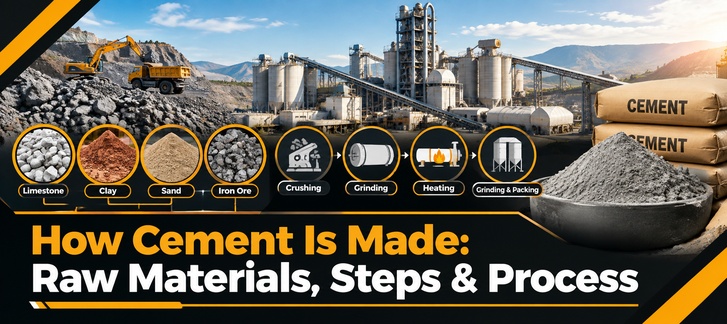
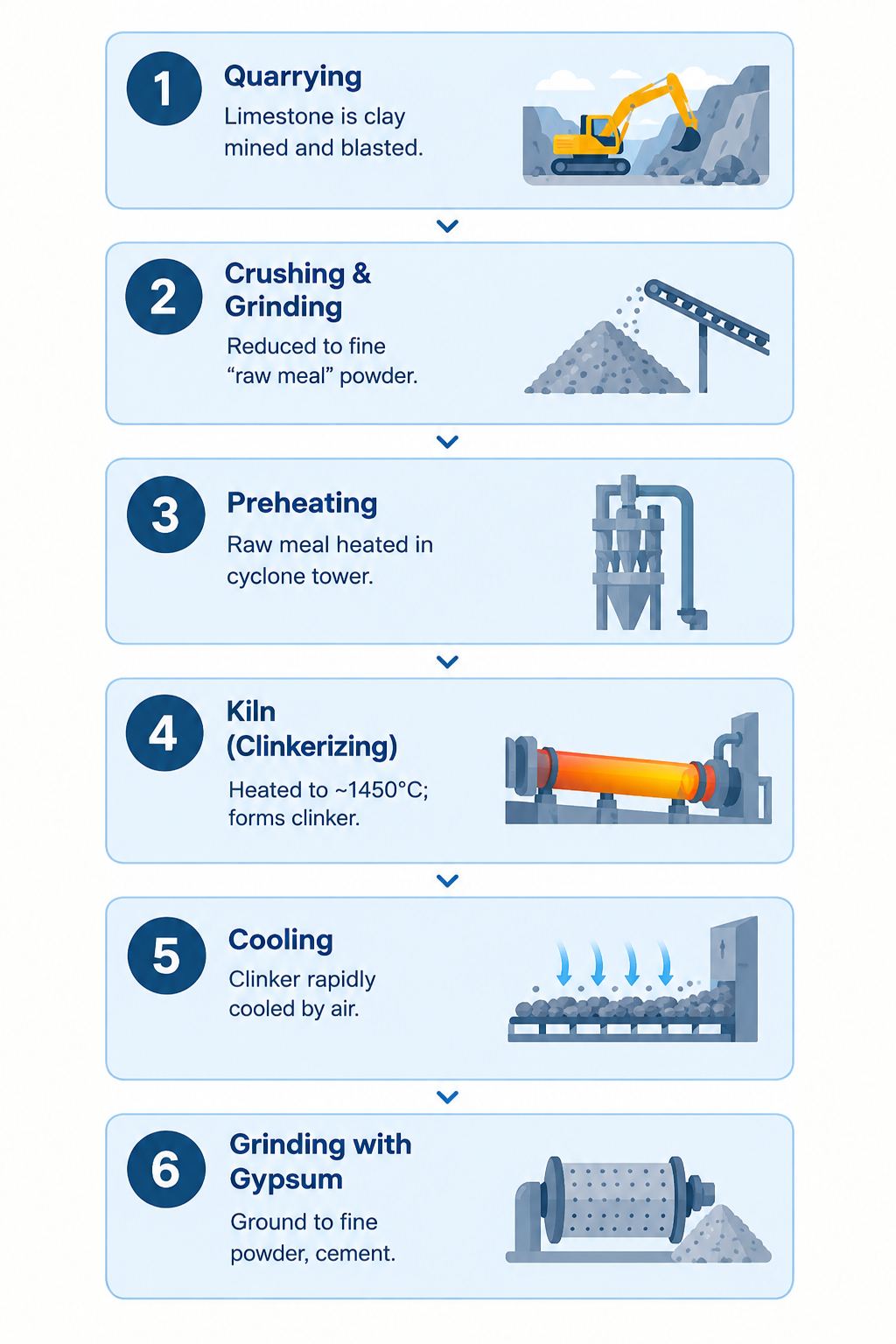
The Cement Manufacturing Process, Step by Step
1. Quarrying the Raw Materials
It starts at the quarry. Limestone gets blasted or excavated in large volumes, and clay gets extracted separately, usually from a nearby deposit since transporting either material very far starts eating into the economics of the whole operation.
2. Crushing and Pre-Homogenisation
Yeah, limestone doesn't come out of the ground as some neat powder ready to use. It comes out in chunks, and not small ones either; we're talking boulders a metre wide, sometimes bigger. So before anything else can happen, all of that has to go through crushers just to get it down to a manageable size.
At the same time, something else is going on too. The crushed material gets blended as it goes, which in the industry they just call homogenisation. Sounds fancier than it is; really, it's just about keeping the chemistry consistent.
Skip that step, or do it badly, and the composition starts jumping around from one batch to the next, which is exactly the mess you don't want carrying into whatever comes after.
3. Grinding Into Raw Meal
The crushed blend then gets ground down further, this time into a genuinely fine powder called raw meal. This is where the corrective materials, iron ore, sand, whatever the mix is short on, typically get added and blended in.
4. Preheating
Before the raw meal reaches the kiln itself, it usually passes through a preheating tower, a stack of cyclones that uses the kiln's own exhaust heat to warm the material on its way in. This step alone cuts a meaningful amount of fuel out of the process, since the kiln isn't starting from cold.
5. The Kiln: Where Clinker Actually Forms
The preheated raw meal goes into a rotary kiln next. It's basically a huge steel tube, lined with brick, slowly spinning, made to handle heat that would destroy normal equipment. And it needs to, temperatures inside hit around 1450°C.
By this point, the limestone's already lost its carbon dioxide. What's left is calcium oxide, and once that's floating around with the silica and alumina still in the mix, the real chemistry starts. Belite forms first.
Then the heat keeps climbing, and the belite doesn't just sit there; it pulls in more calcium oxide and turns into alite. Alite's the one that matters most for strength, honestly. Most of what makes finished cement strong traces back to this step.
6. Cooling the Clinker
Once clinker comes out of the kiln, it doesn't just sit around cooling on its own; it gets blasted with forced air pretty quickly, dropping from well over a thousand degrees down to somewhere around 100 to 200 Celsius in not much time at all.
And that speed actually matters. Cool it fast rather than slow, and you lock in the crystal structure that formed inside the kiln, which is a big part of what makes the finished cement perform the way it's supposed to.
7. Grinding With Gypsum
Cooled clinker on its own isn't cement yet. It gets ground down again, this time in a cement mill, along with a small amount of gypsum, typically around 5 percent of the final blend.
Gypsum's job is to control how fast the cement sets once it's mixed with water. Without it, cement would set almost immediately on contact with water, which would make it close to unusable on an actual job site.
8. Storage and Distribution
The finished powder gets stored in silos before it's bagged or loaded in bulk for transport. From here it's just logistics, getting bags or bulk cement to distributors, construction sites, and retailers before it absorbs moisture from the air and starts losing its quality sitting in storage too long.
The Chemistry That Makes Cement Work
All of this- the strength, the hardening, all of it- traces back to that kiln stage. Alite's the compound doing the heavy lifting here, since it's the dominant one formed at peak temperature, and when it meets water, it kicks off something called hydration.
That's the reaction actually responsible for concrete getting strong over time. Not drying out, which is what a lot of people assume is happening.
And that's why concrete doesn't just stop once the surface looks dry. It's still getting stronger weeks later, because hydration keeps working through the mix long after the top has set.
Sourcing Cement in Pakistan
Cement pricing in Pakistan tracks closely with energy costs, since firing a kiln to 1450 degrees Celsius continuously is genuinely energy intensive; coal and gas prices move cement prices more directly than almost any other input.
Tracks today's cement rate for exactly that reason, since a quote that was accurate last week isn't necessarily accurate today.
Buyers who want to line up suppliers side by side can just head straight to the cement category and check what's currently listed. And if the project needs more than cement alone, the broader building and finishing materials section covers the rest of it.
Cement Brands You Can Source on Zarea
Pakistan's cement market is really dominated by a small group of long-running manufacturers, and most of them turn up more than once in Zarea's cement listings. Top cement brands like Bestway and Lucky don't stick to a single grade; they sell across several.
Here's what's currently listed:
Bestway Cement (SRC)
Shaheen Flying Cement (OPC)
Gharibwal / Paidar Cement (OPC)
Maple Leaf Cement (OPC)
Bestway Cement (OPC)
Flying Cement (OPC)
Lucky Cement (OPC)
Kohat Cement (White)
Pioneer Cement (OPC)
DG Khan Cement (OPC)
Fauji Cement (OPC)
Cherat Cement (OPC)
Ready Mix 3000 PSI
Ready Mix 4000 PSI
Lucky Cement (SRC)
Kohat Cement (OPC)
Maple Leaf Cement (White)
Bestway Pakcem Cement (OPC)
Bestway Xtreme Bond
Bestway White Cement
OPC (Ordinary Portland Cement) is the general-purpose grade covered throughout this guide. SRC (Sulphate Resistant Cement) is formulated for structures exposed to sulphate-heavy soil or water, and white cement is used mainly for finishing and decorative work where a grey surface isn't wanted.
The two ready-mix products listed alongside the bagged cement brands are pre-mixed concrete rather than raw cement, worth noting if a project specifically needs bagged cement rather than a ready-to-pour mix.
Frequently Asked Questions
What are the raw materials for cement?
Limestone mostly; that's your 80 percent right there, and then clay or shale picks up most of the rest. Beyond that you're looking at small amounts of stuff like iron ore, bauxite, or sand, and which one gets used really just depends on what's missing from the main mix.
What is the main ingredient of cement?
Limestone. No contest, really. Something like 80 percent of the raw mix is limestone, and it's what supplies the calcium that the entire clinker reaction depends on. Pull limestone out of the picture and the whole process just doesn't work.
What is the difference between cement and concrete?
Short version: cement is an ingredient, concrete is the finished product. Cement's just the grey powder, the binder. You don't build anything with cement alone.
Mix it with water, sand, and some gravel or crushed stone, and now you've got concrete, which is the actual stuff that ends up in driveways, foundations, whatever. People use the two words like they're synonyms, but they're really not.
Which rock is used for cement?
Limestone. That's the main one, a sedimentary rock that's mostly calcium carbonate, and it does most of the work in the mix. Quarries usually pull it out alongside clay or shale too, since those two bring in the silica and alumina the process needs as well.
Wrap Up
Cement manufacturing is really just a very precise, very hot chemistry process dressed up as heavy industry. Get the raw material ratio wrong, undercook the kiln, skip the gypsum step, and the bag that comes out the other end won't perform the way a contractor expects on site.
Understanding that process end to end also explains why cement pricing moves the way it does, since so much of the cost sits in the energy needed to hit that kiln temperature, not just the raw rock going in.