How the Textile Industry Works: From Cotton to Finished Fabric
Explore the textile industry in Pakistan, its types, value chain, major manufacturing cities, export markets and practical cotton and yarn sourcing.
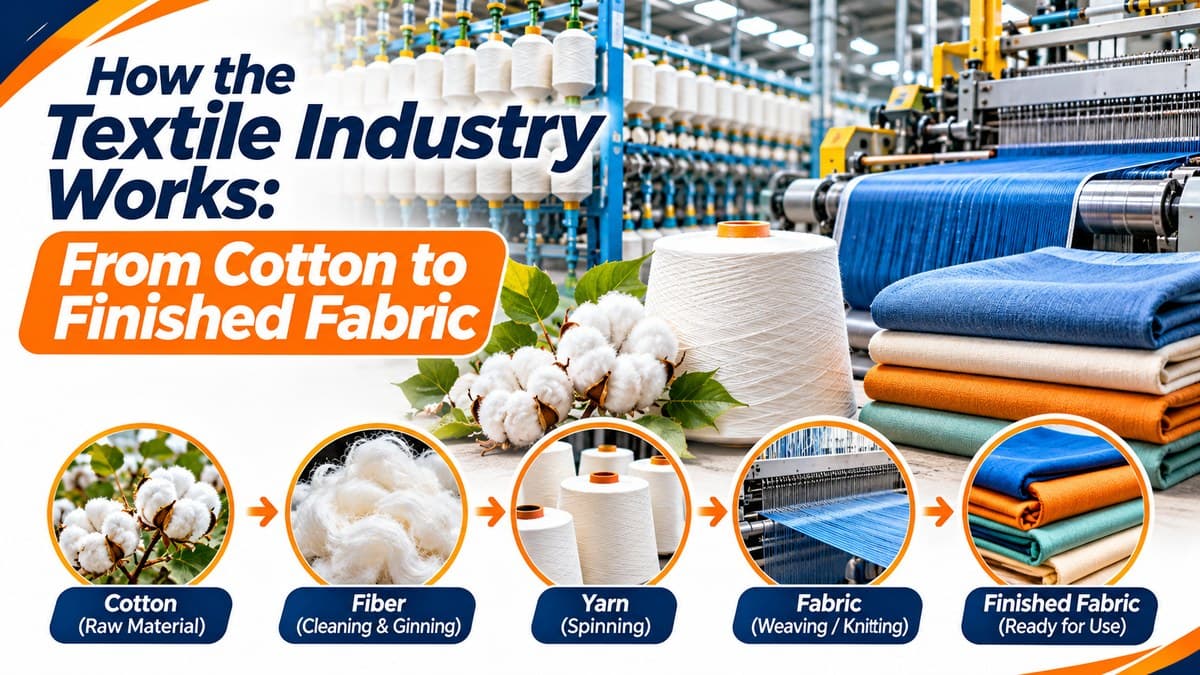
A cotton shirt may pass through several independent factories before it reaches a shop.
One mill spins the fibre, another knits the yarn, and a processing unit dyes the fabric before a garment factory cuts and stitches it.
Pakistan has businesses at each of these stages, making textiles an important part of its manufacturing and export economy.
Quick Answers
1) Scope: Fibre production, yarn manufacturing, fabric making, finishing, and finished goods.
2) Three Broad Production Segments: Upstream, midstream, and downstream.
3) Pakistan: Textile and apparel exports reached approximately US$18 billion in FY2025–26 (Pakistan Textile Council).
4) Key inputs: Cotton, man-made fibres, yarn, dyes and finishing chemicals.
What is the Textile Industry?
The textile industry comprises businesses that turn natural and man-made fibres into yarn, fabrics and finished products.
Its output includes woven and knitted cloth as well as nonwoven materials used in products such as filters and medical dressings.
A textile mill does not necessarily make clothing.
Some factories sell yarn or unfinished cloth to other manufacturers, while vertically integrated mills handle several production stages themselves.
How the Value Chain Works
A conventional woven or knitted product passes through the following stages. Nonwoven fabrics can be made directly from fibres, without spinning yarn first.
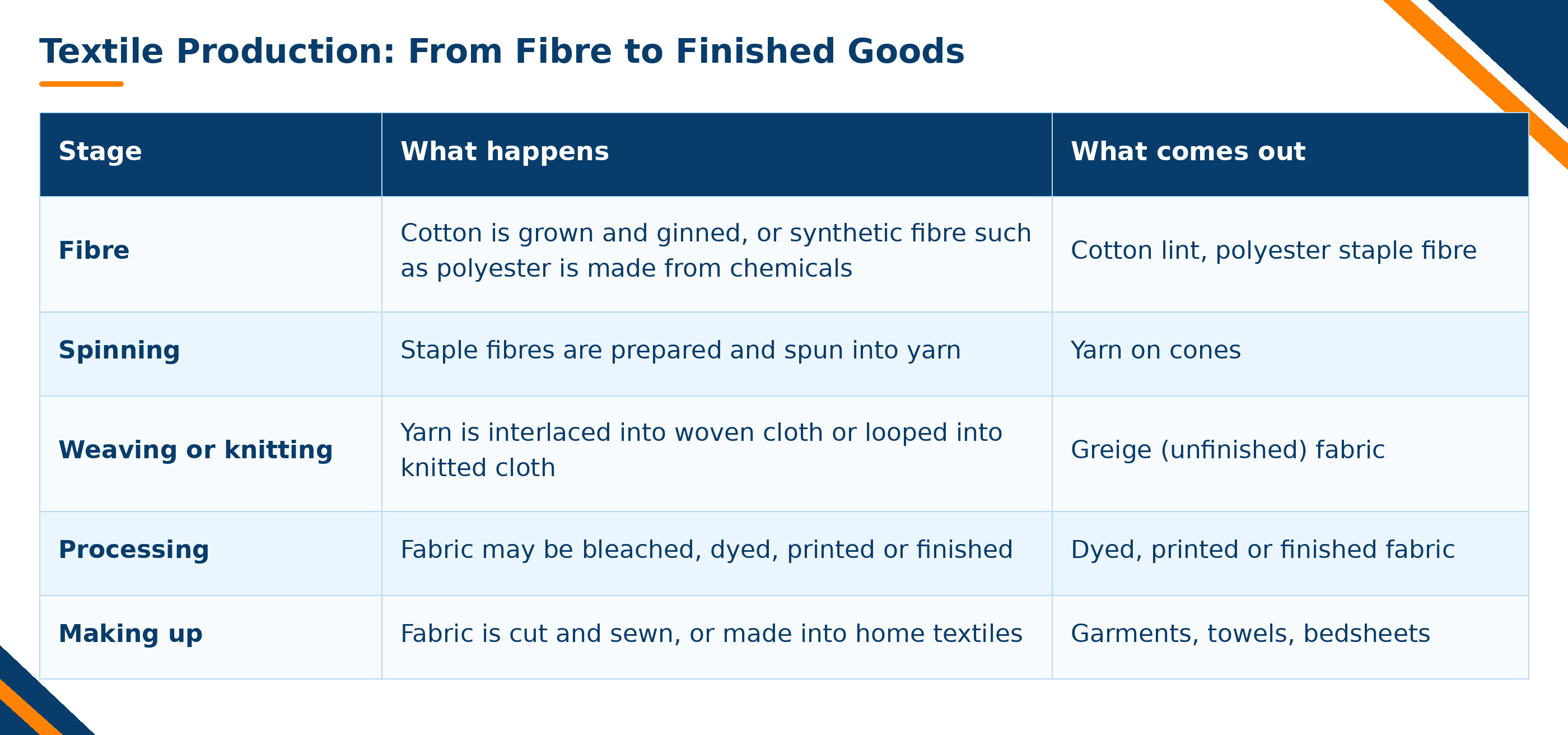
A fault at one stage can become expensive at the next. Uneven yarn may leave visible lines in cloth, while weak yarn can cause frequent machine stoppages.
Once fabric has been dyed and finished, correcting these defects is much harder. Check yarn quality before releasing a lot into production.
Textile Industry Examples
These businesses specialise in different stages or products. A single company may operate more than one type of facility.
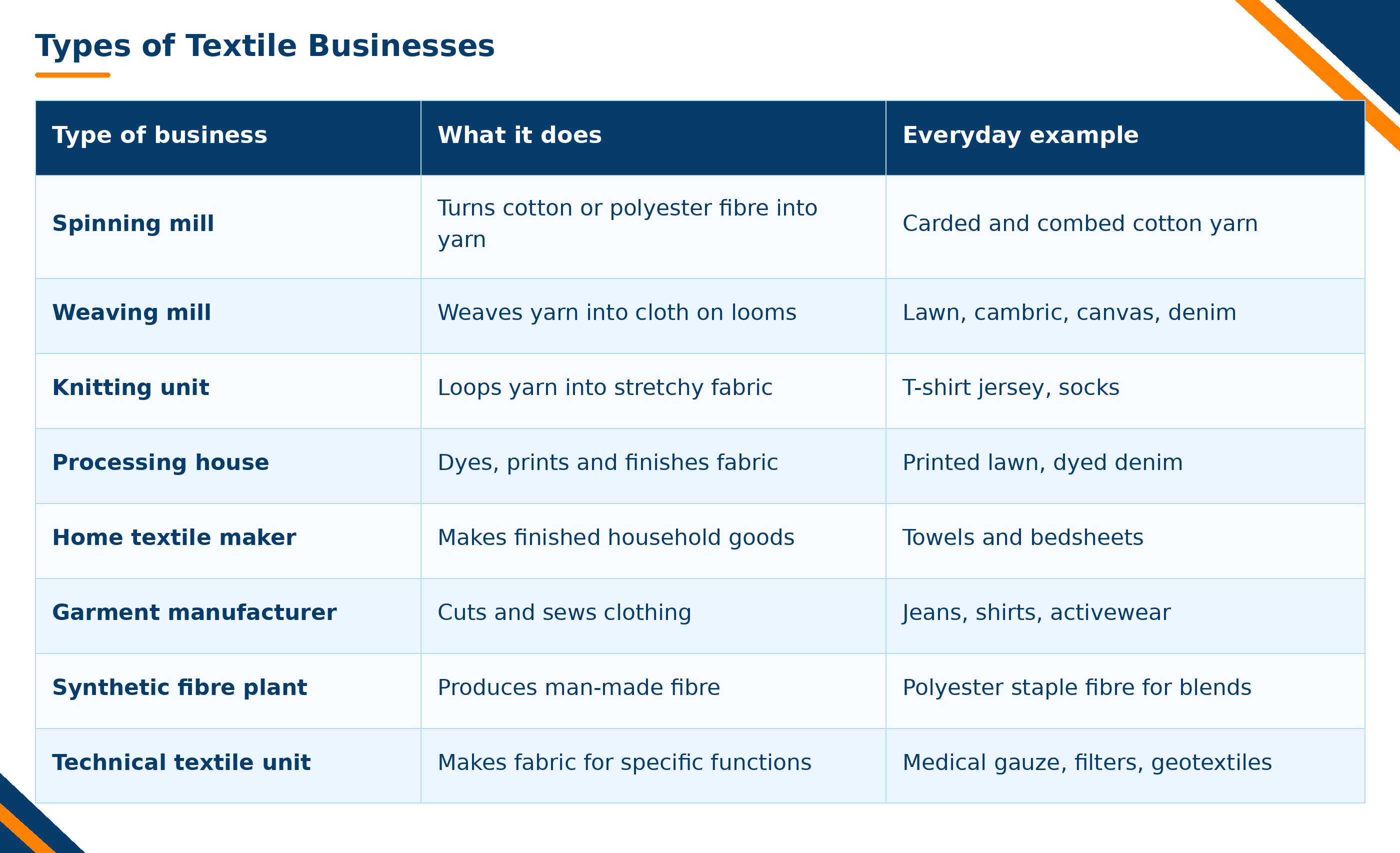
For example, mills producing absorbent towels and breathable garments often use 100% cotton yarn, with the count and spinning method selected for the intended fabric.
Types of Fibre and Yarn
Natural fibres include cotton, wool, silk, jute and flax. Synthetic fibres include polyester, nylon and acrylic.
Viscose belongs to a separate group of man-made fibres produced by regenerating cellulose.
Manufacturers choose fibres according to the required strength, absorbency, appearance and cost.
Uniform and workwear manufacturers may choose polyester-cotton blended yarn when the fabric needs a balance of durability and comfort.
Confirm the polyester-to-cotton ratio before ordering.
Yarn specifications matter as much as fibre composition. Buyers should understand these terms before requesting a quotation:
1) Count (Ne): A higher English cotton count indicates a finer yarn. Compare counts using the same numbering system.
2) Carded or Combed: Combing removes short fibres and improves alignment, generally producing smoother yarn at a higher processing cost.
3) Ring-Spun or Open-End: Rotor-spun yarn is often economical for coarser denim and towels; ring-spun yarn is widely used where finer counts or particular fabric properties are needed.
4) Greige or Dyed: Greige yarn is undyed; dyed yarn has been coloured before fabric production.
For a closer look at woven and knitted cotton materials, see the guide to cotton fabric.
What Are the Three Types of Textile Industry?
One practical way to classify the sector is by its three production segments. This is different from classifying textiles by fibre type.
a) Upstream: fibre production, cotton ginning and spinning.
b) Midstream: weaving, knitting, dyeing, printing and finishing.
c) Downstream: garment manufacturing, home textiles and other finished goods.
Another way to classify manufacturers is by the material they process, such as cotton, wool, silk, jute or man-made fibres.
Importance of the Textile Sector
The sector connects cotton growers, ginners, mills and exporters. A garment order also creates demand for dyes, machinery maintenance, packaging and transport.
Within a factory, production depends on skilled operators, technicians and quality-control staff as well as designers.
Wet processing requires particular attention to water use, chemical handling and wastewater treatment.
Exporters should confirm the environmental and product testing requirements of each customer instead of assuming that a single certification covers every order.
Manufacturers working with recovered fibres can consider recycled yarn, checking its composition, recycled content and strength against the intended application.
Where a customer requires organic material, organic yarn may be suitable.
Request the applicable certification and lot traceability rather than relying on the product name alone.
Pakistan's Textile Landscape
According to the Pakistan Textile Council (PTC), textile and apparel exports reached US$18.0 billion in FY2025–26 (July 2025 to June 2026), an increase of 0.3% over the previous year.
Total national exports were US$30.14 billion, making the sector responsible for approximately 60% of goods exports.
Apparel and home-textile made-ups accounted for US$14.98 billion, or 83.2% of textile and apparel export value.
This share was 77% in FY2021–22. The figures describe export value, not physical production volumes.
Major Textile Cities in Pakistan
Faisalabad, often called the Manchester of Pakistan, is particularly well known for spinning, weaving, and processing.
Karachi has substantial garment, knitwear, and export manufacturing activity. Lahore and Multan also have textile businesses.
Buyers should compare suppliers by capability and delivered cost rather than city alone.
Challenges Facing Pakistan’s Textile Sector
Domestic cotton availability is a concern for spinning mills.
When local supplies fall short, mills may need imported fibre, exposing procurement budgets to currency movements and freight costs.
Cotton quality also varies by lot, so buyers should test staple length, strength, micronaire, and contamination.
Energy costs, machine downtime and wastewater treatment can affect the cost of finished fabric.
Exporters must also manage delivery deadlines and customer-specific testing requirements.
A low raw-material quotation is of little benefit if the lot leads to excessive waste or rejected fabric.
Sourcing Cotton and Yarn for Textile Manufacturing
Zarea’s Cotton and Yarn category lists raw cotton and yarn for spinning, weaving and knitting businesses.
Compare the specifications of the material you need before asking for a bulk quotation.
Before committing to a bulk order, request comparable quotations and confirm the following:
1) Exact fibre composition, yarn count, ply and spinning method.
2) Yarn strength, evenness, hairiness and suitability for the intended machine.
3) Net cone or bale weight, packing, moisture conditions and minimum order quantity.
4) Representative samples, lot-specific test reports and any required certification.
5) Delivered cost, payment terms, dispatch schedule and the procedure for rejected lots.
Before approving a new supplier, run a representative sample on the intended loom or knitting machine. Record yarn breakage, waste, and fabric defects.
For example, if two yarn lots both cost Rs 500 per kg but yield 95% and 90% usable output respectively, their material costs per usable kg are about Rs 526 and Rs 556, before processing expenses.
This illustrative calculation shows why the cheapest quotation is not always the lowest production cost.
Frequently Asked Questions
What are Textiles in Industry?
Textiles are fibre-based materials made by weaving, knitting, bonding, or other fabric-forming methods.
Industrial uses include filters, geotextiles, protective clothing and medical fabrics, in addition to ordinary apparel and home furnishings.
What are the Three Types of Textile Industry?
Upstream production supplies fibres and yarn; midstream operations make and finish fabric; downstream manufacturers turn materials into finished goods.
These are broad supply-chain segments, not a universal classification by fibre.
Who is the Biggest Exporter of Textiles?
China is the leading global textile exporter. WTO data reproduced in a 2025 UNIDO report identifies China as the leader in 2024.
Textile exports and clothing exports are measured separately, so rankings should be compared using the same product classification and year.
Which city of Pakistan is Famous for Textile?
Faisalabad, often called the Manchester of Pakistan, is especially well known for its concentration of textile mills.
Karachi, Lahore and Multan are also important production centres.
What is the Difference Between Textile and Garment Manufacturing?
Textile manufacturing covers the production of fibre-based materials, including yarn and fabric.
Garment manufacturing focuses on turning fabric into clothing through cutting, sewing and finishing.
Is Cotton Still Important to Pakistan’s Textile Sector?
Yes. Cotton remains a key input for spinning, home textiles and apparel.
Mills also use imported cotton, synthetic fibres and blends depending on product requirements and local availability.
Wrap Up
Pakistan’s textile industry links cotton production with spinning, fabric manufacturing and the export of finished goods.
Its mills serve a wide range of markets, from everyday clothing and household linen to specialised industrial fabrics.
Each market has different requirements for fibre composition, yarn quality and finishing.
For manufacturers, a dependable supply of suitable material matters as much as the quoted price.
Agree on specifications, test representative samples, and compare the cost of usable output before committing to bulk purchases.
These steps help reduce production waste and maintain consistent quality across orders.