Vermicompost: Benefits, Price in Pakistan and How to Use
Learn vermicompost benefits, nutrient content, application rates, how to make it, and where to buy quality vermicompost at the right price in Pakistan.

Vermicompost is an organic soil amendment produced when earthworms and microorganisms break down materials such as livestock manure and plant waste.
It supplies nutrients and organic matter, making it useful for garden beds, nurseries, and farmland with poor soil structure.
For growers in Pakistan, the choice between making it on the farm and buying it usually comes down to quantity, quality, and transport cost.
This guide explains how to produce it, how to apply it, and what to check before placing an order.
Vermicompost at a Glance
1) What it is: Worm-processed compost, typically dark brown to black, crumbly and earthy-smelling.
2) Nutrients: Contains nitrogen, phosphorus, and potassium, but concentrations vary with feedstock and moisture.
3) Application: Choose a rate according to crop, soil test, and product analysis; avoid treating field trial rates as universal recommendations.
4) Price: Advertised examples range from Rs 30 per kg in a 50 kg bag to Rs 250 per kg in small retail packs.
5) Limitations: Supplements rather than automatically replacing mineral fertilizer.
What is Vermicompost?
Earthworms consume and fragment decomposing organic material while microorganisms help break it down.
The finished material is usually dark, fine, and earthy-smelling. Red wigglers (Eisenia fetida) are commonly used for this purpose.
Is Vermicompost a Fertilizer or Soil Conditioner?
It serves both purposes. It supplies nutrients in varying amounts and adds organic matter.
Worm castings are the material excreted by worms, whereas vermicompost can also contain decomposed bedding.
For a broader understanding of nutrient sources and soil amendments, read our guide to organic fertilizer.
How to Make Vermicompost: Step by Step
Start with a small shaded bed. The aim is to provide air, moisture, and suitable feed without exposing worms to excessive heat or ammonia.
1) Choose a Shaded Site: Worms hate sun, standing water, and heat. Put beds under a shade net, a roof, or trees, on a slight slope.
2) Pre-compost the Manure: Allow fresh manure to decompose and cool before introducing worms. Do not add worms while the material is heating or smells strongly of ammonia.
3) Build the Bed: Make beds about 3 to 4 feet wide and 1.5 to 2 feet high, 8 to 10 feet long at first. Lay 15 to 20 cm of dry leaves or straw as bedding, then add the pre-composted manure mixed with chopped plant waste.
4) Introduce Red Wigglers: Choose a stocking rate suitable for your bed and supplier guidance. Cover with breathable damp material.
5) Keep it Moist, Not Wet: Aim for 60 to 80% moisture. A handful squeezed in your fist should feel like a wrung-out sponge and release a drop or two.
6) Feed Gradually: Add thin layers of suitable organic waste and gently loosen compacted bedding when necessary.
7) Harvest When Mature: Under favourable conditions, this may take around 45 to 60 days or longer. Separate the worms using fresh, cooled bedding as bait, then sieve the finished material.
Suitable feedstocks include cooled manure, vegetable scraps, dry leaves, and chopped straw.
Commercial producers may use clean rice husk as part of a bedding blend, but it decomposes slowly. Avoid contaminated residues, meat, oil, and dairy.
Managing Worm Beds in Pakistan’s Climate
Keep beds shaded and well-ventilated, ideally near 15–25°C. During hot summers, monitor the temperature inside the bed rather than relying on air temperature alone.
Protect against flooding, pests, and direct sunlight. For manure-based material used on edible crops, follow applicable pathogen-control and food-safety guidance.
Vermicompost Nutrient Content
Nutrient concentrations differ between batches. The figures below are illustrative ranges, not a guaranteed analysis.
Confirm whether laboratory results are reported on a dry-weight or as-sold basis.
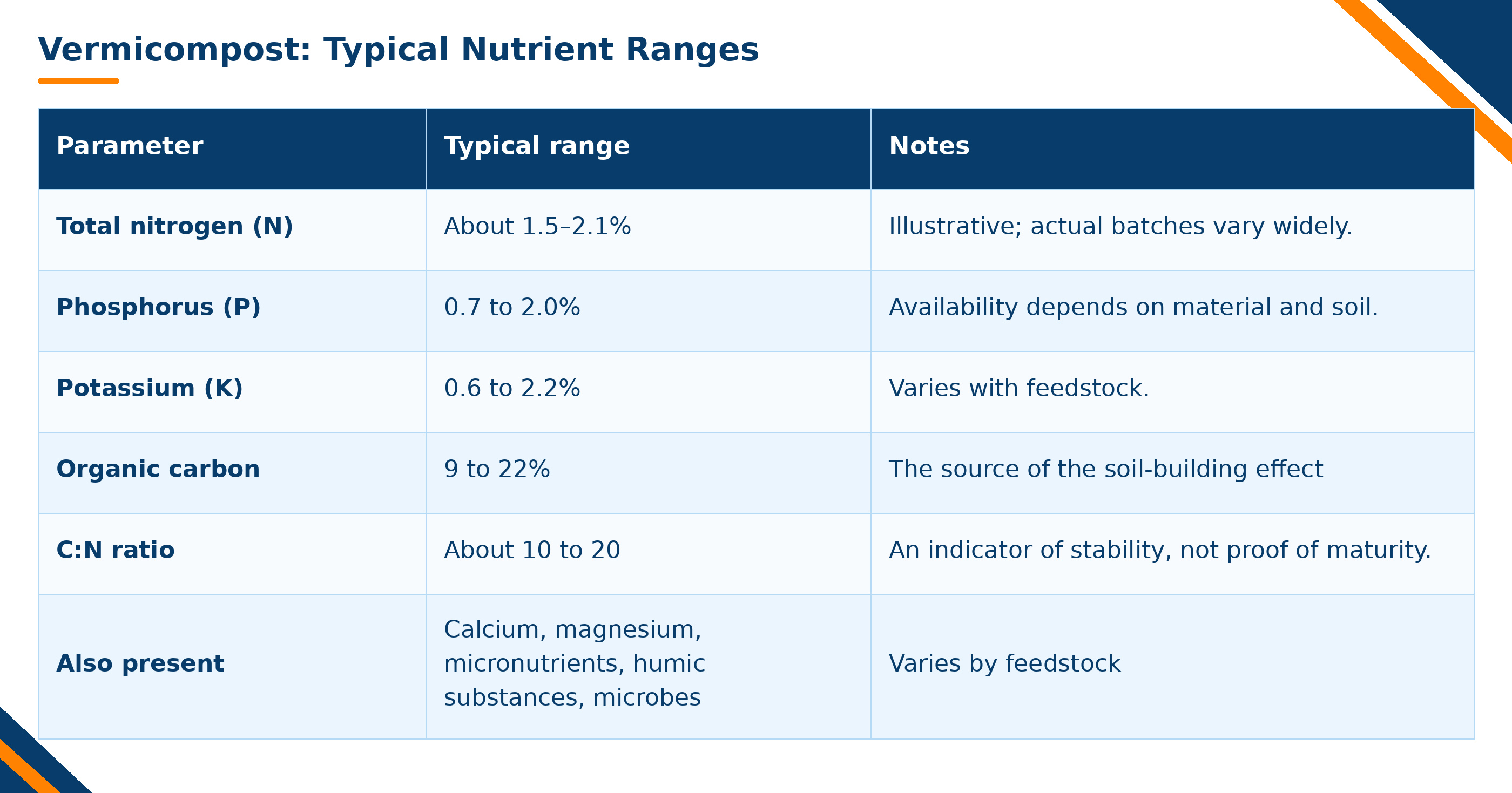
For bulk purchases, request a laboratory report covering N, P, K, organic carbon, pH, electrical conductivity (EC), moisture, and maturity.
For manure-based products, also ask about pathogen and contaminant testing.
Benefits of Vermicompost for Soil and Crops
The main advantage is the combination of organic matter and nutrients in a single amendment.
1) Adds Organic Matter: Regular use can help improve soil organic carbon over time.
2) Supplies Nutrients Gradually: Some nutrients become available as organic material decomposes.
3) Improves Soil Structure: Organic matter can support aggregation and water retention, depending on the soil.
4) Supports Soil Biology: Mature material provides organic substrates for soil microorganisms.
5) Supports Root Development: Suitable mixtures can benefit seedlings and established plants.
6) Complements Mineral Fertilizer. Adjust fertilizer rates only after accounting for crop requirements and soil test results.
Results depend on the application rate, soil conditions, and product quality. Vermicompost does not correct drainage problems or salinity on its own.
How to Use Vermicompost for Different Crops
The following are illustrative starting points or trial ranges, not blanket fertilizer recommendations.
Test a small area before committing to a field-scale purchase.
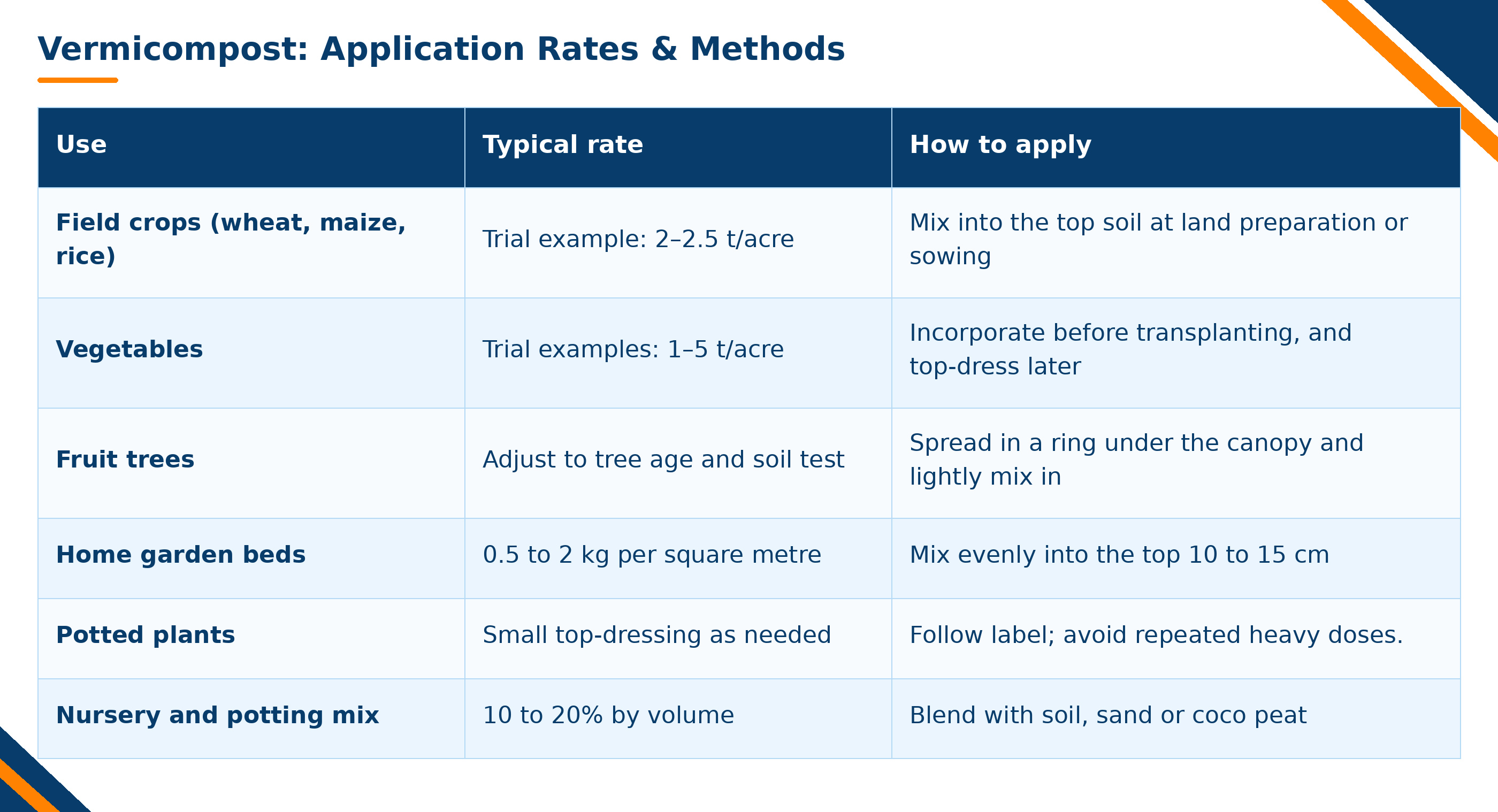
Using the 272.25 square foot marla (about 25.3 square metres), 0.5–1 kg per square metre equals about 13–25 kg per marla or 253–506 kg per kanal.
Local marla sizes can differ.
Mix mature material into the root zone before planting and water as needed.
For container sizes, drainage, and seasonal planting, see our guide to kitchen gardening.
Vermicompost vs Compost, Manure and Urea
Organic amendments differ in nutrient concentration and stability. Urea is included here as a mineral nitrogen source for comparison.
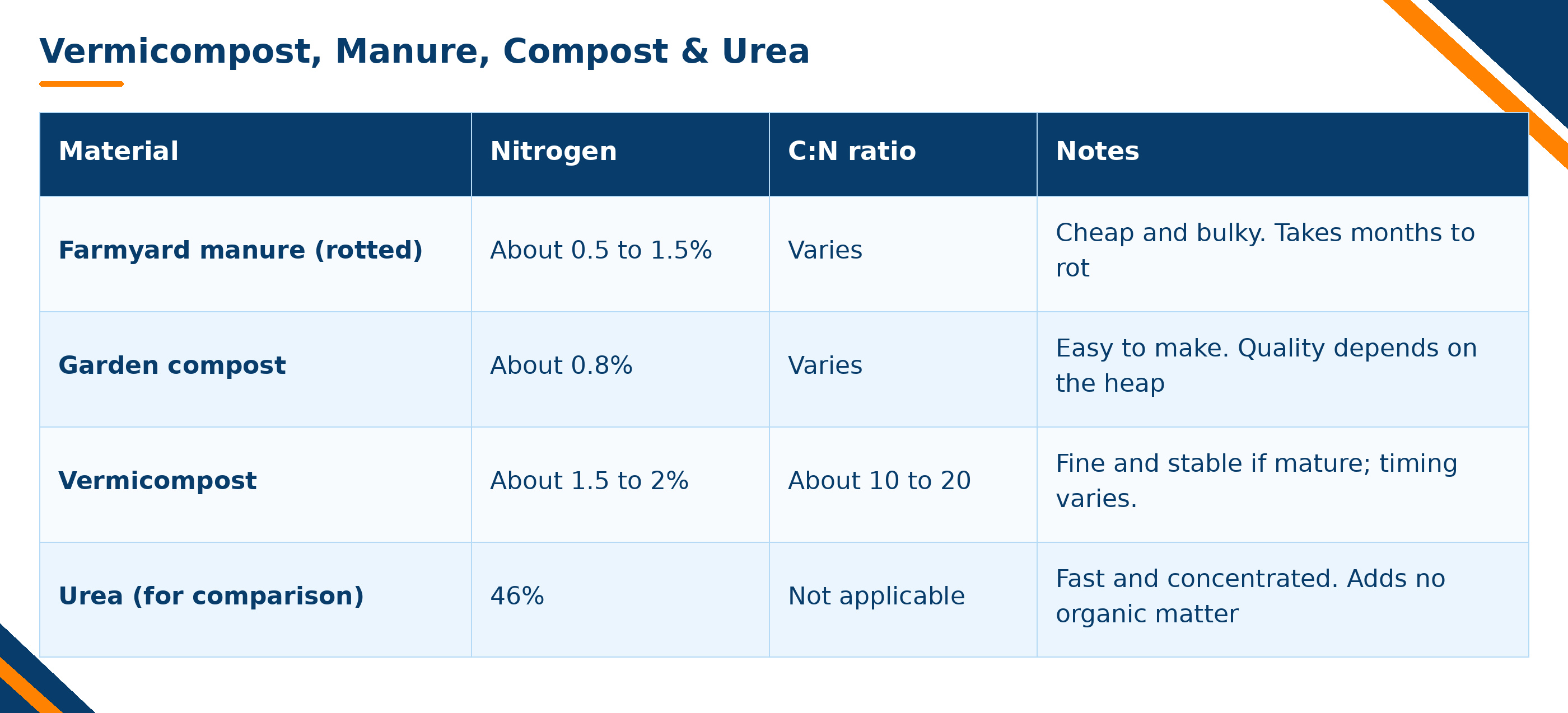
For comparison, 100 kg of total nitrogen requires about 217 kg of urea at 46% N, or 5–6.7 tonnes of vermicompost at 1.5–2% N on the same weight basis.
At illustrative prices of Rs 30–50/kg for vermicompost and Rs 4,810 per 50 kg of urea, the cost per kg of total nitrogen is roughly Rs 1,500–3,333 versus Rs 209.
This does not compare plant-available nitrogen or the value of organic matter.
For a concentrated nitrogen source, Engro Urea 50 kg is one commercial option.
Follow crop-specific fertilizer recommendations rather than substituting it kilogram for kilogram.
Use soil testing to decide whether additional nutrients are required.
Farm buyers can compare suitable products in the fertilizer category before ordering.
Role of Vermicompost in Sustainable Agriculture
Processing suitable farm residues and manure into compost can return organic matter to the soil and reduce the amount of waste requiring disposal.
The environmental benefit depends on how the materials are sourced and managed.
Commercial compost producers can compare suitable plant residues in the agriculture biomass category.
Check cleanliness and suitability for worm bedding before ordering industrial quantities.
Maintaining soil cover and rotating crops can complement organic amendments.
These practices are explained in our guide to conservation agriculture.
A producer selling 1.5 tonnes at an assumed Rs 35/kg would earn Rs 52,500 in gross revenue before labour, worms, feedstock, packaging, transport and losses.
Confirm buyer demand before expanding production.
Where to Buy Vermicompost in Pakistan
Specialist compost producers, farms, nurseries and garden shops sell vermicompost in different pack sizes.
For commercial quantities, request a delivered quotation and a representative sample before ordering.
Vermicompost Price in Pakistan
The following advertised prices are examples from Organica Pakistan, Green Gardens, Organic Greener, Organic Baghbani and Ibrahim Farms, researched on 26 November 2026.
They are not national averages or confirmed live stock prices; delivery may cost extra.
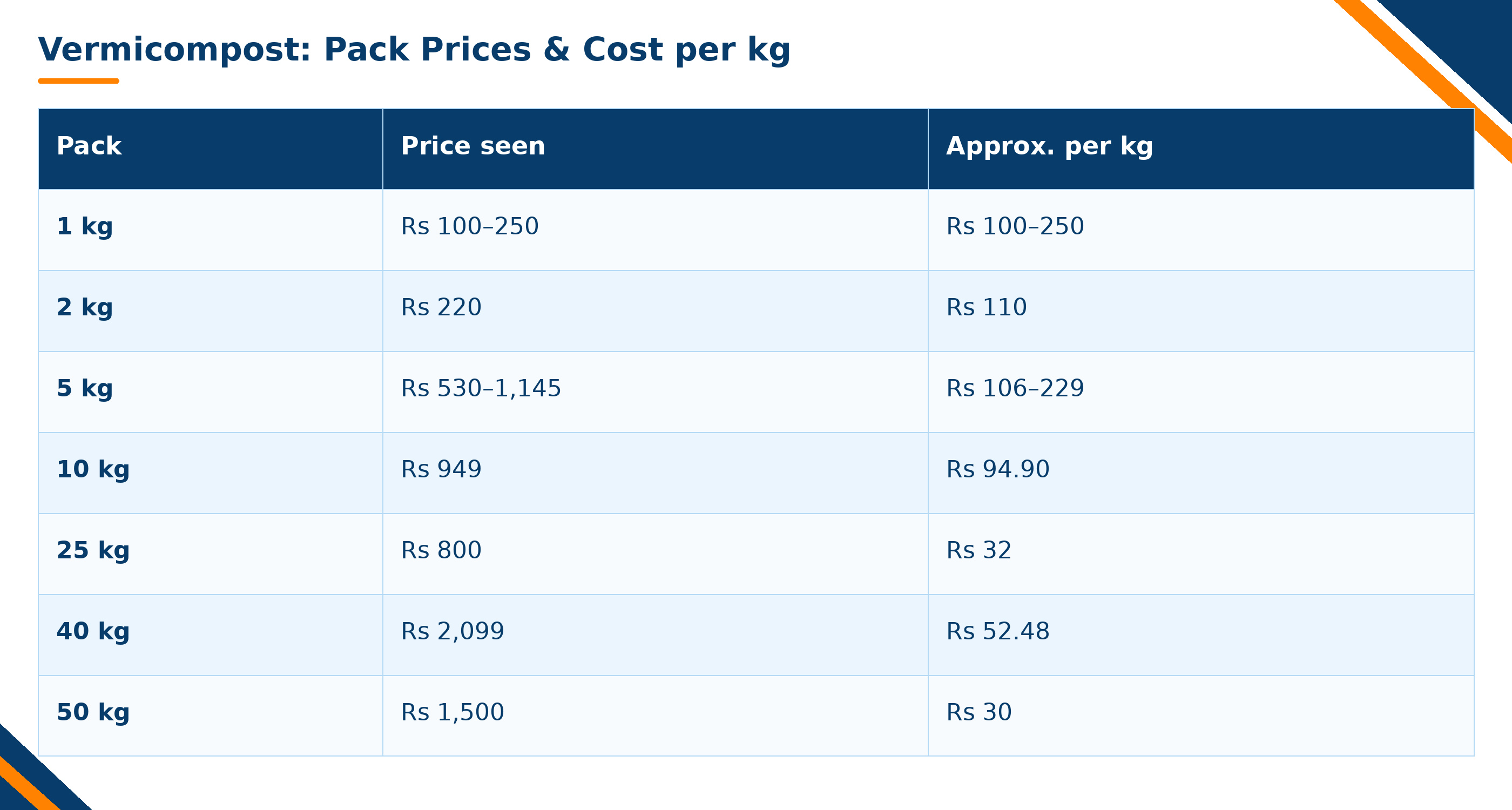
Compare delivered cost per kilogram, moisture and nutrient analysis rather than bag price alone.
Smaller packs suit home gardens; bulk orders make more sense only when the farm has enough demand and suitable storage.
How to Check Vermicompost Quality Before Buying
1) Look and Smell: It should be dark brown to black, crumbly and earthy, like forest soil. A sharp ammonia or sour smell means unfinished or waterlogged material.
2) Texture: Fine and uniform, with no visible lumps of undigested manure or plastic.
3) Moisture: Compare dry matter: Rs 50/kg at 45% moisture costs about Rs 91/kg of dry matter; Rs 39/kg at 30% moisture costs about Rs 56/kg of dry matter.
4) Analysis: Ask for nitrogen, phosphorus, potassium, organic carbon, pH, and salinity figures, and a source for the feedstock.
5) Registration and Claims: Check applicable provincial requirements and ask for evidence behind yield or nutrient claims.
Using Vermicompost with Other Fertilizers
Vermicompost adds organic matter to the soil, but its nutrient content varies.
Where soil tests indicate additional needs, growers can consider other fertilizer products as part of a balanced crop nutrition plan.
When comparing inputs, growers can review Nitrogel and Rhizophos on Zarea.
Check the product labels for their intended crops, nutrient or microbial composition, and application instructions.
Another product to compare is VC 10 Fertilizer. Check its formulation and recommended dose before purchasing.
None of these products should be treated as a direct substitute for vermicompost without confirming its composition and intended use.
For a bulk vermicompost order, ask a specialist producer for batch analysis, pack weight, delivery charges, and a sample.
Do not assume that every organic fertilizer is worm compost.
Frequently Asked Questions
Is vermicompost the same as worm castings?
Not exactly. Castings are earthworm excretions; finished vermicompost may also include decomposed bedding.
Quality depends on the feedstock and processing, not the name alone.
How much vermicompost do I need for a marla or a kanal?
At 0.5–1 kg per square metre, a 25.3 square metre marla needs about 13–25 kg, and a 20-marla kanal needs about 253–506 kg.
Adjust for your local land measurement and soil requirements.
Can vermicompost burn plants?
Mature vermicompost is generally suitable when used at an appropriate rate. Excessive application or immature, salty material can harm sensitive plants.
Test a small quantity first.
Is making vermicompost profitable in Pakistan?
It can generate income if production costs and buyer demand support it.
Calculate the cost per saleable kilogram, including labour, packaging and transport, before investing in a larger unit.
Wrap Up
Vermicompost is a practical way to recycle suitable organic waste and improve soil quality.
Choose mature material, compare its analysis and delivered price, and use it alongside a balanced crop nutrition plan.
For larger farms, a small trial and soil test are more useful than applying a fixed dose across every field.