Kitchen Gardening: How to Start and Maintain a Home Garden
Learn kitchen gardening in Pakistan with easy vegetables to grow, seasonal planting tips, soil preparation, essential tools, and practical home garden ideas.
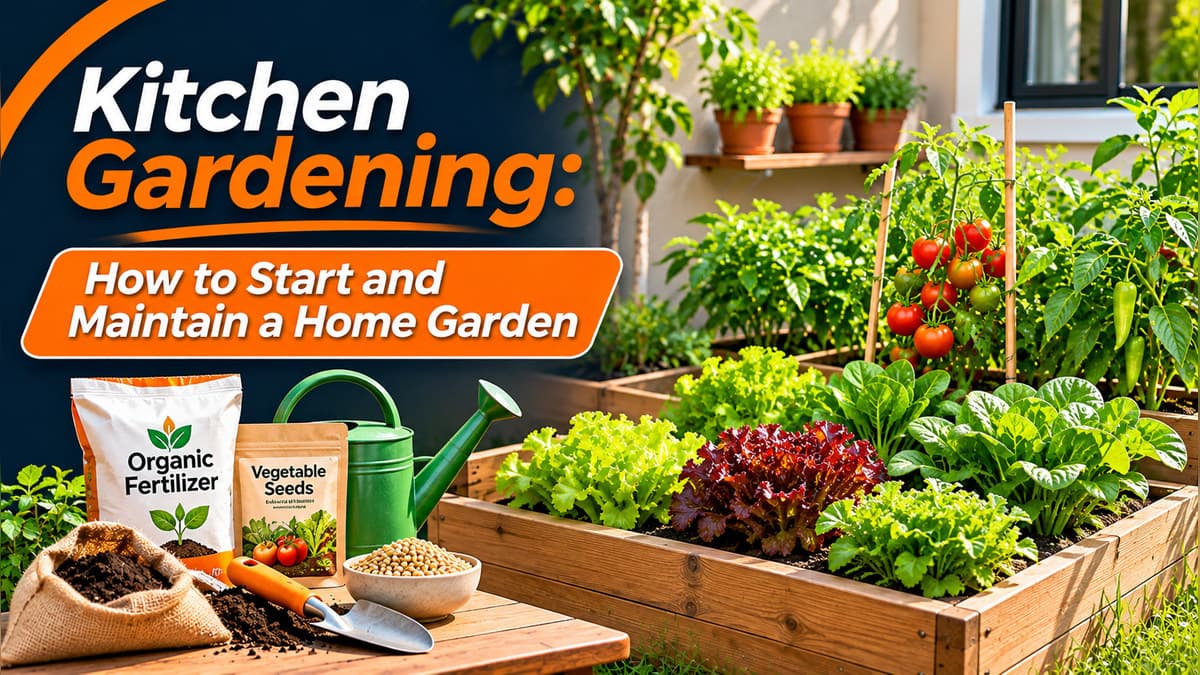
A kitchen garden can begin with one pot of mint on a windowsill. Add a few containers of coriander, spinach, or radish, and you have fresh ingredients within reach without needing a lawn or a large budget.
The basics are straightforward: enough daylight, drainage holes, a suitable growing mix, and crops that match the season.
This guide explains what to grow, when to sow it in different parts of Pakistan, and how to choose containers, soil, and simple tools.
The dates are starting points rather than promises; local weather and the variety you plant can shift the timing.
Quick Answers
1) What it is: growing food at home for your own kitchen, from a few pots to a small plot.
2) Easiest starters: mint, coriander, spinach, fenugreek, radish, and green chilli.
3) Sunlight: at least 6 to 8 hours for tomatoes, chillies, and okra, and 3 to 5 hours for leafy greens.
4) Pots: about 4 litres for herbs and greens, and 11 to 19 litres (a 20-litre bucket works) for tomatoes, chillies, and okra.
5) Mistakes: too little sun, no drainage, overwatering, and sowing at the wrong time of year.
What is Kitchen Gardening?
Kitchen gardening simply means growing some of the food you cook with. It might be herbs beside a kitchen window, vegetables in a courtyard, or a few raised beds on a roof.
You probably will not replace the weekly vegetable shop, but picking your own coriander or spinach is useful in its own right.
It’s older than any trend. In Pakistan, the FAO has run kitchen garden programmes since at least 2015, including a pilot in Balochistan, and it says a kitchen garden can supply up to half of a household’s non-staple food needs.
In one evaluated Pakistani project, households saved about US$9.56 a month on vegetables and earned about $13.39 a month, on average, from selling produce.
Those are small sums, but they add up when money is tight.
Easy Vegetables to Start With
For a first attempt, choose crops you already eat. Fast-growing leaves give you a chance to learn about watering and sunlight before you take on larger plants that need stakes, deeper pots, or more attention.
1) Mint: Start with a healthy cutting in moist soil. Give it a separate pot because its roots spread quickly.
2) Coriander and Fenugreek: Sow these herbs during cooler months and harvest the young leaves. When comparing coriander seeds or fenugreek seeds, check the label before planting: seeds packaged for cooking are not necessarily tested or intended for sowing. Both crops tend to flower early when the weather gets hot.
3) Spinach: Pick the outer leaves first and leave the centre to keep growing.
4) Radish: A useful first root crop because wide varieties are ready relatively quickly.
5) Green Chilli: One well-kept plant can produce over an extended period, though results depend on sunlight and temperature.
6) Tomato and Okra: Worth trying once you have the basics under control; both need more room and consistent care.
Use the table as a planting calendar, not a fixed deadline.
Peas are one option for cooler weather; when choosing green pea seeds, confirm that the variety is intended for sowing and suits your season.
A warm spell, a cold snap, or a different seed variety can move the harvest by several weeks.
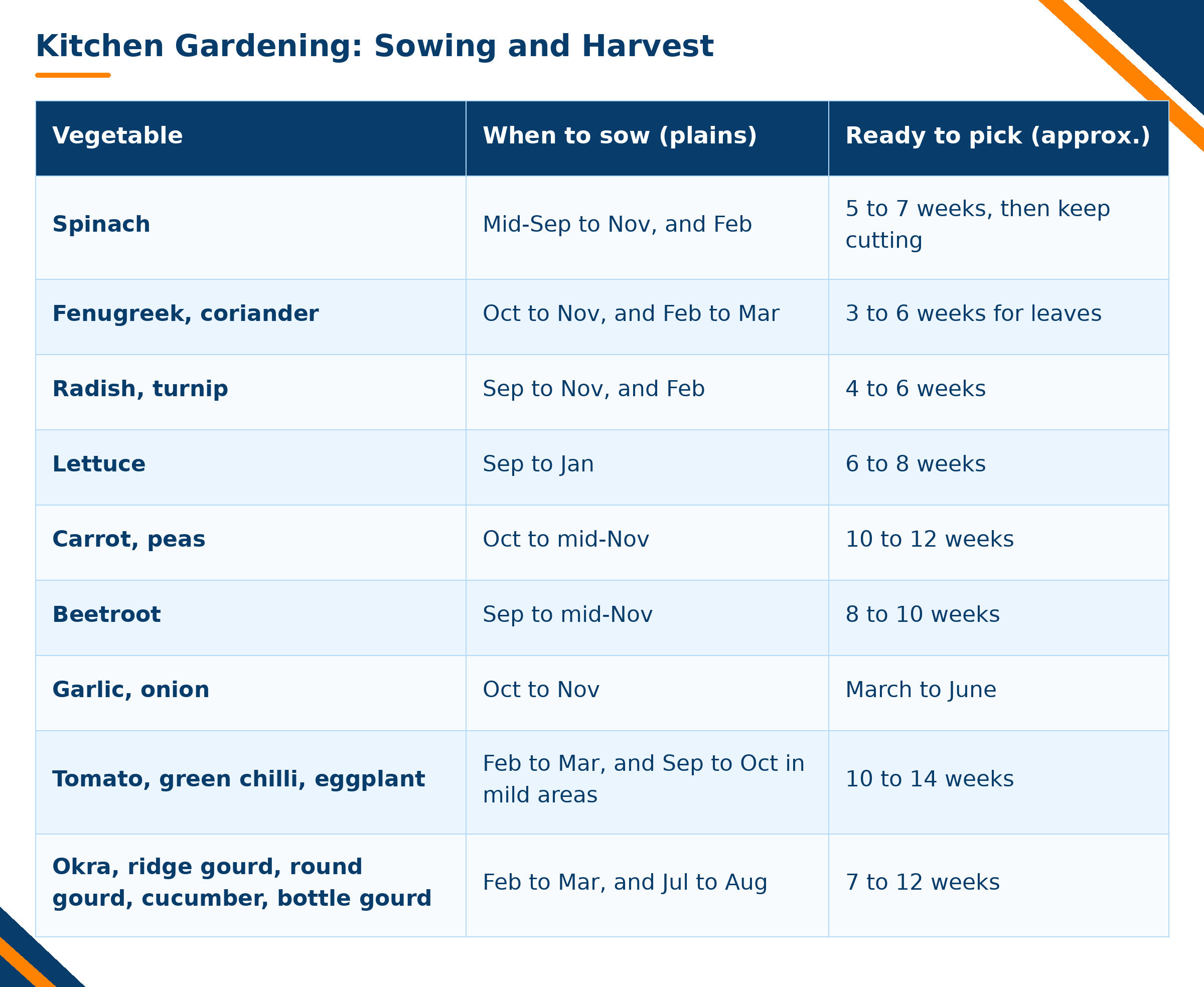
Zones matter too. In Lahore, Faisalabad and Multan, start the winter crops once daytime highs fall below about 35°C, usually mid to late September.
Islamabad and Rawalpindi run two to three weeks ahead. Karachi runs later, with October into December as the main window.
In Quetta, Swat and the northern highlands, winter vegetables are sown in spring instead.
Essential Steps for Beginners
1) Find the Light: Spend a day noting where the sun falls. Fruiting crops like tomato, chilli and okra need 6 to 8 hours. Leafy greens manage on 3 to 5 hours, which makes them ideal for a partly shaded balcony. If you plan to grow tomatoes, compare tomato seeds by variety and mature plant size, and confirm the seed is suitable for planting.
2) Pick Containers or a Bed: Anything works if it holds soil and drains. Drill holes in the bottom, and raise the pot slightly so water can escape.
3) Mix Good Soil: Use equal parts garden soil and compost, then add rice husk or sand so water can drain. More on that below.
4) Sow Properly: Follow the depth on the packet, which is usually two to three times the seed’s width. Tiny seeds like coriander and lettuce need only a light covering. Thin crowded seedlings so the strong ones have room.
5) Water by Touch: Push a finger 2 to 3 cm into the soil. If it’s dry, water slowly until it drains from the bottom. In summer, containers can need water daily.
6) Feed Gently: Compost first. Add more nutrients only when growth slows or leaves yellow.
7) Check for Pests Weekly: Look under leaves. Catch aphids and whitefly early.
8) Harvest Often: Cutting leaves and picking fruit encourages more.
Heat is often the harder part of kitchen gardening in Pakistan.
During the hottest months, check pots more often, protect tender leaves from harsh afternoon sun, and cover bare soil with mulch.
A pot on a concrete roof can dry much faster than the same pot in a shaded courtyard.
Pot Sizes and Soil for a Kitchen Garden
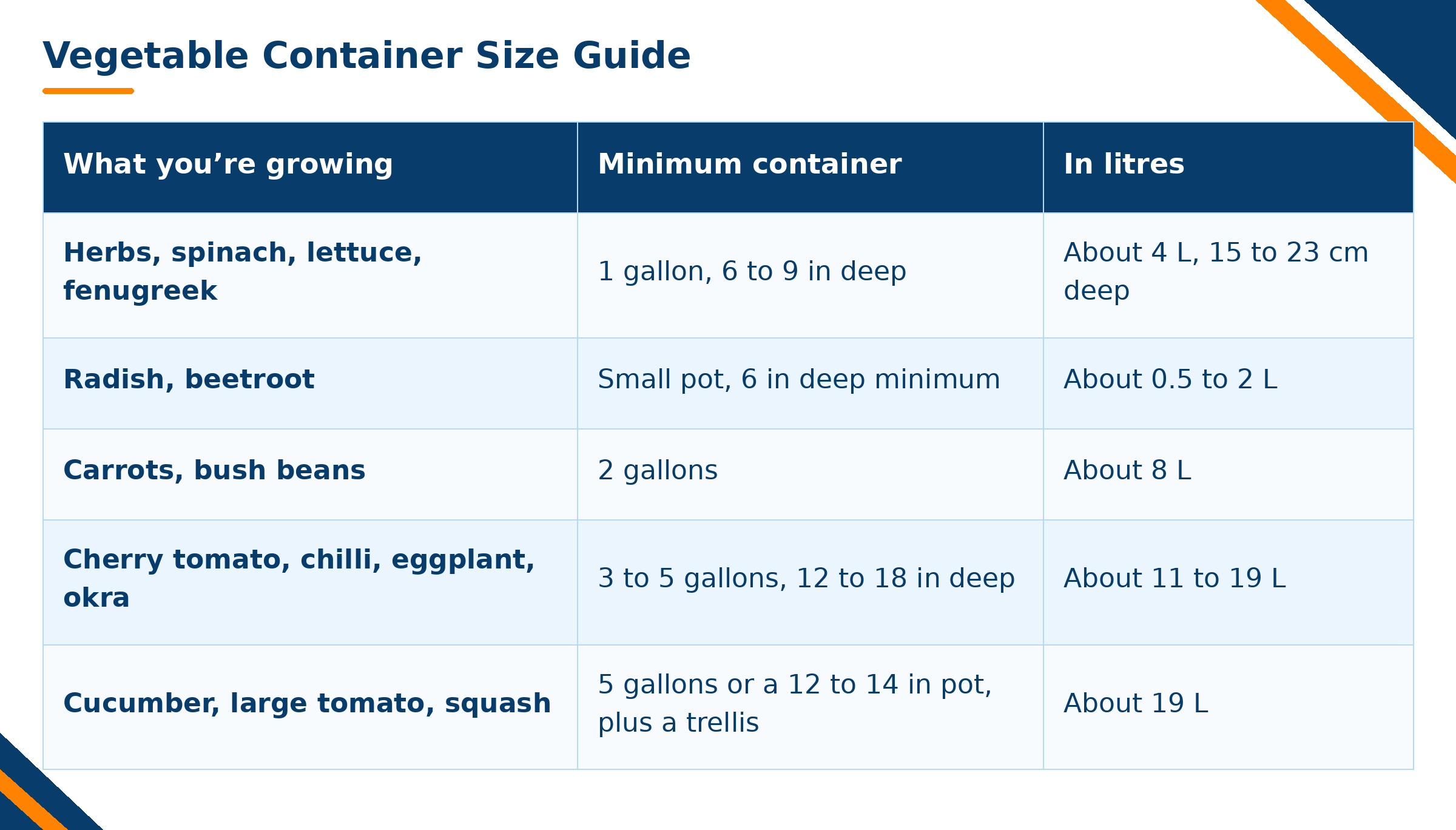
A small pot can look roomy when you plant a seed, then become cramped once roots fill it. Choose the container for the mature plant, not the seedling.
The sizes below are practical starting points from extension guidance; larger containers often make watering easier.
For soil, a good starting mix is equal parts garden soil and compost, with rice husk added to about 10 to 20% of the total volume.
Growers use rice hulls to improve drainage and air in potting mixes, and some sources suggest up to a third of the mix.
They also work as a mulch, in a layer about an inch thick. Husk is cheap and local.
Zarea lists rice husk for bulk buyers, which suits nurseries, while at home a local rice mill or nursery can sell you a bag.
Raw husk can carry weed seeds, so parboiled or heat-treated husk is the cleaner choice. For a closer look at the material itself, see the rice husk uses guide.
Sugarcane bagasse is another farm by-product some growers use as mulch and in compost piles.
If you’re curious about what it is and where it’s used, we explain it in our guide to sugarcane bagasse.
Zarea also lists bagasse as an industrial bulk material, not a ready-made home potting mix.
Feeding, Watering and Pests
A small compost bin is a good place for vegetable peelings, dry leaves, and other suitable plant scraps.
Mix wetter material with plenty of dry leaves or shredded cardboard, keep the pile damp rather than soaked, and turn it occasionally.
Leave out meat, oil, and cooked leftovers that attract pests.
Chemical fertiliser is a different scale. Zarea lists fertilisers for farmers and traders in its fertilizer category, and those are sold for fields, not flower pots.
A bulk product such as engro urea 50 kg is far more than a few pots need. Urea supplies concentrated nitrogen and can damage plants if applied incorrectly.
For a home garden, begin with compost and use only a suitable product at its labelled rate. Bulk bags are more relevant to farms and larger nurseries.
Before watering, check the soil just below the surface. If it is still damp, wait. When you do water, aim at the soil rather than the leaves.
Look under leaves every few days for insects; removing a small problem early is usually easier than dealing with a badly affected plant.
Use any garden treatment only as its label directs, especially on edible crops.
Kitchen Gardening Tools You Actually Need
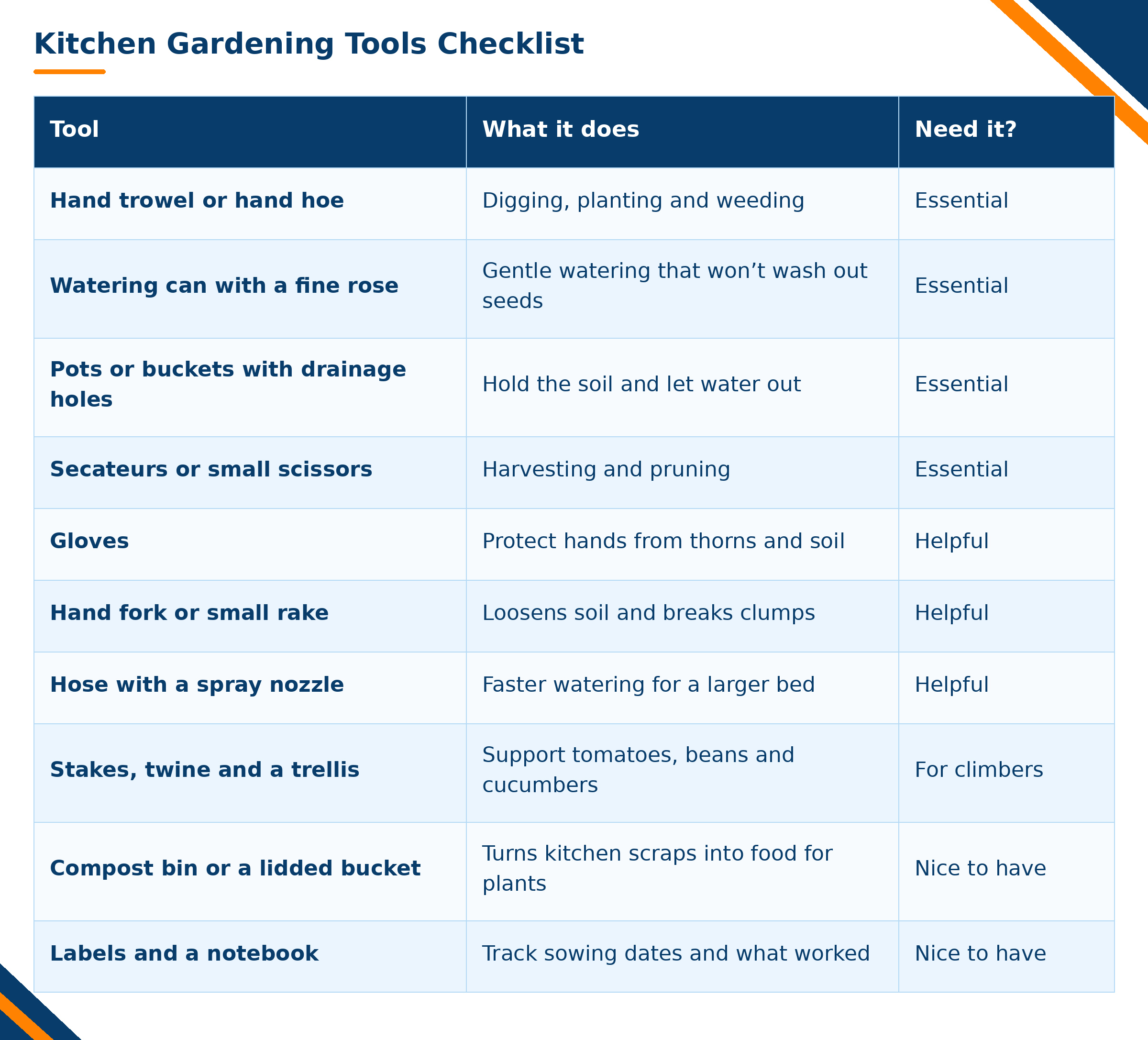
You do not need a full gardening kit. Start with a container, something to water with, and a small tool for planting.
The table separates what is useful on day one from what can wait.
Reusing containers saves money, but be selective. A clean food-grade bucket with drainage holes can work well.
Avoid anything that previously held pesticides, solvents, or other chemicals.
Kitchen Gardening Ideas for Small Spaces
A garden does not have to occupy the whole roof. Look at where the light falls and where water can drain safely, then choose a setup you can reach and maintain every day.
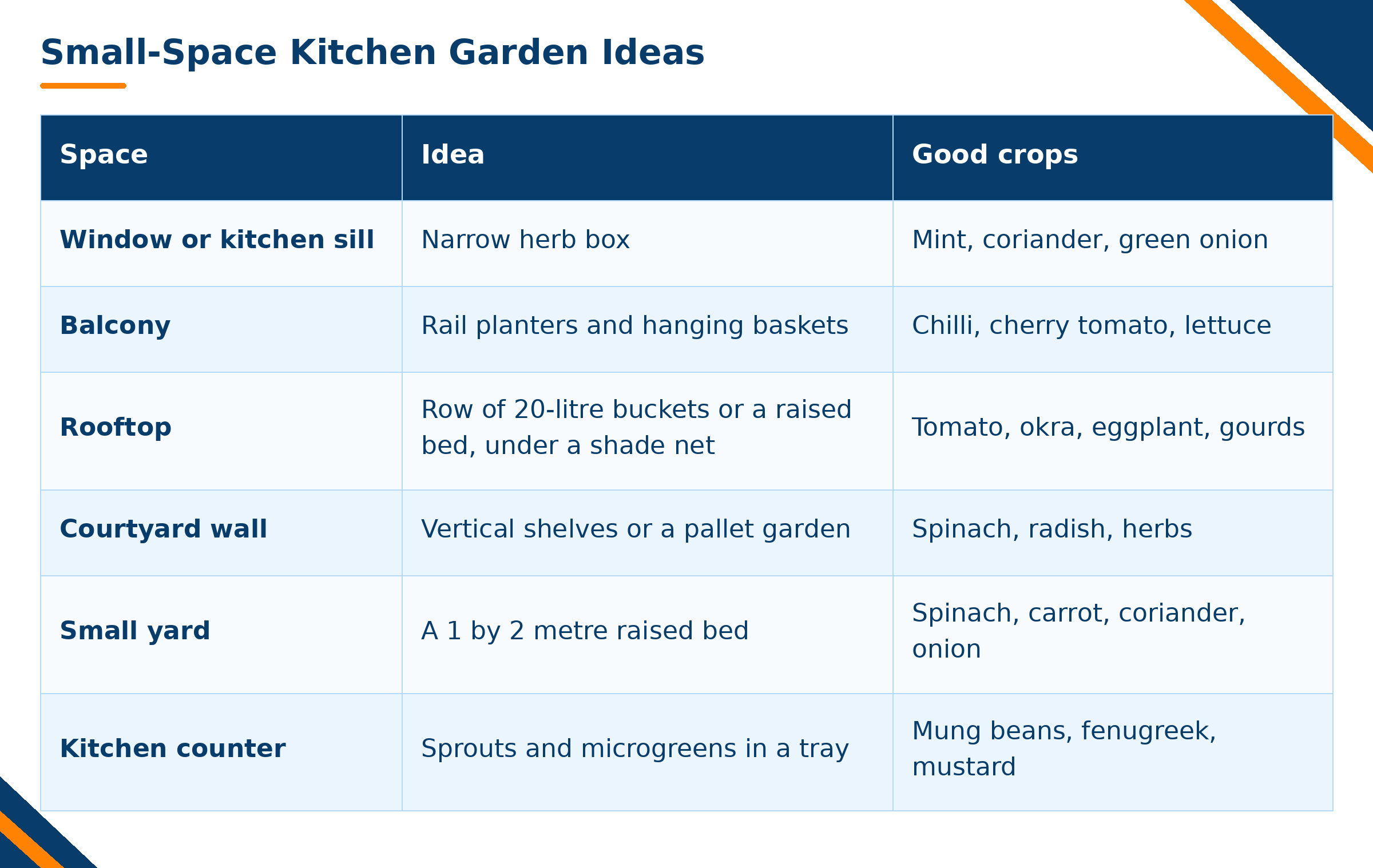
For sprouts and microgreens, hygiene matters as much as speed. Use clean trays and water, and remember that raw sprouts carry a food-safety risk, particularly for pregnant people, young children, older adults, and people with weakened immune systems.
Cooking sprouts thoroughly is the safer option. Start with two or three containers rather than filling every corner at once.
Is Kitchen Gardening Worth It?
A kitchen garden is worthwhile if you enjoy using what you grow. Fresh herbs are convenient, and small harvests can reduce some shopping, but the savings depend on the season, water use and how well the plants do.
Studies of community gardening programmes report benefits, though their results should not be treated as a forecast for an individual household.
The limits are real: summer heat, water, pests and the time needed to check plants.
If a balcony gives you only a few hours of light, grow leafy crops rather than fighting to produce tomatoes there.
Kitchen Gardening for Nurseries, Schools and Community Plots
If you’re setting up a school garden, a community plot or a small nursery, bulk inputs make sense. You can look at what’s on offer in Zarea’s agriculture biomass category.
For a school, nursery, or community plot, the seed can help you compare available products.
Check the variety, whether the seed is intended for sowing, any treatment information, and the minimum order quantity; a culinary seed listing is not automatically a planting-seed listing.
And if you grow seedlings, make compost, or sell garden supplies, the become a supplier page explains how to reach business buyers.
FAQs
Which Vegetables are Easiest to Grow in a Kitchen Garden in Pakistan?
Mint, coriander, fenugreek, spinach, radish, and green chilli are the easiest. Leafy crops and radish are ready in 3 to 7 weeks and forgive mistakes.
Tomato, okra, and eggplant take more care but reward you in summer. Choose crops that match the season you are sowing in.
What Vegetables Can I Plant in November in Pakistan?
In the plains of Punjab and Sindh, sow spinach, fenugreek, coriander, radish, turnip, lettuce, peas and carrots (early November), and plant garlic and onion.
Karachi is in its prime window. In Islamabad and the hills, it is getting late, so stick to quick leafy crops.
What Tools Do I Need for Kitchen Gardening?
You need a hand trowel or hand hoe, a watering can with a fine rose, pots or buckets with drainage holes, and small scissors or secateurs.
Gloves, a hand fork, a hose nozzle, stakes, and a compost bin are helpful extras. Start with the essentials and add more as your garden grows.
How Much Sun Does a Kitchen Garden Need?
Tomatoes, chillies, okra, and other fruiting crops need 6 to 8 hours of direct sun a day.
Leafy greens like spinach, lettuce and coriander manage on 3 to 5 hours, so they suit partly shaded balconies.
In Pakistani summers, give leafy crops afternoon shade.
Wrap Up
Start with the space you actually have. A pot of coriander, a container of spinach and a deeper pot for radish will teach you more than an ambitious garden you cannot maintain.
Watch the light, let excess water drain, and choose crops for the season.
Keep a note of sowing dates and what worked.
Your own observations, along with advice from local growers or an agricultural extension office, will be more useful than following a calendar blindly.