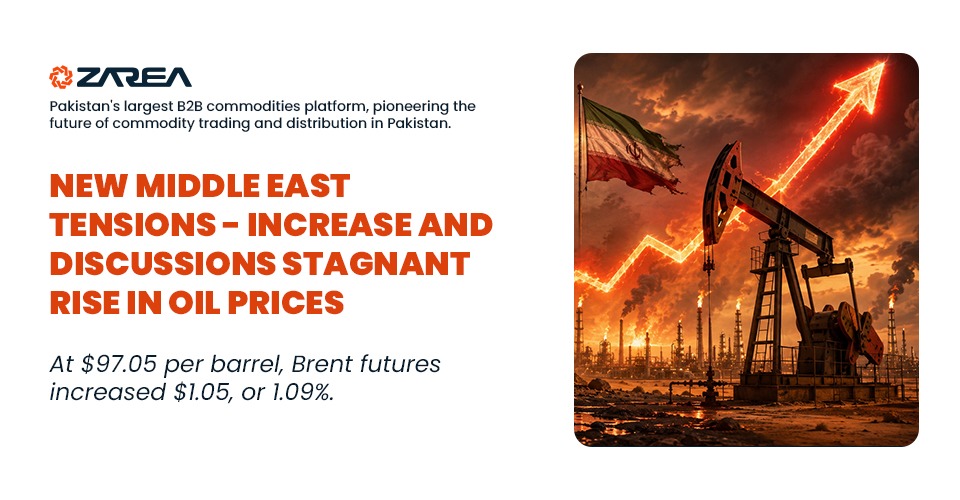
New Middle East Tensions - Increase and Discussions Stagnant Rise in Oil Prices
At $97.05 per barrel, Brent futures increased $1.05, or 1.09%.
Tensions Rises The Oil Prices:
As tensions in the Middle East erupted again with Iran launching missiles at Kuwait and Bahrain and diplomatic negotiations between Iran and the United States made no progress, oil prices increased more than 1% in early trading on Wednesday.
U.S. West Texas Intermediate (WTI) oil increased $1.01, or 1.08%, to end at $94.77, while Brent futures increased $1.05, or 1.09%, to $97.05 a barrel.
In the previous session, both benchmarks reached a one-week high.
Market Update:
Early this morning, as the Middle East's geopolitical situation worsened due to further missile attacks and failed negotiations, crude oil prices surged more than 1%.
1) Brent Crude: Increased 1.21% to $97.17 per barrel.
2) WTI Crude: Increased 1.32% to $95.00 per barrel.
The US-Iran War Update:
According to the US military, Iran launched ballistic missiles against its neighbors Kuwait and Bahrain, but they were unable to reach their targets. In retaliation, US forces attacked Iran's Qeshm Island.
As Tehran examined a possible deal with the United States to end the war, the market anticipated updates on the Iranian conflict.
Iranian media claimed on Tuesday that Iran and Washington had not spoken for a few days, despite Trump's claims that talks had been ongoing.
Daniel Hynes, senior commodity analyst at ANZ Bank, stated that Iran had mined a significant chunk of the crucial waterway, making any attempts to reopen the Strait of Hormuz difficult.
According to Hynes, "there has been a slight tick up in vessels attempting the journey, but total transits remain significantly below pre-conflict levels."
The US-Iran Piece Talk:
With a precarious ceasefire in place, the battle is at a standstill more than three months after the United States and Israel began striking Iran.
According to market sources quoting American Petroleum Institute data issued on Tuesday, U.S. crude oil stocks decreased last week for the seventh consecutive week.
Core Drivers of The Fuel Prices:
1) Missile Attacks: Kuwait and Bahrain were the direct targets of ballistic missiles fired by Iran.
2) Diplomatic Standoff: After Tehran halted contacts, direct negotiations between the United States and Iran came to a standstill.
3) Military Reaction: The United States immediately attacked Iran's Qeshm Island in retaliation.
Crude Prices Decreased:
A significant 6.8 million barrel decline in U.S. crude oil was announced by the American Petroleum Institute (API). However, the petroleum reserves for the week ending May 29, 2026. However, the data from the private sector has greatly increased the upward pressure on oil prices worldwide. due to the fact that it comes before the official government data release.
According to the sources, crude supplies decreased by about 6.8 million barrels for the week ending May 29.
The deadline for U.S. government stockpile statistics is Wednesday at 10:30 a.m. ET (1430 GMT).
Key Inventory Highlights:
1) Sixth Consecutive Drop: This is the sixth consecutive week that U.S. crude stockpiles have decreased. if the government confirms it.
2) Cushing Strain: Stockpiles in Cushing, Oklahoma, are being constantly monitored by traders. There are now only 23 million barrels. because the operational minimum of 20 million barrels is dangerously close to this.
3) Strategic Deficits: Previous data showed that U.S. crude stocks as a whole were already 2.0% below their seasonal five-year average.
What to Watch Next:
The official will release the market-moving U.S. Weekly Petroleum Status Report. Today at 10:30 a.m. ET (1430 GMT), the U.S. Energy Information Administration (EIA). However, traders will check to see if the API's high 6.8 million barrel drawdown estimate is consistent with official data.