Benazir Hari Card: Benefits, Eligibility & How to Apply
Learn about Benazir Hari Card, including eligibility, farmer subsidies, online registration, required documents and how to check your application status.
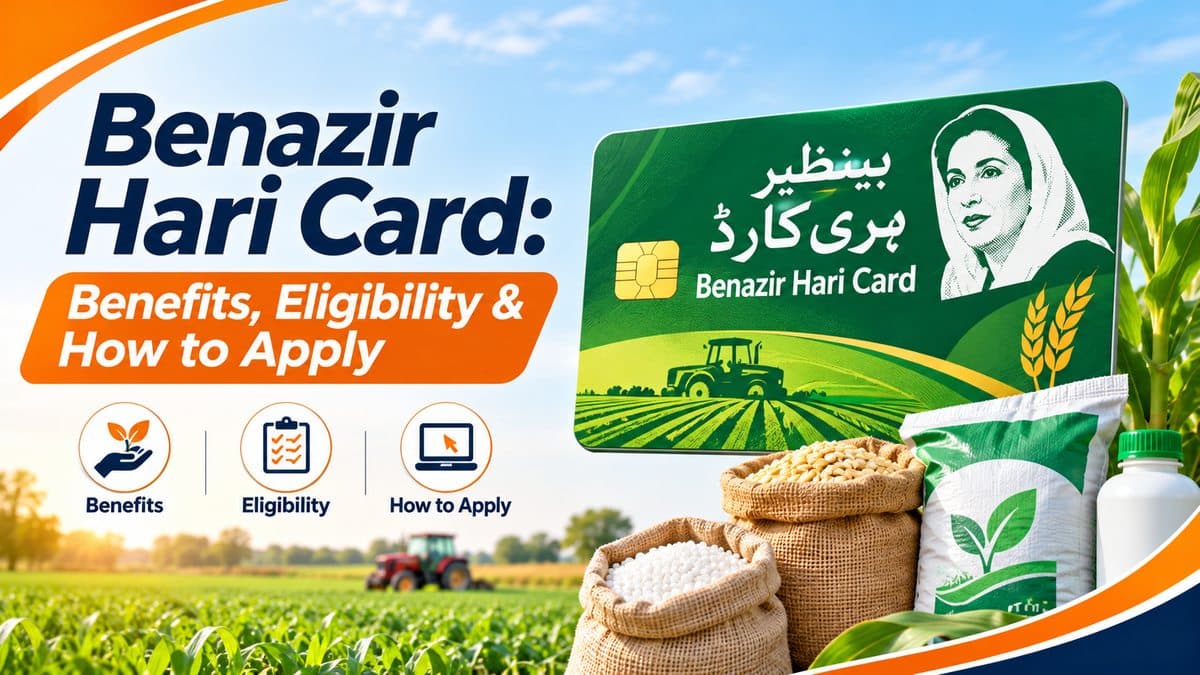
If you farm in Sindh, you have probably heard about the Benazir Hari Card from a neighbour, a field officer, or a forwarded message, and not all of it was accurate.
This guide sticks to what the government has announced and what the official channels say, so you can decide what to do next.
Quick Answers
1) Who it is for: Sindh farmers who hold 1 to 25 acres of farmland and have a valid CNIC.
2) What it is: a Sindh Bank ATM card into which government farm subsidies are paid.
3) New this season: a Rs 14.9 billion wheat subsidy for growers with up to 25 acres, approved by the Sindh cabinet in September 2026.
4) Cost to register: nothing. Registration is free and done online.
5) Checking status: I could not confirm an official public CNIC lookup. The reliable routes are the helpline, the official portal, and your area field officer, covered below.
What is the Benazir Hari Card?
The Benazir Hari Card is a farmer support scheme run by the Agriculture Department of the Government of Sindh.
Instead of handing out subsidies through local middlemen, the province pays eligible growers directly into a bank account linked to the card.
The Sindh government announced the card in October 2024, with the first phase aimed at about 298,000 registered farmers holding up to 25 acres.
Online self-registration followed in February 2025. Sindh Bank issues the card as an ATM card, and payments are meant to be verified biometrically.
The idea behind the 25-acre limit is to focus public money on small and marginal growers rather than large landholders.
That is why the card is described as a small farmer scheme, and why the acreage on your land record matters so much when you register.
The Benazir Hari Card is a provincial agriculture scheme, not part of the federal BISP income support programme.
It is also different from Punjab's Kissan Card. Although both provincial programmes support farmers, they have separate eligibility requirements, application processes, and benefits.
Benazir Hari Card Benefits: What Farmers Actually Get
The main benefit is simple: when the Sindh government announces a farm subsidy, eligible farmers receive it directly in their Hari Card account.
In practice, that has meant support on key crop inputs.
1) Fertiliser support. For the 2025-26 crop, a urea payment of Rs 8,000 an acre was reported, paid from February 2026 through Sindh Bank.
2) Wheat support. For 2026-27, the cabinet approved a subsidy toward DAP fertiliser or an approved alternative, plus a higher bonus for wheat sold to the Food Department (details below).
3) Direct payment. Money goes to the farmer’s own account rather than through an agent.
The official Hari Card website also describes interest-free loans as part of the programme.
That is an announced benefit, not proof that a loan facility is currently open to every registered farmer.
Ask the department which support is active, who qualifies, and whether a separate application is required.
Crop insurance and disaster assistance have also appeared in launch coverage, but current availability should be checked before relying on them.
Farmers comparing seed or fertiliser options should check the required crop variety, product grade, and minimum order before purchasing.
Zarea’s agricultural categories are commercial listings, not official subsidy redemption points. Browse the fertilizer only for market comparisons.
How the payment reaches you matters too. The department announces a package, verifies the registered list, and then Sindh Bank credits the accounts.
If your name is not on the verified list for that scheme, the money will not arrive, even if you hold a card. That is why checking your registration before each season is a good habit.
The Hari Card focuses on agricultural support, while Punjab's Asaan Karobar Card is intended to help eligible small businesses access financing.
The two programmes serve different purposes, so farmers exploring business opportunities should check the eligibility and repayment conditions separately.
Eligibility and Requirements
Official wording across recent announcements is consistent: growers with up to 25 acres.
Older reports mention a 12.5-acre limit, but the department’s own statements and the 2025 and 2026 wheat packages use 25 acres.
Here is what to have ready.
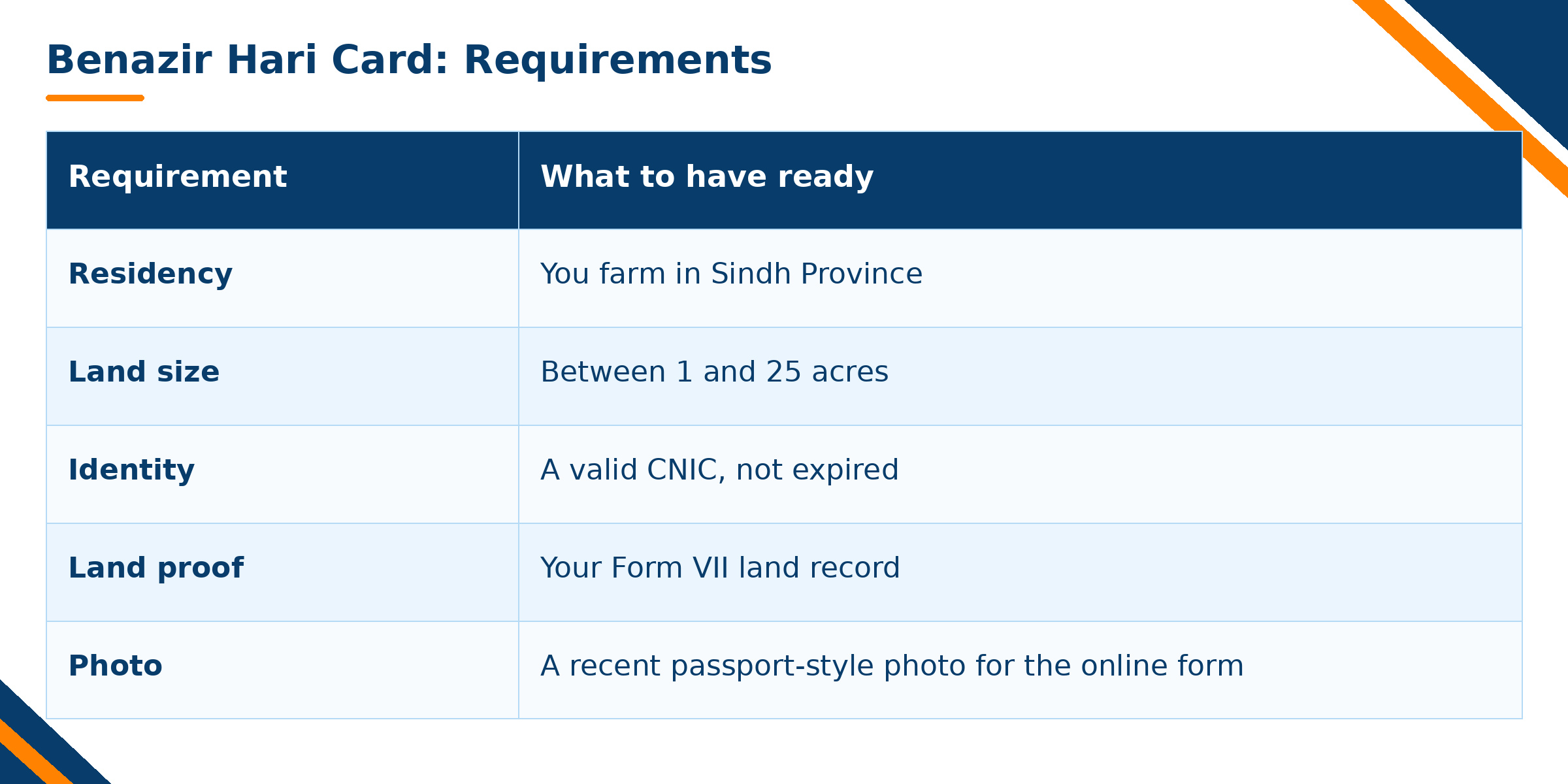
Tenant farmers should note that the form asks for a land record. If you cultivate land that is not in your name, check with the helpline before you spend time on an application.
Eligibility rules also differ between provincial farming initiatives. Punjab's apna khet apna rozgar scheme has its own conditions related to land and applicants.
Farmers should check the requirements of each programme rather than assume that eligibility for the Benazir Hari Card applies to other schemes.
Benazir Hari Card Online Application: Step by Step
Registration is free. Nobody needs to be paid to fill the form for you.
1) Gather your documents. CNIC, Form VII record, and a photo.
2) Open the official portal. Type benazirharicard.gos.pk into your browser yourself. Do not follow links from messages or social posts.
3) Fill in the form. Enter your CNIC, personal details, and land information exactly as they appear on your records.
4) Submit and note your reference. Keep a screenshot or written note of any tracking number you receive.
5) Complete verification. After approval, Sindh Bank handles the account and the ATM card, with biometric checks.
Field names and steps on the portal can change between seasons. If something does not match this list, trust the screen in front of you and call the helpline.
Common Mistakes that Delay Approval
1) A name or CNIC number that does not match the Form VII record exactly.
2) An expired CNIC, which most often needs to be renewed at NADRA first.
3) A blurry or cropped photo that the portal or reviewer cannot read.
Official sources checked: Benazir Hari Card registration portal (benazirharicard.gos.pk) and Sindh Agriculture Department Wheat Growers Support Program 2026 (agri.sindh.gov.pk/swgsp-2026).
Check these pages for updates; the figures in this guide are dated reporting, not a promise of payment.
4) Avoid agents charging a registration fee or websites that imitate the government portal. Check every entry against your documents before submitting; even a small mismatch can delay verification.
Benazir Hari Card Check Online: What Actually Works
Plenty of websites claim you can enter a CNIC and see your status instantly.
I could not verify an official public tool that does this, and typing your CNIC into an unofficial site is a real privacy risk. These routes are safer.
1) Call the helpline: 0311 1646111. Keep your CNIC in front of you.
2) Use the official portal: benazirharicard.gos.pk, including its complaint page if something looks wrong.
3) Ask your field officer: for the 2026 wheat subsidy, the department publishes an officer list on its program page at agri.sindh.gov.pk/swgsp-2026.
4) Visit Sindh Bank: your branch can tell you whether the account is open and the card is ready.
For a Benazir Hari Card balance check, use the ATM or your Sindh Bank branch. Be careful with the number 8171.
That is the BISP service, not the Hari Card, and mixing them up is a common mistake.
If Your Status is Still Unclear
When you call or visit, have your CNIC, your registration reference if you saved one, and your Form VII details ready.
Ask three plain questions: Is my registration complete, has my account been opened at Sindh Bank, and am I on the list for the current wheat subsidy?
Write down the name of the person you spoke to and the date.
Do not enter your CNIC, card PIN, or banking details on a website simply because it promises an instant status result.
Use the government portal and verified contacts; never share an ATM PIN or one-time password with a caller.
The 2026 Wheat Subsidy: What is New This Season
On 17 September 2026, the Sindh cabinet approved a wheat support package for growers with up to 25 acres. The reported details are below.
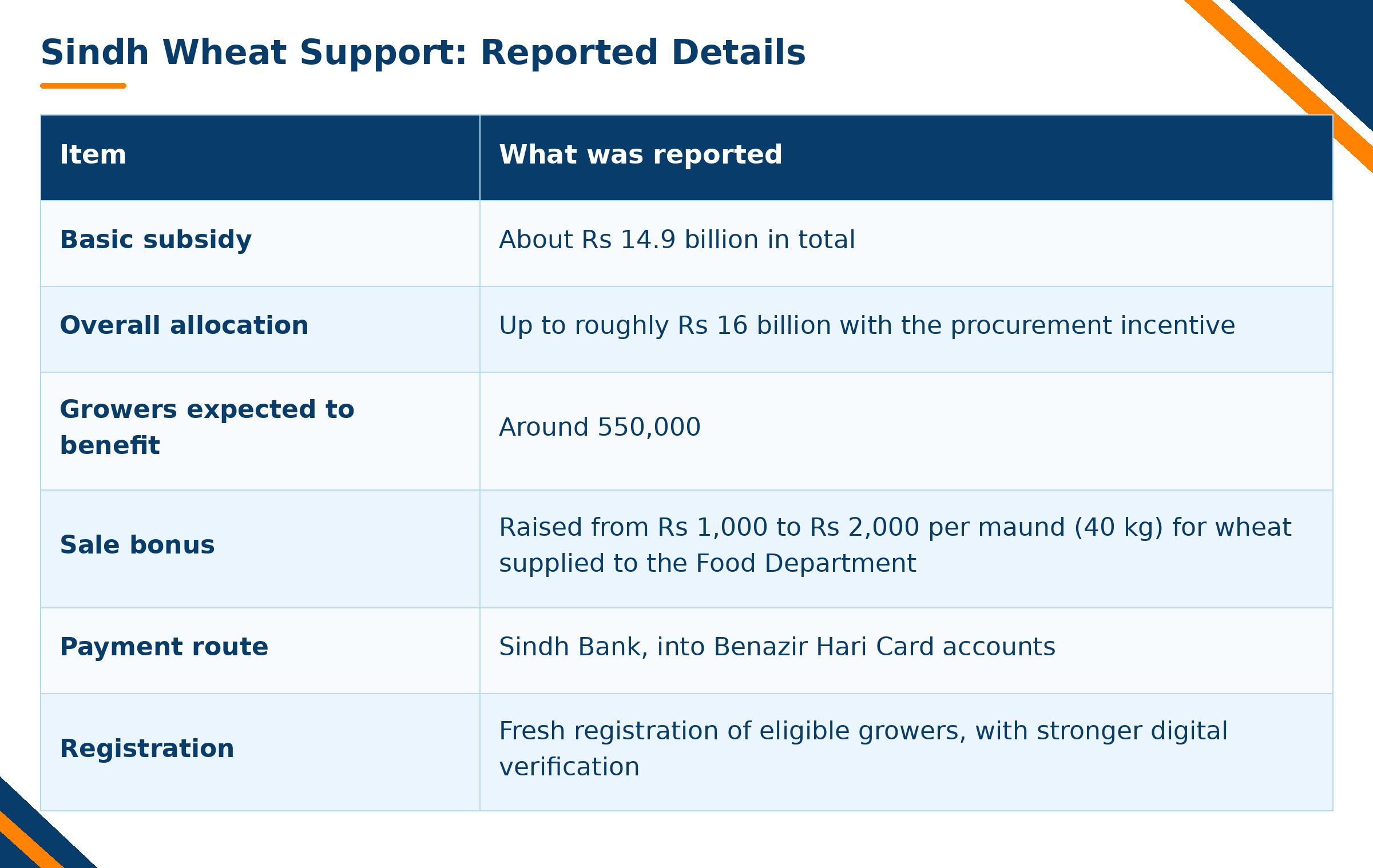
A per-acre figure is where reports differ. One outlet quoted the agriculture minister as saying Rs 4,000 an acre, while other coverage and the department pages I read gave no confirmed per-acre amount.
The cabinet also postponed the 2026-27 wheat support price. Wait for the department’s official notice before you budget around any acre rate.
What to Do Now
1) If you are already registered, confirm that your name is on the 2026 wheat subsidy list.
2) If you are not registered and hold up to 25 acres, register through the official portal while fresh registration is open.
3) If you plan to sell to the Food Department, keep your delivery records, because the higher Rs 2,000 per maund bonus is tied to wheat supplied.
4) Keep an eye on the department page for the per-acre amount and the final payment dates.
Planning Your Inputs Once the Subsidy Lands
A subsidy can help cover seasonal inputs, but it is worth checking what your crop actually needs before buying fertiliser.
Compare available products and their quantities rather than choosing by price alone.
For reference, Zarea lists Engro Urea in 50 kg bags; a soil test or agricultural adviser can help determine an appropriate application rate.
See the Engro Urea 50 kg product for pack size and current order terms.
For farmers selling wheat, check the buyer’s quality requirements, transport costs, and payment terms alongside market prices.
Zarea’s wheat product listing can help illustrate commercial specifications, but it is not a government procurement or subsidy channel.
Compare the wheat listing and daily grain and pulse prices only as market references.
If you also grow rice, review variety and grain-quality requirements before deciding what to sell.
Sugarcane residues can have commercial uses too, although the Hari Card does not guarantee a buyer.
For background, see Zarea’s rice varieties or its sugarcane bagasse.
FAQs
Is the Benazir Hari Card the Same as the BISP Hari Card?
No. The Benazir Hari Card is a Sindh Agriculture Department scheme for farmers with up to 25 acres, paid through Sindh Bank.
BISP is a separate federal income support programme with its own registration and its own checking service. Do not mix up the two.
Can a Tenant Farmer Without Land Get a Hari Card?
Registration asks for a Form VII land record, so a farmer with no land in their name may struggle to qualify directly.
The official pages I read do not clearly explain the rules for tenants. Call the helpline on 0311 1646111 or ask your area field officer first.
Does the Hari Card Pay a Fixed Amount Every Month?
No. It is a bank card into which subsidies are paid when the government announces a package, such as fertiliser support.
Payments follow those announcements, not a monthly salary schedule, and the amount depends on the scheme and your landholding.
Is 8171 the Hari Card SMS service?
No. 8171 belongs to BISP, the federal programme. The Hari Card is run by Sindh’s Agriculture Department, so use its helpline, official portal, or field officer instead.
Some websites say otherwise, but I found no official Hari Card service on that number.
Wrap Up
If you farm in Sindh, start by checking the current eligibility rules and registration window.
Use the official portal, the published helpline, or your designated field officer for status and payment questions.
Keep your registration reference and crop records, and confirm each new subsidy announcement before making spending decisions.