Biggest Rice Producers in the World: Top 10 Countries (2026)
Discover the top 10 biggest rice producers in the world in 2026, including production rankings, leading rice exporters and Pakistan's position.
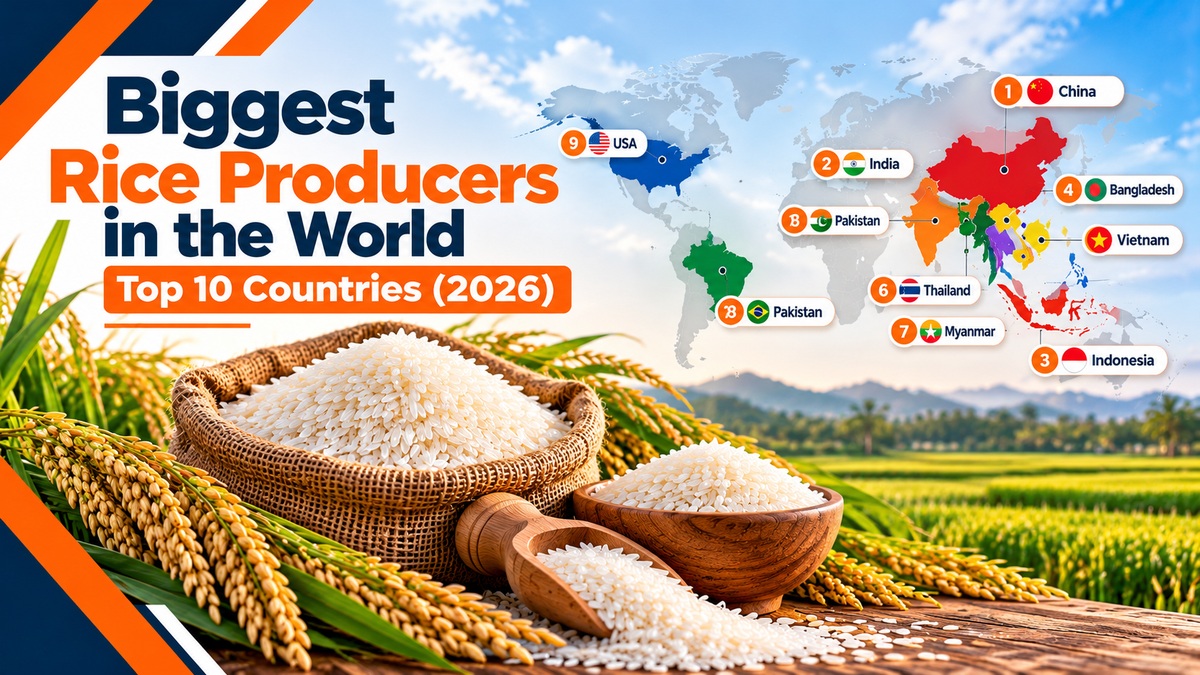
India is the biggest rice producer in the world on the latest full-year numbers, at about 154 million tonnes of milled rice in 2025/26, ahead of China at 146 million. But 2026 is a close call.
USDA's October 2026 forecast puts both countries at 147 million tonnes for the 2026/27 crop, so the top spot is a tie on paper. Bangladesh, Indonesia and Vietnam take places three to five.
Below you'll find the top 10 ranked, the reason different lists give different answers, the five biggest exporters, and where Pakistan fits in. Every figure is USDA's, in milled rice, and the USDA revises them monthly, so look at the date before you quote anything.
Quick answers
Biggest producer: India, at 154.0 million tonnes in 2025/26. China was close behind at 146.3 million.
2026/27 forecast: India and China are both at 147.0 million tonnes. It's India's first fall in output since 2015/16.
Top five producers: India, China, Bangladesh, Indonesia and Vietnam, together about 73% of world output.
Where it's grown: about 89% in Asia.
Top five exporters: India, Vietnam, Thailand, Pakistan, and Cambodia.
Top 10 Rice-Producing Countries in the World
Here is the ranking, in million tonnes of milled rice. The first number column is USDA's estimate for the 2025/26 crop; the second is its current forecast for 2026/27.
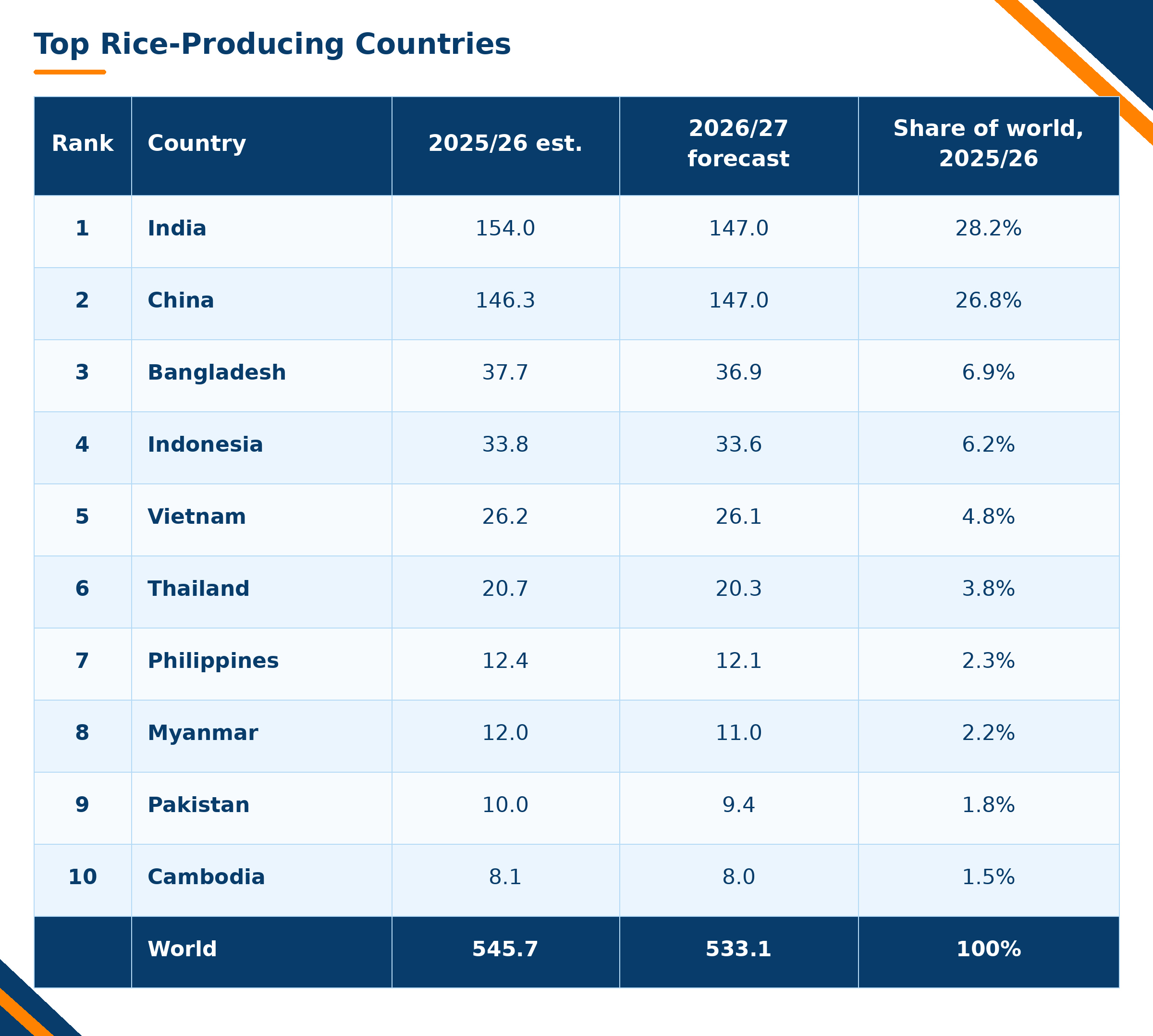
Two countries do more than half the work. India and China make about 55% of the world's rice. Add Bangladesh and the top three reach 62%, and the top ten cover roughly 85%. After the first five, the volumes drop off a cliff. Vietnam, in fifth place, grows about a sixth of what India does.
The 2026/27 column is the interesting one. In September, the USDA's Economic Research Service cut India's new crop by 3 million tonnes to 147.0 million, blaming a smaller yield and less harvested area.
That's India's first year-on-year drop since 2015/16. Before it, output had climbed for ten years straight and hit the 154.0 million tonne record. China barely moved, so the two now sit level.
Don't read too much into that tie. Both countries show exactly 147,000 tonnes in USDA's tables, and a single monthly revision can flip the order. Until harvest data firms up, "who is number one in 2026" is honestly too close to call.
Why rice rankings disagree with each other
You may see much higher rice production figures on other websites, especially when they report paddy rice rather than milled rice. These figures are not directly comparable because they measure rice at different processing stages.
Paddy versus milled. Paddy is rice as harvested, with its outer husk still attached. Milled rice is measured after processing removes the husk and some outer layers. Milled rice typically represents around 65–70% of paddy weight, depending on the variety and milling process. USDA production tables commonly report milled-rice equivalents, while many FAO production statistics use paddy rice. Always compare the same crop year and measurement basis before concluding.
Marketing year versus calendar year. Rice production and international trade are not always reported using the same time periods. USDA production figures follow country-specific marketing years, while its international rice trade forecasts commonly refer to calendar years. Check the reporting period before comparing production and export figures from different tables.
Estimate versus forecast. A forecast for a crop that's still in the ground will move—an estimate for a crop that's already milled and shipped moves much less. Say which one you're quoting.
The leading producers, one by one
India. The world's biggest producer and, by a mile, its biggest exporter. It shipped about 23 million tonnes in 2026, which is only around 15% of its crop, so the rest feeds a very large home market. India also held 59 million tonnes in stocks at the end of 2025/26. USDA has just trimmed its 2027 export forecast by a million tonnes to 24.0 million, citing lower shipments of broken and white rice, and Indian FOB quotes have been creeping up on limited availability.
China. Number two in output and almost entirely a domestic story. It exports about 2 million tonnes and imports around 4 million. What stands out is its stockpile, 105.5 million tonnes at the end of 2025/26, which is more than half the world's rice stocks.
Bangladesh. Third, at 37.7 million tonnes, and close to self-sufficient. It eats about 38 million tonnes a year, so it only needs small imports in a bad year.
Indonesia. Fourth at 33.8 million tonnes. It consumes a bit more than it grows, but a high import tariff keeps its buying low. USDA puts its 2026 imports at just 0.4 million tonnes.
Vietnam and Thailand. Fifth and sixth, and both lean hard on exports. Vietnam sells about 31% of its crop abroad and Thailand about 34%. Vietnam's main customer is the Philippines. Thai rice carries the highest price tag of the big Asian exporters.
Where is 90% of rice grown?
In Asia. Add USDA's 2025/26 numbers for East, South and Southeast Asia, and you get 485.8 million tonnes out of 545.7 million, or about 89% of the world crop.
Asia's dominance in rice production reflects its suitable growing conditions, established farming systems, extensive irrigation networks and seasonal rainfall.
Many rice varieties are cultivated in flooded fields, although growing methods and water requirements vary across regions.
Africa is the reverse story. Sub-Saharan Africa grows about 24 million tonnes and imports around 19 million, which makes it the biggest buyer region in the world. That's roughly a third of all rice traded.
The type of rice matters too. USDA's Economic Research Service puts indica at 62 to 66% of global rice trade, aromatic rice such as basmati and jasmine at 23 to 25%, japonica at 9 to 10%, and glutinous and specialty types at 2 to 3%.
Top 5 largest rice exporters
Rice is mostly eaten where it's grown, so only about 11% of the crop crosses a border. Of the 59.6 million tonnes traded in 2026, India alone supplies 23 million, or around 39%. Here are the top five.
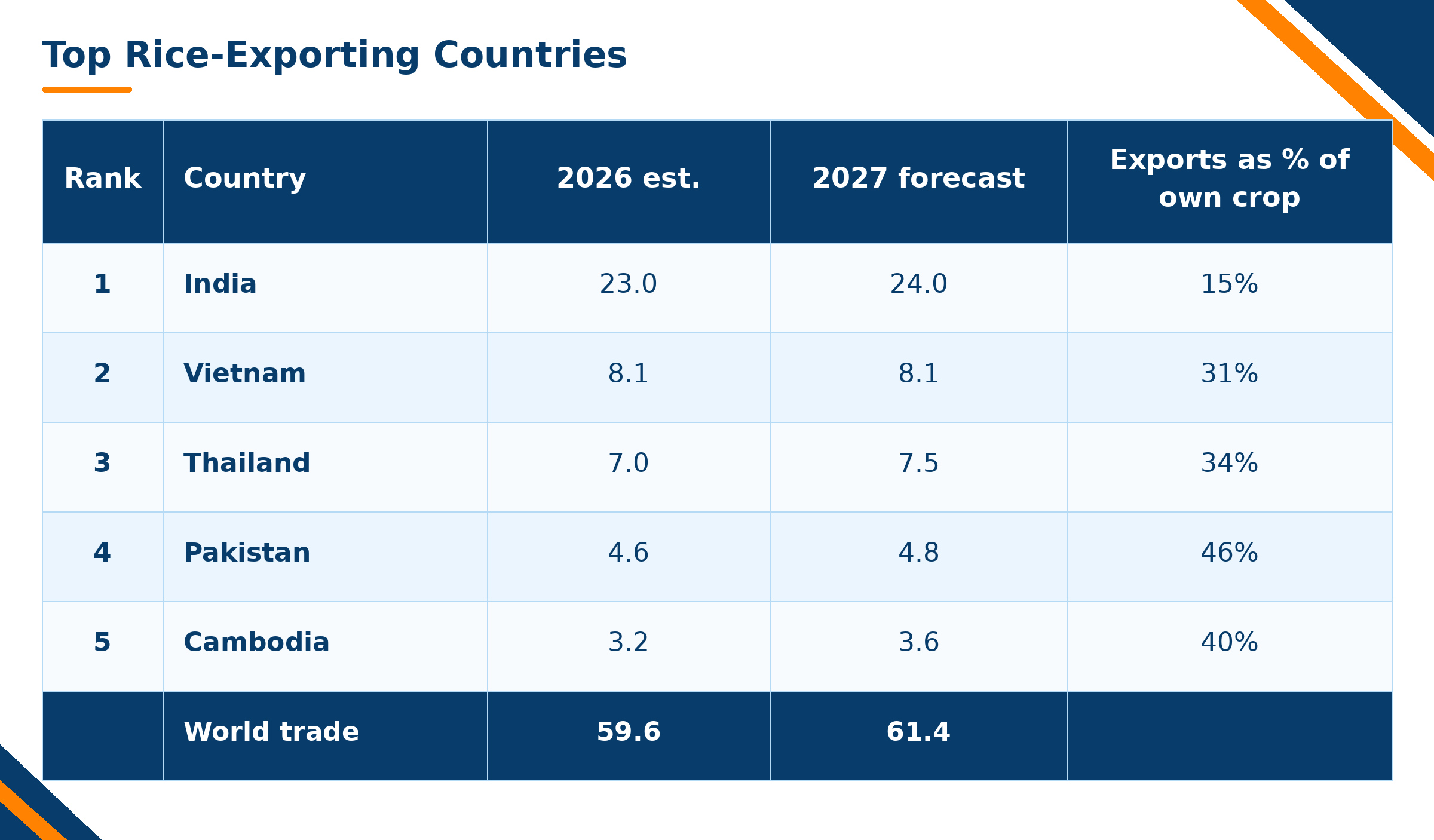
A note on fifth place. Plenty of articles still put the United States there. On USDA's current volume numbers, the US ships 2.55 million tonnes, which puts it sixth, behind Cambodia. Rankings by value can look different, so check which one a source is using.
The last column is the one I'd stare at. India is the biggest exporter but sells just 15% of what it grows. Pakistan sells nearly half. That makes Pakistan far more exposed to a short crop or a change in buyer demand.
Where Pakistan Fits in
Pakistan is the ninth-largest producer, at about 10 million tonnes of milled rice, and the fourth-largest exporter at 4.6 million tonnes. USDA's October update cut its 2027 export forecast by 200,000 tonnes to 4.8 million, blaming a smaller crop, and trimmed the 2026/27 crop to 9.4 million tonnes.
Prices have softened since the new harvest. USDA's October report has Pakistani export quotes down $17 to $396 a tonne. For comparison, Indian quotes sit at $384 and rising, Vietnamese at $415, Thai at $466, and US rice far above the rest at $639.
These are 5% broken white rice quotes, except Thai 100B at 100% grade B, and they move every week. If you want to follow local rates, Pakistan's role in the global rice market extends beyond its production ranking.
Rice quality, export demand, international competition, and logistics costs all influence how Pakistani suppliers compete. For a closer look at these factors, explore our guide to Pakistan's rice production, exports, and global markets.
What this means if you buy or sell rice in bulk
Global rice production rankings do not determine the price a buyer pays. Rice variety, broken-grain percentage, crop year, quality and packaging all influence the final quotation.
Before comparing suppliers, confirm whether the price is ex-mill, FOB or delivered, and account for freight and handling costs. Businesses sourcing rice can explore the grains and pulses to compare product options.
Crop year and variety also matter. Old-crop and new-crop rice may differ in price, moisture content and cooking characteristics. Buyers should check grain length, broken percentage and quality specifications before placing an order. For example, premium steam basmati rice is one of the rice products listed on Zarea.
If you're importing or exporting rice and need help with the paperwork or shipment, Zarea's import and export service lets you request a quote directly. For domestic deliveries across Pakistan, ask about the logistics support on offer as well.
And if you mill or trade rice, you can list your stock as a supplier. The become a supplier page explains how it works.
Rice milling also produces valuable byproducts. Rice husk accounts for roughly one-fifth of paddy weight and can be used as fuel in compatible industrial boilers, as well as in other agricultural and manufacturing applications.
Learn more about rice husk uses and industrial applications, including biomass energy and value-added products.
For businesses looking to source this material, Zarea also offers a rice husk product listing with specifications and ordering details.
FAQs
Which country is the biggest rice producer in the world?
India is the world's largest rice producer based on the 2025/26 figures presented in this article, producing approximately 154 million tonnes of milled rice, compared with China's 146.3 million tonnes. The rankings may change as newer production forecasts become available.
Where is 90% of rice grown?
In Asia. USDA's 2025/26 estimates put East, South and Southeast Asia together at 485.8 million of 545.7 million tonnes, which is about 89% of the world crop. India, China, Bangladesh, Indonesia and Vietnam do most of it.
Which are the top five rice-exporting countries?
According to the 2026 export estimates used in this article, the five largest rice exporters are India, Vietnam, Thailand, Pakistan and Cambodia. These rankings are based on export volume rather than export value and should be checked against the latest USDA trade estimates..
Who is the largest producer of rice in the world in 2026?
India, going by the latest full-year estimate: 154.0 million tonnes in 2025/26 against China's 146.3 million. For the 2026/27 crop, USDA now has both at 147.0 million tonnes, after cutting India's forecast, so the lead is a tie for now.
Wrap-up
India remains the biggest rice producer in the world based on the latest completed crop-year figures presented in this article, with China close behind. Bangladesh, Indonesia and Vietnam complete the top five, highlighting Asia's dominant position in global rice production.
However, production rankings tell only part of the story. Paddy and milled rice figures are measured differently, while forecasts can change as harvest data becomes available. Pakistan also holds an important position in international rice trade, particularly as a major exporter.
For rice buyers and suppliers, understanding global production trends is useful, but variety, quality, crop year, and delivery terms remain essential when comparing prices and making purchasing decisions.