Corn Market Price Today: Latest Rates & Market Trends
Check today's corn market price in Pakistan and globally, see per-kg and per-ton rates, and understand what actually moves the maize price day to day.

If you're checking the corn market price today, you're probably after one of two things: what corn, or maize- it's the same crop, just a different word depending on where you're from- is actually going for right now, or why that number won't sit still.
Fair questions, both of them. Truth is, corn pricing runs on two tracks that move somewhat independently: the local market, where real grain gets bought and sold, and the global futures market, which tends to set the mood for where things are headed next.
This piece walks through both, with actual numbers attached, so you're not stuck guessing.
What Is Today's Corn Market Price?
Right now, as of September 2026, the grains and pulses price has maize sitting at Rs 325 per kg in Pakistan's physical market.
That's what buyers and sellers are working with for bulk local maize today, and it won't stay put; this updates daily as supply, demand, and whatever else is moving the market shifts around.
One thing worth being upfront about: this number is for physical grain, the kind you can actually go pick up, not a futures contract and not some international benchmark price.
Depending on your region, the quality grade, and how much you're ordering, the real number you get quoted might land a bit differently. Think of this as a solid reference point, not a locked-in quote for every deal out there.
Corn Rate Today vs Maize Rate Today: Are They the Same Thing?
Yes. "Corn" and "maize" refer to the same crop, Zea mays. In American English, "corn" is the standard term. In British English and across most of South Asia, including Pakistan, "maize" is more common, though "corn" shows up constantly too, especially in trading and market contexts.
So if you're searching for the corn rate today or the maize rate today, you're looking for the same commodity and, on Zarea's platform, the same listing.
The terminology mostly matters for search and sourcing purposes. A supplier quoting a "maize today rate" and one quoting a "corn price" are talking about the identical product, which is worth knowing if you're comparing quotes from different regional suppliers who may default to one term or the other.
Why Does the Corn Price Change Every Day?
A handful of factors move the daily rate, some local, some global.
Harvest timing and local supply. Prices generally soften right after harvest when supply is abundant, and firm up later in the season as stock tightens.
Currency movements. Since a meaningful share of grain trade is priced with an eye on international benchmarks, a weaker or stronger local currency against the US dollar filters into domestic pricing.
Global futures markets. Corn futures trade continuously on exchanges like the Chicago Board of Trade (CBOT), and significant moves there tend to ripple into local physical markets within days, even in markets that don't trade the futures contract directly.
Input costs. Fertilizer, fuel, and transport costs all feed into what farmers and traders need to charge to stay profitable.
Demand from feed and food processing. Corn is a major input for poultry feed, livestock feed, and food processing, so demand swings from those sectors show up in the price.
None of these move in isolation, which is why the current corn market price on any given day is really a snapshot of several forces balancing out at once, rather than a number set by any single factor.
Corn Price Per Ton Today: Converting Kg to Ton
Most bulk buyers think in tons rather than kilograms, so it helps to have the conversion handy. At Rs 325 per kg:
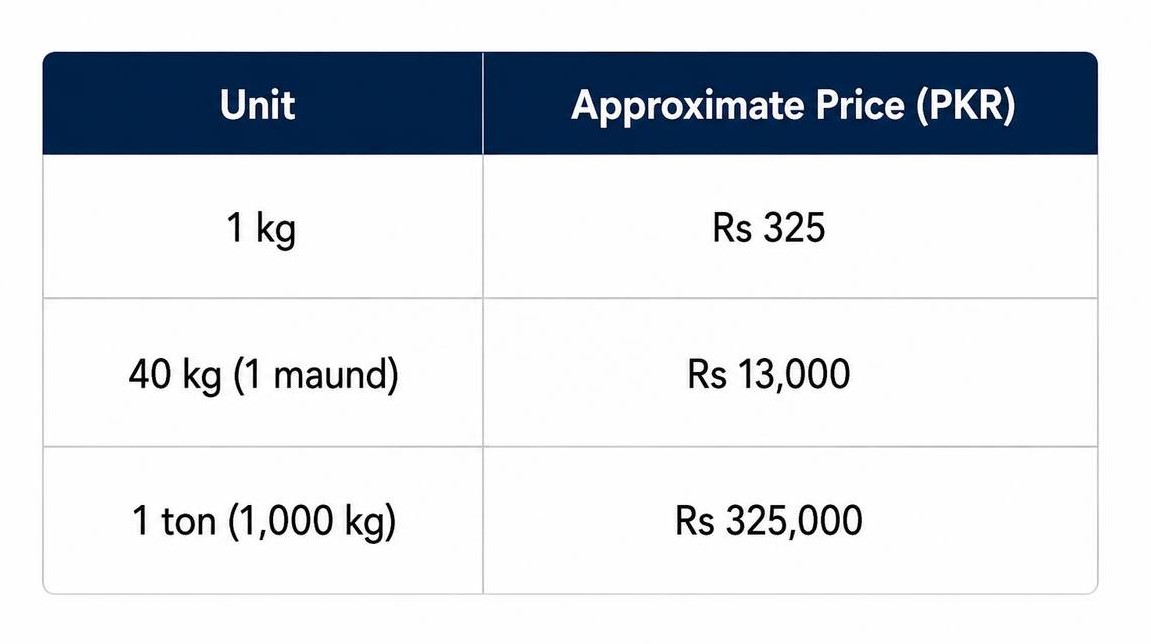
These figures scale directly off the per-kg rate, so if the price moves, the same math applies to whatever the current corn market price happens to be on the day you're ordering.
For exact, up-to-the-day numbers rather than a fixed snapshot, checking the live rate before finalizing a purchase is always the safer move.
Global Corn Futures vs Local Corn Market Price
It helps to understand how the local rate relates to the much larger global futures market, since the two are connected but not identical.
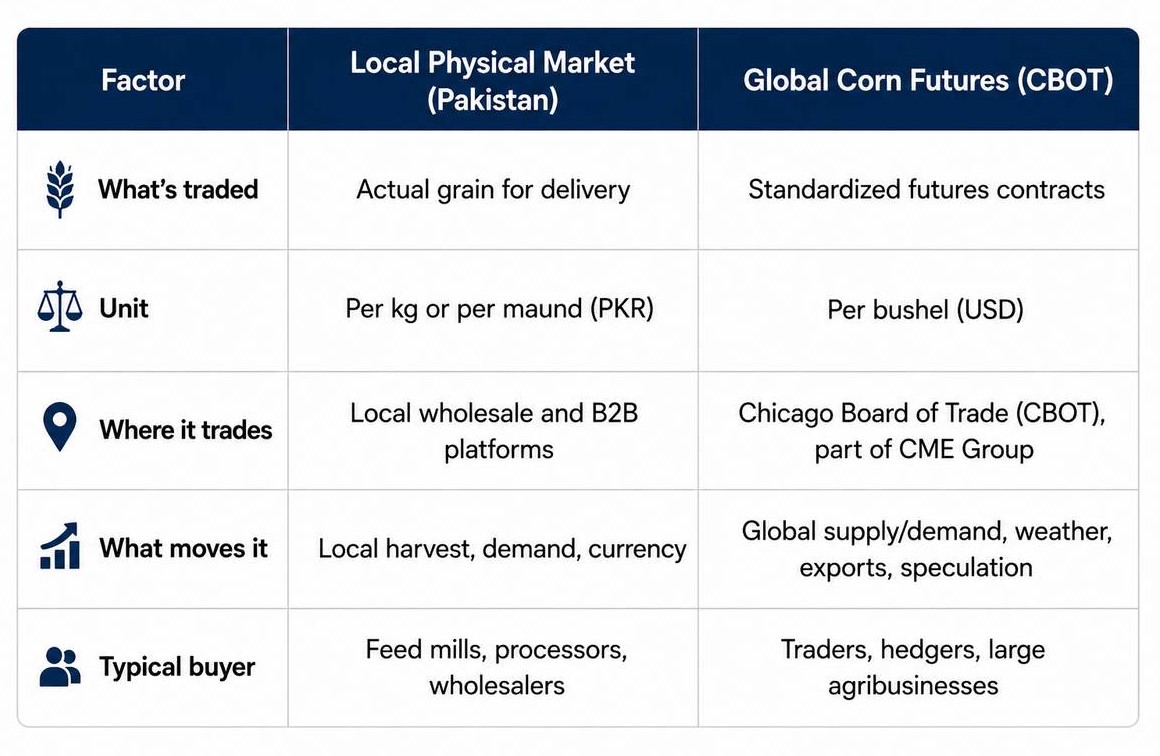
For some global context, CBOT's most actively traded corn contract was sitting around $5.42 a bushel as of September 3, 2026, per Reuters reporting picked up by Business Recorder, not far off a three-year high thanks to worries over tightening supply worldwide.
Keep in mind that the number's moving constantly throughout the trading session, so treat it as a snapshot rather than something set in stone, and if the global benchmark actually matters for your business, go check CME Group's own market data directly for whatever the price is right this moment.
How to Track the Current Corn Market Price
If corn pricing affects your business regularly, checking a single static number occasionally isn't enough; prices move daily and sometimes faster than that. A few practical habits help:
Check daily grains and pulses prices before placing any bulk order, rather than relying on last week's quote.
Compare against prices across other commodity categories if you're sourcing more than one input, since input costs often move together.
If cash flow around large purchases is a concern, trade credit options can help bridge the gap between paying a supplier and receiving payment from your own buyers.
Who Actually Buys and Sells at the Corn Market Price?
Corn's demand base runs wider than most people realize. The biggest buyers are usually poultry and livestock feed mills; corn's a core ingredient in most animal feed, so they're moving serious volume.
Food processors take a chunk too, for all sorts of products, and a smaller slice goes toward industrial use. On the other end, farmers either sell directly or go through traders and aggregators who pull together all the smaller lots into the bulk quantities that feed mills and processors are actually looking for.
This is where a structured B2B marketplace earns its place. Instead of negotiating with a single local dealer, businesses can buy and sell commodities, including corn, through verified listings, compare current rates before committing, and deal directly with suppliers or buyers at scale.
A Practical Example
Take a feed mill that needs 10 tons of corn to get through its weekly production run. At today's rate of Rs 325 per kg, that's Rs 3,250,000 right there, and that's before transport, handling, or whatever bulk discount they manage to negotiate gets added in.
Now say the price ticks up to Rs 335 the following week. Same order, same 10 tons, but suddenly it's Rs 3,350,000, a hundred thousand rupees more for doing nothing different.
That gap is exactly why buyers moving this kind of volume check the rate every single time instead of just going off whatever number they remembered from a few weeks back.
FAQs
What is the price of 1 kg of corn in Pakistan?
Right now, Zarea has maize listed at Rs 325 per kg as of September 2026. That number moves daily, though, so don't just take this and run with it weeks later; pull up the current listing before you actually place an order.
What is the current market price of a bushel of corn?
Over on the global futures side, CBOT corn was hovering around $5.42 a bushel as of September 3, 2026, per Reuters. That's a dollar-denominated price that keeps shifting all through trading hours, and it's a completely different number from what you'd pay locally per kg in Pakistan.
Why do corn and maize prices change every day?
A bunch of things push the price around: how much came in from the last harvest, currency swings, what's happening on the global futures market, fertilizer and fuel costs, even how much feed mills and processors are buying that week. They don't all pull in the same direction at once, which is honestly why the rate can move even when nothing dramatic seems to be going on.
Is the corn price the same across all of Pakistan?
Not really, no. There's a national rate that gives you a rough idea, but what you actually pay can shift depending on your region, how far you are from the main markets, the grade of corn, and how much you're buying.
Better to check a live, verified rate than assume the number you saw somewhere applies everywhere.
Wrap-Up
At the end of the day, whether you call it corn or maize, today's price really breaks down into two separate things: the local rate you'd actually pay for physical grain right now, and the global futures market humming along in the background, setting the general direction everything else follows.
As of September 2026, Zarea has local maize listed at Rs 325 per kg, while CBOT corn futures were sitting around $5.42 a bushel as of the last session. And both those numbers move every single day, which is really the whole point.
If you're in this market regularly, buying or selling, check the current rate before every deal instead of going off whatever figure's still floating around in your head from last time.