Oil Declines As OPEC+ Consents to Increase Production Goals
Brent crude futures fell 24 cents, or 0.33%, to $71.88 per barrel.
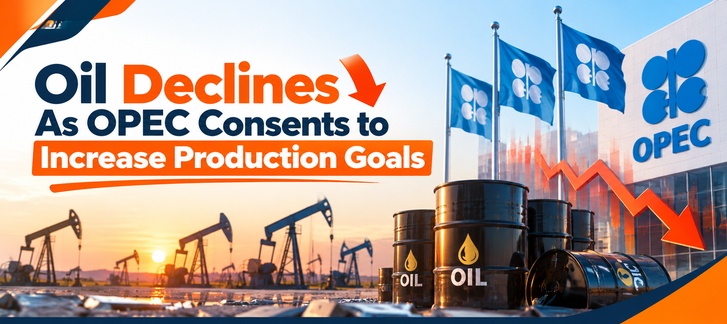
The Decline in Crude Oil Prices:
Oil prices slipped on Monday after OPEC+ decided to boost its output goals starting in August. Although exports from major producers through the Strait of Hormuz are rebounding, possibly increasing global supplies.
1) The Future of Brent Crude: Brent crude futures dropped 24 cents, or 0.33%, to $71.88 a barrel by 0010 GMT after closing 0.45% up on Friday.
2) Brent Crude Prices Drop: US West Texas Intermediate crude was priced at $68.58 a barrel, declining by 11 cents, which is a drop of 0.16%.
3) The WTI Settlement: There was no WTI settlement on Friday since US markets were shut down for the Independence Day holiday on Saturday.
The Us-Iran Talk:
Both contracts saw minimal changes last week. After largely declining in recent weeks, investors closely monitored discussions between the United States and Iran regarding the future of shipping in the Strait of Hormuz. Monitoring the progress of the recovery in Gulf oil exports.
The Organization of the Petroleum Exporting Countries and its allies, including Russia, agreed on Sunday to raise output goals by 188,000 barrels per day starting in August. However, in addition to comparable rises for June and July.
Nevertheless, the rise has mostly existed only in theory. This occurs due to the US-Israeli conflict with Iran, which has barred tanker traffic in the Strait of Hormuz for important OPEC nations. Incorporating Saudi Arabia, Kuwait, and Iraq, limiting their production.
“The figure was mainly consistent with projections,” stated IG market analyst Tony Sycamore, “Considering the UAE's exit and that quotas might still be unmet as production gradually increases after the conflict - I question their significance at this time.”
The UAE Queit OPEC:
The United Arab Emirates left OPEC starting May 1.
Gulf states have started restoring supplies that were halted during the Iran war and are boosting exports. In June, OPEC oil production increased by 3.3 million barrels daily from the previous month, reaching 19.43 million bpd. A Reuters poll revealed an improvement from its lowest point in over twenty years.
In June, Gulf oil exports surged over 3 million barrels from May, surpassing 10 million barrels daily. Even though the volume stayed 40% lower than pre-war levels. Nevertheless, the information indicated.
Moreover, oil exports from Russia’s western ports reached an all-time high in June and are anticipated to sustain that level in July. Industry sources stated that drone attacks by Ukraine have damaged its refineries, prompting Moscow to increase crude exports.
why crude benchmarks have declined towards the $70 per barrel mark:
This information clarifies why crude benchmarks have declined towards the $70 per barrel mark. Thus, the relaxation of the shipping crisis in the Middle East (alongside elevated Russian export levels) has largely removed the risk of a drawn-out global supply deficit.
The Historical Shifts in OPEC:
1) The UAE's Strategic Withdrawal: The United Arab Emirates has formally exited OPEC. As it liberates the country from rigid production limits. Establishing an autonomous production capability of 4.85 million bpd. As the UAE sought to enhance its hydrocarbon earnings and finance diversification ahead of the rapid global energy transition.
2) Rebounding Production Caps: The rise to 19.43 million bpd in June does not include the UAE's figures. This indicates that the 3.3 million bpd increase signifies a forceful comeback of dormant capacity from the other 11 members as regional stability improves.
Gulf Export Metrics vs. Pre-War Baselines:
1) A Quick Increase of 3 Million BPD: Total joint exports from Saudi Arabia, Kuwait, Iraq, and Iran surpassed 10 million bpd in June. The swift recovery was significantly boosted by the United States helping to ensure safer routes for commercial tankers via the important Strait of Hormuz.
2) The 40% Deficit Situation: Although a flow of 10 million bpd signifies a significant month-on-month enhancement. It emphasizes that a significant portion of supply is still offline in relation to the 16.5 million bpd. Thus, the area regularly exported before the conflict.
The Bottom Line:
The worldwide crude oil market is experiencing a significant structural change due to a substantial surge in supply. The blend of regional post-war rebuilding, fractured alliances, and redirected trade paths has successfully transferred power from a centralized cartel. It is also placing a significant downward pressure on worldwide oil prices.