Rice Husk: Uses, Benefits & Industrial Applications
Discover the ultimate guide to rice husk. Explore its powerful uses in gardening, sustainable bioenergy, and modern construction, plus its global eco-impact.
Introduction:
Rice is the world's one of the most important staple crops. But its grain is only one part of the harvest of this crop. It leaves behind a tough outer covering known as the rice husk or rice hull when rice is processed.
For years, this agricultural by-product called the husk was often treated as waste. However, rice husks are increasingly viewed as a valuable raw material today. While it also has some applications that range from renewable energy to agriculture. This product is also used in construction, packaging and industrial manufacturing as well.
So, what exactly is the rice husk? Why is this simple agricultural by-product attracting so much attention?
Let's explore its properties and potential in the modern agricultural economy. We will also describe its major products, uses and benefits in different fields.
What Is Rice Husk?
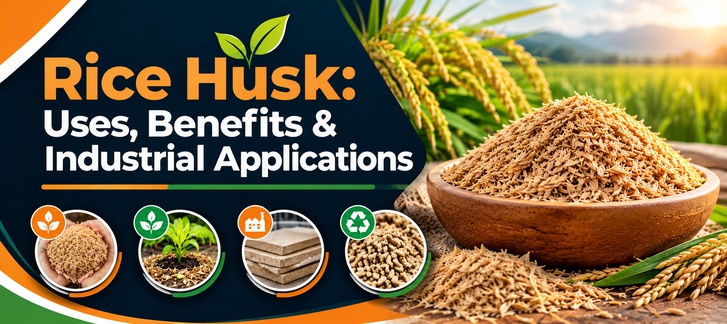
Rice's husk is the hard protective outer layer surrounding rice grains. This layer is removed during the milling process before edible rice reaches consumers.
Rice grain consists broadly of its husk, bran and the inner rice kernel. The husk protects the grain while it develops and contains significant amounts of silica. As the grain also has cellulose, lignin, and other organic components as well.
Because rice is produced on a massive scale especially worldwide. Therefore rice mills can generate millions of tonnes of husks every year.
Rice husks are relatively tough and slow to decompose naturally. When you compare husks to other agricultural residues. This characteristic can make disposing challenging for industries and farmers. But it also gives the material useful properties for industrial applications.
That's why the concept of rice husk products became important globally. Businesses can process it into useful materials instead of treating the husk as waste.
Rice Husk vs Rice Hulls: Is There a Difference?
The terms rice husk and rice hull are generally refer to the same material that we discussed above.
"Rice husks" are commonly used in agricultural and industrial discussions. While "rice hulls" is another widely used term. This term is particularly used in horticulture and on some international markets as well.
Regardless of terminology, the material is the outer shell removed during rice milling.
Particularly its unique composition and its relatively high silica content make it different from other products. Therefore many other agricultural residues such as wheat straw or corn stalks have different characteristics.
What Are the Major Rice Husk Products?
One of the most interesting aspects of husk is that it can be converted into several value-added products.
Major products and materials derived from husk include:
1) Rice husk fuel
2) Rice husk briquettes
3) Rice husk pellets
4) Rice husk ash
5) Silica-rich materials
6) Horticultural growing media
7) Construction materials
8) Composite boards and materials
9) Biochar
10) Activated carbon
The final product depends on how the husk is processed and the requirements of the end-use industry.
Rice Husk Uses:
Growing interest in it's versatility largely drives this biomass product.
1) Biomass Fuel
One of the most established husk uses is biomass energy generation.
Rice husks can be burned as biomass fuel in specially designed boilers for industrial use. Therefore rice mills can use this material to generate heat. It also generates energy for its own operations. This property of the husk can reduce its dependence on conventional fuels.
It can also be compressed into briquettes or pellets to make handling, transportation and combustion more convenient.
This creates a particularly useful circular model: the rice-processing industry generates a residue and then uses that residue as an energy or biogas energy resource.
2) Rice Husk Ash
Rice husk ash (RHA) is only produced when husks are burned under controlled conditions.
Rice husk ash is particularly a valuable product. Because it contains a high concentration of silica. The quality and characteristics of ash depend heavily on its combustion conditions. While it also depends on its temperature and processing methods as well.
When properly produced, RHA can be used in construction, cement and concrete applications, as well as certain industrial processes.
Its high silica content is one of the main reasons husk has attracted interest beyond the agricultural sector.
3) Construction Materials
Husk and husk ash have been investigated and used in various construction applications.
Rice husk ash can act as a supplementary cementitious material in certain concrete formulations. Its reactive silica can contribute to the performance of cement-based materials when the ash is appropriately processed.
Husk can also be incorporated into composite boards, bricks and other construction materials.
The attraction is straightforward: an abundant agricultural residue can potentially replace part of a conventional raw material while creating an additional market for a milling by-product.
4) Agriculture and Horticulture
Rice hulls can also be useful in many agricultural products.
They may be incorporated into a growing medium to improve their physical structure. While drainage and aeration are also added to a growth medium for strengthening the process. Horticultural applications include potted mixes and other growing systems. Where some soil amendments are also included in these applications.
Rice hulls can also be processed into biochar and other products. It has attracted interest as a soil amendment and carbon-management material.
However, the application rates of hulls depend on soil conditions. While its suitability depends on crop requirements and the processed material's characteristics.
5) Animal Bedding
Another practical use of rice hulls is as bedding material for livestock and poultry.
The lightweight structure of the hulls allows them to provide a relatively dry and absorbent layer. After use, the material can potentially enter composting or nutrient-recycling systems depending on farm management practices.
6) Packaging and Composite Products
Husk fibers can be incorporated into composite materials, including certain packaging and consumer products.
Manufacturers are exploring agricultural residues as alternatives or supplements to conventional materials. So particularly where consumers and businesses are looking for products with a stronger sustainability story.
How Is Rice Husk Processed?
The processing method depends on the desired end product.
For simple agricultural applications, rice husk may require little processing beyond cleaning, drying and sizing.
The husk can be compacted into briquettes or pellets for energy applications.
The husk undergoes controlled combustion for husk ash. Therefore, managing combustion conditions is important for husk ash. Because the resulting ash properties depend heavily on how the material is burned.
For higher-value industrial applications, additional processes may be used to extract silica or convert the husk into carbon-based materials.
The key principle is simple: different processing methods unlock different values from the same agricultural residue.
Benefits of Rice Husk:
The growing commercial interest in husk comes from several potential benefits.
1) Waste Reduction
Turning husk as residue into useful products can reduce the amount of agricultural residue requiring disposal.
2) Renewable Resource
Renewable agricultural crops like rice can generates husks or rice straw. Therefore its use can contribute to biomass-based production systems when managed responsibly.
3) Energy Potential
Its combustible nature makes biomass husks as useful as biomass fuel. So particularly this biomass product is available in rice-producing regions with large milling operations.
4) Value Addition
Processing husks can create additional revenue opportunities for rice mills. While some agricultural businesses also use them.
Instead of viewing husk as a disposal cost, businesses can potentially transform it into fuel, ash, construction inputs or other commercial products.
5) Circular Economy
Rice husk demonstrates the basic concept of a circular economy: a material left over from one production process can become an input for another.
The rice industry can therefore create value from more than the rice grain itself.
What Is Rice Husk Ash Used For?
Husk ash deserves special attention in agriculture-related countries. Because it can have significantly higher-value applications compared to untreated husks.
Its primary attraction is its silica content.
Potential applications include:
1) Cement and concrete
2) Construction materials
3) Silica production
4) Soil-related applications
5) Industrial fillers
6) Certain specialty materials
However, not all husk ash is identical. Poorly controlled combustion can produce ash with characteristics that limit its suitability for specific applications.
For industrial use, factors such as silica content, carbon content, particle size, surface area and combustion conditions can be important.
Environmental Impact of Rice Husk:
Rice husks can provide environmental advantages when they are properly managed. But it is not automatically sustainable simply because it is an agricultural residue.
Open burning of residue can create air pollution. This is because uncontrolled disposal can create waste management problems for the environment.
The better approach is to process and use husk through controlled systems.
For example, converting husk into useful energy, biochar, construction materials or other products can potentially reduce waste while displacing some conventional raw materials.
The environmental outcome ultimately depends on the entire process—including transportation, energy consumption, combustion technology and the final application.
Challenges of Using Rice Husk:
Rice husk has some limitations despite its potential in many fields.
Husks' low bulk density can make transport relatively expensive. Especially when you compare them with heavier materials. It can also be difficult to handle in large quantities without the appropriate storage. While processing equipment can also help in managing agri biomass husks.
The combustion of husk pellets requires suitable technology. Because uncontrolled residue burning can produce excessive smoke and undesirable emissions.
Consistent husk quality is also important for high-value applications. Ash composition can affect husk-derived products' performance. While variations in moisture can also affect the processing conditions of the husk.
These challenges mean that husks require successful utilization. Because its utilization demands more than simply collecting material. So it requires appropriate infrastructure and technology according to market demand.
The Future of Rice Husk Products:
The future of rice husk lies in value addition.
As industries search for renewable raw materials, lower-waste production systems and alternatives to conventional resources, agricultural residues are becoming increasingly interesting.
Husk sits at an attractive intersection of agriculture, energy, construction and materials science.
A rice mill can potentially generate several valuable streams from the same crop: edible rice for food, bran for other applications, husk for energy or industrial use, and ash for silica-rich applications.
This approach can improve resource efficiency while creating new economic opportunities around rice processing.
Wrap Up:
Although rice husks may look like little more than dry agricultural residue. Yet its potential extends far beyond the rice mill.
Rice hulls are used in horticulture to make husk fuel and husk ash. While it is also used in briquettes and biochar for multiple purposes. Therefore this material can be transformed into products that serve agriculture and manufacturing. Same as the energy and construction sectors use them as a by-product.
The most important shift about this product is in how we think about agricultural waste.
Instead of asking, How do we dispose of rice husks? Because modern industries are increasingly asking, "What can we make of it?"
That change in perspective is at the heart of a circular agricultural economy. With appropriate processing technology, quality control and market development, husk can move from being a milling by-product to becoming a valuable industrial resource.
In the future, the true value of rice production may not be measured only by the amount of rice harvested. But also by how effectively every part of the crop is utilized.
Frequently Asked Questions About Rice Husk:
What is rice husk used for?
Rice husk is used in agriculture and eco-friendly manufacturing as well. While it also use in gardening, energy production, construction and animal bedding. It can be processed into fuel and rice husk ash. Its high silica content also makes it useful for certain industrial applications. Same as industry also make briquettes, pellets, biochar and composite materials from it.
What can we do with rice husk?
Rice husk can be converted from an agricultural waste material into several useful products. Therefore common rice husk uses include gardening and horticulture. While biomass fuel, animal bedding, construction materials, biodegradable products, biochar and industrial materials made from rice husk ash.
What are rice hulls?
Rice hulls are another name for rice husks. They are the hard outer coverings removed from rice grains during the milling process. Because rice hulls are lightweight and contain significant amounts of silica and organic material. So they can be used for energy and manufacturing applications. Where this by-product also use in agriculture and construction sector as well.
What is the difference between rice husk and rice husk ash?
Rice husk is the original outer shell removed from a rice grain during milling. Rice husk ash is produced after the husk undergoes controlled combustion. Rice husk is commonly used for biomass fuel, gardening and material applications, while rice husk ash is particularly valued for its silica-rich composition and potential use in construction and industrial materials.
What is the future of rice husk products?
The future of rice husk products is closely linked to the growing demand for renewable materials, biomass energy and circular-economy solutions. Advances in processing technology could enable more rice husk to be converted into higher-value products for construction, agriculture, energy and advanced materials.
References:
Science Direct: Rice Husk
Wikipedia: Rice Hull
National Institute of Health: Rice Husk Research